UPVC Backing Rings
A UPVC backing ring is a small piece of material welded between two pipes. They are usually round to fit most pipes, but there are also square-shaped rings. It is also called a back-up ring or anti-extrusion ring. UPVC backing rings are especially common in situations involving groove welds or butt welds, where the components to be welded are aligned edge-to-edge. The upvc backing ring is positioned on the root side of the joint, and the welding is performed from the opposite side, often referred to as the “face side” of the joint.
A upvc backing ring is a circular or annular metal piece used in welding to provide support and reinforcement to the root side of a weld joint. It is commonly used in applications where welding is performed from one side only, and the joint needs additional support to prevent the molten weld metal from flowing through the joint and to ensure proper fusion.
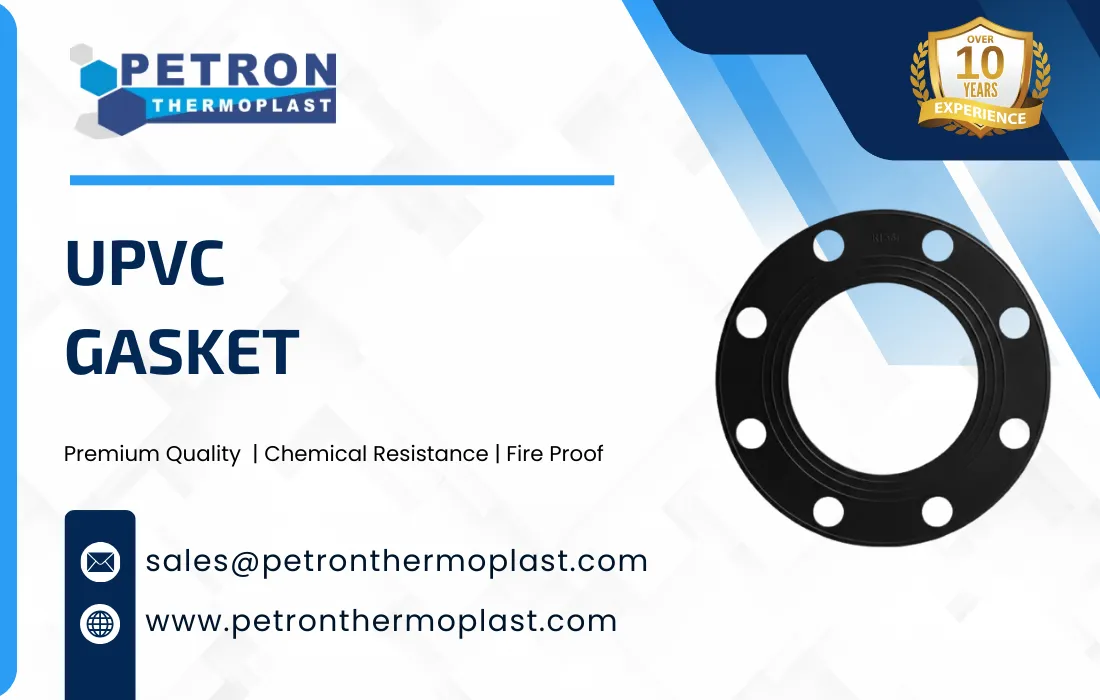
There are many types of upvc backing rings, including plain rings, machine-welded rings, and gasket rings. Other, more advanced ones include grove, flat, and ridge types. The exact choice of ring depends on the application it is intended to be used for. They are used to hold pipes and fittings together in industries like automotive, construction, and aerospace. No welded material can be allowed to spatter and attach itself to the insides of the pipe to ensure the smooth flow of gas, or other chemicals.
- Chemical Resistance
- Low Maintenance Requirement
- Low Thermal Conductivity
- Long Service Life
- Easy Installation
- Corrosion Resistance
UPVC Backing Rings Details
- OD – Outer Diameter
- PCD – Pitch Circle Diameter (for flange bolt circle)
- D – Outside Diameter (often used interchangeably with OD)
- Holes × Dia – Number of Bolt Holes × Diameter of Each Hole
| Nominal Pipe | Pipe OD (mm) | Ring OD D (mm) | Bolt Circle PCD (mm) | Holes × Dia (mm) |
| ½″ (DN15) | ~21.3 | ~89 | ~60.3 | 4 × ~16 |
| ¾″ (DN20) | ~26.7 | ~98.6 | ~69.8 | 4 × ~16 |
| 1″ (DN25) | ~33.4 | ~108 | ~79.4 | 4 × ~16 |
| 1¼″ (DN32) | ~42.2 | ~117.3 | ~88.9 | 4 × ~16 |
| 1½″ (DN40) | ~48.3 | ~127 | ~98.5 | 4 × ~16 |
| 2″ (DN50) | ~60.3 | ~152.4 | ~120.6 | 4 × ~19 |
| 2½″ (DN65) | ~73.0 | ~177.8 | ~139.7 | 4 × ~19 |
| 3″ (DN80) | ~88.9 | ~190.5 | ~152.4 | 4 × ~19 |
| 4″ (DN100) | ~114.3 | ~228.6 | ~190.5 | 8 × ~19 |
| Parameter | Specification |
| Standard Compliance | ASTM D2467 (Socket Dimensions), ANSI B16.5 Class 150 (Flange Drilling) |
| Type | VanStone Style (Loose Backing Ring) |
| Size Range | DN15 (½″) to DN110 (4″) |
| Material | Industrial-grade Lead-free uPVC |
| Application | Suitable for SCH 80 piping systems |
| Use Case | Chemical plants, potable water, corrosive fluid systems |
| Max Operating Temp | Up to ~60 °C |
| Design Benefit | Allows ease of alignment and disassembly |
1. Material Properties
Made of UPVC: Unplasticized PVC, which is rigid, durable, and corrosion-resistant.
Chemical Resistance: Resistant to acids, alkalis, salts, and many chemicals, making it suitable for aggressive fluid environments.
Non-conductive: Electrically insulating, which can be beneficial in certain applications.
2. Structural Features
Rigid Support: Provides mechanical support to gaskets, especially in plastic or thin metal flanges.
Prevents Gasket Extrusion: Helps maintain gasket shape and prevents it from being pushed out under pressure.
Uniform Load Distribution: Ensures even distribution of flange bolt load, reducing the risk of leaks.
3. Design Flexibility
Custom Sizes: Available in various diameters and thicknesses to match flange standards (e.g., ANSI, DIN).
Lightweight: Easier to handle compared to metal rings, reducing installation effort.
Corrosion-resistant Coating (if applicable): Fully UPVC, so no additional coating needed.
4. Performance Advantages
Temperature Resistance: Suitable for typical plastic piping ranges (up to ~60–65°C for continuous operation).
Durability: Long service life in chemical pipelines.
Cost-effective: Cheaper than stainless steel or metal reinforcement rings for many applications.
5. Application-Specific Features
Flange Support: Often used behind soft gaskets in plastic flanges (like UPVC, CPVC) to prevent flange distortion.
Non-Metallic Systems: Ideal for completely plastic piping systems to maintain non-metallic continuity.
Ease of Installation: Can be easily cut or machined if needed for special applications.
Pressure Class Overview
| Pressure Class | Maximum Working Pressure | Typical Application |
| PN6 | 6 bar | Low-pressure chemical lines |
| PN10 | 10 bar | Standard chemical & irrigation systems |
| PN16 | 16 bar | Industrial & chemical piping |
Size-wise Pressure Rating
| Nominal Size | DN | PN6 Rating | PN10 Rating | PN16 Rating |
| 25 mm | DN25 | 6 bar | 10 bar | 16 bar |
| 32 mm | DN32 | 6 bar | 10 bar | 16 bar |
| 40 mm | DN40 | 6 bar | 10 bar | 16 bar |
| 50 mm | DN50 | 6 bar | 10 bar | 16 bar |
| 63 mm | DN63 | 6 bar | 10 bar | 16 bar |
| 75 mm | DN75 | 6 bar | 10 bar | 16 bar |
| 90 mm | DN90 | 6 bar | 10 bar | 16 bar |
| 110 mm | DN110 | 6 bar | 10 bar | 16 bar |
| 125 mm | DN125 | 6 bar | 10 bar | 16 bar |
| 160 mm | DN160 | 6 bar | 10 bar | 16 bar |
Temperature Derating Factor
| Operating Temperature | Pressure Factor |
| 20–27 °C | 1.00 |
| 30 °C | 0.90 |
| 40 °C | 0.75 |
| 50 °C | 0.60 |
| 60 °C | 0.50 |
1. Density
Typically around 1.35–1.45 g/cm³, making it lightweight compared to metals.
This contributes to easier handling and installation in piping systems.
2. Hardness
Rigid and hard material (Shore D hardness ~75–80).
Provides strong mechanical support for gaskets and flanges without deformation under normal load.
3. Tensile Strength
Tensile strength: ~50–60 MPa.
Enough to withstand flange bolt loads and prevent cracking under normal operating conditions.
4. Flexural Strength
Flexural strength: ~60–90 MPa.
Offers rigidity while resisting bending or warping under stress.
5. Impact Strength
Moderate impact resistance (~2–4 kJ/m² notched Izod).
Resistant to moderate shocks but can crack under very high impact, so careful handling is recommended.
6. Thermal Properties
Maximum continuous service temperature: ~60–65°C
Coefficient of thermal expansion: ~0.06–0.07 mm/m/°C
UPVC backing rings can expand slightly with temperature but are stable within normal operating ranges for plastic piping.
7. Absorption
Very low (~0.04% after 24 hours).
Does not swell significantly in wet environments, maintaining dimensional stability.
8. Chemical Resistance
Resistant to acids, alkalis, salts, and most chemicals, which is why UPVC is preferred in chemical piping.
Not resistant to strong solvents like ketones or aromatic hydrocarbons.
9. Electrical Properties
Non-conductive: Provides electrical insulation if needed.
High dielectric strength (~40–50 kV/mm).

Custom Product Manufacturing Available
If you are searching for customized product designs that meet your requirements, don’t worry. Petron Thermoplast also offers custom product manufacturing services to meet the unique needs of various industries. Work with our expert engineers to create custom designs suited for your application.
Benefits of Using UPVC Backing Rings
Corrosion Resistance
Made of uPVC, so they are resistant to rust, scaling, and chemical corrosion.
Ideal for, chemical, and industrial piping.
Lightweight
Easier to handle, transport, and install compared to metal flanges.
Cost-Effective
Low material and maintenance costs.
No painting, coating, or anti-corrosion treatment required.
Durable & Long-Lasting
uPVC is rigid and dimensionally stable, providing years of service.
Ease of Installation
Loose flange/backing ring rotates freely, allowing easy alignment of bolts during installation.
Leak-Proof Connections
Works with stub ends and gaskets to provide tight, reliable joints.
Low Maintenance
Non-corrosive and non-conductive; no regular inspection or treatment needed.
Chemical Resistance
Resistant to acids, alkalis, salts, and most industrial fluids.
Standard Compliant
Manufactured according to DIN / ISO / IS standards, ensuring interchangeability and quality assurance.
Types of UPVC backing rings
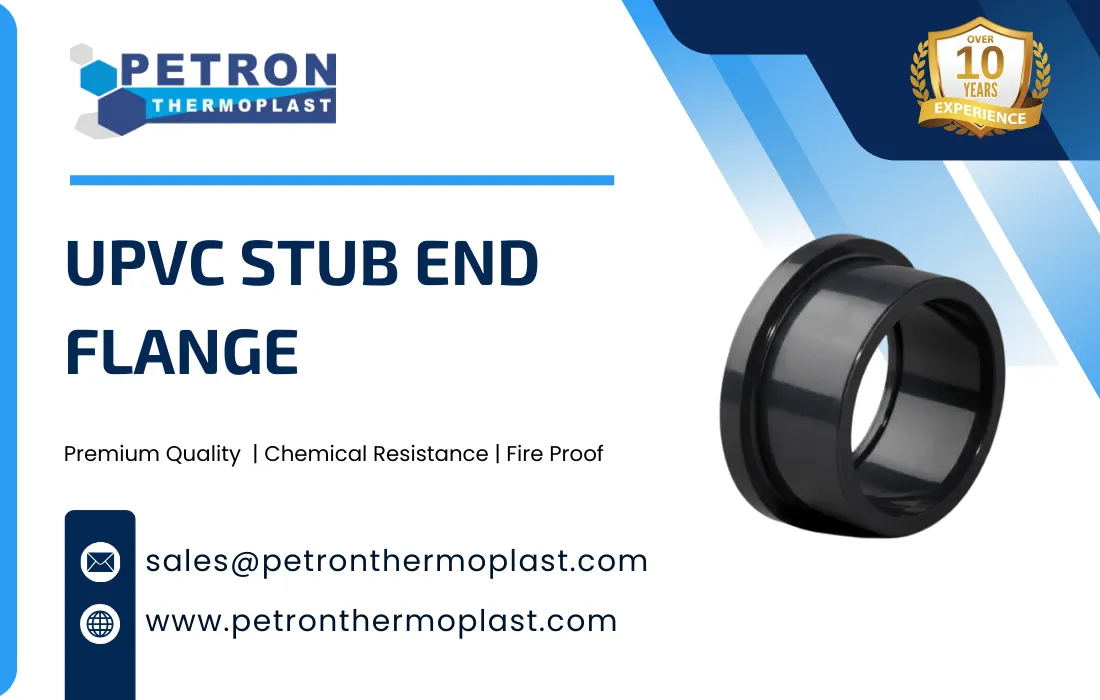
Flat UPVC Backing Ring (Standard Loose Flange)
Simple flat ring with bolt holes; used with uPVC stub ends to form a flanged joint.,and chemical lines.
Raised Face UPVC Backing Ring
Ring with a slightly raised central portion to accommodate gasket seating,Provides better sealing for high-pressure joints
Full-Face UPVC Backing Ring
Ring that covers the full flange face; bolt holes positioned around full diameter,Industrial piping where uniform load distribution is needed.
Split UPVC Backing Ring
Ring divided into two halves for easier installation around existing pipes,Retrofitting or maintenance on existing pipelines.
Reinforced / Thick UPVC Backing Ring
Thicker or rib-reinforced uPVC ring to withstand higher torque or load.
Threaded / Adapter UPVC Backing Ring
Ring with internal threads or combination for connecting to threaded components.
Why Choose Petron Thermoplast?
When it comes to industrial-grade systems, the choice of the right manufacturer is as important as the material itself. Petron Thermoplast has earned a reputation as a trusted global leader in the field of UPVC backing rings and industrial flow solutions. Our products are known for precision, performance, and durability, designed to meet the most demanding industry standards across chemical and infrastructure sectors.
With so many options on the market, why should you trust Petron Thermoplast for your UPVC backing rings needs? The answer lies in our commitment to quality, service, and understanding your unique challenges.
UPVC Pipe Fittings
We offer UPVC Pipe Fittings products in all standard sizes and provide complete customization options to meet your specific project requirements across our entire product range.