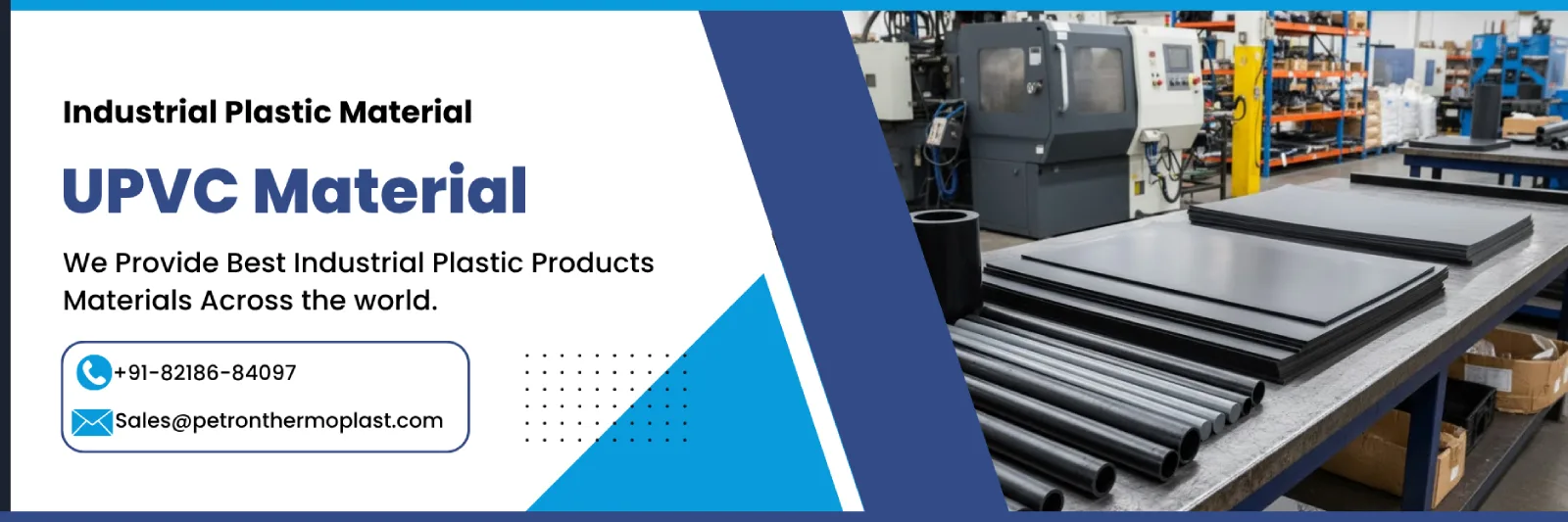
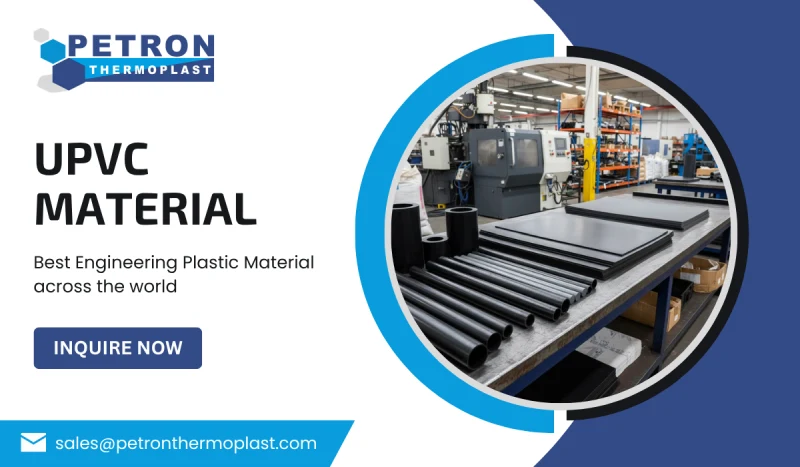
UPVC Material
Unplasticized Polyvinyl Chloride (UPVC) material is one of the most widely used thermoplastic materials in modern industries. Known for its durability, corrosion resistance, and versatility, UPVC has become a preferred choice for manufacturing pipes, fittings, valves, profiles, and various industrial components. Unlike standard PVC, UPVC does not contain plasticizers, which makes it rigid, stronger, and highly resistant to environmental and chemical influences.
At Petron Thermoplast, we specialize in delivering high-quality UPVC material solutions for industrial, commercial, and residential applications, ensuring long-lasting performance in the toughest conditions.UPVC material is an essential material in modern construction, renowned for its durability, versatility, and efficiency. As an advanced form of PVC, uPVC is not altered by plasticizers, making it rigid and remarkably strong. This distinctive quality makes uPVC an ideal solution for an array of construction applications, including windows, doors, piping, and cladding.
- Chemical Resistance
- Low Maintenance Requirement
- Low Thermal Conductivity
- Long Service Life
- Easy Installation
- Corrosion Resistance
UPVC Materials Details
| Property | Technical Details / Typical Values |
| Material Name | Unplasticized Polyvinyl Chloride (uPVC) |
| Polymer Structure | Thermoplastic, rigid |
| Density | 1.38 – 1.45 g/cm³ |
| Colour | Grey, White (Standard), or as specified |
| Surface Finish | Smooth, non-porous (low friction loss) |
| Water Absorption | < 0.1% |
| Operating Temperature Range | 0°C – 60°C |
| Vicat Softening Temperature | 80°C – 85°C |
| Thermal Conductivity | 0.16 – 0.18 W/m·K |
| Coefficient of Linear Expansion | 5 – 8 × 10⁻⁵ /°C |
| Tensile Strength | 45 – 55 MPa |
| Compressive Strength | 60 – 80 MPa |
| Flexural Strength | 80 – 100 MPa |
| Modulus of Elasticity | 2.5 – 3.2 GPa |
| Impact Strength (Charpy) | 2 – 5 kJ/m² (Brittle at low temperatures) |
| Hardness | Shore D 75 – 85 (High surface hardness) |
| Flame Resistance | Self-extinguishing |
| Chemical Resistance | Excellent (Acids, Alkalis, Salts); Poor (Ketones, Aromatic Solvents) |
| Corrosion Resistance | Excellent (No rust, scale, or pitting) |
| UV Resistance | Moderate (Improved with UV-stabilized grades) |
| Dielectric Strength | 40 – 60 kV/mm |
| Volume Resistivity | >10¹³ Ω·cm |
| Pressure Class | PN6, PN10, PN16 (Depending on size/standard) |
| Service Life | 25 – 50 years under normal conditions |
| Nominal Size (DN / Inch) | Outer Diameter (OD, mm) | Standard Wall Thickness (mm) | Pressure Rating (PN / Bar) |
| 15 mm / ½” | 21.2 | 2.0 | 10 |
| 20 mm / ¾” | 26.9 | 2.3 | 10 |
| 25 mm / 1″ | 33.2 | 3.2 | 10 |
| 32 mm / 1¼” | 42.2 | 3.6 | 10 |
| 40 mm / 1½” | 48.3 | 4.2 | 10 |
| 50 mm / 2″ | 60.3 | 4.8 | 10 |
| 63 mm / 2½” | 75.0 | 5.8 | 10 |
| 75 mm / 3″ | 90.0 | 6.8 | 10 |
| 90 mm / 3½” | 110.0 | 7.5 | 10 |
| 110 mm / 4″ | 125.0 | 8.5 | 10 |
| 160 mm / 6″ | 160.0 | 10.0 | 10 |
| 200 mm / 8″ | 200.0 | 12.0 | 10 |
| 250 mm / 10″ | 250.0 | 15.0 | 10 |
| 315 mm / 12″ | 315.0 | 18.0 | 10 |
| 400 mm / 16″ | 400.0 | 19.0 | 10 |
| 500 mm / 20″ | 500.0 | 20.0 | 10 |
| 630 mm / 24″ | 630.0 | 22.0 | 10 |
High durability – Strong, rigid, and long-lasting; resists corrosion, rot, and rust.
Weather resistant – Handles rain, heat, cold, and UV exposure without warping or fading.
Low maintenance – No painting or polishing needed; easy to clean with soap and water.
Excellent insulation – Good thermal insulation (keeps heat in/out) and sound insulation.
Fire resistant – Self-extinguishing; does not easily catch fire.
Chemical resistant – Not affected by most chemicals, acids, or alkalis.
Lightweight yet strong – Easier to install compared to metals.
Eco-friendly – Recyclable and energy-efficient over its lifespan.
Termite & moisture proof – Unlike wood, it doesn’t absorb water or attract pests.
Cost-effective – Cheaper than aluminum or wood over the long term.
| Pressure Class | Max Working Pressure @ 20°C | Max Working Pressure @ 40°C | Typical Application |
| PN4 | 4 bar (~58 psi) | 3 bar (~44 psi) | Low-pressure irrigation, drainage |
| PN6 | 6 bar (~87 psi) | 4.5 bar (~65 psi) | Drip irrigation, small water pipelines |
| PN8 | 8 bar (~116 psi) | 6 bar (~87 psi) | Medium-pressure water supply |
| PN10 | 10 bar (~145 psi) | 7–8 bar (~102–116 psi) | Domestic water pipelines, fertigation |
| PN12.5 | 12.5 bar (~181 psi) | 9–10 bar (~130–145 psi) | Industrial water supply, medium pressure |
| PN16 | 16 bar (~232 psi) | 12–13 bar (~174–188 psi) | High-pressure pipelines, industrial use |
| Property | Typical Value / Description |
| Material Type | Unplasticized Polyvinyl Chloride (uPVC) |
| Polymer Structure | Thermoplastic, rigid |
| Color | Grey / White (standard) |
| Density | 1.38 – 1.45 g/cm³ |
| Water Absorption | < 0.1% |
| Transparency | Opaque |
| Odor | Odorless |
| Surface Finish | Smooth, non-porous |
| Thermal Conductivity | ~0.16 W/m·K (low) |
| Operating Temperature Range | 0°C – 60°C |
| Vicat Softening Temperature | 80 – 85°C |
| Coefficient of Thermal Expansion | 5–8 × 10⁻⁵ /°C |
| Tensile Strength | 45 – 55 MPa |
| Compressive Strength | 60 – 80 MPa |
| Flexural Strength | 80 – 100 MPa |
| Modulus of Elasticity | 2.5 – 3.2 GPa |
| Impact Strength (Charpy) | 2 – 5 kJ/m² |
| Hardness | Shore D 75 – 85 |
| Electrical Conductivity | Non-conductive |
| Dielectric Strength | 40 – 60 kV/mm |
| Volume Resistivity | >10¹³ Ω·cm |
| Corrosion Resistance | Excellent (no rust, scale, or pitting) |
| Chemical Resistance | Resistant to acids, alkalis, salts; poor to aromatic solvents and ketones |
| UV Resistance | Moderate; improved with UV-stabilized grades |
| Pressure Class | PN6, PN10, PN16 (depending on wall thickness) |
| Service Life | 25–50 years under normal conditions |
User Manual for UPVC Materials
Step 1: Measurement & Cutting
- UPVC material measurement is required according to the pipe length accurately.
- Cut the pipe in square shape and straight using a pipe cutter or saw.
- Avoid uneven or angled cuts.
Step 2: Deburring & Cleaning
- Remove the burrs from the cut pipe end.
- Clean pipe ends and fitting sockets to remove dust, grease, or moisture.
Step 3: Dry Fit Check
- Assemble pipes and fittings without cement to ensure correct alignment.
- Mark the insertion depth on the pipe.
Step 4: Apply Solvent Cement
- Apply UPVC solvent cement evenly on:
- Outside of the pipe end
- Inside the fitting socket
- Use recommended cement only (do not use CPVC cement).
Step 5: Joint Assembly
- Insert the pipe fully into the fitting with a slight twisting motion.
- Hold the joint for 20–30 seconds to prevent push-out.
Step 6: Cleaning Excess Cement
- Wipe off extra cement around the joint with a clean cloth.
Step 7: Curing Time
- Allow joints to cure as per manufacturer’s instructions:
- Initial set: 15–30 minutes
- Full curing before pressure test: 12–24 hours
Step 8: Pipe Support & Alignment
- Provide proper pipe supports and clamps at recommended intervals.
- Ensure pipes are free from stress, bending, or misalignment.
Step 9: Pressure Testing
- After full curing, test the system with water pressure.
- Check all joints for leakage.
1. Color & Finish
- Available in white, off-white, beige, gray, black, etc.
- Laminated / foil finishes (wood-grain like teak, oak, walnut).
- Matte, glossy, or textured surface finishes.
- UV-coated colors to prevent fading.
2. Profile Design
- Different profile shapes and thicknesses.
- Multi-chamber profiles for better thermal and sound insulation.
- Reinforced profiles (steel or aluminum inserts for strength).Custom frame sizes and depths.
3. Glass Options (for doors & windows)
- Single, double, or triple glazing.
- Clear, tinted, frosted, or reflective glass.
- Low-E glass for energy efficiency.
- Laminated or toughened safety glass.
4. Hardware & Accessories
- Choice of handles, hinges, locks, rollers.
- Multi-point locking systems.
- Child-safety locks and insect mesh.
- Different opening styles: sliding, casement, tilt-and-turn, fixed.
5. Thermal & Acoustic Performance
- Added insulation chambers.
- Weather seals and gaskets customization.
- Soundproofing upgrades for noisy areas.
6. Size & Shape
- Made-to-measure sizes.
- Arched, circular, bay, or corner window designs.
- Custom door widths and heights.
7. Special Performance Add-ons
- Fire-retardant grades.
- High wind-load resistance.
- Coastal-grade uPVC for high-humidity or saline areas.
| Test / Parameter | Purpose of Test | Standard / Specification |
| Tensile Strength Test | Measures strength and resistance to pulling | IS 2530 / ASTM D638 |
| Impact Resistance Test | Checks resistance to sudden impact | IS 10192 / ASTM D256 |
| Vicat Softening Temp | Determines heat resistance | IS 10192 / ASTM D1525 |
| Heat Reversion Test | Measures dimensional stability at high temp | IS 10192 / EN 479 |
| Density Test | Checks material consistency | IS 13360 / ASTM D792 |
| Water Absorption Test | Measures moisture resistance | IS 10192 / ASTM D570 |
| Weathering (UV) | Evaluates durability under sunlight exposure | EN 513 / ASTM G154 |
| Fire Resistance Test | Checks flammability behavior | IS 15061 / ASTM E84 |
| Thermal Conductivity | Measures insulation performance | EN ISO 12667 |
| Sound Insulation Test | Measures noise reduction | EN ISO 10140 |
| Dimensional Tolerance | Ensures accuracy in profile dimensions | IS 13630 / EN 12608 |
| Surface Finish Test | Checks smoothness and defects | EN 12608 |
| Weld Strength Test | Measures corner joint strength | EN 514 |
| Chemical Resistance | Resistance to acids, alkalis, salts | ASTM D543 |
| Color Fastness Test | Resistance to fading | EN 513 |
- Durability
UPVC material is resistant to corrosion, termites, and weather damage. Its ability to withstand saltwater makes it suitable for coastal cities.
- Low Maintenance
UPVC materials require no painting or polishing. Cleaning with mild soap and water keeps it looking new for years.
- Energy Efficiency
The thermal insulation properties of UPVC material help to reduce electricity bills by maintaining indoor temperatures more efficiently than aluminum or wood frames.
- Acoustic Comfort
Double-glazed UPVC material windows significantly reduce external noise and make them suitable for urban homes and commercial spaces.
- Sustainability
UPVC material is recyclable and consumes less energy during production compared to aluminum. It also supports green building certifications such as LEED and GRIHA.
1. Water Supply
- Upvc material is suitable for Cold water and distribution systems
- Easiest to Potable drinking water pipelines
- Overhead and underground piping
2. Irrigation & Agriculture
- Upvc material is drip and sprinkler irrigation systems
- Fertigation and water conveyance lines
3. Chemical & Industrial Piping
- Acid and alkali transfer lines
- Chemical dosing systems
- Industrial process pipelines
4. Drainage & Sewerage
- Wastewater and sewage pipelines
- Stormwater drainage systems
5. Water Treatment Plants
- RO plants and filtration systems
- Effluent and wastewater treatment plants
6. Construction & Building Materials
- Window and door frames
- Electrical conduits and cable protection
- Roofing and cladding components
7. Electrical & Electronics
- Cable conduits and trunking
- Insulating components
8. HVAC & Cooling Systems
- Chilled water lines
- Cooling towers and circulation systems
9. Swimming Pools & Fountains
- Pool circulation and filtration piping
- Chlorinated water handling systems
10. Industrial Fabrication
- Tanks, ducts, and liners
- Custom-machined components (bushes, spacers, valve parts)
Benefits of UPVC Materials
Corrosion & Rust Resistant
UPVC material does not corrode, rust, or scale like metal pipes. UPVC material is ideal for water supply, chemical handling, and outdoor applications.
Chemical Resistance
UPVC is resistant to most acids, alkalis, salts, and many industrial chemicals. This is suitable for chemical processing, irrigation, and water treatment systems.
Lightweight
UPVC is easier to handle than metal pipes. UPVC material is reducing the installation time and labor costs.
Fire Retardant
Self-extinguishing; does not propagate flames easily.
Easy Fabrication & Installation
Can be cut, joined with solvent cement, or threaded. Flexible for system design changes or extensions.
Smooth Surface & Low Friction
UPVC material reduces the pressure of loss and prevents scale or biofilm buildup. Environmentally Friendly 100% recyclable and non-hazardous compared to metals.
Durable & Long Life
We can last 25–50 years under normal conditions. UPVC materials are strong enough for pressure piping systems.
Low Maintenance
A smooth internal surface reduces deposits and friction losses. Required minimal cleaning or repair over its lifetime.
Cost-Effective
UPVC material is lower material and installation costs are compared to metals. Their reduced maintenance cost adds to long-term savings.
Non-Toxic & Safe
Safe for drinking water and potable applications (if certified).
Industries We Served
Petron Thermoplast has created a unique presence in the pipe market and gained several dedicated clients. Our clients vouch highly for the quality of our products and our excellent customer service. With the largest plant in North highly praised for the quality of our products and our excellent customer service. With the largest plant of North India, we are able to provide a large
quantity of UPVC material pipes & fittings and other supplies in a timely manner, which is why the vendors who purchase from us never have to worry about
delays in deliveries. Our product portfolio has a wide variety of products at different price ranges, which is why we can cater to all sorts
of clients, from small shops to big showrooms, to traders, exporters, distributors, etc.
According to the market overview, in recent years, UPVC material has become an essential material in the industrial piping and construction
sectors. Their durability, resistance to chemicals, and ability to handle varying temperatures make them ideal for a wide range of applications.
The global market for UPVC pipes is expected to grow significantly due to rising demand in residential, commercial, and industrial sectors.
Increased Construction Activities
Rapid urbanization and infrastructure development are creating a growing demand for UPVC material in residential and commercial areas.
Industrial Growth
Industrial sectors such as chemical processing and oil and gas rely on the chemical resistance and strength of UPVC material.
Sustainability
The push toward eco-friendly construction materials has led to an increased interest in UPVC material, which is more sustainable compared to traditional materials like metal.
Why Choose Petron Thermoplast for UPVC Materials?
Petron Thermoplast is a seasoned name in the manufacturing and supply of high-quality UPVC material. Our Specialties:
Premium Quality Materials
fittings, valves, sheets, rods, and tanks
High-Quality Standards
durable, tested, and certified products
Customization Available
tailored solutions for your projects
Industry Expertise
trusted supplier across India and the Middle East
Competitive Pricing
premium quality at the best value
Conclusion
UPVC material has proven to be one of the most versatile, reliable, and cost-efficient thermoplastics for modern industries. Its strength, chemical resistance, and low maintenance make it the first choice for applications in piping systems, construction, and industrial manufacturing. Petron Thermoplast is committed to delivering premium quality UPVC materials and products, designed to meet the evolving demands of industries across India and worldwide.
To wrap up, what UPVC material is more than just a definition—it’s about understanding how these essential components keep your system strong, efficient, and reliable. With their durability, cost-effectiveness, and safety, UPVC materials have become a go-to choice worldwide. By choosingUPVC material anywhere else, you’re investing in quality and peace of mind for years to come.
UPVC has established itself as an indispensable material in the construction industry, offering unparalleled durability, low maintenance, energy efficiency, and cost-effectiveness. Whether for windows, doors, piping, or other applications, UPVC continues to deliver exceptional results across various construction projects. Its sustainability, versatility, and impressive performance make it the go-to material for modern building needs.
Frequently Asked Questions
It is made from rigid polyvinyl chloride resin mixed with stabilizers, fillers, and additives to improve strength and durability.
Typically 25–30 years with minimal maintenance.
Yes, it is non-toxic, lead-free, and safe for indoor use.
Yes, it can be recycled multiple times without losing quality.
High-quality UPVC profiles stabilized with titanium dioxide remain colorfast and UV-resistant for decades.
UPVC material is a good thermal insulator. Modern UPVC frames use multi-chamber profiles that trap air and reduce heat transfer.
When combined with:
- Argon-filled double glazing
- Low-emissivity glass
- Warm edge spacers
Absolutely. UPVC is a recyclable material and has a lower environmental impact compared to metals or non-recyclable plastics.
Petron Thermoplast is a leading manufacturer and supplier of UPVC materials and products in India, offering high-grade quality, custom fabrication, and worldwide supply.
With proper installation and use, PVDF materials can last decades in harsh environments due to their chemical inertness, mechanical durability, and resistance to corrosion.
Petron Thermoplast is a trusted supplier of premium PVDF pipes, fittings, valves, sheets, rods, and custom solutions. With expertise in high-performance plastics, we provide durable and cost-effective solutions for demanding industrial projects.