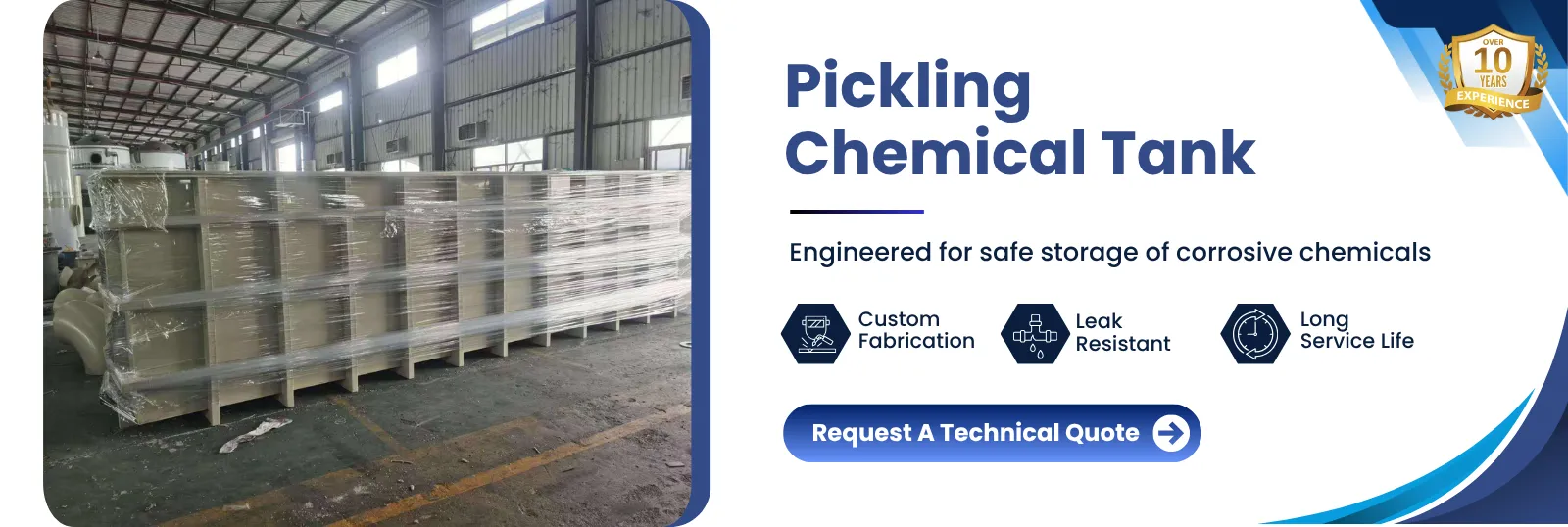






Pickling Chemical Tank
A Pickling Chemical Tank is specially designed for industrial storage and processing. Pickling Chemical Tanks are used for storing, mixing, and handling chemicals and acidic solutions. Pickling tanks are used in metal surface treatment processes. These tanks are manufactured using highly corrosion-resistant materials such as HDPE, PP, FRP, PVDF, and PVC to withstand aggressive chemicals and acidic environments. Pickling chemical tanks are primarily used in metal processing industries for removing rust, scale, oxides, impurities, and surface contaminants. Pickling chemical storage tanks are made of metals such as stainless steel, carbon steel, and other alloys before further of processing or finishing operations.
Pickling chemical tanks are available in various capacities, shapes, and customized designs, and depending on the chemical concentration, operating temperature, and industrial process requirements. Pickling Tanks are constructed with leak-proof construction, excellent chemical resistance, strong mechanical strength, and long service life to make them ideal for safe and efficient chemical treatment applications. Petron Thermplast deals in Pickling Chemical Tanks are guarantee for the best quality products.
Excellent Chemical Resistance
Resistant to Acids, Alkalis, Corrosive, Industrial solvents
Temperature Resistance
Safely handle moderate operating temperatures.
Corrosion-Free Construction
No rusting when exposed to chemicals & moisture.
Long Service Life
Excellent durability and can operate for many years
ISO / ASTM / DVS Certified
Manufactured to international quality standards
-10°C to 120°C
Operating Temperature
100 L – 100K L
Capacity (Customizable)
ASTM, ASME, ISO, DIN
Certified quality standards
5 mm – 50 mm
Wall Thickness

Excellent Chemical Resistance
Pickling Chemical Tanks are manufactured using highly chemical-resistant materials such as HDPE, PP, FRP, PVDF, PVC, and stainless steel to safely handle aggressive pickling acids and corrosive chemicals.

Temperature Resistance
Designed to handle varying operating temperatures depending on the chemical type and material selection.

Long Service Life
The durable construction and anti-corrosive materials ensure extended operational life with minimal maintenance.

Leak-Proof Welded Joints
High-quality welding and secure joints provide leak-proof operation for safe storage and processing of hazardous chemicals.

Technical Details
| Parameter | Technical & Physical Details |
| Product Name | Pickling Chemical Tank |
| Material Options | HDPE, PP, FRP, PVDF, PVC, Stainless Steel, Rubber-Lined Steel |
| Tank Type | Vertical, Horizontal, Cylindrical, Rectangular |
| Storage Capacity | 100 Liters to 100,000+ Liters |
| Wall Thickness | 5 mm to 50 mm (depending on tank size & application) |
| Shape | Cylindrical / Rectangular / Square |
| Design Standard | ASTM, ASME, ISO, DIN Standards |
| Operating Temperature | -10°C to 120°C (depends on chemical and material used) |
| Pressure Rating | Atmospheric to customized pressure rating |
| Chemical Compatibility | Suitable for acids, pickling solutions, and corrosive chemicals |
| Corrosion Resistance | Excellent resistance to aggressive acids and chemicals |
| Density of Material | HDPE: 0.94–0.97 g/cm³, PP: 0.90–0.91 g/cm³, FRP: 1.5–2.0 g/cm³ |
| UV Resistance | UV-stabilized material available for outdoor use |
| Color Options | Natural, Black, White, Grey, Customized |
| Mounting Type | Ground Mounted / Skid Mounted |
| Inlet Connection | Top inlet / Side inlet |
| Outlet Connection | Flanged, Threaded, Socket Weld |
| Lining Options | PTFE, Rubber, FRP, HDPE, PVDF |
| Reinforcement | FRP reinforcement / Steel support structure |
| Fabrication Method | Extrusion welding, Butt welding, Rotational molding, Fabrication |
| Surface Finish | Smooth internal finish / Anti-corrosive finish |
| Leak Protection | Leak-proof welded construction |
| Ventilation System | Optional vent and pressure release arrangement |
| Level Indicator | Optional level gauge installation |
| Agitator Provision | Available on request |
| Manhole Provision | Customized manhole sizes available |
| Drainage System | Bottom drain outlet available |
| Impact Resistance | High impact and abrasion resistance |
| Thermal Stability | Suitable for moderate to high temperature applications |
| Mechanical Strength | High structural and load-bearing strength |
| Safety Features | Anti-corrosion, chemical resistance, UV protection |
| Maintenance Requirement | Low maintenance |
| Service Life | Long operational life |
| Applications | Metal pickling, chemical processing, surface treatment, steel industries |
| Installation Type | Indoor & Outdoor installation |
| Customization | Available as per customer requirements |
Chemical compatibility of a pickling chemical tank refers to the ability of the tank material to safely withstand and highly corrosive pickling acids and process chemicals without corrosion, leakage, deformation, and structural failure. Proper chemical compatibility is essential for safe pickling operations, long service life, and reliable industrial performance.
Pickling chemicals are to highly aggressive, especially at elevated temperatures, so selecting the correct tank material is very important.
Common Pickling Chemicals
| Chemical | Typical Application |
| Hydrochloric Acid (HCl) | Steel pickling |
| Sulfuric Acid (H₂SO₄) | Metal descaling |
| Nitric Acid (HNO₃) | Stainless steel treatment |
| Hydrofluoric Acid (HF) | Stainless steel pickling |
| Phosphoric Acid | Surface treatment |
| Mixed Acid Solutions | Industrial pickling systems |
Common Materials Used for Pickling Chemical Tanks
| Tank Material | Main Characteristics |
| Polypropylene (PP) | Excellent acid resistance |
| HDPE | Good corrosion resistance |
| FRP | High structural strength |
| PVDF | Superior resistance to aggressive acids |
| Rubber-Lined Steel | Heavy-duty industrial applications |
| Stainless Steel | Limited compatible applications |
Compatibility of Common Pickling Chemicals
| Chemical | PP | HDPE | FRP | PVDF | Rubber-Lined Steel |
| Hydrochloric Acid (HCl) | Excellent | Good | Excellent | Excellent | Excellent |
| Sulfuric Acid | Excellent | Good* | Excellent | Excellent | Excellent |
| Nitric Acid | Good | Moderate | Good | Excellent | Good |
| Hydrofluoric Acid | Moderate | Moderate | Good | Excellent | Good |
| Phosphoric Acid | Excellent | Excellent | Excellent | Excellent | Excellent |
| Mixed Acid Solutions | Good | Moderate | Good | Excellent | Excellent |
Testing and quality to assurance are critical in the manufacturing of a Pickling Chemical Tank to ensure the safe handling of corrosive chemicals, long service life, and reliable plant operation. These tanks are commonly used for storing and processing acids such as hydrochloric acid (HCl), sulfuric acid (H₂SO₄), nitric acid, and phosphoric acid in metal treatment and pickling applications.
Importance of Quality Testing
Proper testing ensures that the tank:
- Safely withstands corrosive chemicals
- Prevents leakage and environmental hazards
- Maintains structural integrity under load
- Performs efficiently under varying temperatures and pressures
- Meets industrial safety and quality standards
Major Testing Procedures for Pickling Chemical Tank
1. Visual Inspection
The tank is visually inspected to check:
- Surface finish quality
- Welding uniformity
- Joint alignment
- Cracks, pinholes, or surface defects
- Dimensional accuracy
This is the first stage of quality verification before advanced testing.
2. Hydrostatic Leak Test
The tank is filled with water and kept under observation for a specified duration.
Purpose:
- Detect leakage from joints or welds
- Verify structural strength
- Ensure pressure resistance
Benefits:
- Confirms leak-proof performance
- Ensures safe chemical storage capability
3. Spark Testing
Spark testing is mainly used for plastic-lined or welded thermoplastic tanks.
Purpose:
- Detect invisible pinholes or weak weld areas
- Verify liner integrity
Process:
A high-voltage spark tester passes over weld seams and surfaces to identify defects.
4. Weld Joint Testing
Weld quality is highly important for chemical tanks.
Common Weld Tests:
- Visual weld inspection
- Bend testing
- Peel testing
- Air pressure weld testing
Purpose:
- Ensure strong fusion between welded joints
- Prevent future crack formation
5. Dimensional Accuracy Testing
Tank dimensions are checked according to approved drawings.
Parameters Checked:
- Diameter
- Height
- Wall thickness
- Nozzle positioning
- Reinforcement placement
This ensures proper installation and compatibility with plant piping systems.
6. Material Quality Verification
Raw material testing confirms chemical resistance and strength.
Materials Commonly Tested:
- HDPE
- PPH
- FRP
- PVDF
- PVC
Verification Includes:
- Density
- Thickness
- Chemical resistance
- Tensile strength
- Manufacturer certification
7. Ultrasonic Thickness Testing (UT Test)
UT testing measures wall thickness without damaging the tank.
Purpose:
- Ensure uniform wall thickness
- Detect weak sections
- Verify manufacturing quality
This test improves long-term reliability.
8. Vacuum Testing
Vacuum testing checks the tank’s resistance to negative pressure conditions.
Purpose:
- Verify vacuum handling capability
- Detect hidden leaks
- Ensure structural stability
Commonly used in process tanks and scrubber systems.
9. Chemical Resistance Testing
The tank material is tested against the intended pickling chemicals.
Evaluated Factors:
- Corrosion resistance
- Temperature compatibility
- Chemical concentration tolerance
- Long-term durability
This helps select the correct tank material for specific acid applications.
10. Load & Structural Strength Testing
The tank is evaluated for mechanical strength under operating conditions.
Includes:
- Static load testing
- Support structure inspection
- Reinforcement checking
Ensures safe operation during full-capacity usage.
Quality Standards Followed
Manufacturers often follow international and industrial standards such as:
- ASTM Standards
- DVS Welding Standards
- ISO Quality Standards
- ASME Guidelines
- DIN Standards
Compliance ensures high manufacturing reliability and safety.
Documentation Provided After Testing
After successful inspection and testing, the following documents may be provided:
- Quality inspection report
- Hydro test certificate
- Material test certificate (MTC)
- Dimensional inspection report
- Welding test report
- Dispatch clearance report
Industries We Serve

Metal Pickling Processes
Primarily used for removing:
Rust
Oxide layers
Scale
Surface impurities

Stainless Steel Industries
Used in stainless steel manufacturing and fabrication units for:
Surface cleaning
Descaling
Passivation processes
Weld cleaning operations

Steel Processing Plants
Pickling tanks are widely used in steel plants for treating:
Carbon steel
Mild steel
Alloy steel
Steel coils and sheets

Galvanizing Industries
Used before galvanizing operations to ensure clean metal surfaces for better zinc coating adhesion.

Metal Finishing Industries
Suitable for metal surface preparation processes such as:
Surface conditioning
Chemical cleaning
Pre-treatment operations
Surface activation

Pipe & Tube Manufacturing Industries
Used for cleaning and treating:
Stainless steel pipes
Metal tubes
Industrial piping components

Wire & Rod Processing Industries
Used in wire and rod manufacturing for removing scale and oxidation from metal surfaces.

Electroplating Industries
Pickling chemical tanks are used before electroplating to clean metal parts and improve coating quality.

Automotive Industries
Used for metal treatment and surface preparation of automotive components before painting or coating.

Heavy Engineering Industries
Suitable for cleaning and preparing heavy metal structures and fabricated equipment.

Pharmaceutical & Food Equipment Manufacturing
Used in the treatment of stainless steel equipment to achieve clean and corrosion-resistant surfaces.
Features & Benefits of Pickling Chemical Tanks

1. Excellent Chemical Resistance
Pickling Chemical Tanks are manufactured using highly chemical-resistant materials such as HDPE, PP, FRP, PVDF, PVC, and stainless steel to safely handle aggressive pickling acids and corrosive chemicals.

2. Corrosion-Resistant Construction
The tank structure is specially designed to resist corrosion caused by acidic pickling solutions, ensuring long-term durability and reliable performance.

3. Leak-Proof Design
High-quality welding and secure joints provide leak-proof operation for safe storage and processing of hazardous chemicals.

4. High Mechanical Strength
These tanks are built with strong structural integrity to withstand industrial loads, chemical pressure, and harsh operating conditions.

5. Long Service Life
The durable construction and anti-corrosive materials ensure extended operational life with minimal maintenance.

6. UV & Weather Resistance
UV-stabilized materials protect the tank from sunlight and environmental exposure, making them suitable for outdoor installation.

7. High Temperature Resistance
Designed to handle varying operating temperatures depending on the chemical type and material selection.

8. Smooth Internal Surface
The smooth inner finish minimizes chemical buildup, scaling, and contamination while improving cleaning efficiency.

9. Lightweight Structure
Plastic and hybrid pickling tanks are lightweight, making transportation, installation, and handling easier.

10. Low Maintenance Requirement
Corrosion-resistant materials and smooth surfaces reduce maintenance and cleaning costs.
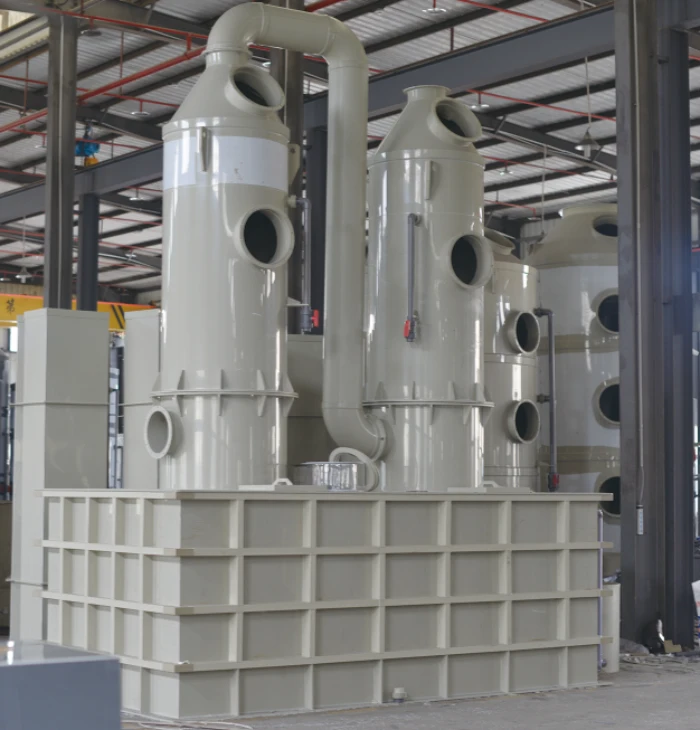
Manufacturing Process of Pickling Chemical Tank
The manufacturing process of a pickling chemical tank involves to precision engineering, corrosion-resistant material selection, fabrication, welding, reinforcement, and quality testing to safely handle the highly corrosive pickling acids and chemical solutions. These tanks are specially designed for acid pickling, metal cleaning, descaling, and surface treatment applications.
The manufacturing process begins with detailed engineering calculations based on:
- Type of pickling acid
- Chemical concentration
- Operating temperature(-10°C to 120°C (depends on chemical and material used))
- Tank capacity (100 Liters to 100,000+ Liters)
- Process requirements
- Structural load conditions
Design calculations determine:
- Tank dimensions
- Wall thickness
- Reinforcement requirements
- Nozzle arrangement
- Heating and ventilation provisions
The tank material is selected according to:
- Acid compatibility
- Temperature resistance
- Mechanical strength
- Corrosion resistance
- PPH sheets
- HDPE sheets
- FRP materials
- PVDF lining sheets
- Rubber lining
- Structural steel
Raw material sheets are cut into required dimensions using:
- CNC cutting machines
- Circular saws
- Thermoplastic cutting equipment
- Precision fabrication tools
Prepared sections include:
- Tank walls
- Bottom plates
- Top covers
- Reinforcement sections
The cut sheets are fabricated into the required tank shape.
Common configurations include:
- Rectangular pickling tanks
- Cylindrical tanks
- Open-top process tanks
- Vertical tanks
Proper alignment ensures:
- Structural stability
- Accurate dimensions
- Uniform fabrication quality
Tank sections are joined using specialized welding methods.
Thermoplastic Tanks
Common welding techniques:
- Butt fusion welding
- Extrusion welding
- Hot gas welding
Steel Tanks
Common welding techniques:
- TIG welding
- MIG welding
- Arc welding
These methods provide:
- Strong welded joints
- Leak-proof seams
- Chemical-resistant construction
The tank bottom and top sections are assembled according to process requirements.
Top Designs
- Open top
- Covered top
- Ventilated top
Bottom Designs
- Flat bottom
- Sloped bottom
- Cone bottom
Depending on drainage and chemical circulation needs.
Various fittings are installed, such as:
- Inlet nozzles
- Outlet nozzles
- Drain valves
- Overflow systems
- Vent connections
- Sampling ports
- Level indicators
All fittings are carefully aligned and welded.
For highly corrosive applications:
- FRP reinforcement may be applied
- PVDF lining may be installed
- Rubber lining may be bonded
This improves:
- Corrosion resistance
- Structural strength
- Thermal stability
Additional support systems may include:
- External stiffeners
- Reinforcement ribs
- Steel support frames
- Structural bracing
- Chemical load
- Thermal expansion
- Mechanical stress
If required, the tank may include:
- Steam coil provision
- Electric heater support
- Fume extraction nozzles
- Scrubber connections
This improves process efficiency and safety.
Finishing operations may include:
- Surface cleaning
- Weld polishing
- Edge trimming
- Protective coating
- UV-resistant coating
The completed tank undergoes hydro testing by filling it with water to verify:
- Leak-proof construction
- Weld integrity
- Structural performance
How to Select the Right Pickling Chemical Tank
The first step is to determine:
- Type of pickling acid
- Chemical concentration
- Operating temperature
- Corrosive nature
- Process requirement
- Hydrochloric Acid (HCl)
- Sulfuric Acid (H₂SO₄)
- Nitric Acid (HNO₃)
- Hydrofluoric Acid (HF)
- Mixed acid solutions
The tank material must be compatible with the pickling chemicals.
Common tank materials include:
- PP (Polypropylene)
- HDPE
- FRP
- PVDF-lined systems
- Rubber-lined steel
- Stainless Steel (for selected applications)
- Chemical corrosion
- Leakage
- Material degradation
- Structural failure
Higher acid concentrations increase corrosiveness.
This may require:
- Thicker tank walls
- Advanced lining systems
- Additional reinforcement
- Specialized thermoplastic materials
Temperature is a critical factor in pickling applications.
Higher temperatures may require:
- PVDF lining
- High-temperature PP
- Enhanced reinforcement
- Specialized fabrication methods
- Process temperature
- Heating system requirements
- Thermal expansion conditions
Tank capacity should be selected according to:
- Production volume
- Batch size
- Chemical consumption
- Process cycle
- Small process tanks
- Medium industrial tanks
- Large pickling baths
| Tank Material | Suitable Applications |
| PP | Acid pickling systems |
| HDPE | Mild acid storage |
| FRP | Structural reinforcement applications |
| PVDF | High-temperature aggressive acids |
| Rubber-Lined Steel | Heavy industrial pickling |
| Stainless Steel | Limited compatible chemical systems |
Common tank configurations include:
- Rectangular pickling tanks
- Vertical tanks
- Horizontal tanks
- Open-top process tanks
- Process flow
- Component size
- Space availability
- Chemical circulation requirements
Pickling tanks must withstand:
- Chemical load
- Thermal stress
- Agitator load
- Mechanical handling stress
- Reinforcement ribs
- Structural frames
- External supports
Some pickling processes require heated chemicals.
The tank should support:
- Steam coils
- Electric heaters
- External heating systems
Proper material selection is essential for heated applications.
Pickling chemicals generate corrosive fumes.
The tank system may require:
- Vent nozzles
- Fume extraction systems
- Scrubber connections
- Exhaust ducts
This improves workplace safety.
Some applications require:
- Chemical agitation
- Solution circulation
- Air sparging systems
The tank should include:
- Agitator support
- Reinforced mounting arrangement
Common accessories include:
- Inlet nozzles
- Outlet nozzles
- Drain valves
- Overflow systems
- Sampling ports
- Level indicators
- Manholes
Tank thickness depends on:
- Acid concentration
- Operating temperature
- Tank size
- Mechanical load
- Structural stability
- Leak prevention
- Long service life
Choose tanks tested for:
- Hydrostatic leak testing
- Spark testing
- Weld inspection
- Vacuum testing
- Dimensional verification
- ASTM standards
- DVS welding standards
- Industrial fabrication standards
An experienced manufacturer ensures:
- Correct material selection
- Precision fabrication
- Reliable welding quality
- Proper engineering support
- Long-term performance

Custom Product Manufacturing Available
If you are searching for customized product designs that meet your requirements, don’t worry. Petron Thermoplast also offers custom product manufacturing services to meet the unique needs of various industries. Work with our expert engineers to create custom designs suited for your application.
Why Choose Petron Thermoplast?
Petron Thermplast deals in Pickling Chemical Tank. With our experience in the field of industrial manufacturing, we guarantee the best quality products. Petron Thermoplast has a professional team; we are all experienced and highly skilled in Manufacturing. For our safety, it is a top priority to have modern machinery and facilities for safety purposes. So it’s well worth the investment in safety. We are a leading name in the industrial sector, and we believe in hard work and innovation to pursue excellence.
Frequently Asked Questions
A Pickling Chemical Tank is a specially designed storage and processing tank used for holding acidic pickling solutions such as hydrochloric acid (HCl), sulfuric acid (H₂SO₄), nitric acid, or mixed acid solutions used for metal surface cleaning and oxide removal.
Pickling tanks are commonly manufactured using:
- HDPE (High-Density Polyethylene)
- PPH (Polypropylene Homopolymer)
- FRP (Fiber Reinforced Plastic)
- PVC/CPVC-lined tanks
These tanks are widely used in:
- Steel processing plants
- Galvanizing industries
- Metal finishing units
- Wire and tube manufacturing
- Electroplating industries
- Chemical processing plants
Pickling chemicals are highly corrosive. Proper chemical compatibility ensures:
- Long tank life
- Safe chemical storage
- Leak prevention
- Reduced maintenance costs
- Improved operational safety
Yes, but the allowable temperature depends on the tank material:
- HDPE tanks generally handle moderate temperatures
- PPH tanks are suitable for higher temperatures
- FRP tanks can be designed for elevated temperature applications
Always verify operating temperature before selection.
Recommended safety features include:
- Vent systems
- Overflow nozzles
- Level indicators
- Secondary containment
- Chemical-resistant gaskets
- Leak-proof welded joints
- Emergency drain arrangements
Important selection factors include:
- Type of chemical
- Chemical concentration
- Operating temperature
- Storage capacity
- Installation location
- Pressure requirements
- Tank orientation (vertical/horizontal)
Yes, most tanks are custom-designed according to:
- Chemical properties
- Space availability
- Process requirements
- Flow rates
- Client specifications
The manufacturing process generally includes:
- Design and engineering
- Material selection
- Sheet cutting and fabrication
- Butt welding/extrusion welding
- Nozzle and fitting installation
Common quality tests include:
- Hydrostatic testing
- Spark testing
- Weld inspection
- Visual inspection
- Dimensional checking
- Leakage testing
- Material verification