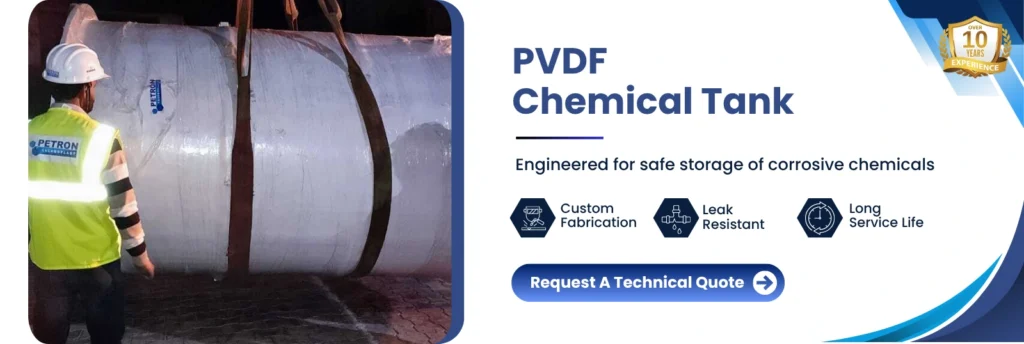






PVDF Chemical Tank
A PVDF Chemical Tank is an specialized for storage and process tank which is manufactured from PVDF Polyvinylidene Fluoride, a high-performance fluoropolymer known for its exceptional chemical resistance, high-temperature stability, and there superior mechanical properties. These tanks are specifically designed to safely store, handle, and process the highly corrosive chemicals that may not be suitable for the conventional thermoplastic materials.
PVDF Chemical Tanks are widely used in industries where the aggressive acids, oxidizing agents, ultra-pure chemicals, and high-temperature process fluids to require the reliable and long-lasting containment. Petron thermoplast providing the leading manufacturer of superior range of PVDF Chemical Tanks, with our highly qualified and technically sound team.
Excellent Chemical Resistance
Outstanding resistance to acids, oxidizers, and aggressive chemicals
Temperature Resistance
-20°C to +140°C (depending on chemical service)
Corrosion-Free Construction
No rusting when exposed to chemicals & moisture.
Long Service Life
Excellent durability and can operate for many years
ASTM, DVS, DIN, ISO Certified
Manufactured to international quality standards
-20°C to +140°C
Operating Temperature
100 L – 100K L
Capacity (Customizable)
ASTM, DVS, DIN, ISO
Certified quality standards
5 mm – 25 mm
Wall Thickness

Corrosion-Free Construction
PVDF tanks are immune to rust, corrosion, and chemical degradation, ensuring reliable long-term performance.

High Temperature Resistance
PVDF maintains its mechanical strength and chemical resistance at elevated temperatures, making it suitable for demanding industrial processes.

Excellent UV Resistance
PVDF performs exceptionally well in outdoor installations and prolonged sunlight exposure without significant degradation.

Leak-Proof Fabrication
Advanced thermoplastic welding techniques create strong, homogeneous, and leak-tight joints for safe chemical containment.

Technical Details
| Parameter | Technical Details |
| Product Type | PVDF Chemical Tank |
| Material of Construction | Polyvinylidene Fluoride (PVDF) |
| Tank Configuration | Vertical, Horizontal, Rectangular, Cylindrical, Custom Fabricated |
| Storage Capacity | 50 Liters to 100,000 Liters or Customized |
| Tank Diameter | As per design requirement |
| Tank Height | Customized |
| Wall Thickness | Typically 5 mm to 40 mm (depending on size and application) |
| Bottom Thickness | Designed according to chemical load and operating conditions |
| Operating Temperature Range | -20°C to +140°C (depending on chemical service) |
| Design Temperature | Up to 150°C |
| Operating Pressure | Atmospheric or Low Pressure |
| Specific Gravity Design | Up to 2.0 SG or higher as required |
| Corrosion Resistance | Excellent |
| UV Resistance | Excellent |
| Chemical Resistance | Outstanding resistance to acids, oxidizers, and aggressive chemicals |
| Fabrication Method | Thermoplastic Sheet Fabrication |
| Welding Method | Butt Fusion Welding, Extrusion Welding, Hot Gas Welding |
| Tank Shape | Cylindrical, Rectangular, Square, Vertical, Horizontal |
| Top Design | Open Top, Flat Top, Dome Top |
| Bottom Design | Flat Bottom, Cone Bottom, Dish Bottom |
| Reinforcement Type | PVDF Stiffeners, FRP Backing, Structural Supports |
| Nozzle Material | PVDF Fabricated Nozzles |
| Drain Connection | Bottom Drain or Side Drain |
| Vent Connection | Available |
| Overflow Connection | Available |
| Level Monitoring System | Sight Glass, Float Type, Ultrasonic, Radar |
| Manhole Access | Optional |
| Agitator Provision | Optional |
| Heating Coil Provision | Optional |
| Surface Finish | Smooth, Non-Porous Surface |
| Leak-Proof Construction | Yes |
| Testing Standards | Hydrostatic Test, Leak Test, Visual Inspection |
| Manufacturing Standards | ASTM, DVS, DIN, ISO, Customer Specifications |
PVDF (Polyvinylidene Fluoride) Chemical Tanks are widely recognized for their exceptional resistance to aggressive chemicals, oxidizing agents, and high-temperature process fluids. PVDF is one of the most chemically resistant thermoplastics available, making it an ideal material for storing and processing highly corrosive chemicals in demanding industrial environments.
Why Chemical Compatibility is Important
Proper chemical compatibility ensures:
- Safe chemical storage and handling
- Long tank service life
- Prevention of material degradation
- Reduced maintenance costs
- Leak-free operation
- Improved process reliability
- Enhanced workplace safety
Before selecting a PVDF Chemical Tank, factors such as chemical concentration, operating temperature, and exposure conditions should always be evaluated.
Chemical Resistance Properties of PVDF
PVDF offers excellent resistance to:
- Strong acids
- Oxidizing chemicals
- Halogen compounds
- Chlorinated chemicals
- High-purity process fluids
- Many organic and inorganic chemicals
Its low permeability and high chemical stability make it suitable for critical chemical storage applications.
Compatibility with Acids
Hydrochloric Acid (HCl)
Compatibility: Excellent
Applications:
- Chemical storage
- Water treatment systems
- Pickling processes
- Chemical dosing systems
Sulfuric Acid (H₂SO₄)
Compatibility: Excellent
Applications:
- Chemical processing
- Fertilizer production
- Industrial acid storage
Nitric Acid (HNO₃)
Compatibility: Excellent
PVDF is often selected for nitric acid applications because of its excellent resistance to oxidizing acids.
Phosphoric Acid (H₃PO₄)
Compatibility: Excellent
Applications:
- Fertilizer manufacturing
- Chemical processing
- Surface treatment operations
Hydrofluoric Acid (HF)
Compatibility: Generally Good to Excellent*
Compatibility should be verified based on concentration and operating temperature.
Compatibility with Oxidizing Chemicals
One of PVDF’s major advantages is its outstanding resistance to oxidizing agents.
Sodium Hypochlorite
Compatibility: Excellent
Commonly used in:
- Water treatment plants
- Disinfection systems
- Chemical dosing systems
Hydrogen Peroxide
Compatibility: Excellent
Applications:
- Semiconductor manufacturing
- Chemical processing
- Pharmaceutical industries
Chlorine-Based Chemicals
Compatibility: Excellent
PVDF performs exceptionally well in chlorination and oxidation environments.
Compatibility with Alkalis
PVDF is resistant to many alkaline solutions, including:
- Sodium Hydroxide (NaOH)
- Potassium Hydroxide (KOH)
- Ammonium Hydroxide
Compatibility: Good to Excellent
Compatibility should be verified for high concentrations and elevated temperatures.
Compatibility with High-Purity Chemicals
PVDF is widely used in high-purity applications due to its low contamination characteristics.
Suitable for:
- Semiconductor Chemicals
- Electronic Grade Chemicals
- Pharmaceutical Process Fluids
- Ultra-Pure Water Systems
Compatibility with Organic Chemicals
PVDF offers resistance to many organic compounds, including:
- Alcohols
- Organic Acids
- Selected Solvents
- Process Chemicals
Compatibility should always be confirmed for specific solvents and operating conditions.
General Chemical Compatibility Guide
| Chemical | Compatibility with PVDF |
| Hydrochloric Acid ($HCl$) | Excellent |
| Sulfuric Acid ($H_2SO_4$) | Excellent |
| Nitric Acid ($HNO_3$) | Excellent |
| Phosphoric Acid ($H_3PO_4$) | Excellent |
| Sodium Hypochlorite | Excellent |
| Hydrogen Peroxide | Excellent |
| Ferric Chloride | Excellent |
| Alum Solution | Excellent |
| Sodium Hydroxide | Good to Excellent |
| Potassium Hydroxide | Good to Excellent |
| Ultra-Pure Water | Excellent |
| Chlorine-Based Chemicals | Excellent |
| Organic Acids | Excellent |
| Selected Organic Solvents | Compatibility Check Required |
Testing and quality assurance are critical aspects of manufacturing a PVDF Chemical Tank (Polyvinylidene Fluoride Chemical Tank). Since these tanks are often used for storing highly corrosive chemicals, oxidizing agents, and high-purity process fluids, rigorous inspection and testing procedures are necessary to ensure safety, reliability, and long-term performance.
1. Raw Material Inspection
Quality control begins with the inspection of incoming PVDF raw materials.
Inspection Parameters
- PVDF material grade verification
- Sheet thickness measurement
- Surface quality inspection
- Material Test Certificate (MTC) verification
- Batch traceability confirmation
- Dimensional accuracy checks
Only approved materials are used for fabrication.
2. Visual Inspection
Visual inspections are carried out throughout the manufacturing process to identify:
- Surface defects
- Scratches and dents
- Material imperfections
- Fabrication defects
- Welding irregularities
This ensures consistent workmanship and product quality.
3. Dimensional Inspection
The fabricated tank is checked against approved drawings and specifications.
Parameters Inspected
- Tank diameter
- Tank height
- Length and width (for rectangular tanks)
- Wall thickness
- Bottom thickness
- Nozzle orientation
- Nozzle size and location
- Reinforcement positioning
Accurate dimensions are essential for proper installation and operation.
4. PVDF Weld Inspection
The quality of welded joints is one of the most important aspects of PVDF tank fabrication.
Weld Inspection Criteria
- Uniform weld appearance
- Proper fusion
- Joint alignment
- Weld continuity
- Absence of cracks
- Absence of porosity
- Absence of undercuts
All welds are inspected to ensure structural integrity and leak-proof performance.
5. Welding Procedure Verification
The welding methods used in PVDF fabrication are verified for compliance with approved procedures.
Common Welding Methods
- Butt Fusion Welding
- Extrusion Welding
- Hot Gas Welding
Proper welding ensures strong and chemically resistant joints.
6. Reinforcement Inspection
Structural reinforcements are inspected to verify:
- Correct dimensions
- Proper placement
- Secure attachment
- Adequate structural support
This is particularly important for large-capacity tanks.
7. Nozzle and Fitting Inspection
All nozzles and fittings are inspected for:
- Correct sizing
- Proper alignment
- Secure welding
- Leak-tight installation
This ensures reliable process connections.
8. Surface Finish Inspection
The tank surfaces are checked for:
- Smooth internal finish
- Uniform external appearance
- Clean weld profiles
- Absence of sharp edges
A smooth surface reduces contamination risks and simplifies maintenance.
9. Leak Testing
Leak testing is performed to verify the integrity of:
- Welded joints
- Nozzle connections
- Drain fittings
- Vent connections
- Overflow arrangements
The objective is to confirm complete leak-proof performance.
10. Hydrostatic Testing
Hydrostatic testing is a key quality assurance procedure.
Purpose
- Verify structural strength
- Confirm leak-tightness
- Assess weld performance
- Evaluate tank stability under load
The tank is filled with water and monitored for leakage or deformation
Industries We Serve
HDPE’s unique molecular architecture makes it the leading material choice for the most demanding chemical storage applications worldwide.

Chemical Processing Industrya
PVDF Chemical Tanks are extensively used for:
Storage of corrosive acids
Chemical reaction processes
Intermediate chemical storage
Batch processing operations
Chemical dosing systems
Their superior chemical resistance ensures safe handling of aggressive chemicals.

Semiconductor Industry
PVDF tanks are used for:
Ultra-pure chemical storage
Semiconductor wet processing
Chemical distribution systems
Acid handling systems
High-purity water applications
The low contamination characteristics of PVDF make it ideal for these critical processes.

Pharmaceutical Industry
PVDF Chemical Tanks are used in pharmaceutical manufacturing for:
High-purity chemical storage
Process fluid handling
Cleaning and sanitization systems
Chemical preparation tanks
Water treatment processes
Their clean and non-reactive surface supports strict quality requirements.

Water and Wastewater Treatment Industry
PVDF tanks are commonly installed for storing and handling:
Sodium Hypochlorite
Hydrochloric Acid
Sulfuric Acid
Ferric Chloride
Water Treatment Chemicals
Disinfection Chemicals
They provide long-term resistance to corrosive treatment chemicals.

Electroplating Industry
Electroplating facilities use PVDF Chemical Tanks for:
Acid storage
Plating chemical containment
Surface treatment operations
Chemical preparation systems
Process solution storage
PVDF's resistance to aggressive plating chemicals ensures reliable operation.
Metal Finishing Industry
Applications include
:
Pickling chemical storage
Surface treatment processes
Acid cleaning systems
Chemical preparation tanks
Descaling operations
The material's corrosion resistance helps maintain process integrity.

Electronics Manufacturing Industry
PVDF tanks support:
High-purity chemical handling
Etching chemical storage
Process chemical distribution
Cleaning chemical systems
Semiconductor-grade applications
The material helps minimize contamination risks.

Specialty Chemical Industry
Specialty chemical manufacturers use PVDF tanks for:
Aggressive chemical storage
High-temperature process fluids
Oxidizing chemical containment
Chemical blending operations
Process intermediate storage
PVDF performs well in challenging process environments.

Mining and Mineral Processing Industry
PVDF Chemical Tanks are used for:
Acid storage
Leaching chemical systems
Mineral processing chemicals
Process solution handling
Their resistance to aggressive chemicals ensures dependable performance.
Features of HDPE Chemical Storage Tanks

Exceptional Chemical Resistance
PVDF provides outstanding resistance to a wide range of aggressive chemicals, including:
Hydrochloric Acid (HCl)
Sulfuric Acid (H₂SO₄)
Nitric Acid (HNO₃)
Phosphoric Acid (H₃PO₄)
Sodium Hypochlorite
Hydrogen Peroxide
Chlorine-Based Chemicals
High-Purity Process Chemicals

High Mechanical Strength
The material offers:
Excellent impact resistance
High tensile strength
Good dimensional stability
Resistance to mechanical stress

High Impact Strength
PVDF is widely used in industries requiring contamination-free processing because of its:
Low extractable content
Smooth non-reactive surface
Excellent purity standards

Excellent Resistance to Oxidizing Agents
Unlike many conventional thermoplastics, PVDF performs exceptionally well when exposed to strong oxidizing chemicals, making it ideal for critical chemical applications.

High Temperature Resistance
PVDF maintains its mechanical strength and chemical resistance at elevated temperatures, making it suitable for demanding industrial processes.

Leak-Proof Fabrication
Advanced thermoplastic welding techniques create strong, homogeneous, and leak-tight joints for safe chemical containment.

Corrosion-Free Construction
PVDF tanks are immune to rust, corrosion, and chemical degradation, ensuring reliable long-term performance.

Excellent UV Resistance
PVDF performs exceptionally well in outdoor installations and prolonged sunlight exposure without significant degradation.

Low Permeability
PVDF offers low permeability to gases and liquids, helping maintain product integrity and reducing chemical losses.
Manufacturing Process of HDPE Chemical Storage Tank
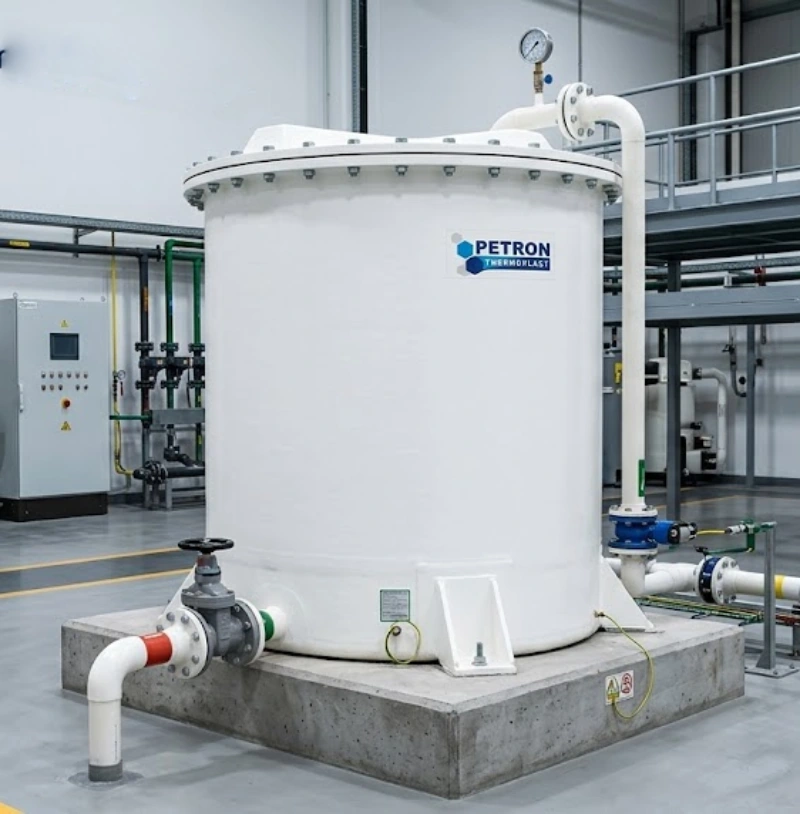
The manufacturing of a PVDF Chemical Tank (Polyvinylidene Fluoride Chemical Tank) involves specialized thermoplastic fabrication techniques to produce a highly durable, chemically resistant, and leak-proof storage vessel. Due to the premium nature of PVDF and its use in critical chemical applications, strict quality control and precision engineering are maintained throughout the manufacturing process.
The process begins with detailed engineering and design calculations based on:
- Chemical type
- Chemical concentration
- Storage capacity (50 Liters to 100,000 Liters or Customized)
- Operating temperature(-20°C to +140°C (depending on chemical service)
- Specific gravity of the liquid
- Pressure conditions
- Installation environment
- Structural loading requirements
Engineering Deliverables
- General Arrangement (GA) Drawings
- Fabrication Drawings
- Nozzle Layout Drawings
- Structural Reinforcement Details
- Bill of Materials (BOM)
High-quality PVDF sheets and components are selected according to the application requirements.
Materials Used
- PVDF Sheets
- PVDF Welding Rods
- PVDF Nozzles and Fittings
- PVDF Structural Components
- FRP Backing Materials (for dual-laminate construction, if required)
Material selection is based on chemical compatibility and operating conditions.
All incoming materials undergo thorough inspection to verify:
- Material grade
- Sheet thickness
- Surface quality
- Dimensional accuracy
- Material Test Certificates (MTC)
- Batch traceability
Only approved materials are released for production.
PVDF sheets are cut according to approved fabrication drawings using:
- CNC Cutting Machines
- Precision Panel Saws
- Thermoplastic Cutting Equipment
Accurate cutting ensures proper fit-up and dimensional precision.
The cut sheets are fabricated into individual components such as:
- Tank shell panels
- Side walls
- Bottom sections
- Top covers
- Reinforcement members
- Internal partitions (if required)
Each component is prepared according to design specifications.
The fabricated components are assembled to form the tank structure.
This stage includes:
- Panel alignment
- Corner assembly
- Shell formation
- Temporary positioning and fixing
Careful alignment ensures structural integrity and dimensional accuracy.
PVDF components are permanently joined using specialized welding techniques.
Butt Fusion Welding
Used for joining large PVDF sheets and structural sections.
Extrusion Welding
Used for corner joints, reinforcement attachments, and nozzle welding.
Hot Gas Welding
Used for detailed fabrication work and finishing operations.
These welding processes produce strong, chemically resistant, and leak-proof joints.
Depending on tank size and application, reinforcement systems may include:
- PVDF Structural Stiffeners
- FRP Reinforcement Layers
- Structural Rings
- Steel Support Frames
Reinforcements improve mechanical strength and prevent deformation.
How to Select the Right HDPE Chemical Storage Tank
The first and most important step is understanding which type of chemical stored:
- Type of chemical
- Concentration level
- Corrosive nature
- Specific gravity
- Compatibility with HDPE material
HDPE tanks are suitable for the moderate temperature applications.
- Minimum and maximum liquid temperature
- Ambient environmental temperature
- Need for insulation and UV protection
The tank must be designed according to the liquid’s specific gravity (SG).
- Standard tanks are generally designed for SG 1.0
- Higher SG chemicals required to thicker tank walls and stronger construction
Vertical Tanks
- Best for large-volume storage
- Space-saving design
- Common in industrial plants
Horizontal Tanks
- Suitable for transport and mobile applications
- Easier low-height installation
Rectangular Tanks
- Ideal where installation space is limited
Depending on the application:
- Chemical storage tank
- Dosing tank
- Mixing tank
- Process tank
- Pickling tank
- Day tank
- Indoor or outdoor installation
- UV exposure
- Wind load conditions
- Earthquake zone requirements
- Foundation strength and level
HDPE tanks are generally designed for:
- Atmospheric storage
- Low-pressure applications
- Easy cleaning
- Inspection access
- Drainage
- Component replacement

Custom Product Manufacturing Available
If you are searching for customized product designs that meet your requirements, don’t worry. Petron Thermoplast also offers custom product manufacturing services to meet the unique needs of various industries. Work with our expert engineers to create custom designs suited for your application.
Why Choose Petron Thermoplast?
Petron Thermoplast, has been the leading manufacturer of superior range of PVDF Chemical Tanks. With our highly qualified and technically sound team along with State of the art infrastructure, sophisticated manufacturing and sourcing of quality raw material, we are able to fabricate quality products as per International standards. Our vast experience help us to design the system to be most cost efficient.
Frequently Asked Questions
A PVDF Chemical Tank is a storage or process tank manufactured from Polyvinylidene Fluoride (PVDF), a high-performance fluoropolymer known for its exceptional chemical resistance, high-temperature capability, and durability. It is used for handling highly corrosive and oxidizing chemicals.
PVDF (Polyvinylidene Fluoride) is a premium engineering thermoplastic that offers:
- Excellent chemical resistance
- High-temperature stability
- Superior mechanical strength
- UV resistance
- High purity characteristics
It is widely used in critical chemical processing applications.
PVDF tanks are preferred when:
- Strong oxidizing chemicals are involved
- Higher operating temperatures are required
- Ultra-pure chemical storage is needed
- Superior chemical resistance is essential
PVDF generally offers better performance in aggressive chemical environments than PP or HDPE.
PVDF tanks are suitable for:
- Hydrochloric Acid (HCl)
- Sulfuric Acid (H₂SO₄)
- Nitric Acid (HNO₃)
- Phosphoric Acid (H₃PO₄)
- Sodium Hypochlorite
- Hydrogen Peroxide
- Ferric Chloride
- Chlorine-Based Chemicals
- Ultra-Pure Water
Chemical compatibility should always be verified based on concentration and temperature.
PVDF tanks are commonly used in:
- Chemical Processing Plants
- Semiconductor Manufacturing
- Pharmaceutical Industries
- Water Treatment Facilities
- Electronics Manufacturing
- Electroplating Plants
- Metal Finishing Industries
- Specialty Chemical Industries
Key advantages include:
- Exceptional chemical resistance
- Excellent oxidizer resistance
- High-temperature capability
- Corrosion-free construction
- Long service life
- High purity performance
- UV resistance
- Low maintenance requirements
PVDF Chemical Tanks can be manufactured in capacities ranging from:
- 50 Liters
- 500 Liters
- 1,000 Liters
- 10,000 Liters
- 50,000 Liters
- 100,000 Liters and above
Custom sizes can also be fabricated.
Common configurations include:
- Vertical Tanks
- Horizontal Tanks
- Cylindrical Tanks
- Rectangular Process Tanks
- Custom Fabricated Tanks
PVDF tanks are typically suitable for temperatures ranging from -20°C to +140°C, depending on:
- Chemical type
- Chemical concentration
- Process conditions
- Tank design
Yes. PVDF offers excellent UV and weather resistance, making it suitable for both indoor and outdoor installations.