





Manhole and Ladder Arrangement Tank banner Final

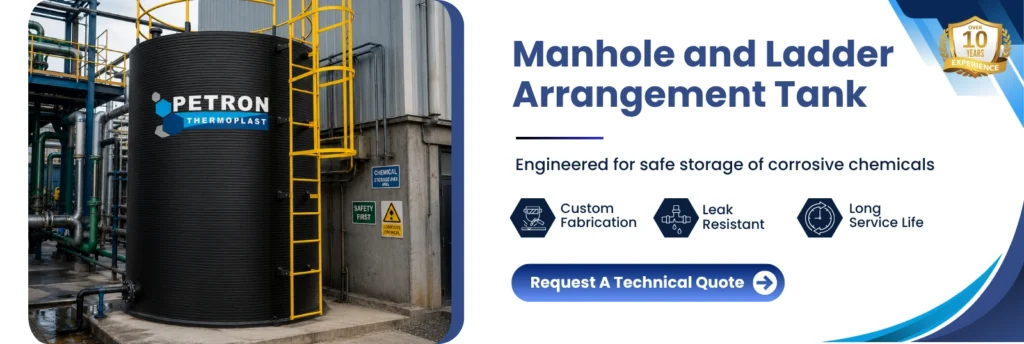
Manhole and Ladder Arrangement Tank

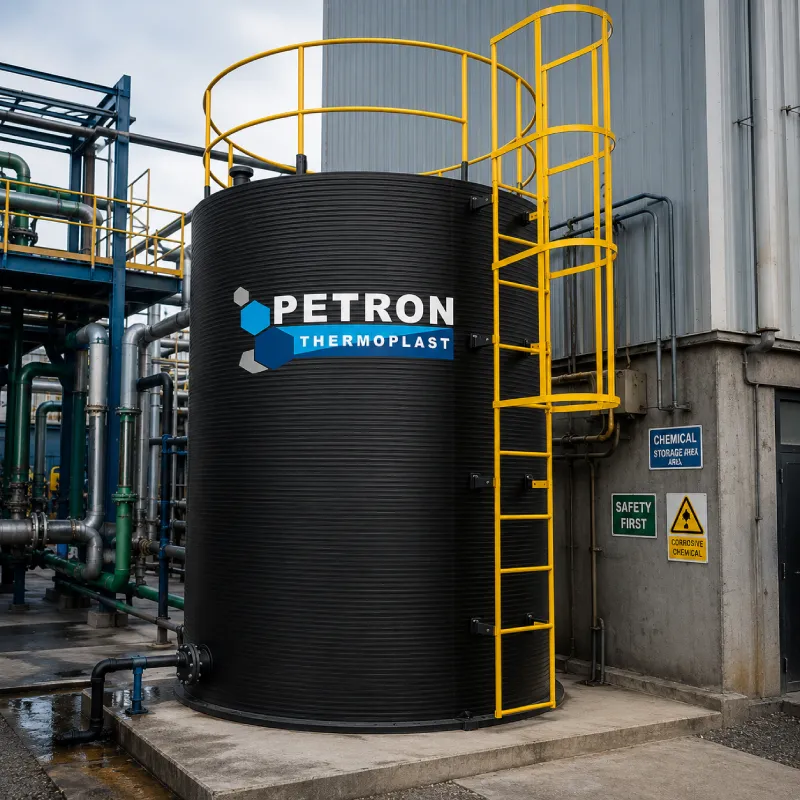
A Manhole and Ladder Arrangement Tank is an industrial storage process tank equipped with a manhole opening and a ladder system. Manhole and ladder arrangement tanks provide safe and convenient access for inspection, cleaning, maintenance, and operational activities. The Manhole and Ladder Arrangement Tank allows personnel to enter and inspect the tank internally, while the ladder arrangement ensures secure access to the top or inside of the tank.

Manhole and Ladder Arrangement Tanks are widely used in industries such as chemical processing, water treatment, pharmaceuticals, oil & gas and electroplating, where the regular inspection, cleaning, and monitoring of tanks are essential. Petron Thermoplast also provides safe and convenient Manhole and Ladder Arrangement Tanks for access for internal inspection, cleaning, maintenance, and operational monitoring. Petron Thermoplast also provides safe and convenient Manhole and Ladder Arrangement Tanks for access for internal inspection, cleaning, maintenance, and operational monitoring. 

defence

Material of Construction

HDPE, PP, FRP, PVDF, SS 304, SS 316, Mild Steel

weather (1)

Temperature Resistance

-10°C to 120°C (Depends on Material)

layer

Corrosion-Free Construction

Excellent Chemical & Corrosion Resistance

grade

Long Service Life

Excellent durability and can operate for many years

guarantee

ISO / ASTM / DVS Certified

Manufactured to international quality standards

-10°C to 120°C

Operating Temperature

100 L – 100K L

Capacity (Customizable)

ASTM D1998 & ISO

Certified quality standards

5 mm to 50 mm

Wall Thickness

corrosion

Corrosion-Resistant Structure

Offers excellent resistance to against chemicals, moisture, and harsh industrial environments.

fire

Temperature Resistance

Suitable for handling the corrosive chemicals and varying the operating temperatures.

accuracy

Long Service Life

Designed for reliable long-term industrial performance to under demanding conditions.

shield

Leak-Proof Welded Joints

Precision fabrication to ensure the safe, reliable, and leak-free liquid storage and handling.

Technical Details

ParameterDetails
Product NameManhole and Ladder Arrangement Tank
Tank TypeStorage Tank / Process Tank / Chemical Handling Tank
Material of ConstructionHDPE, PP, FRP, PVDF, SS 304, SS 316, Mild Steel
Tank ShapeVertical, Horizontal, Cylindrical, Rectangular
Capacity Range100 Liters to 100,000 Liters or Customized
Thickness Range5 mm to 50 mm (Depending on Size & Application)
Manhole TypeTop Manhole / Side Manhole
Manhole Size300 mm to 800 mm or Customized
Ladder TypeFixed Ladder / Cage Ladder / Platform Ladder
Ladder MaterialSS, MS, FRP, HDPE Coated Steel
Operating Temperature-10°C to 120°C (Depends on Material)
Pressure RatingAtmospheric to Low Pressure
Corrosion ResistanceExcellent Chemical & Corrosion Resistance
Surface FinishSmooth / Matte / Mirror Finish (for SS Tanks)
Fabrication MethodButt Welding, Extrusion Welding, FRP Lamination
Safety FeaturesAnti-Slip Ladder, Secure Handrails, Leak-Proof Design
Mounting ArrangementFloor Mounted / Skid Mounted / Platform Mounted
Accessories AvailableLevel Indicator, Agitator, Vent, Drain Valve, Nozzles
ApplicationsChemical Storage, Mixing, Water Treatment, Process Handling
Industry UsageChemical, Pharma, Food, Textile, Oil & Gas, Electroplating
MaintenanceEasy Inspection & Low Maintenance
CustomizationAvailable as per Client Requirement
Service LifeLong Operational Life with High Durability

Chemical compatibility is a critical consideration when selecting a Manhole and Ladder Arrangement Tank. While the tank body stores the chemical, the manhole assembly, ladder supports, fasteners, gaskets, and associated fittings may also be exposed to chemical vapors, splashes, or direct contact with the stored media. Proper material selection ensure to safe operation, structural integrity, and long service life.

Why Chemical Compatibility is Important

Proper chemical compatibility helps to:

  • Prevent corrosion and material degradation
  • Maintain structural strength and safety
  • Extend equipment service life
  • Reduce maintenance and repair costs
  • Prevent leakage through manhole seals
  • Ensure safe access for inspection and maintenance

Components Requiring Compatibility Evaluation

The following components should be assessed for chemical resistance:

  • Tank body
  • Manhole cover
  • Manhole neck
  • Gaskets and seals
  • Ladder mounting brackets
  • Support structures
  • Fasteners and hardware
  • Access platforms
  • Handrails and guardrails
  • Vent and inspection connections

All exposed components should be suitable for the stored chemical and operating environment.

Common Materials Used

HDPE (High-Density Polyethylene)

HDPE is widely used for chemical storage tanks and manhole assemblies.

Compatible with:

  • Sulfuric Acid
  • Hydrochloric Acid
  • Phosphoric Acid
  • Sodium Hydroxide
  • Ferric Chloride
  • Sodium Hypochlorite
  • Excellent corrosion resistance
  • Lightweight construction
  • Low maintenance requirements

PPH (Polypropylene Homopolymer)

PPH is suitable for more demanding chemical applications and elevated temperatures.

Compatible with:

  • Strong acids
  • Strong alkalis
  • Salt solutions
  • Industrial process chemicals:
  • Excellent chemical resistance
  • Higher temperature capability
  • Good structural strength

PVDF (Polyvinylidene Fluoride)

PVDF is selected for highly aggressive chemicals and high-purity applications.

Compatible with:

  • Nitric Acid
  • Chlorinated chemicals
  • Oxidizing agents
  • High-purity process fluids:
  • Exceptional chemical resistance
  • Long-term durability
  • High-temperature performance

Stainless Steel Components

Stainless steel may be used for:

  • Ladder structures
  • Platforms
  • Handrails
  • Fasteners

Common grades include:

  • SS 304
  • SS 316

Typical Chemical Compatibility Guide

ChemicalHDPEPPHPVDFPTFE
Sulfuric AcidExcellentExcellentExcellentExcellent
Hydrochloric AcidExcellentExcellentExcellentExcellent
Phosphoric AcidExcellentExcellentExcellentExcellent
Sodium HydroxideExcellentExcellentExcellentExcellent
Sodium HypochloriteExcellentExcellentExcellentExcellent
Ferric ChlorideExcellentExcellentExcellentExcellent
Nitric AcidGood*Good*ExcellentExcellent
Acetic AcidGoodExcellentExcellentExcellent
Ammonia SolutionExcellentExcellentExcellentExcellent

The Testing and Quality Assurance of a Manhole and Ladder Arrangement Tank are essential to ensure structural integrity, safe access, leak-proof performance, and long-term reliability. Since manholes and ladders are critical for inspection, maintenance, and operator safety, comprehensive quality checks are conducted throughout the manufacturing process and before final dispatch.

Importance of Quality Testing

Quality testing helps to:

  • Ensure safe personnel access
  • Verify structural strength and stability
  • Confirm leak-proof tank construction
  • Validate manhole sealing performance
  • Ensure ladder and platform safety
  • Meet industry and safety standards
  • Extend equipment service life

1. Raw Material Inspection

Quality control begins with the verification of all incoming materials.

Material Verification

Inspection includes:

  • Material grade confirmation
  • Review of Material Test Certificates (MTC)
  • Chemical compatibility verification
  • Surface quality inspection

Thickness Verification

Materials are measured to ensure compliance with approved engineering drawings and design specifications.

2. Dimensional Inspection

Critical dimensions are checked during fabrication.

Inspection Parameters

  • Tank diameter, height, and capacity
  • Manhole diameter and location
  • Ladder dimensions
  • Platform dimensions
  • Mounting bracket positions
  • Nozzle and accessory locations

Accurate dimensions ensure proper installation and safe operation.

3. Weld Quality Inspection

All thermoplastic welds and structural joints are inspected.

Visual Weld Inspection

Checks include:

  • Uniform weld bead appearance
  • Proper weld penetration
  • Absence of cracks
  • Absence of porosity
  • No incomplete fusion
  • Smooth surface finish

Critical Areas

Special attention is given to:

  • Tank shell welds
  • Bottom welds
  • Manhole attachment welds
  • Ladder support welds
  • Reinforcement welds

4. Hydrostatic Testing

Hydrostatic testing verifies the tank’s leak-proof performance and structural integrity.

Test Procedure

  • The tank is filled with water to the specified test level.
  • The tank remains under observation for a designated period.
  • All welds, joints, and connections are inspected for leaks.

Purpose

  • Confirm leak-free construction
  • Verify structural performance
  • Validate fabrication quality

5. Manhole Leak Testing

The manhole assembly undergoes dedicated testing.

Inspection Includes

  • Gasket sealing verification
  • Cover fitment inspection
  • Fastener tightening checks
  • Leakage inspection around the manhole opening

This ensures reliable sealing during normal operation.

6. Ladder and Platform Load Inspection

The ladder arrangement is evaluated for safety and structural performance.

Inspection Activities

  • Ladder alignment verification
  • Rung spacing measurement
  • Bracket inspection
  • Platform stability assessment
  • Handrail and guardrail inspection

These checks help ensure safe access for operators and maintenance personnel.

7. Structural Integrity Verification

The tank and access systems are evaluated for mechanical stability.

Inspection Includes

  • Wall deflection checks
  • Reinforcement effectiveness
  • Ladder mounting strength
  • Platform support verification
  • Manhole reinforcement inspection

This confirms the tank can safely withstand operational and maintenance loads.

8. Safety Feature Inspection

All safety-related components are inspected.

Components Checked

  • Safety cages
  • Handrails
  • Guardrails
  • Anti-slip ladder rungs
  • Access platforms
  • Mounting hardware

These features are verified for compliance with project and safety requirements.

9. Spark Testing (Where Applicable)

For lined tanks or specialized thermoplastic constructions, spark testing may be performed.

Purpose

  • Detect pinholes
  • Identify liner defects
  • Verify weld continuity

This non-destructive test enhances overall quality assurance.

10. Visual Final Inspection

A comprehensive visual inspection is conducted before dispatch.

Inspection Areas

  • Surface finish
  • Weld appearance
  • Manhole assembly
  • Ladder installation
  • Platform construction
  • Accessory installation
  • Overall workmanship

Only tanks meeting quality standards proceed to shipment.

Industries We Serve

chemical

Chemical Processing Industries

They are used for safe storage, inspection, and maintenance of chemicals, acids, alkalis, and industrial liquids.

wafer-probing-test

Water & Wastewater Treatment Plants

Suitable for the treatment tanks, storage tanks, and processing systems to requiring the regular internal inspection and cleaning.

power (1)

Oil & Gas Industries

Applied in the fuel storage and process the tanks for the safe operational access and maintenance activities.

sintering

Electroplating Industries

Used for the tanks to handling the plating chemicals and surface treatment solutions to requiring the periodic inspection.

power

Mixing & Agitation Systems

Allows the convenient access to agitators, mixers, and internal process equipment for servicing.

molecular

Industrial Storage Applications

Supports are the safe access for the operators during to tank filling, inspection, and process monitoring.

lightning (2)

Process Control & Monitoring Systems

Provides the access for installation and servicing of sensors, nozzles, and instrumentation of equipment.

switch

Customized Industrial Applications

Suitable for the specialized storage and the process systems where the safe personnel access is required.

Features of Manhole and Ladder Arrangement Tank?

guarantee

Safe Access Design

Equipped with an secure the manhole and ladder to arrangement for easy inspection, cleaning, and maintenance.

shield

Strong & Durable Construction

Manufactured using the high-quality materials such as HDPE, PP, FRP, PVDF, Stainless Steel, and Mild Steel.

corrosion

Corrosion-Resistant Structure

Offers excellent resistance to against chemicals, moisture, and harsh industrial environments.

leak

Leak-Proof Tank Design

Precision fabrication to ensure the safe, reliable, and leak-free liquid storage and handling.

purity

Easy Internal Inspection

Manhole arrangement allows to convenient access to the inside of the tank for monitoring and servicing.

sintering

Heavy-Duty Ladder System

Designed with the anti-slip steps and strong support for an operator safety and stability.

switch

Customizable Configuration

Available in the different sizes, capacities, ladder types, and manhole arrangements as per the application needs.

defence

Enhanced Operational Safety

Improves the workplace to safety during the tank operation, maintenance, and inspection activities.

construction

Low Maintenance Requirement

Durable the materials and robust construction to reducing the maintenance frequency and operational downtime.

high-temperature

Temperature & Chemical Resistance

Suitable for handling the corrosive chemicals and varying the operating temperatures.

adhesive-tape

Supports Additional Accessories

Can be integrated with an level indicators, nozzles, agitators, vents, valves, and sensors.

deadline

Long Service Life

Designed for reliable long-term industrial performance to under demanding conditions.

molecular

Easy Cleaning & Maintenance

Facilitates of faster cleaning operations and the efficient servicing of the internal tank components.

wafer-probing-test

Wide Industrial Applications

Ideal for the chemical processing, pharmaceuticals, water treatment and oil & gas industries.
Manufacturing Process of Manhole and Ladder Arrangement Tank

A Manhole and Ladder Arrangement Tank is a storage or process tank designed with integrated access systems that allow to safe inspection, maintenance, cleaning, and operational monitoring. The manufacturing process combines precision tank fabrication with the installation of manholes, ladders, platforms, and safety accessories to ensure durability, accessibility, and compliance with safety standards.

Stage 1
Design and Engineering

The manufacturing process begins with detailed engineering based on:

  • Tank capacity and dimensions(100 Liters to 100,000 Liters or Customized)
    • Chemical compatibility requirements
  • Operating temperature and pressure(-10°C to 120°C (Depends on Material))
  • Manhole size and location
  • Ladder and platform requirements
  • Maintenance access needs
  • Applicable industry and safety standards

Detailed fabrication drawings are prepared showing tank geometry, nozzle locations, manhole arrangements, ladder supports, and reinforcement details.

1
Stage 2
Material Selection

Materials are selected according to the stored chemicals and operating conditions.

Common Tank Materials

  • HDPE (High-Density Polyethylene)
  • PPH (Polypropylene Homopolymer)
  • PP (Polypropylene)
  • PVDF (for highly corrosive chemicals)

Ladder and Platform Materials

  • HDPE/PPH fabricated structures
  • Stainless Steel 304
  • Stainless Steel 316
  • FRP (Fiber Reinforced Plastic)

Material certificates are reviewed before fabrication.

2
Stage 3
Sheet Cutting and Preparation

Thermoplastic sheets are cut according to approved engineering drawings.

This stage includes preparation of:

  • Tank shell panels
  • Bottom plates
  • Roof sections
  • Manhole neck sections
  • Reinforcement pads
  • Structural supports

Precision cutting ensures dimensional accuracy and proper assembly.

3
Stage 4
Tank Body Fabrication

Shell Construction

The tank shell is formed by:

  • Rolling thermoplastic sheets into cylindrical shapes, or
  • Fabricating rectangular tank panels

The shell sections are aligned and prepared for welding.

Bottom Assembly

The tank bottom is welded to the shell using approved thermoplastic welding techniques to create a leak-proof structure.

Roof Fabrication

The roof may be:

  • Flat top
  • Dome top
  • Sloped roof

Depending on the application requirements.

4
Stage 5
Manhole Fabrication

The manhole assembly is manufactured according to design specifications.

Components Include

  • Manhole neck
  • Manhole cover
  • Gasket seating surface
  • Fastening arrangement
  • Reinforcement rings
5
Stage 6
Manhole Installation

The manhole assembly is positioned and welded to the tank.

Installation Activities

  • Marking and cutting manhole opening
  • Alignment of manhole neck
  • Welding of manhole assembly
  • Installation of reinforcement pads
  • Fitment of cover and gasket arrangement

Proper installation ensures safe access and leak-proof performance.

6
Stage 7
Ladder Fabrication

Ladders are manufactured according to safety and accessibility requirements.

Ladder Components

  • Side rails
  • Ladder rungs
  • Mounting brackets
  • Safety cages (where required)

The ladder design is based on:

  • Tank height
  • Access frequency
  • Safety regulations
7
Stage 8
Platform and Safety Access Installation

Where required, additional access systems are fabricated and installed.

Typical Components

  • Access platforms
  • Walkways
  • Guardrails
  • Handrails
  • Safety cages
  • Toe plates

These features improve operator safety and maintenance accessibility.

8

How to Select the Right Manhole and Ladder Arrangement Tank

Selecting the right Manhole and Ladder Arrangement Tank is essential for ensuring safe access, efficient maintenance, easy inspection, and regulatory compliance. A properly designed manhole and ladder system allows personnel to safely enter, inspect, clean, and maintain the tank while minimizing operational risks.

1. Determine the Tank Application

The first step is understanding the tank’s intended use:

  • Chemical storage
  • Water storage
  • Process tanks
  • Mixing tanks
  • Effluent treatment tanks
  • Dosing tanks

The application influences the size, location, and design of the manhole and ladder arrangement.

2. Consider Tank Capacity and Dimensions

Tank size plays a major role in selecting the appropriate access system.

Small Tanks

  • Top inspection manhole
  • Portable access ladder

Medium Tanks

  • Fixed ladder
  • Top access platform
  • Standard manhole

Large Tanks

  • Multiple manholes
  • External ladder systems
  • Safety cages
  • Access platforms and walkways

Larger tanks generally require enhanced access arrangements for safe maintenance.

3. Select the Appropriate Manhole Type

Top Manhole

Installed on the tank roof for:

  • Internal inspection
  • Cleaning
  • Maintenance access
  • Simple design
  • Commonly used in storage tanks

Side Manhole

Installed on the tank wall for:

  • Easier entry into large tanks
  • Internal maintenance
  • Inspection activities

Advantages:

  • Improved accessibility
  • Easier confined-space entry

Combination Arrangement

Many industrial tanks use both top and side manholes to maximize accessibility and safety.

4. Determine the Correct Manhole Size

Manhole size should allow safe personnel access.

Common considerations:

  • Operator entry requirements
  • Maintenance equipment access
  • Inspection needs
  • Cleaning operations

Larger tanks often require larger access openings for safe confined-space work.

5. Evaluate Chemical Compatibility

The manhole assembly should be constructed from materials compatible with the stored media.

Common materials include:

  • HDPE
  • PPH
  • PP
  • PVDF
  • Stainless Steel Components

Gaskets and seals should also be chemically compatible with the stored liquid.

6. Select the Proper Ladder Arrangement

External Fixed Ladder

Provides permanent access to the tank roof.

Suitable for:

  • Medium and large tanks
  • Frequent inspections

Ladder with Safety Cage

Recommended for taller tanks.

Benefits:

  • Improved fall protection
  • Enhanced operator safety
  • Regulatory compliance

Platform and Ladder System

Provides:

  • Safe working area
  • Instrument access
  • Maintenance convenience

Commonly used on large industrial storage tanks.

7. Consider Safety Requirements

The arrangement should comply with applicable safety regulations.

Important features include:

  • Anti-slip ladder rungs
  • Safety cages
  • Handrails
  • Guardrails
  • Access platforms
  • Fall protection systems

Safety should always be a primary consideration.

8. Maintenance
  • Easy cleaning
  • Inspection access
  • Drainage
  • Component replacement
Repairing Service

Custom Product Manufacturing Available

If you are searching for customized product designs that meet your requirements, don’t worry. Petron Thermoplast also offers custom product manufacturing services to meet the unique needs of various industries. Work with our expert engineers to create custom designs suited for your application.

Why Choose Petron Thermoplast?

Petron Thermoplast provides the Manhole and Ladder Arrangement Tanks, which are preferred for industrial storage and process applications. Petron Thermoplast also provides safe and convenient Manhole and Ladder Arrangement Tanks for access for internal inspection, cleaning, maintenance, and operational monitoring. The integrated manhole allows easy entry into the tank, while the ladder arrangement to ensures and secures the tank top and service areas.

Petron Thermoplast tanks are using durable and corrosion-resistant materials such as HDPE, PP, FRP, PVDF, and Stainless Steel. These material suitable for handling chemicals, water, and industrial fluids in demanding environments. Their robust construction enhances operational safety and simplifies routine maintenance activities.

Frequently Asked Questions

1. What is a Manhole and Ladder Arrangement Tank?

A Manhole and Ladder Arrangement Tank is a storage or process tank equipped with a manhole for internal access and a ladder system for safe entry to the tank roof or inspection points. These arrangements facilitate maintenance, cleaning, inspection, and operational monitoring.

2. Why is a manhole provided on a tank?

A manhole provides access for:

  • Internal inspection
  • Tank cleaning
  • Maintenance activities
  • Repair work
  • Periodic safety checks

It allows personnel to safely enter the tank when required.

3. What is the purpose of a tank ladder?

A tank ladder provides safe access to:

  • Tank roof
  • Manholes
  • Level indicators
  • Vent systems
  • Instrumentation
  • Maintenance platforms

It enables operators to perform inspections and maintenance safely.

4. What types of manholes are commonly used?

Top Manhole

Installed on the tank roof for routine inspection and maintenance.

Side Manhole

Installed on the tank wall for easier personnel entry into larger tanks.

Combination Arrangement

Some tanks use both top and side manholes for maximum accessibility.

5. What materials are used for manholes and ladders?

Common materials include:

Tank and Manhole Materials

  • HDPE
  • PPH
  • PP
  • PVDF

Ladder and Platform Materials

  • Stainless Steel 304
  • Stainless Steel 316
  • FRP (Fiber Reinforced Plastic)
  • Thermoplastic Fabricated Structures

Material selection depends on chemical compatibility and environmental conditions.

6. How is the manhole size determined?

Manhole size is selected based on:

  • Personnel access requirements
  • Maintenance needs
  • Tank dimensions
  • Inspection frequency
  • Safety regulations

The opening should allow safe entry and exit for maintenance personnel.

7. Are ladders required for all tanks?

Not necessarily. Ladder requirements depend on:

  • Tank height
  • Accessibility requirements
  • Inspection frequency
  • Safety standards

Larger tanks generally require fixed ladder systems.

8. What is a ladder safety cage?

A ladder safety cage is a protective enclosure surrounding the ladder to reduce fall risks and improve operator safety during climbing.

It is commonly used on tall tanks.

9. Can platforms be added to the tank?

Yes. Access platforms can be installed to provide:

  • Safe working areas
  • Easier maintenance access
  • Instrument servicing
  • Improved operator safety

Platforms are often used on large industrial tanks.

10. Are manholes leak-proof?

Yes. Properly designed manholes use:

  • Chemical-resistant gaskets
  • Secure fastening systems
  • Precision sealing surfaces

This ensures leak-free performance under normal operating conditions.