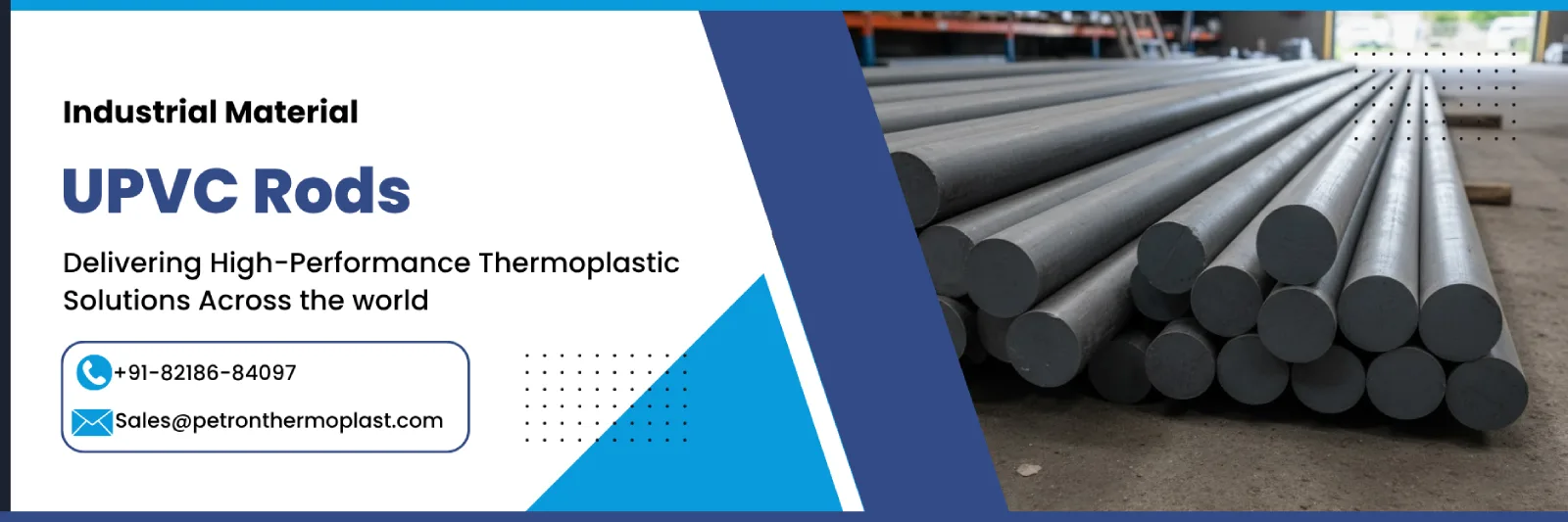
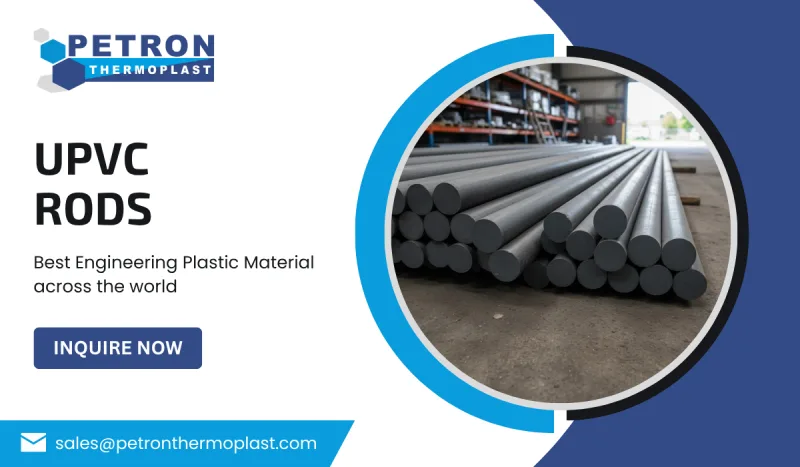
UPVC Rods
Petron Thermoplast is a UPVC rod manufacturer known for delivering high-quality and precision-engineered rods to meet the demands of various types of requirements in industries. Our Unplasticised Polyvinyl Chloride (UPVC) rods are manufactured using premium-grade materials and advanced production techniques, ensuring durability, dimensional accuracy, and excellent chemical resistance.
UPVC rods are lightweight yet incredibly they offer high tensile strength while being easy to machine and fabricate.
Their non-toxic and flame-resistant properties make them suitable for industrial machinery, fluid handling systems, and construction projects. Whether your application demands high mechanical strength, resistance to acids and alkalis, or long-term performance in harsh environments, our UPVC rods provide the ideal solution.
UPVC Rods Details
| Parameter / Property | Specification / Description |
| Material | Chlorinated Polyvinyl Chloride (CPVC) |
| Shape / Form | Solid round rod |
| Diameter Range | Typically 6 mm to 200 mm |
| Standard Length | Usually 1 m, 2 m, or 3 m (can vary) |
| Color | Off-white / Cream / Light grey |
| Maximum Service Temperature | 0 to 100°C |
| Density | Approximately 1.50 – 1.55 g/cm³ |
| Tensile Strength | Around 50 – 55 MPa (Max stress before stretching) |
| Flexural Strength | Approximately 90 – 100 MPa (Resistance to bending) |
| Hardness | Rockwell M 95 – 100 (Surface indentation resistance) |
| Impact Strength | High resistance to sudden shocks |
| Water Absorption | Very low (<0.04%) for dimensional stability |
| Thermal Conductivity | About 0.14 W/m·K |
| Thermal Expansion | High coefficient (expands with temperature increase) |
| Chemical Resistance | Excellent resistance to acids, alkalis, and salts |
| Machinability | Easy to cut, drill, and machine using standard tools |
| Standards | ASTM D1784 / ASTM D284 |
| Diameter (mm) | Diameter (inch) |
| 6 mm | 1/4″ |
| 8 mm | 5/16″ |
| 10 mm | 3/8″ |
| 12 mm | 1/2″ |
| 16 mm | 5/8″ |
| 20 mm | 3/4″ |
| 25 mm | 1″ |
| 30 mm | 1¼” |
| 40 mm | 1½” |
| 50 mm | 2″ |
| 63 mm | 2½” |
| 75 mm | 3″ |
| 90 mm | 3½” |
| 100 mm | 4″ |
| 110 mm | 4½” |
| 125 mm | 5″ |
| 140 mm | 5½” |
| 150 mm | 6″ |
| 200 mm | 8″ |
1. High Mechanical Strength
Upvc rod are rigid and hard materials
These are good compressive and tensile strengths
This is suitable for load-bearing and structural applications.
2. Excellent Chemical Resistance
The resistant to most acids, alkalis, salts, and chemicals
UPVc rods do not rust, corrode, or react with water.
Ideal for chemical and industrial environments
3. Good Electrical Insulation
High electrical resistivity
Low electric loss
These are commonly used in electrical and electronic components.
4. Lightweight
Upvc rods are much lighter than metal rods.
Upvc rods are easy to handle, transport, and install
Reduces overall structural weight
5. Weather & UV Resistant
These are suitable for indoor and outdoor use.
Resistant to moisture, humidity, and sunlight
Maintains shape and properties over time
6. Low Water Absorption
Does not swell or degrade in wet conditions
Suitable for damp or submerged environments
7. Fire Retardant
Self-extinguishing material
Does not support flame propagation
Higher safety compared to many plastics
8. Easy to Machine & Fabricate
These can be cut, drilled, turned, milled, or threaded.
The Good dimensional stability during machining
These can be solvent-cemented or welded.
9. Smooth Surface Finish
Low-friction surface
Hygienic and easy to clean
Suitable for food-contact grades (if specified)
10. Long Service Life & Low Maintenance
Resistant to wear, corrosion, and aging
Minimal maintenance required
Cost-effective over long-term use
11. Environment-Friendly (Compared to Metals)
Recyclable
No toxic leaching during normal use
Energy-efficient manufacturing compared to metals
| Nominal Size | Mean OD (mm) Min. | Mean OD (mm) Max. | Sch 40 Press. (Kg/cm2) | Sch 40 Wall (mm) Min/Max | Sch 80 Press. (Kg/cm2) | Sch 80 Wall (mm) Min/Max | Sch 120 Press. (Kg/cm2) | Sch 120 Wall (mm) Min/Max |
| 1/2″ | 21.2 | 21.4 | 21.2 | 2.8 / 3.3 | 29.3 | 3.7 / 4.2 | 35.0 | 4.3 / 4.9 |
| 3/4″ | 26.6 | 26.8 | 16.6 | 2.9 / 3.4 | 23.8 | 3.9 / 4.4 | 27.0 | 4.3 / 4.9 |
| 1″ | 33.3 | 33.5 | 15.5 | 3.4 / 3.9 | 21.7 | 4.6 / 5.1 | 25.0 | 5.1 / 5.7 |
| 1 1/4″ | 42.0 | 42.3 | 12.8 | 3.6 / 4.1 | 18.0 | 4.9 / 5.4 | 21.0 | 5.5 / 6.1 |
| 1 1/2″ | 48.1 | 48.4 | 11.4 | 3.7 / 4.2 | 16.2 | 5.1 / 5.7 | 19.0 | 5.7 / 6.4 |
| 2″ | 60.2 | 60.5 | 10.4 | 3.9 / 4.4 | 14.0 | 5.5 / 6.2 | 16.2 | 6.4 / 7.1 |
| 2 1/2″ | 72.8 | 73.2 | 9.7 | 5.2 / 5.8 | 15.0 | 7.0 / 7.9 | 16.2 | 7.6 / 8.5 |
| 3″ | 88.7 | 89.1 | 9.0 | 5.5 / 6.2 | 13.0 | 7.6 / 8.5 | 15.0 | 8.9 / 10.0 |
| 4″ | 114.1 | 114.5 | 7.6 | 6.0 / 6.7 | 11.0 | 8.6 / 9.6 | 15.0 | 11.1 / 12.4 |
| 5″ | 141.1 | 141.6 | 6.6 | 6.6 / 7.3 | 10.0 | 9.5 / 1.7* | 14.0 | 12.7 / 14.2 |
| 6″ | 168.0 | 168.6 | 6.2 | 7.1 / 8.0 | 9.7 | 11.0 / 12.3 | 13.0 | 14.3 / 16.0 |
| 8″ | 218.7 | 219.5 | 5.5 | 8.2 / 9.2 | 8.6 | 12.7 / 14.2 | 13.0 | 18.2 / 20.4 |
| 10″ | 282.7 | 273.4 | 4.9 | 9.3 / 10.4 | 8.0 | 15.1 / 16.9 | 13.0 | 21.4 / 24.0 |
| 12″ | 323.5 | 324.2 | 4.5 | 10.3 / 11.6 | 8.0 | 17.5 / 20.5 | 12.0 | 25.4 / 28.5 |
| Characteristics | Method | Unit | PVC Value |
| Density | DIN 53479 | $g/cm^3$ | 1.40 |
| Elongation | ISO R527 | % | 125 |
| Modulus to traction | ISO R527 | $Kg/cm^2$ | 30,000 |
| Resistance to traction | ISO R527 | $N/mm^2$ | 55 |
| Tensile strength | ISO R527 | $Kg/cm$ | 520 |
| ZOD impact strength at 23°C | ASTM D256 | $Kg/cm^2$ | 3.5 / 4.5 |
| Vicat softening point (5 kgs) | ISO R306 | °C | 76 |
| Thermal conductivity | ASTM C177 | $Kcal/mh$ °C | 0.15 |
| Coefficient of linear expansion | ASTM D696 | $m/m$ °C | $8 \times 10^{-5}$ |
| Water absorption | ISO R527 | $mg/cm^3$ | < 4 |
| Flammability | — | — | Self-extinguishing M1 |
- Base Material – Polyvinyl Chloride (PVC) Resin
- UPVc rod is mainly used as a raw material.
- These are produced by the polymerizing vinyl chloride monomer (VCM)
- Stabilizers
- The UPVc rod is very suitable for calcium–Zinc stabilizers also in an eco-friendly way.
- Upvc Rod lead-based stabilizers (older / restricted in many regions)
- Prevent degradation from heat and UV.
- Lubricants
- UPVc rod has internal lubricants which reduce friction within the melt.
- Also, External lubricants (reduce friction with machinery)
- Fillers (Optional)
- In UPVc rod, calcium carbonate (CaCO₃), which is the most common
- Also improves surface finish.
- Impact Modifiers (Optional)
- Acrylic-based modifiers
- CPE (chlorinated polyethylene)
- UV Absorbers / Protectants (Optional)
- Titanium dioxide (TiO₂)
- UV stabilizing additives
- Pigments (Optional)
- Titanium dioxide for white
User Manual for UPVC Rods
UPVC rods and fittings are easy to install and require minimal maintenance. UPVC is also an environmentally friendly material that can be recycled. This makes UPVC an excellent choice for sustainable projects.
To install UPVC rods, you will need a hacksaw, measuring tape, solvent cement, and rod cutters.
First, measure the length of the rods you need and mark it with a marker. Then, use a hacksaw/rods cutter to cut the rods to size.
Next, apply solvent cement to the ends of the rods and fit them together using UPVC couplings or elbow joints.
Make sure you apply pressure to ensure a tight seal. For higher diameter rods, primer should be applied before using solvent cement.
Finally, allow the solvent cement joint to set for at least 24 hours before using the rods.
To maintain UPVC rods and fittings, simply clean them with soap and water. You can also use a stiff brush to remove any buildup.
Their long-term durability and performance make them a valuable investment for Indian homeowners. UPVC rods combine durability, energy efficiency, security, and modern aesthetics—making them an ideal choice for Indian homes. Whether you are building a new house or upgrading an existing one, installing UPVC rods ensures long-term comfort, safety, and savings. With their ability to withstand Indian climate conditions, resist wear and tear, and enhance home interiors, UPVC rods are a smart investment for a modern and sustainable lifestyle.
- Pre-Installation Preparation:
Inspect the uPVC rod for cracks, warping, or surface defects.
- Verify diameter, length, and tolerance as per design.
- Clean the rod surface to remove dust or grease.
- Ensure ambient temperature is above 5 °C (uPVC becomes brittle at low temperatures)
- Cutting & Machining
- Cut using a fine-tooth saw or a power saw.
- Use slow speeds to avoid heat buildup.
- Deburr edges with sandpaper or a chamfering tool.
- Drilling should be done with sharp drill bits at low speed.
- Installation Methods
Depending on the application:
- Mechanical Fixing
- Insert the rod into the brackets, clamps, or housings.
- Avoid excessive tightening (uPVC is rigid, not ductile)
- Use washers or sleeves to distribute the load
- Adhesive Bonding
- Clean surfaces with solvent cleaner
- Use PVC solvent cement or epoxy.
- Allow proper curing time before loading.
- Press Fit / Interference Fit
- Ensure correct tolerance
- Apply a light lubricant
- Avoid hammering directly (use a rubber mallet if needed)
- Alignment & Support
- Ensure the rod is straight and well-supported
- Avoid point loading
- Provide expansion gaps for thermal expansion.
- Regular Cleaning
- Upvc rod is cleaned periodically to remove dust, grease, or chemical residue.
- Use mild soap or detergent to clean the water.
- Wipe with a soft cloth or sponge.
- Inspection
- Daily check for cracks, deformation, discoloration, or surface damage
- Inspect joints, supports, and fasteners if installed in assemblies.
- In industrial use, to look for signs of chemical attack
- Mechanical Care
- Upvc rod to ensure rods are not under excessive load or bending stress
- Avoid sharp impacts to UPVC, which is rigid, not flexible.
- Use proper supports to prevent sagging in long lengths.
- Environmental Protection
- For outdoor use, confirm the rod is UV-stabilized
- Avoid prolonged exposure to temperatures above 60°C
- Keep away from direct flame or high heat sources
- Chemical Exposure Control
- UPVc rod is verifying the compatibility for use with chemicals.
- Rinse rods after contact with aggressive chemicals.
- Do not expose to strong solvents or chlorinated hydrocarbons unless rated.
- Lubrication (If in Moving Parts)
- UPVc rods are generally not required.
- If needed, use silicone-based lubricants only.
- Avoid petroleum-based oils and greases
- Storage & Handling
- Store horizontally on flat supports.
- Keep in a shaded, dry area.
- Avoid stacking heavy loads on top.
- Handle carefully to prevent chipping at the edges.
Customization means modifying the UPVC rod to meet the specific design.
- Dimensional Customization
- Diameter: UPVC rods are manufactured from small (≈10 mm) to large (≈100 mm or more)scale.
- Length: Cut-to-size (standard: 1–3 m; custom lengths possible)standard form.
- Tolerance: Upvc rod has a tight tolerance for precision application
- Machining Customization
- Cutting: Upvc rod has a fine-tooth saw, due to CNC cutting
- Drilling: These are the low-speed drilling with sharp bits
- Turning: Lathe machining for bushes, rollers, and spacers
- Threading: External or internal threads using taps/dies
- Shape & Surface Customization
- Upvc rod has a chamfered and rounded edge.
- Grooving and slotting
- Polished or matte finish
- Upvc rods had a knurled or textured surface (limited)
- Material Customization
- UV-stabilized UPVC rods for outdoor use
- Impact-modified UPVC for higher toughness
- Color customization is also used in (grey, white, black)
| Process Stage | Description | Key Considerations |
| Raw Material Preparation | Drying uPVC resin + additives | Moisture < 0.2% to prevent defects |
| Injection Molding | Molten uPVC injected into molds | Temperature 180–210°C, mold pressure controlled |
| Extrusion | For spigot parts or large pipes | Continuous extrusion line with cooling |
| Cooling & Demolding | Solidification of the fitting | Avoid warping, maintain dimensional accuracy |
| Machining / Trimming | Remove flash, smooth edges | Chamfered socket ends for easy insertion |
| Socket Formation | Create proper depth & diameter | Tolerances per ASTM / ISO / DIN standards |
| Threading (if required) | Cut BSP/NPT threads | Ensure a leak-proof seal with PTFE |
| Rubber Ring Insertion | For push-fit / drainage | Check gasket elasticity & seating |
Raw Material Testing
- UPVC rod has a resin K-value check
- The moisture content test also appears
- Visual inspection for contamination
- Additive proportion of verification
Mechanical Testing
- Tensile Test
- Measurement of tensile strength and elongation
- Standard: ASTM D638 / ISO 527
- Acceptable tensile strength: 45–55 MPa
- Flexural Test
- Upvc rod is measuring the bending strength.
- Standard: ASTM D790
- Compression Test
- Determines the load-bearing ability
- Standard: ASTM D695
- Impact Test
- Izod or Charpy of the impact test
- Standard: ASTM D256
- Ensuring resistance to sudden shock
Thermal Testing
- Vicat softening the temperature (ASTM D1525)
- UPVc rod has a heat deflection temperature (HDT) (ASTM D648)
- Ensuring the performance under heat exposure
Electrical Testing
- Upvc rod has a resistivity test of volume.
- Dielectric strength test
- Used for insulation applications
Chemical Resistance Testing
- Exposure to acids, alkalis, oils, and gases
- Weight change and damage to the surface are monitored
Petron Thermoplast stands for innovation and setting new trends in the piping chemical industry. Bringing newer piping technologies and innovation is continuous, existing as well as new products have been the focal point at Petron Thermoplast. This special emphasis helps the brand to set a higher standard and lead by example.
At Petron Thermoplast, our professional team will work with you every step of the way to ensure that our UPVC Rods are a perfect fit for your application. When you need a customized UPVC rod at a competitive price with a fast turnaround, turn to Petron Thermoplast. Being the best UPVC Rod Manufacturers and suppliers, we provide consistent, long-lasting rods at affordable prices.
According to the market overview, in recent years, UPVC rods have become an essential material in industrial rods and construction applications. Their durability, resistance to chemicals, and ability to handle the varying temperatures make them ideal for a wide range of applications.
The market for UPVC rods is globally expected to grow significantly due to its rising demand in residential, commercial, chemical, and industrial sectors.
- Increased Construction Activities: Rapid urbanization and infrastructure development are creating a growing demand for UPVC rod in the residential and commercial industries.
- Industrial Growth: Industrial sectors such as chemical processing and oil and gas rely on the chemical resistance and strength of UPVC rod.
- Sustainability: The push toward eco-friendly construction materials has led to an increased interest in UPVC rods, which are more sustainable compared to traditional materials like metal
Advantages of UPVC Rods
Non-Toxic
UPVC rods are made from PVC resin, which is a non-toxic material. This makes UPVC an excellent choice for potable water applications. Since UPVC is non-toxic, it will not leach chemicals into the water supply. UPVC rods are also FDA-approved for use in food and beverage applications. This makes UPVC an excellent choice for rods in restaurants, hospitals, and other food service applications. UPVC rods behave neutrally irrespective of the nature of their carrier fluid/water, and since they are completely odourless and tasteless, which makes them the safest bet for drinking water transportation. What’s more important is that UPVC rods are 100% lead-free, which means they are safe for your family.
Durable
UPVC rods are extremely durable and can last up to 100 years with proper maintenance, and assuming rod lines are installed as per the engineer’s design and installation is done by adhering to the standard rod installation and jointing procedures. This makes UPVC an excellent choice for long-term projects. UPVC is also resistant to corrosion, chemical damage, and weathering. This means that UPVC rods will not rust, rot, or degrade over time.
Easy to Install
UPVC rods are easy to install because they are lightweight and can be cut to fit any application. UPVC rods are also easy to join together using solvent cement or threaded fittings. This makes UPVC an excellent choice for do-it-yourself projects.
Low Maintenance
UPVC rods require minimal maintenance and are easy to clean. This makes UPVC an excellent choice in hard-to-reach places. UPVC rods are also resistant to scale build-up, so they will not need to be descaled like other types of materials
Cost-Effective
UPVC rods are very cost-effective because they are easy to install and require minimal maintenance. UPVC is also an environmentally friendly material that can be recycled. This makes UPVC an excellent choice for sustainable projects.
Leak Resistant
UPVC rods are extremely leak-resistant because they are made from a single piece of material. This makes UPVC an excellent choice for high-pressure applications. UPVC rods are also less likely to burst in freezing temperatures.
Smooth Flow
UPVC rods have a smooth inner surface that reduces friction and increases flow. This makes UPVC an excellent choice for applications that require high water volume.
Acid Resistance
UPVC rods are resistant to acid damage, making them an excellent choice for chemical processing applications. UPVC is also resistant to alkalis, salts, and other corrosive materials.
Temperature Resistance
UPVC rods can withstand temperatures up to 60 degrees Celsius without deforming. This makes UPVC an excellent choice for hot water applications. UPVC is also resistant to cold temperatures and will not burst in cold weather.
Why Choose Petron Thermoplast?
Petron Thermplast has an extremely wide collection of UPVC Rods. With our experience in the field of industrial manufacturing, we guarantee the best quality products. Petron Thermoplast has a professional team; we are all experienced and highly skilled in Manufacturing. For our safety is a top priority to have modern machinery and facilities for safety purposes. So it’s well worth the investment in safety. Petron Thermoplast has a large scale of UPVC rods; we are a leading name in the industrial sector, and we believe in hard work and innovation to pursue excellence.
Conclusion
UPVC rods are an excellent choice for projects because they are easy to install and require minimal maintenance. UPVC is also an environmentally friendly material that can be recycled and is time-tested and trusted for many decades. This makes UPVC an excellent choice for sustainable projects. Wide range in upvc rods with different pressure classes and variants to suit different requirements in agriculture, irrigation, water lines, and sanitation.
At Petron Thermoplast, we deliver top-grade UPVC rods that are engineered for industrial efficiency, safety, and longevity. With unbeatable chemical resistance, mechanical strength, and thermal stability, our UPVC rods are the perfect choice for demanding environments.
Frequently Asked Questions
A UPVC rod is a solid cylindrical bar made from Unplasticized Polyvinyl Chloride (UPVC), a rigid and durable plastic material. It is widely used in industrial and engineering applications because of its high strength, excellent chemical resistance, corrosion resistance, and low maintenance requirements.
UPVC rods are extremely lightweight compared to metal and concrete. But don’t let the lightweight fool you; these rods are quite strong and can withstand pressure. These rods prevent damage from harmful UV rays, making them suitable for outdoor usage as well.
There are three main types of UPVC rods: solid wall, cellular core, and multi-layer.
- Solid Wall UPVC Rod
- Cellular Core UPVC Rods
- Multi-Layer UPVC Rods
The main difference between PVC and UPVC is that PVC is not as strong as UPVC. PVC is also not as durable as UPVC.
Yes! UPVC rods are lead-free, non-toxic, and NSF-certified, making them safe for potable water supply systems.
Yes! Petron Thermoplast specialises in bulk supply and custom fabrication of UPVC rod fittings and industrial plastic components to meet your specific needs.
Check the rods’ colour and markings. CPVC rods are usually cream or light yellow and are rated for hot and cold water. uPVC rods are typically white or grey and used only for cold water. The product label or manufacturer’s stamp will also specify whether it is CPVC or uPVC.
Yes, uPVC is considered better than regular because it does not contain plasticisers, making it more rigid, durable and chemical-resistant. uPVC is ideal for cold water systems, drainage and electrical conduits, while PVC is softer and typically used in flexible applications like garden hoses or cable insulation.
Yes, both UPVC rods are eco-friendly and recyclable, offering long-lasting, sustainable solutions.
Store CPVC rods in a cool, dry place, away from direct sunlight and excessive heat. Keep them supported evenly to avoid bending.
When properly designed and used within recommended limits, UPVC rods offer high dimensional stability and resist cracking, creep, and deformation.