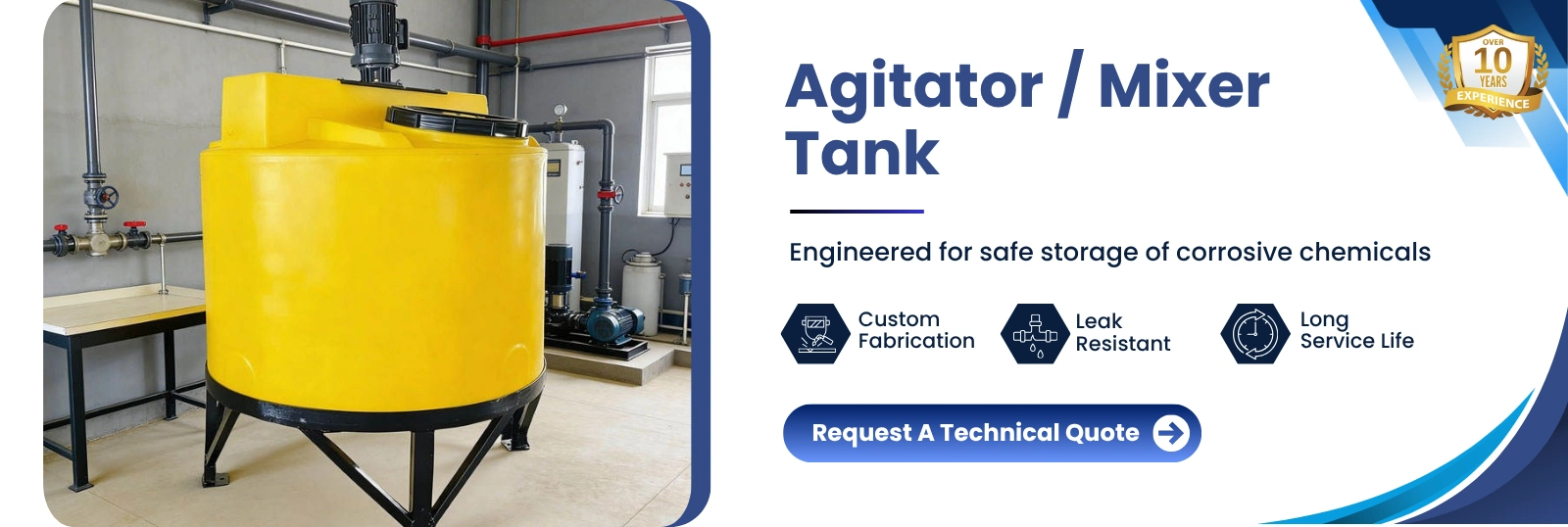
Agitator / Mixer Tank
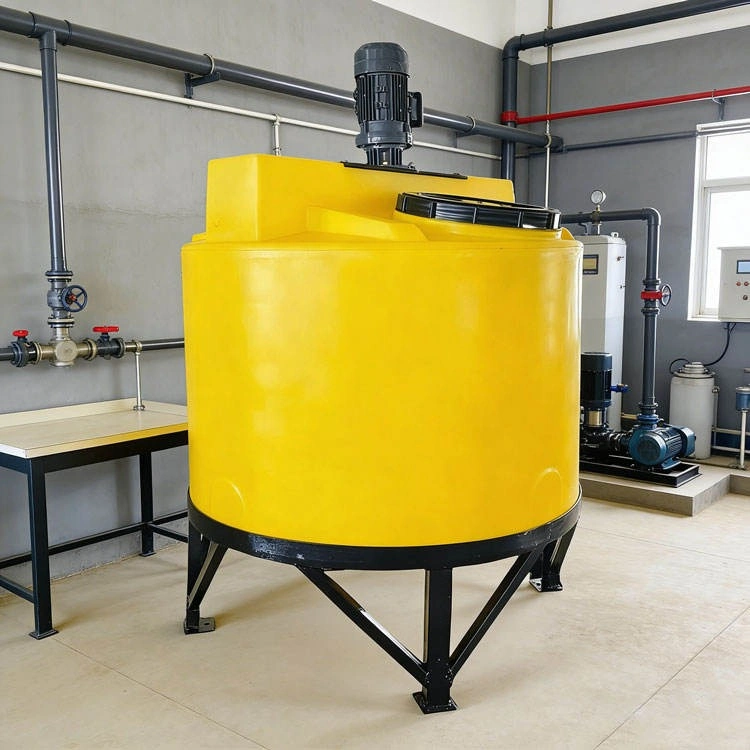
An Agitator / Mixer Tank is an industrial piece of equipment. Agitator / Mixer Tank are combining to a vessel (tank) with a mechanical device (agitator) to mix, blend, homogenize, suspend liquids, gases, and powders. It uses a motor-driven system to rotate the shaft with impellers (propellers, turbines, or paddles) to create the fluid motion and enhance the chemical reactions and temperature to control industries.
Agitator / Mixer Tanks are widely used in industries such as chemicals, pharmaceuticals, treatment, and petrochemicals. To ensure the uniform consistency and efficient processing of the materials, agitator / Mixer Tanks are manufactured in various materials like HDPE, PPH, FRP, and PVDF. Agitator / Mixer Tank depends on the application and chemical compatibility requirements. Petron Thermoplast offer durable and corrosion-resistant material of Agitator Tanks are suitable for handling aggressive chemicals and demanding industrial conditions


Material of Construction
HDPE, PPH, FRP, PVDF, SS 304, SS 316

Temperature Resistance
Safely handle moderate operating temperatures.

Corrosion-Free Construction
No rusting when exposed to chemicals & moisture.

Long Service Life
Excellent durability and can operate for many years

ASTM, ISO, DIN, GMP, and IS Certified
Manufactured to international quality standards
-10°C to 150°C
Operating Temperature
50 L – 100K L
Capacity (Customizable)
10–25 years
Service Life
ASTM, ISO, DIN, GMP, IS
Certified quality standards
5 mm to 50 mm
Wall Thickness

Variable Speed Control
Adjust the speed of drives to allow for optimization of mixing intensity, ensuring consistent product quality, reducing energy waste, and allowing for gentle handling and high-shear, intense mixing.

Temperature Resistance
Often designed with jackets for heating or cooling, allowing for the precise regulation of the product's temperature during the processing (ideal for blending, reaction, or melting).

High-Efficiency Motors
These are to provide robust, reliable power for demanding applications. They often feature explosion-proof configurations (e.g., ATEX, UL, CSA) for hazardous environments.

Durable, Hygienic Construction
Commonly constructed from high-grade, corrosion-resistant materials. To withstand harsh chemical environments and meet strict hygiene standards for pharmaceutical and cosmetic applications.
Technical Details
| Parameter | Details |
| Product Name | Agitator / Mixer Tank |
| Tank Type | Mixing Tank / Agitation Tank |
| Tank Orientation | Vertical / Horizontal |
| Material of Construction | HDPE, PPH, FRP, PVDF, SS 304, SS 316 |
| Capacity Range | 50 Liters to 100,000 Liters |
| Shape | Cylindrical / Conical Bottom |
| Mixing Function | Blending, Dissolving, Homogenizing, Suspension |
| Agitator Type | Paddle, Propeller, Turbine, Anchor, High-Speed Mixer |
| Agitator Speed | 20 RPM to 3000 RPM |
| Motor Power | 0.5 HP to 50 HP |
| Operating Temperature | -10°C to 150°C |
| Pressure Rating | Atmospheric to 5 Bar |
| Density Handling Capacity | Up to 2.0 SG |
| Wall Thickness | 5 mm to 50 mm |
| Diameter Range | 500 mm to 5000 mm |
| Height Range | 1000 mm to 12000 mm |
| Mounting Type | Leg Mounted / Skid Mounted / Saddle Mounted |
| Surface Finish | Smooth Internal & External Finish |
| Mixing Efficiency | Uniform and Continuous Mixing |
| Chemical Resistance | Excellent Resistance to Corrosive Chemicals |
| Insulation Option | Available |
| Heating/Cooling Jacket | Optional |
| Inlet/Outlet Connections | Flanged / Threaded / Socket Type |
| Accessories | Manhole, Baffles, Level Indicator, Drain Valve, Sampling Port |
| Seal Type | Mechanical Seal / Gland Packing |
| Power Supply | Single Phase / Three Phase |
| Automation | Optional PLC Control System |
| Fabrication Method | Butt Welding / Extrusion Welding / Fabrication |
| UV Stabilization | Available for Outdoor Use |
| Maintenance Requirement | Low Maintenance |
| Testing | Hydro Test, Leak Test, Weld Inspection, Dimensional Check |
| Compliance Standards | ASTM, ISO, DIN, GMP, and IS Standards |
| Service Life | 10–25 Years |
| Customization | Available as per Industrial Requirement |
Customizable Agitator Mechanisms: Different impellers can be used to depending on the needed shear and flow, such as the propellers for rapid and low-viscosity of circulation and turbines/paddles for the viscous blending and high-shear dispersion.
Variable Speed Control: Adjust the speed of drives to allow for optimization of mixing intensity, ensuring consistent product quality, reducing energy waste, and allowing for gentle handling and high-shear, intense mixing.
Durable, Hygienic Construction: Commonly constructed from high-grade, corrosion-resistant materials. To withstand harsh chemical environments and meet strict hygiene standards for pharmaceutical and cosmetic applications.
Temperature Control System: Often designed with jackets for heating or cooling, allowing for the precise regulation of the product’s temperature during the processing (ideal for blending, reaction, or melting).
Multiple Mounting Options: Agitators can be mounted on the top, side, or bottom of the tank, with flexible mounting to brackets, ensuring optimal agitation across the entire volume. Including the top-entry or side-entry for different tank sizes.
Ease of Maintenance and Cleaning: Features can be often to include the polished, smooth interior surfaces and the Clean-in-Place (CIP) systems, which is simplify the cleaning and minimize the downtime for hygiene-sensitive industries.
High-Efficiency Motors: These are to provide robust, reliable power for demanding applications. They often feature explosion-proof configurations (e.g., ATEX, UL, CSA) for hazardous environments.
Chemical compatibility is a critical factor when selecting an agitator or mixer tank. It refers to the ability of the tank, agitator, impeller, shaft, and associated components to withstand chemical exposure without corrosion, degradation, swelling, cracking, or contamination of the process fluid.
Proper chemical compatibility ensures:
- Safe operation
- Long equipment life
- Consistent product quality
- Reduced maintenance costs
- Improved process reliability
Why Chemical Compatibility is Important
An incompatible tank material can result in:
- Chemical corrosion
- Tank leakage
- Agitator damage
- Product contamination
- Structural failure
- Increased downtime
Therefore, both the tank material and agitator components must be compatible with the chemicals being mixed.
Common Materials Used for Agitator / Mixer Tanks
| Material | Characteristics |
| HDPE | Good resistance to many chemicals and water treatment solutions |
| Polypropylene (PP) | Excellent resistance to acids and alkalis |
| FRP | High structural strength and corrosion resistance |
| PVDF | Superior resistance to highly aggressive chemicals |
| Stainless Steel (SS 304/316) | Suitable for hygienic and selected chemical applications |
Chemical Compatibility Chart
| Chemical | HDPE | PP | FRP | PVDF | SS 316 |
| Hydrochloric Acid (HCl) | Good | Excellent | Excellent | Excellent | Poor |
| Sulfuric Acid (H₂SO₄) | Good* | Excellent | Excellent | Excellent | Good* |
| Nitric Acid (HNO₃) | Moderate | Good | Good | Excellent | Good |
| Phosphoric Acid | Excellent | Excellent | Excellent | Excellent | Good |
| Sodium Hydroxide (NaOH) | Excellent | Excellent | Good | Excellent | Moderate |
| Potassium Hydroxide (KOH) | Excellent | Excellent | Good | Excellent | Moderate |
| Sodium Hypochlorite | Excellent | Good | Good | Excellent | Poor |
| Ferric Chloride | Good | Excellent | Excellent | Excellent | Poor |
| Alum Solution | Excellent | Excellent | Excellent | Excellent | Good |
| Process Water | Excellent | Excellent | Excellent | Excellent | Excellent |
* Compatibility depends on chemical concentration and operating temperature.
Testing and quality assurance are critical stages in the manufacturing of an agitator or mixer tank. Comprehensive inspections and testing procedures to ensure the tank delivers reliable mixing performance, structural integrity, chemical resistance, and long-term operational safety.
1. Raw Material Inspection
The quality process begins with verification of all incoming materials.
Inspection Parameters
- Material grade verification
- Thickness measurement
- Surface quality inspection
- Chemical resistance suitability
- Material Test Certificate (MTC) verification
Materials Checked
- PP (Polypropylene)
- HDPE
- FRP
- PVDF lining materials
- Stainless Steel
- Agitator components
2. Dimensional Inspection
All fabricated components are measured against approved drawings.
Parameters Verified
| Inspection Item | Purpose |
| Tank Diameter/Length | Confirm design dimensions |
| Tank Height | Verify capacity |
| Wall Thickness | Ensure structural strength |
| Nozzle Locations | Verify piping alignment |
| Agitator Position | Ensure proper mixing performance |
3. Visual Inspection
A detailed visual inspection is performed throughout fabrication.
Checks Include
- Surface defects
- Cracks
- Scratches
- Material damage
- Fabrication irregularities
- Weld appearance
This helps identify defects before final assembly.
4. Welding Inspection
The integrity of welded joints is critical to tank performance.
Thermoplastic Tanks
Inspection of:
- Butt fusion welds
- Extrusion welds
- Hot gas welds
Stainless Steel Tanks
Inspection of:
- TIG welds
- MIG welds
- Weld penetration quality
- Leak-proof joints
- Structural reliability
- Long service life
5. Hydrostatic Testing
Hydrostatic testing is conducted by filling the tank with water and maintaining it for a specified period.
Purpose
- Detect leaks
- Verify weld integrity
- Confirm structural stability
- Check deformation resistance
This is one of the most important quality tests.
6. Agitator Trial Run Test
The agitator assembly is tested under operating conditions.
Parameters Checked
- Motor operation
- Shaft alignment
- Impeller rotation
- Vibration levels
- Noise levels
- Gearbox performance
This ensures a smooth and reliable mixing operation.
Industries We Serve

Chemical Processing Industries
Used for mixing chemicals, acids, solvents, and reactive solutions during manufacturing processes.

Water & Wastewater Treatment Plants
Helps in chemical blending, flocculation, pH adjustment, and treatment solution preparation.
Electroplating & Surface Treatment Plants
Supports chemical agitation and solution consistency in plating and treatment tanks.
Oil, Lubricant & Petrochemical Industries
Used for blending oils, lubricants, additives, and industrial fluids.

Industrial Manufacturing Processes
Suitable for slurry preparation, suspension mixing, and material homogenization in various industries.
Manufacturing Process of Agitator / Mixer Tank
The manufacturing process of an agitator or mixer tank to involves detailed engineering, material selection, tank fabrication, agitator assembly, quality testing, and final inspection. These tanks are designed to provide the efficient mixing, blending, suspension, dissolution, and reaction processes in various industrial applications.
How to Select the Right Agitator / Mixer Tank
Selecting the right agitator or mixer tank is essential for achieving the efficient mixing, product consistency, process reliability, and long equipment life. Agitator tanks are widely used in chemical processing, water treatment, pharmaceuticals, electroplating, and various types of industrial manufacturing applications.

Custom Product Manufacturing Available
If you are searching for customized product designs that meet your requirements, don’t worry. Petron Thermoplast also offers custom product manufacturing services to meet the unique needs of various industries. Work with our expert engineers to create custom designs suited for your application.
Why Choose Petron Thermoplast?
Petron Thermoplast deals in Agitator / Mixer Tanks, which are widely used in industrial processes. Petron Thermoplast provides the efficient and uniform mixing of liquids, chemicals, powders, and suspensions. Mixer Tanks help to maintain consistent product quality, improve reaction efficiency, and prevent the material from settling and separating during processing. Petron Thermoplast offers durable and corrosion-resistant materials. Agitator Tanks are suitable for handling aggressive chemicals and demanding industrial conditions. Petron Thermoplast offers customizable agitator designs, motor capacities, and mixing arrangements that allow them to meet specific processing requirements across different industries. Agitator / Mixer tanks are easy to install, energy-efficient, and compatible with automated control systems.