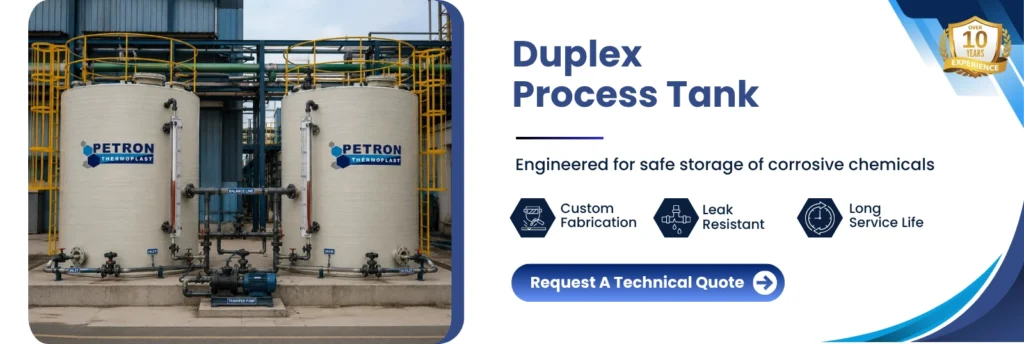
FRP Backed Thermoplastic Tank
An FRP Backed Thermoplastic Tank is a dual layer industrial storage or process tank. Made by combining a thermoplastic inner liner with the external FRP (Fiber Reinforced Plastic) structural backing. The thermoplastic layer provides excellent chemical and corrosion resistance while the FRP of the outer layer offers high mechanical strength, durability, and structural support.
FRP Backed Thermoplastic Tanks are specially designed for storing and handling. The aggressive chemicals, acids, alkalis, and corrosive liquids in demanding industrial environments. Common of the thermoplastic materials to used for the inner lining include HDPE, PP, PVC, PVDF, and CPVC, depending on the application and chemical compatibility. FRP backed thermoplastic tanks are widely used in the chemical processing, electroplating, wastewater treatment, and other industries that require long-lasting corrosion-resistant storage solutions. Petron Thermoplast provides an excellent combination of the chemical resistance, mechanical strength, and long-term durability.


Excellent Chemical Resistance
Excellent Resistance to Acids, Alkalis & Corrosive Chemicals

Temperature Resistance
Up to 120°C (Depending on Thermoplastic Material)

Corrosion-Free Construction
Excellent Internal and External Corrosion Resistance

Long Service Life
Excellent durability and can operate for many years

ASTM, DVS, IS, ASME Certified
Manufactured to international quality standards
Up to 120°C
Operating Temperature
100 L – 100K L
Capacity (Customizable)
ASTM, DVS, IS, ASME
Certified quality standards
5 mm to 50 mm
Wall Thickness

Excellent of chemical and corrosion resistance.

Excellent temperature of the resistance, depending on the liner material

Long operational of service life

UV-resistant of outer surface to available for the outdoor installation
Technical Details
| Parameter | Details |
| Product Type | FRP Backed Thermoplastic Storage / Process Tank |
| Construction Type | Dual-Layer Construction |
| Inner Lining Material | HDPE, PP, PVC, CPVC, PVDF |
| Outer Reinforcement | FRP (Fiber Reinforced Plastic) |
| Tank Shape | Vertical, Horizontal, Cylindrical, Rectangular |
| Manufacturing Process | Thermoplastic Fabrication with FRP Lamination |
| Capacity Range | 100 Liters to 100 KL or Customized |
| Thickness Range | 5 mm to 50 mm (Depending on Size & Application) |
| Operating Temperature | Up to 120°C (Depending on Thermoplastic Material) |
| Pressure Rating | Atmospheric to Low-Pressure Applications |
| Chemical Resistance | Excellent Resistance to Acids, Alkalis & Corrosive Chemicals |
| Structural Strength | High Mechanical Strength with FRP Reinforcement |
| UV Resistance | Available with UV Stabilized Outer Coating |
| Corrosion Protection | Excellent Internal and External Corrosion Resistance |
| Jointing Method | Butt Welding / Extrusion Welding |
| Surface Finish | Smooth Internal Finish for Easy Cleaning |
| Nozzle & Fittings | PP, HDPE, PVC, FRP, or SS Fittings |
| Accessories Available | Manhole, Ladder, Level Indicator, Vent, Drain Valve |
| Design Standards | ASTM, DVS, IS, ASME (As Required) |
| Installation Type | Ground Mounted / Skid Mounted |
| Leakage Protection | Leak-Proof Welded Construction |
| Maintenance Requirement | Low Maintenance |
| Service Life | Long Operational Life |
| Applications | Chemical Storage, Pickling, Electroplating, Effluent Treatment, Pharmaceuticals |
- Excellent of chemical and corrosion resistance.
- Dual-layer of the construction for the superior durability.
- Strong FRP outer layer to provide high mechanical strength.
- Thermoplastic inner lining to ensure leak-proof performance
- Suitable for storing aggressive acids, alkalis, and chemicals
- Lightweight compared to the conventional of metal tanks
- Long operational of service life
- High impact and abrasion resistance
- UV-resistant of outer surface to available for the outdoor installation
- Low maintenance and easy cleaning
- Excellent temperature of the resistance, depending on the liner material
- Customizable shapes, sizes, and capacities
JGFRP Backed Thermoplastic Tanks combine the superior chemical resistance of a thermoplastic liner with the structural strength of Fiber Reinforced Plastic (FRP). The thermoplastic inner layer acts as the primary corrosion barrier, while the FRP outer shell to provides the mechanical strength and durability. This dual-construction design make them to these tanks highly suitable for storing and processing a wide range of corrosive chemicals.
Chemical compatibility depends primarily on the type of thermoplastic liner used, the chemical concentration, and the operating temperature.
Common Thermoplastic Liners and Their Chemical Compatibility
1. Polypropylene (PP)
PP offers excellent resistance to many industrial chemicals.
Compatible Chemicals:
- Sulfuric Acid (moderate concentrations)
- Hydrochloric Acid
- Phosphoric Acid
- Sodium Hydroxide
- Potassium Hydroxide
- Salt Solutions
- Water Treatment Chemicals
- Chemical storage
- Dosing systems
- Wastewater treatment
2. Polypropylene Homopolymer (PPH)
PPH provides enhanced strength and higher temperature resistance compared to standard PP.
Compatible Chemicals:
- Alkalis
- Detergents
- Industrial process chemicals
- Pickling solutions
- Process tanks
- Scrubber systems
- Chemical storage tanks
3. High-Density Polyethylene (HDPE)
HDPE is widely used for general chemical storage applications.
Compatible Chemicals:
- Hydrochloric Acid
- Sulfuric Acid
- Sodium Hypochlorite
- Caustic Soda
- Water treatment plants
- Bulk chemical storage
4. Polyvinyl Chloride (PVC)
PVC is suitable for many corrosive chemical applications at moderate temperatures.
Compatible Chemicals:
- Hydrochloric Acid
- Sulfuric Acid
- Nitric Acid (limited concentrations)
- Salt solutions
- Water treatment chemicals
- Chemical process tanks
- Scrubber systems
5. Chlorinated Polyvinyl Chloride (CPVC)
CPVC provides improved temperature resistance compared to PVC.
Compatible Chemicals:
- Strong acids
- Alkalis
- Oxidizing chemicals
- Hot corrosive liquids
- High-temperature chemical storage
- Industrial processing systems
6. Polyvinylidene Fluoride (PVDF)
PVDF offers outstanding resistance to highly aggressive chemicals and elevated temperatures.
Compatible Chemicals:
- Concentrated Sulfuric Acid
- Hydrochloric Acid
- Nitric Acid
- Hydrogen Peroxide
- Sodium Hypochlorite
- Ultra-pure chemicals
- Semiconductor industry
- Pharmaceutical manufacturing
- Specialty chemical processing
Testing and quality assurance are vital in the manufacturing of FRP Backed Thermoplastic Tanks. These tanks are designed to store and process corrosive chemicals safely, making it essential to verify the integrity of both the thermoplastic liner and the FRP structural shell. A comprehensive quality control program ensures that the tank meets design specifications, industry standards, and operational requirements.
Importance of Quality Testing
Quality testing helps to:
- Ensure safe chemical storage
- Verify leak-proof performance
- Confirm structural integrity
- Detect manufacturing defects
- Extend service life
- Reduce maintenance costs
- Ensure compliance with project specifications
1. Raw Material Inspection
Quality control begins with the inspection of incoming materials.
Thermoplastic Material Checks
- Material grade verification
- Thickness measurement
- Surface quality inspection
- Manufacturer certification review
- Chemical compatibility confirmation
FRP Material Checks
- Fiberglass quality verification
- Resin type confirmation
- Catalyst and additive inspection
- Storage condition assessment
Only approved materials are used for fabrication.
2. Dimensional Inspection
Dimensional accuracy is verified throughout the manufacturing process.
Inspection Parameters
- Tank diameter
- Height and length
- Wall thickness
- Nozzle locations
- Manhole dimensions
- Reinforcement positioning
Accurate dimensions ensure proper installation and system integration.
3. Thermoplastic Weld Inspection
The thermoplastic liner serves as the primary corrosion barrier and requires careful inspection.
Visual Weld Inspection
Checks for:
- Uniform weld bead appearance
- Proper fusion
- Surface defects
- Cracks and pinholes
- Incomplete penetration
Weld Quality Verification
- Weld profile measurement
- Joint alignment verification
- Compliance with approved welding procedures
4. Spark Testing (Holiday Testing)
Spark testing is one of the most important tests for thermoplastic-lined tanks.
Purpose
- Detect pinholes
- Identify cracks
- Locate discontinuities in welds
- Verify liner integrity
A controlled electrical voltage is applied to reveal defects that may not be visible during visual inspection.
Benefits
- Non-destructive testing
- Rapid defect identification
- Enhanced leak prevention
5. FRP Lamination Inspection
The FRP shell is inspected to verify structural quality.
Inspection Items
- Laminate thickness
- Resin distribution
- Fiber reinforcement placement
- Air bubble detection
- Delamination checks
- Surface finish quality
Proper lamination ensures long-term mechanical strength.
6. Thickness Measurement
Thickness measurements are taken at multiple locations.
Areas Checked
- Thermoplastic liner
- FRP shell
- Reinforcement sections
- Nozzle regions
This ensures compliance with design requirements and structural calculations.
Industries We Serve

Chemical Manufacturing & Processing
The Storage and processing of the aggressive chemicals, including hydrofluoric, sulfuric, and nitric acids.

Metal Finishing & Plating
Used as the pickling tanks and plating to baths where the acidic or alkaline solutions are present.

Water & Wastewater Treatment
Storage of the treated water, demineralized water, and corrosive chemical wastewater.

Petrochemical and Refining
Containment of the corrosive petrochemicals and intermediate of chemicals. Industrial Process & Manufacturing Plants

Semiconductor industries
Ideal for high-purity chemical handling and ultra-clean process applications.

Acid & Alkali Storage Systems
Used for safe containment of highly aggressive acidic and alkaline liquids.

Power Plants & Industrial Utilities
Supports chemical storage and utility process systems in industrial facilities.
Manufacturing Process of FRP Backed Thermoplastic Tank
FRP Backed Thermoplastic Tanks are engineered storage and process vessels that combine a corrosion-resistant thermoplastic liner with a structurally strong Fiber Reinforced Plastic (FRP) outer shell. The thermoplastic layer provides the chemical resistance, while the FRP backing delivers to mechanical strength, rigidity, and durability. These tanks are widely used in chemical processing, water treatment, metal finishing, pharmaceuticals, and other industries to handling the corrosive fluids.
The manufacturing process to involves the precision fabrication, specialized welding techniques, FRP lamination, and rigorous quality to control and ensure the safe and reliable performance.
The manufacturing process begins with detailed engineering and design calculations.
Design Parameters:
- Tank capacity and dimensions(100 Liters to 100 KL or Customized)
- Chemical compatibility
- Operating temperature(Up to 120°C (Depending on Thermoplastic Material))
- Specific gravity of stored liquid
- Pressure and vacuum conditions
- Installation environment
- Nozzle and accessory requirements
- Structural reinforcement needs
The appropriate thermoplastic material is selected based on chemical compatibility and operating conditions.
Common Liner Materials:
- Polypropylene (PP)
- Polypropylene Homopolymer (PPH)
- High-Density Polyethylene (HDPE)
- Polyvinyl Chloride (PVC)
- Chlorinated Polyvinyl Chloride (CPVC)
- Polyvinylidene Fluoride (PVDF)
The liner acts as the primary corrosion barrier.
All incoming materials are inspected before fabrication.
Inspection Includes:
- Material grade verification
- Thickness measurement
- Surface quality checks
- Material certification review
- Resin and fiberglass inspection
Only approved materials proceed to production.
The inner thermoplastic tank is fabricated first.
Fabrication Steps:
- Sheet cutting according to drawings
- Edge preparation
- Sheet rolling and forming
- Bottom and top fabrication
- Assembly and alignment
The liner is manufactured to precise dimensions before FRP reinforcement is applied.
Specialized welding techniques are used to join thermoplastic components.
Welding Methods:
- Hot Gas Welding
- Extrusion Welding
- Butt Fusion Welding
- Socket Welding
Welding Objectives:
- Leak-proof joints
- Strong structural connections
- Uniform weld quality
All welds are visually inspected during fabrication.
Before applying the FRP backing, the thermoplastic surface is prepared to promote mechanical bonding.
Preparation Activities:
- Surface cleaning
- Roughening of designated areas
- Inspection of liner integrity
- Verification of dimensional accuracy
Proper preparation ensures effective attachment of the FRP shell.
The FRP structural shell is applied over the thermoplastic liner.
FRP Components:
- Glass fiber reinforcement
- Polyester resin
- Vinyl ester resin (for enhanced chemical resistance)
- Catalyst and additives
Lamination Methods:
- Hand Lay-Up
- Spray-Up
- Filament Winding (for specific applications)
Multiple layers are applied to achieve the required structural strength.
After lamination, the FRP structure is allowed to cure.
Purpose:
- Develop mechanical strength
- Achieve resin hardening
- Stabilize structural properties
Controlled curing conditions ensure optimal performance of the FRP shell.
How to Select the Right FRP Backed Thermoplastic Tank
The correct tank selection depends on several factors, including chemical compatibility, operating conditions, tank size, and installation requirements.
The first and most important consideration is the type of chemical the tank will contain.
Key Information Required:
- Chemical name
- Concentration
- Specific gravity
- Chemical mixture composition
- Corrosive characteristics
Different thermoplastic liners offer different levels of chemical resistance.
Common Thermoplastic Materials:
- PP (Polypropylene)
- PPH (Polypropylene Homopolymer)
- HDPE (High-Density Polyethylene)
- PVDF (Polyvinylidene Fluoride)
- PVC (Polyvinyl Chloride)
- CPVC (Chlorinated Polyvinyl Chloride
The thermoplastic liner must be compatible with the stored chemical.
- Strong acids: PP, PPH, PVDF
- Caustic solutions: HDPE, PP, PPH
- Oxidizing chemicals: PVDF, CPVC
- High-purity chemicals: PVDF
Always verify compatibility charts before finalizing material selection.
Calculate the required tank volume based on process needs.
Factors to Consider:
- Daily chemical consumption
- Storage duration
- Future expansion requirements
- Emergency reserve capacity
Typical capacities range from a few hundred liters to several hundred cubic meters.
Temperature significantly affects material performance.
Material Temperature Ranges:
| Material | Typical Operating Temperature |
| HDPE | Up to 60°C |
| PP | Up to 90°C |
| PPH | Up to 100°C |
| CPVC | Up to 95°C |
| PVDF | Up to 140°C |
Choose a liner material that can safely withstand the maximum operating temperature.
Tank design must account for the weight of the stored liquid.
- Higher specific gravity creates greater wall stress.
- Additional FRP reinforcement may be required.
- Structural design must support full load conditions.
Determine where the tank will be installed.
Indoor Installation:
- Lower UV exposure
- Reduced weather impact
Outdoor Installation:
- UV-resistant FRP outer layer required
- Wind load considerations
- Rain and temperature variation protection
The tank design should match the application.
Common Tank Configurations:
- Vertical cylindrical tanks
- Horizontal tanks
- Rectangular process tanks
- Conical-bottom tanks
- Open-top process tanks
The choice depends on available space and process requirements.
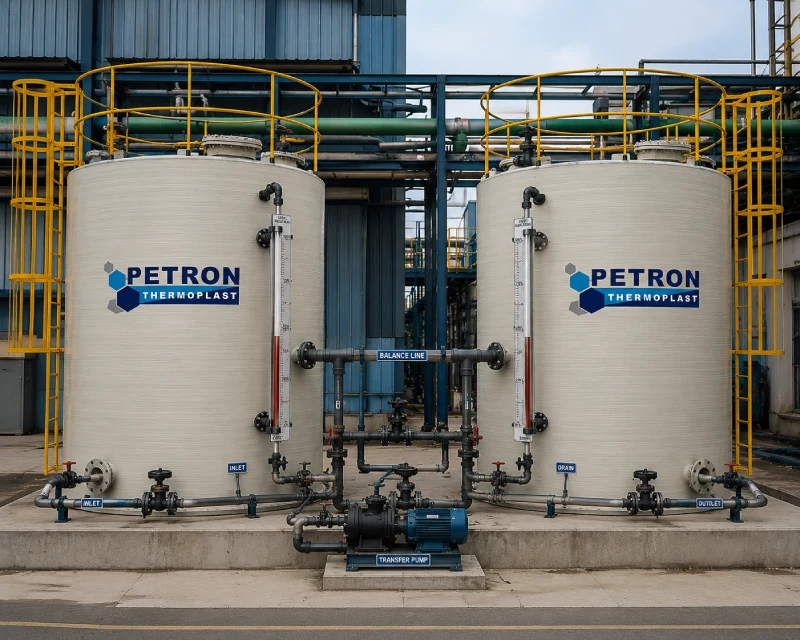

Custom Product Manufacturing Available
If you are searching for customized product designs that meet your requirements, don’t worry. Petron Thermoplast also offers custom product manufacturing services to meet the unique needs of various industries. Work with our expert engineers to create custom designs suited for your application.
Why Choose Petron Thermoplast?
Petron Thermoplast provides FRP Backed Thermoplastic Tanks, which are widely preferred in industrial applications. Petron Thermoplast provides an excellent combination of the chemical resistance, mechanical strength, and long-term durability. These tanks are specially designed to handle the highly corrosive chemicals and aggressive process conditions where are the ordinary metal or plastic tanks may fail.
Because of their leak proof construction, long service life and low maintenance needs. Excellent to operational reliability, FRP Backed Thermoplastic Tanks are an ideal solution for industries such as chemical processing, electroplating, pharmaceuticals, wastewater treatment and petrochemicals.
Frequently Asked Questions
An FRP Backed Thermoplastic Tank is a composite tank consisting of an inner thermoplastic liner and an outer FRP (Fiber Reinforced Plastic) structural shell. The thermoplastic liner provides chemical resistance, while the FRP backing offers mechanical strength and structural support.
These tanks are used for storing and processing corrosive chemicals because they combine the excellent chemical resistance of thermoplastics with the high strength and durability of FRP.
Common liner materials include:
- Polypropylene (PP)
- Polypropylene Homopolymer (PPH)
- High-Density Polyethylene (HDPE)
- Polyvinyl Chloride (PVC)
- Chlorinated Polyvinyl Chloride (CPVC)
- Polyvinylidene Fluoride (PVDF)
Key advantages include:
- Excellent chemical resistance
- High structural strength
- Long service life
- Corrosion-free operation
- Low maintenance requirements
- Leak-resistant construction
- Suitable for harsh industrial environments
These tanks can store:
- Sulfuric Acid
- Hydrochloric Acid
- Nitric Acid
- Phosphoric Acid
- Sodium Hydroxide
- Sodium Hypochlorite
- Hydrogen Peroxide
- Various industrial chemicals
Chemical compatibility should always be verified before use.
The liner material should be selected based on:
- Chemical type
- Chemical concentration
- Operating temperature
- Process conditions
- Service life requirements
A chemical compatibility assessment is recommended before final selection.
These tanks are widely used in:
- Chemical Manufacturing
- Water Treatment
- Pharmaceuticals
- Metal Finishing
- Power Plants
- Electronics Manufacturing
- Semiconductor Industries
FRP Backed Thermoplastic Tanks can be custom-fabricated in capacities ranging from a few hundred liters to several hundred cubic meters, depending on project requirements.
Yes. The FRP outer shell provides excellent weather and UV resistance, making these tanks suitable for outdoor installations.
Yes. Tanks can be customized with:
- Manholes
- Nozzles
- Level indicators
- Overflow systems
- Agitator mountings
Ladders and platforms
Instrument connections