





HDPE Chemical Storage Tank - Manufacturer | Supplier | Exporter
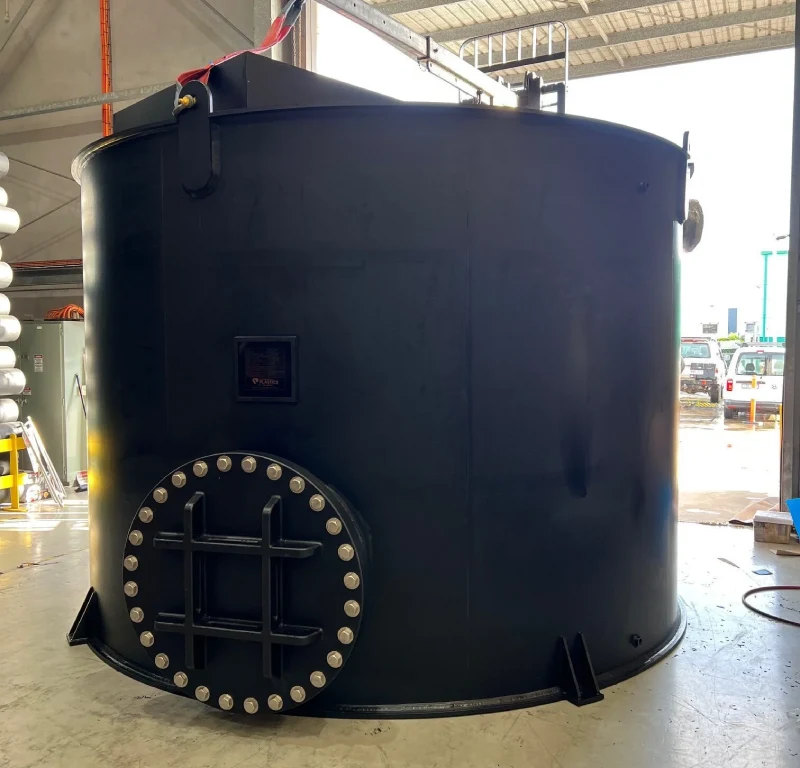
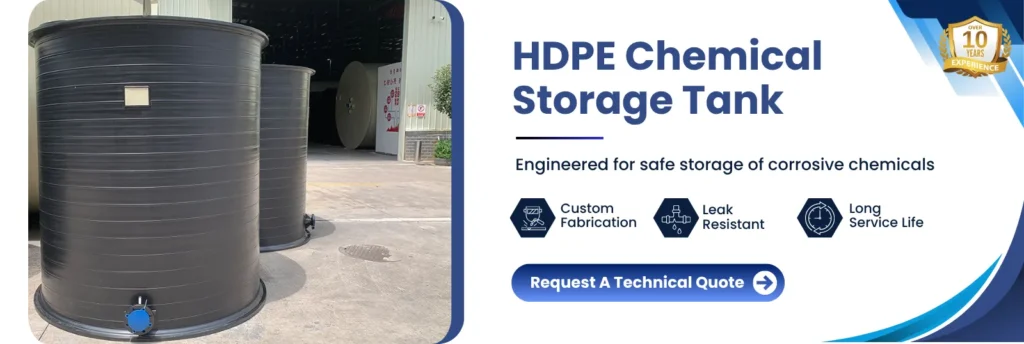
An HDPE chemical storage tank is a highly durable, corrosion-resistant container made from High-Density Polyethylene, designed to securely store acids, alkalis, and industrial liquids. These seamless, often rotationally molded or spiral-wound tanks are used in water treatment and chemical processing for safe containment of hazardous substances. HDPE is a strong, durable plastic known for its high strength-to-density ratio.
These tanks are specifically engineered to store a wide range of chemicals, including acids, bases, solvents, and other corrosive substances, safely and efficiently. HDPE chemical storage tanks are widely used across various industries, including chemicals, water treatment, and pharmaceuticals. Offering a 20-30 year lifespan, these maintenance-free, lightweight tanks are available in vertical, horizontal, or cone-bottom designs, with capacities ranging from 20 up to 50,000+ liters.
HDPE Chemical Storage Tank Details
| Property Category | Parameter | Specification / Details |
| Material Info | Material | HDPE (High-Density Polyethylene), UV stabilized, FDA/ASTM compliant |
| General Info | Capacity | 500 L – 1,00,000 L (customizable) |
| General Info | Shape | Vertical cylindrical, horizontal cylindrical, rectangular |
| Physical | Wall Thickness | 5 mm – 25 mm (depending on capacity and chemical) |
| Physical | Color | Natural black, blue, white, or custom (UV-stabilized) |
| Thermal | Temperature Range | Operating: -40°C to +60°C; Short-term: up to 80°C |
| Pressure | Pressure Rating | Usually atmospheric (typically non-pressurized, ≤1 bar) |
| Mechanical | Fittings / Nozzles | 1″ – 6″ (or custom); Material: HDPE / PP / PVC |
| Mechanical | Lid / Cover | HDPE dome or flat lid with gasket; Optional vented/lockable |
| Mechanical | Reinforcement | Ribbed or double-walled for structural strength |
| Environmental | UV Resistance | UV stabilized, suitable for outdoor exposure |
| Chemical | Chemical Compatibility | Compatible with acids, bases, salts, and alcohols |
| Logistics | Installation | Free-standing, on concrete pad, skid-mounted, or frame-supported |
| Quality | Standards | ASTM D1998, ISO 9001, FDA compliant |
| Accessories | Optional Extras | Level indicators, mixers, valves, overflow, secondary containment |
| Service Life | Life Expectancy | 10–25 years depending on usage and maintenance |
Welded Structural Integrity: HDPE tanks are fabricated using thermoplastic welding equipment, specifically extrusion welding to join sheet panels, creating strong, seamless, and leak-proof joints.
Customized Fittings & Nozzles: Machining allows for the custom placement of flanged inlets, outlets, drain valves, and manhole covers to suit specific process piping needs.
Reinforcement Structures: Large tanks are reinforced with thick, welded HDPE plates to prevent deformation and counteract the material’s long-term creep.
Conical/Sloped Bottom Design: To facilitate complete draining, tanks can be machined with specialized conical or sloped bottoms to minimize residue buildup.
Quality & Testing OF HDPE Chemical Storage Tank
1. Raw Material Quality
- Uses virgin HDPE resin with high density and molecular strength
- Conforms to standards like ASTM D4976 / ISO 4427
- Free from contamination, voids, and recycled impurities (unless specified)
2. Manufacturing Quality
- Rotational molding (for seamless tanks)
- Extrusion and butt fusion welding (for fabricated tanks)
- Uniform wall thickness
- Smooth inner surface (prevents chemical deposits)
- Proper fusion of joints in fabricated tanks
3. Design and Engineering Standards
HDPE tanks are designed as per recognized standards such as:
- ASTM D1998 (for rotational molded tanks)
- DVS 2205 / DVS 2210 (for welded tanks)
- ISO guidelines for thermoplastic tanks
Design considerations include:
- Chemical compatibility
- Temperature resistance
- Pressure and load conditions
- Wind and seismic loads (for large tanks)
4. Structural Strength and Stability
- Adequate wall thickness based on capacity and chemical density
- Reinforced with ribs or stiffeners where required
- Designed to resist:
- Bulging
- Deformation
- Environmental stress cracking
5. Chemical Compatibility Assurance
- Verified using chemical resistance charts
- Ensures no reaction, swelling, or degradation
- Suitable for acids, alkalis, and industrial chemicals
Testing of HDPE Chemical Storage Tanks
1. Visual Inspection
- Surface defects (cracks, pinholes, bubbles)
- Welding uniformity
- Finishing quality
2. Hydrostatic Leak Test
- The tank is filled with water and kept under observation
- Detects leakage or structural weakness
- Mandatory for all storage tanks
3. Ultrasonic Thickness Testing (UTT)
- Measures wall thickness at multiple points
- Ensures compliance with design specifications
4. Spark Testing
- Detects pinholes or discontinuities in welded joints
- Ensures leak-proof construction in fabricated tanks
5. Pressure / Vacuum Testing
- Conducted for tanks used in pressurized or vacuum conditions
- Verifies mechanical strength under operating conditions
6. Impact Resistance Testing
- Assesses the tank’s ability to withstand mechanical shocks
- Important during transport and installation
7. Environmental Stress Crack Resistance (ESCR) Test
- Determines resistance to cracking under stress and chemical exposure
- Ensures long-term durability
8. Chemical Resistance Testing
- Samples are exposed to specific chemicals
- Observes changes like swelling, weight loss, or degradation
9. UV Stabilization Testing
- Ensures resistance to sunlight degradation
- Important for outdoor tanks
10. Dimensional and Capacity Check
- Tank dimensions
- Volume capacity
- No deformation after testing
Size
The size of the tank depends on how much chemical storage capacity you require. HDPE tanks come in a range of sizes from 30 to 50,000 gallons and larger. Choose a size that will adequately contain the volume of chemicals you need to store while also fitting in your designated storage area.
Shape
The shape of the tank also depends on your needs and space. Vertical tanks maximize height and are ideal when space is limited. Horizontal tanks take up more floor space but provide a larger surface area. Consider your spatial constraints and chemical properties to determine the best shape.
Robustness
HDPE is an extremely durable material, but the thickness of the tank walls still matters. Thicker walls can withstand more impact and last longer.

Custom Product Manufacturing Available
If you are searching for customized product designs that meet your requirements, don’t worry. Petron Thermoplast also offers custom product manufacturing services to meet the unique needs of various industries. Work with our expert engineers to create custom designs suited for your application.
Application of HDPE Chemical Storage Tanks
1. Chemical Industry
HDPE tanks are extensively used to store aggressive chemicals such as acids, alkalis, and solvents. They are ideal for storing substances like hydrochloric acid, sulfuric acid, and sodium hydroxide due to their corrosion-resistant properties.

2. Water Treatment Plants
- Storing treatment chemicals (chlorine, alum, lime)
- Holding potable water
- Sludge storage and processing
3. Electroplating Industry
HDPE tanks are ideal for storing plating chemicals an d solutions such as chromium, nickel, and zinc baths due to their non-corrosive nature.

4. Mining Industry
Used for storing slurry, leaching chemicals, and other harsh mining chemicals. Their rugged construction ensures long service life in tough environments.

5. Lightweight and Easy Installation
Compared to steel or concrete tanks, HDPE tanks are much lighter, making them easy to transport, handle, and install with minimal effort.
6. UV and Weather Resistance
HDPE tanks can be manufactured with UV stabilizers, allowing them to resist sunlight and extreme weather conditions, making them suitable for outdoor applications.
7. Leak-Proof and Seamless Design
Most HDPE tanks are manufactured using rotational molding or welding techniques, resulting in seamless construction that minimizes the risk of leakage.
8. Long Service Life
Due to their resistance to chemicals, corrosion, and environmental stress, HDPE tanks have a long operational lifespan, often lasting many years with minimal degradation.
9. Low Maintenance Requirement
HDPE tanks require very little maintenance compared to traditional materials, as they do not need painting, coating, or anti-corrosion treatments.
Conclusion
Pipe spools are an essential component of modern industrial piping systems, offering efficient fabrication, easy installation, and reliable performance. Being prefabricated assemblies, they help reduce on-site labor, minimize installation time, and improve overall project efficiency.
Manufactured from materials such as HDPE, stainless steel, carbon steel, PVC, and FRP, pipe spools are suitable for a wide range of applications including chemical processing, water treatment, oil & gas, pharmaceuticals, and power plants. Their strong construction, leak-proof joints, and customizable design make them highly dependable for handling various fluids under different pressure and temperature conditions.
With proper material selection, precise fabrication, and rigorous quality testing, pipe spools provide long service life, reduced maintenance, and enhanced operational safety. Their versatility and cost-effectiveness make them a preferred solution for industrial piping infrastructure.
Frequently Asked Questions
A pipe spool is a pre-fabricated section of piping that includes pipes, fittings, flanges, valves, and other components assembled together before installation at the project site.
Pipe spools are commonly manufactured using:
- HDPE
- Stainless Steel
- Carbon Steel
- PVC / CPVC
- FRP
- Faster installation
- Reduced on-site labor
- Improved quality control
- Leak-proof performance
- Easy maintenance and replacement
Pipe spools are widely used in:
- Chemical plants
- Water treatment facilities
- Oil & gas industries
- Power plants
- Pharmaceutical industries
Common types include:
- Straight pipe spool
- Flanged pipe spool
- Welded pipe spool
- Threaded pipe spool
- HDPE pipe spool
- Stainless steel pipe spool
Pressure ratings typically range from:
- PN6
- PN10
- PN16
PN25
depending on material type, wall thickness, and application.
Pipe spools can be connected using:
- Flanged joints
- Butt welding
- Threaded connections
- Electrofusion welding (for HDPE)
Common quality tests include:
- Hydrostatic pressure testing
- Visual inspection
- Non-destructive testing (NDT)
- Dimensional inspection
- Weld quality testing
Yes, pipe spools can be customized based on:
- Size and dimensions
- Material type
- Pressure rating
- End connections
- Project specifications
With proper installation and maintenance, pipe spools can last 20–50 years or more, depending on material and operating conditions.
Yes, pipe spools made from HDPE, FRP, SS, or CPVC provide excellent chemical resistance and are widely used in chemical industries.