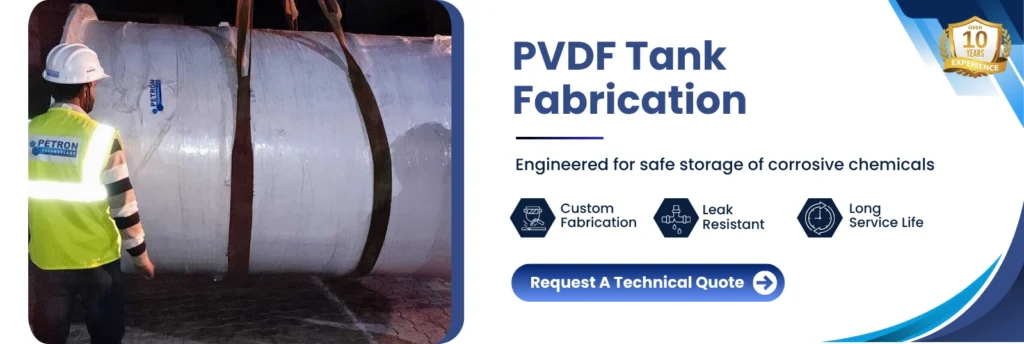
PVDF Tank Fabrication
PVDF Tank Fabrication are refers to the manufacturing and process assembly of industrial tanks. PVDF Tank Fabrication is made from Polyvinylidene Fluoride (PVDF), an high-performance thermoplastic material known for its chemical exceptional resistance. These tanks are specially designed for the storing, handling, and processing of highly corrosive chemicals, acids, solvents, and ultra-pure liquids in demand of the chemical industrial environments.
PVDF tanks are fabricated to using the advanced welding and fabrication techniques such as butt welding, extrusion welding, and thermoplastic fabrication methods to ensure the strong joints, leak-proof construction, and long service life. The material offered an excellent resistance to aggressive chemicals, UV radiation, oxidation, and high temperatures, to make it ideal for critical industrial applications.Petron thermoplast offers PVDF Tank Fabrication, which is widely preferred for industrial applications because it offers to exceptional resistance and to highly corrosive chemicals, high temperatures, and harsh operating environments.


Excellent Chemical Resistance
Excellent resistance to acids, alkalis, solvents, and oxidizing chemicals

Temperature Resistance
Safely handle -20°C to +140°C operating temperatures.

Corrosion-Free Construction
Superior corrosion and chemical attack resistance

Long Service Life
Excellent durability and can operate for many years

ISO / ASTM / DVS Certified
Manufactured to international quality standards
-20°C to +140°C
Operating Temperature
50 L – 100K L
Capacity (Customizable)
DVS, ASTM, ISO
Certified quality standards
3 mm – 25 mm
Wall Thickness

Excellent Chemical Resistance
Excellent chemical resistance to against the strong acids, alkalis, solvents, and corrosive chemicals.

Temperature Resistance
High temperature resistance is suitable for demanding the industrial applications.

Long Service Life
HDPE tanks offer excellent durability and can operate for many years with minimal maintenance under proper working conditions.

Easy Installation
Lightweight construction compared to the metal tanks for easier handling and installation.
Technical Details
| Parameter | Specification / Details |
| Product Name | PVDF Fabricated Tank |
| Material Used | Polyvinylidene Fluoride (PVDF) |
| Construction Type | Welded / Fabricated Thermoplastic Tank |
| Tank Shape | Cylindrical Vertical, Cylindrical Horizontal, Rectangular, Custom Shape |
| Capacity Range | 50 Liters to 100,000 Liters or Customized |
| Wall Thickness | 3 mm to 25 mm (depending on capacity and application) |
| Operating Temperature | -20°C to +140°C |
| Pressure Rating | Atmospheric to Low-Pressure Applications |
| Chemical Resistance | Excellent resistance to acids, alkalis, solvents, and oxidizing chemicals |
| UV Resistance | High UV and weather resistance |
| Corrosion Resistance | Superior corrosion and chemical attack resistance |
| Fabrication Method | Butt Welding, Extrusion Welding, Hot Gas Welding |
| Reinforcement Options | PP/FRP External Reinforcement, MS Structure Support |
| Tank Orientation | Vertical / Horizontal Installation |
| Lining Option | PVDF Lining Available for MS/FRP Tanks |
| Surface Finish | Smooth Internal & External Finish |
| Nozzle Material | PVDF / PP / HDPE / PTFE Compatible Fittings |
| Joint Strength | Leak-proof Thermoplastic Welded Joints |
| Insulation Option | Thermal Insulation Available |
| Agitator Provision | Optional Mixer / Agitator Mounting |
| Level Indicator Provision | Optional Level Gauge & Sensors |
| Manhole Size | 300 mm to 600 mm Standard |
| Color Availability | Natural, White, Grey, or Customized |
| Standards Followed | DVS, ASTM, ISO Thermoplastic Fabrication Standards |
| Testing Methods | Hydro Test, Spark Test, Leak Test, Visual Inspection |
| Installation Type | Indoor & Outdoor Installation |
| Maintenance Requirement | Low Maintenance |
| Service Life | Long Operational Life under Harsh Chemical Conditions |
| Applications | Chemical Processing, Pharmaceutical, Semiconductor, Electroplating, and Water Treatment Industries |
- Excellent chemical resistance to against the strong acids, alkalis, solvents, and corrosive chemicals.
- High temperature resistance is suitable for demanding the industrial applications.
- Superior corrosion protection for the long service life in aggressive environments.
- Leak-proof welded construction ensures safe chemical storage and handling.
- Smooth internal surface to minimize the scaling, contamination, and product buildup.
- High purity material are suitable for pharmaceutical, semiconductor, and ultra-pure chemical applications.
- Strong UV and weather resistance for indoor and outdoor installations.
- Lightweight construction compared to the metal tanks for easier handling and installation.
- Low maintenance requirements with the reduced operational downtime and custom fabrication available in various shapes, sizes, and capacities.
- Excellent mechanical strength and the dimensional stability are compatible with the fittings, nozzles, agitators, level indicators, and instrumentation systems.
PVDF (Polyvinylidene Fluoride) is a high-performance for fluoropolymer widely used for fabricating of chemical storage tanks, process tanks, scrubber tanks, and dosing tanks. PVDF offered resistance to exceptional for aggressive chemicals, high temperatures, UV radiation, and corrosion to make it an ideal material for demanding the industrial applications.
Understanding the chemical compatibility of PVDF tanks is essential to ensure the long service life, operational safety, and reliable performance in chemical processing environments.
Chemicals Compatible with PVDF Tanks
PVDF tanks exhibit excellent resistance to a broad range of corrosive chemicals, including:
1. Strong Acids
- Sulfuric Acid (H₂SO₄)
- Hydrochloric Acid (HCl)
- Nitric Acid (HNO₃)
- Phosphoric Acid (H₃PO₄)
- Chromic Acid
- Acetic Acid
2. Strong Alkalis
- Sodium Hydroxide (Caustic Soda)
- Potassium Hydroxide
- Ammonium Hydroxide
3. Oxidizing Agents
- Hydrogen Peroxide
- Sodium Hypochlorite
- Chlorine Water
- Potassium Permanganate
4. Halogens and Halogenated Compounds
- Chlorine
- Bromine Solutions
- Fluorinated Chemicals
5. Solvents
PVDF provides good resistance
- Alcohols
- Ketones
- Esters
- Aromatic Hydrocarbons (depending on concentration and temperature)
6. High-Purity Chemicals
- Semiconductor-grade acids
- Ultra-pure water systems
- Electronic-grade chemical solutions
Temperature Considerations
PVDF maintains excellent chemical resistance over a wide temperature range:
| Parameter | Typical Range |
| Continuous Operating Temperature | Up to 140°C |
| Short-Term Exposure | Up to 150°C |
| Low Temperature Resistance | Down to -40°C |
Chemical compatibility should always be evaluated based on:
- Chemical concentration
- Operating temperature
- Exposure duration
- Pressure conditions
Chemicals Requiring Special Evaluation
Although PVDF is highly resistant, compatibility should be verified for:
- Highly concentrated hot alkalis
- Certain strong organic solvents at elevated temperatures
- Molten alkali metals
- Highly reactive fluorinating agents
- Special mixed for chemical formulations
A detailed compatibility review is recommended before final tank selection.
Testing and quality are assurance for critical aspects of PVDF (Polyvinylidene Fluoride) tank fabrication.. A comprehensive inspection and testing program is conducted throughout the fabrication process to verify material integrity, weld quality, dimensional accuracy, and leak-tightness. PVDF tanks are commonly used for storing and processing to highly corrosive chemicals, maintaining the highest standards of quality is essential for ensuring safety, reliability, and long-term performance.
Importance of Quality Testing
Quality testing helps to:
- Ensure structural integrity of the tank
- Verify leak-proof performance
- Confirm compliance with design specifications
- Detect manufacturing defects before installation
- Improve operational safety
- Extend service life of the tank
- Minimize maintenance and downtime
Raw Material Inspection
Quality control begins with the inspection of incoming PVDF materials.
Inspection Parameters:
- Material grade verification
- Sheet thickness measurement
- Surface condition inspection
- Manufacturer certification review
- Dimensional accuracy check
- Chemical resistance compliance
Only approved and certified PVDF materials are used for fabrication.
In-Process Quality Control
Throughout the fabrication process, regular inspections are performed to maintain manufacturing quality.
Key Checks:
- Cutting accuracy
- Component alignment
- Shell roundness verification
- Joint preparation inspection
- Reinforcement placement verification
- Nozzle positioning accuracy
These inspections help prevent dimensional and structural issues during later stages.
Weld Quality Inspection
Since welding is the most critical part of PVDF tank fabrication, every weld is carefully examined.
Visual Weld Inspection
Checks for:
- Uniform weld bead appearance
- Proper fusion
- Surface defects
- Cracks or voids
- Undercuts and incomplete welding
Weld Dimension Verification
- Correct weld size
- Proper bead profile
- Adequate penetration
- Compliance with fabrication standards
Spark Testing
Spark testing is commonly used to detect pinholes, cracks, or discontinuities in welded areas.
- Identify microscopic defects
- Verify weld continuity
- Ensure leak-proof joints
A controlled electrical spark is passed over the weld area to reveal imperfections that may not be visible during visual inspection.
Leak Testing
Leak testing confirms the integrity of welds and tank joints.
- Air pressure testing
- Soap solution testing
- Vacuum box testing
- Pneumatic leak testing
This testing ensures that no chemical leakage will occur during operation.
Hydrostatic Testing
Hydrostatic testing is one of the most important quality verification procedures.
Procedure:
- Tank is filled with water
- Maintained at specified test conditions
- Observed for leakage, deformation, or structural instability
- Verifies structural strength
- Confirms tank integrity
- Detects hidden fabrication defects
Dimensional Inspection
All critical dimensions are verified against approved drawings.
Inspection Items:
- Tank diameter
- Height and length
- Wall thickness
- Nozzle locations
- Manhole dimensions
- Reinforcement placement
Accurate dimensions ensure proper installation and system compatibility.
Non-Destructive Testing (NDT)
Depending on project requirements, additional non-destructive testing methods may be used.
Common NDT Techniques:
- Visual Examination (VT)
- Holiday Testing
- Spark Testing
- Ultrasonic Thickness Measurement
These methods evaluate tank quality without damaging the structure.
Structural Stability Verification
Large PVDF tanks may undergo additional checks to confirm mechanical stability.
Evaluations Include:
- Reinforcement effectiveness
- Support structure inspection
- Deflection measurement
- Load-bearing assessment
This ensures safe operation under actual service conditions.
Industries We Serve

Semiconductor Manufacturing
They are to storage of the ultrapure water (UPW) and the high-purity etching chemicals.

Chemical Processing
Tanks for the storage and the processing of aggressive, high-temperature solvents, acids, and bases.

Electroplating & Metal Finishing
Tanks are specifically for the containing chromic acid and other bright to dipping or pickling the solutions.

Waste Treatment
Specialized the storage for hazardous, corrosive liquid waste.

Acid & Alkali Storage Systems
Ideal for handling strong acids, alkalis, and reactive chemicals safely and efficiently.

Industrial Process Applications
Suitable for high-temperature and corrosive industrial environments requiring long-lasting and reliable tank solutions.
Manufacturing Process of PVDF Tank Fabrication
PVDF (Polyvinylidene Fluoride) tank fabrication is specialized for the manufacturing process used to produce the high-performance chemical storage and process tanks for capable of handling the highly corrosive chemicals, high temperatures, and ultra-pure applications. The manufacturing process to follow the strict quality of standards to ensure the structural integrity, leak-proof performance, and long service life.
Due to its exceptional chemical resistance and mechanical strength of PVDF is widely used in the chemical, pharmaceutical, semiconductor, and water treatment industries.
The fabrication process begins with detailed engineering and design based on customer requirements and operating conditions.
Design Considerations:
- Tank capacity and dimensions(50 Liters to 100,000 Liters or Customized)
- Chemical compatibility
- Operating temperature and pressure(-20°C to +140°C)
- Installation location
- Nozzle and fitting requirements
- Structural reinforcement needs
- Applicable industry standards
Advanced CAD software is often to used and create the fabrication drawings and manufacturing layouts.
High-quality PVDF sheets, rods, and welding consumables are selected according to the application requirements.
Material Verification:
- Grade certification
- Thickness verification
- Surface quality inspection
- Chemical resistance confirmation
- Mechanical property validation
Only certified PVDF materials are used to ensure the long-term performance.
PVDF sheets are cut according to the fabrication-approved drawings.
Cutting Methods:
- CNC cutting
- Panel saw cutting
- Router cutting
- Precision machining
After cutting, all edges are cleaned and prepared for welding.
The tank shell is formed by rolling flat to PVDF sheets into cylindrical or rectangular shapes.
Fabrication Activities:
- Sheet rolling
- Alignment and positioning
- Temporary fixing
- Dimensional verification
Proper alignment is essential to maintain the tank geometry and structural strength.
The tank bottom and top cover are fabricated separately and prepared for assembly.
Common Configurations:
- Flat bottom
- Conical bottom
- Dish bottom
- Flat top cover
- Domed top cover
The design depends on process requirements and drainage needs.
Welding is the most critical stage of PVDF tank fabrication.
Welding Techniques:
- Hot Gas Welding
- Extrusion Welding
- Butt Welding
- Socket Welding (for piping connections)
Welding Requirements:
- Controlled temperature
- Proper welding speed
- Certified welding procedures
- Skilled fabricators
All weld joints must be uniform, strong, and free from defects.
After the tank body is completed, process connections and accessories are installed.
Typical Accessories:
- Inlet and outlet nozzles
- Vent connections
- Drain connections
- Manholes
- Level indicators
- Overflow nozzles
- Sampling points
- Support brackets
Each fitting is welded and inspected for leak-tight performance.
Depending on tank size and operating conditions, structural reinforcements are added.
Reinforcement Components:
- External stiffening rings
- Rib supports
- Steel support structures
- Base support systems
These reinforcements improve mechanical stability and prevent deformation.
The fabricated tank undergoes cleaning and finishing operations.
Inspection Parameters:
- Surface quality
- Weld appearance
- Dimensional accuracy
- Alignment verification
- Material integrity
Any defects identified during inspection are corrected before testing.
How to Select the Right PVDF Tank Fabrication
Begin by understanding the intended use of the tank:
- Chemical storage
- Process tanks
- High-purity chemical handling
- Semiconductor applications
- Pharmaceutical manufacturing
- Water treatment systems
- Electroplating and pickling processes
The application determines the tank design, fabrication method, and material specifications.
HDPE tanks are suitable for the moderate temperature applications.
- Minimum and maximum liquid temperature
- Ambient environmental temperature
- Need for insulation and UV protection
PVDF performs well at elevated temperatures compared to many other thermoplastics.
- Normal operating temperature
- Maximum process temperature
- Temperature fluctuations
The fabrication design should be accommodate thermal expansion and operating conditions.
Tank capacity should be based on:
- Storage requirements
- Process demand
- Future expansion plans
- Available installation space
PVDF tanks can be fabricated in a wide range of capacities depending on project requirements.
Vertical Tanks
- Bulk chemical storage
- Limited floor space
- High-volume applications
Rectangular Tanks
- Process applications
- Electroplating lines
- Chemical treatment systems
Custom Fabricated Tanks
- Specialized process requirements
- Space constraints
- Unique installation conditions
- Tank dimensions
- Liquid density
- Wind loads
- Seismic conditions
- Support requirements
Proper reinforcement to ensure the long-term structural integrity.
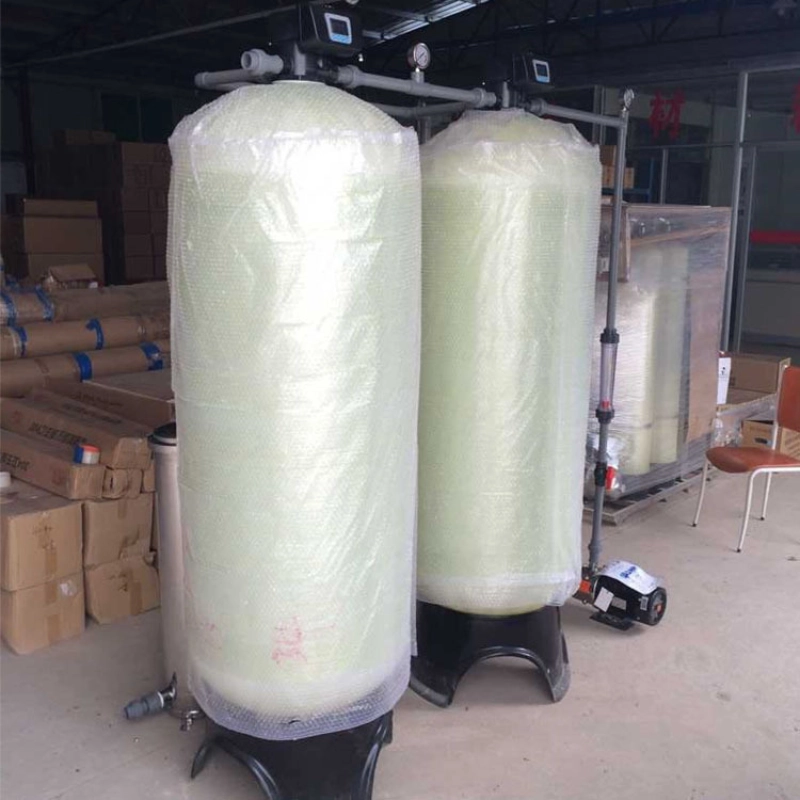

Custom Product Manufacturing Available
If you are searching for customized product designs that meet your requirements, don’t worry. Petron Thermoplast also offers custom product manufacturing services to meet the unique needs of various industries. Work with our expert engineers to create custom designs suited for your application.
Why Choose Petron Thermoplast?
Petron thermoplast offers PVDF Tank Fabrication, which is widely preferred for industrial applications because it offers to exceptional resistance and to highly corrosive chemicals, high temperatures, and harsh operating environments. PVDF (Polyvinylidene Fluoride) is a high-performance thermoplastic material known for its excellent durability, purity, and long service life.
Petron thermoplast provides PVDF tanks that are ideal for storing and processing aggressive acids, alkalis, solvents, and ultra-pure chemicals. The usage of PVDF tanks in industries such as chemical processing, semiconductors, electroplating, and water treatment. PVDF tanks Fabrication also provides a leak-proof performance, low maintenance requirements, and the excellent resistance to UV exposure and environmental conditions. Petron Thermoplast offered a customizable designs, strong structural performance, and reliable to chemical compatibility. PVDF Tank Fabrication ensure to safe, efficient, and long-lasting industrial chemical handling solutions.
Frequently Asked Questions
PVDF tank fabrication is the process of manufacturing storage and process tanks using Polyvinylidene Fluoride (PVDF), a high-performance thermoplastic known for its excellent chemical resistance, high-temperature tolerance, and durability.
PVDF is used because it offers:
- Exceptional resistance to corrosive chemicals
- High thermal stability
- Excellent UV resistance
- Low permeability
- Long service life
- High mechanical strength
PVDF tanks are suitable for storing:
- Sulfuric Acid
- Hydrochloric Acid
- Nitric Acid
- Phosphoric Acid
- Sodium Hydroxide
- Hydrogen Peroxide
- Sodium Hypochlorite
- Many oxidizing and corrosive chemicals
Compatibility should always be confirmed based on chemical concentration and operating temperature.
PVDF tanks can typically withstand continuous operating temperatures up to 140°C, depending on design conditions and chemical exposure.
Yes. PVDF offers excellent resistance to sunlight, UV radiation, and weathering, making it ideal for outdoor installations.
PVDF tanks can be custom-fabricated in a wide range of capacities, from small dosing tanks to large industrial storage and process tanks.
Common types include:
- Vertical storage tanks
- Horizontal tanks
- Process tanks
- Mixing tanks
- Scrubber tanks
- Dosing tanks
- Pickling tanks
- Custom-designed chemical tanks
PVDF tanks are fabricated using specialized thermoplastic welding techniques such as:
- Hot Gas Welding
- Extrusion Welding
- Butt Fusion Welding
- Socket Welding
These methods ensure strong and leak-proof joints.
Yes. PVDF is highly resistant to corrosion caused by acids, alkalis, oxidizers, and many aggressive industrial chemicals.
Yes. Tanks can be customized with:
- Nozzles and flanges
- Manholes
- Level indicators
- Agitator arrangements
- Overflow connections
- Ladders and platforms
- Instrument mounting provisions
With proper design, installation, and maintenance, PVDF tanks can provide reliable service for many years, even in highly corrosive environments.