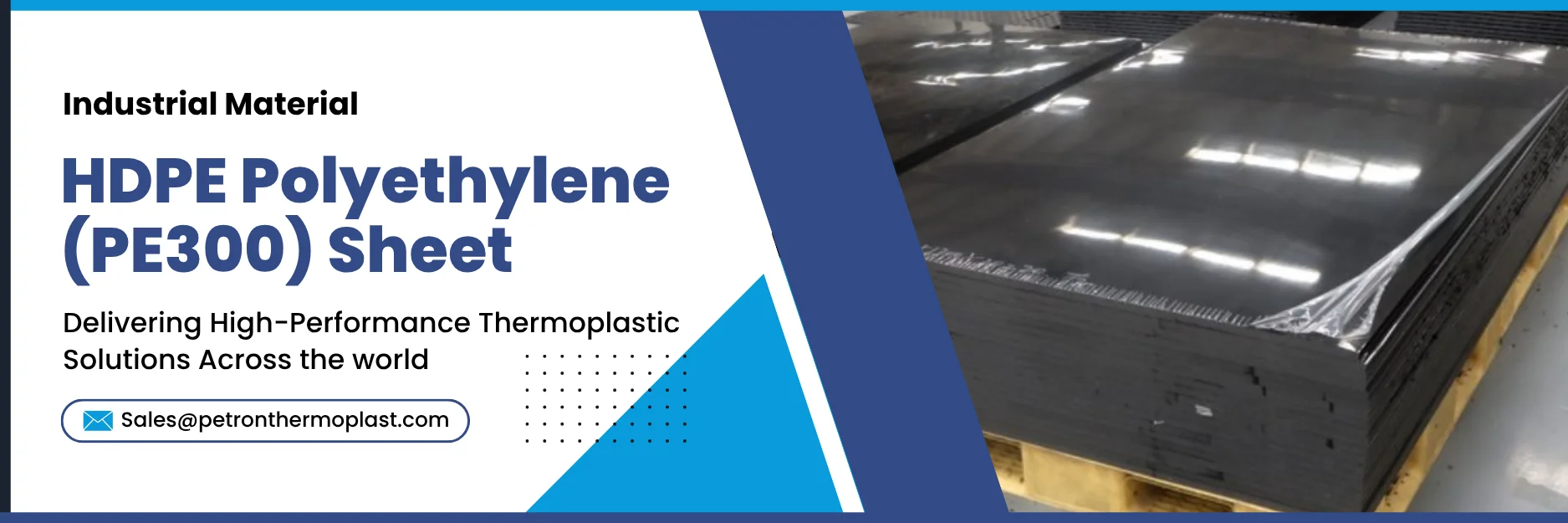
HDPE Polyethylene (PE300) Sheet
Polyethylene PE300 sheet, commonly known as HDPE (High-Density Polyethylene) sheet, is a thermoplastic polymer material made from petroleum-based polyethylene. It is classified as PE300 based on its molecular density, offering a balance of strength, rigidity, and cost-effectiveness.
PE300 HDPE sheets are characterized by their high strength-to-density ratio, excellent chemical resistance, and good impact resistance, making them suitable for a wide range of industrial and general-purpose applications. These sheets are lightweight, moisture-resistant, and easy to fabricate, weld, and machine.PE300 HDPE sheet is a durable, versatile plastic sheet material used in industries such as construction, chemical processing, packaging, and water management.

Polyethylene PE300 Sheet – HDPE Details
| Property | Details |
| Material Type | Thermoplastic polymer (High-Density Polyethylene) |
| Chemical Formula | (C₂H₄)ₙ |
| Density | 0.941 – 0.965 g/cm³ |
| Molecular Structure | Linear structure with minimal branching |
| Tensile Strength | 20 – 37 MPa |
| Elongation at Break | 100% – 1000% |
| Flexural Modulus | 600 – 1500 MPa |
| Impact Resistance | High (excellent resistance to shock and stress) |
| Hardness | Shore D 55 – 70 |
| Melting Point | 120°C – 135°C |
| Working Temperature | -40°C to +60°C (can vary by grade) |
| Thermal Conductivity | 0.4 – 0.5 W/m·K |
| Water Absorption | < 0.01% |
| Chemical Resistance | Excellent (resistant to acids, alkalis, salts, and many solvents) |
| UV Resistance | Moderate (improved with carbon black additives) |
| Electrical Properties | Good insulator (high dielectric strength) |
| Abrasion Resistance | Very good |
| Permeability | Low for water, moderate for gases |
| Joining Methods | Butt fusion, electrofusion, socket fusion, compression fittings |
| Standards | ISO 4427, ASTM D3350, DIN standards |
1. High Durability
- HDPE fittings are extremely tough and long-lasting.
- They can perform efficiently for 50+ years without cracking or failure.
2. Corrosion & Chemical Resistance
- Resistant to acids, alkalis, salts, and chemicals.
- Do not rust or corrode like metal fittings.
3. Leak-Proof Joints
- Joined using butt fusion or electrofusion, creating a homogeneous joint.
- Joints are as strong as the pipe itself and prevent leakage.
4. Lightweight & Easy Installation
- Much lighter than metal fittings.
- Easy to transport, handle, and install, reducing labor cost.
5. High Flexibility
- Can bend without breaking, suitable for uneven or shifting soil.
- Reduces need for extra fittings and joints.
6. Excellent Impact Resistance
- Performs well under low temperatures and high pressure.
- Resistant to cracking, stress, and sudden impacts.
7. Smooth Inner Surface
- Provides low friction and high flow efficiency.
- Minimizes scaling, deposits, and pressure loss.
8. Non-Toxic & Safe
- Suitable for drinking water systems.
- Does not contaminate water or support bacterial growth.
9. Weather & UV Resistance
- Can withstand harsh environmental conditions.
- Suitable for both underground and outdoor applications.
10. Low Maintenance & Cost-Effective
- Requires minimal maintenance over time.
- Long service life reduces replacement costs.
| Sheet Size (mm) | Sheet Size (feet approx.) |
| 2000 × 1000 | 6.5 × 3.3 ft |
| 3000 × 1500 | 10 × 5 ft |
| 4000 × 2000 | 13 × 6.5 ft |
| 2440 × 1220 | 8 × 4 ft (common industrial size) |
| Thickness (mm) | Approx. Pressure Capacity* |
| 3 – 5 mm | Low pressure (0.1 – 0.3 bar) |
| 6 – 10 mm | Moderate pressure (0.3 – 0.8 bar) |
| 12 – 20 mm | Medium pressure (0.8 – 2.0 bar) |
| 25 – 50 mm | Higher pressure (2.0 – 5.0 bar) |
- Infrastructure: HDPE pipes are used in water supply, gas distribution, and sewage systems, offering a longer lifecycle and corrosion resistance compared to metal pipes.
- Packaging: HDPE is extensively used in the packaging sector, especially in FMCG and chemical industries, providing high impact resistance and safety during storage and transportation.
- Thermoforming: HDPE is ideal for thermoforming applications, such as agricultural equipment, industrial tanks, outdoor enclosures, and automotive underbody components, due to its UV stability, moisture resistance, and low cost.
1. High-Density Polyethylene (HDPE) Resin
- Main base material used in PE300 sheets
- Derived from petroleum-based hydrocarbons (ethylene monomer)
- Produced through polymerization of ethylene gas
- Key properties:
- High strength-to-density ratio
- Excellent chemical resistance
- Low moisture absorption
- Good impact resistance
2. UV Stabilizers
- Protect sheets from sunlight degradation
- Essential for outdoor applications
3. Antioxidants
- Prevent thermal degradation during:
- Processing
- Long-term use
- Improve lifespan of the material
4. Color Masterbatches (Pigments)
- Provide desired colors (black, blue, green, etc.)
- Also help in UV resistance (especially black sheets)
5. Anti-static Agents (ESD Additives)
- Reduce static electricity buildup
- Used in electronics and sensitive environments
6. Flame Retardants (Optional)
- Improve fire resistance
- Used in safety-critical applications
7. Processing Aids
- Improve flow and moldability during manufacturing
- Help achieve smooth surface finish
8. Recycled HDPE Material
- Used in non-critical or cost-sensitive applications
- Mixed with virgin material or used alone
- Eco-friendly and cost-effective
- Sheets are cooled, trimmed, and surface-finished
- Final inspection ensures quality standards
User Manual for Polyethylene PE300 Sheet – HDPE
| Property | Value |
| Working Temperature Range | -50°C to +80°C |
| Short-Term Maximum Temperature | Up to +100°C (without load) |
| Melting Point | 120°C to 135°C |
| Softening Temperature (Vicat) | ~75°C to 85°C |
| Brittle Temperature | Below -50°C (excellent low-temp performance) |
| Property | Value |
| Density Range | 0.94 – 0.96 g/cm³ |
| Typical Density | ~0.95 g/cm³ |
| Classification | High-Density Polyethylene (HDPE) |
1. Surface Preparation
- Ensure the base surface is clean, dry, and level
- Remove dust, तेल (oil), grease, or sharp objects
- Uneven surfaces can cause stress points and deformation
2. Cutting & Machining
- Sheets can be cut using:
- Circular saw
- Jigsaw
- CNC router
- Use sharp tools to avoid rough edges
- Maintain proper tolerances for expansion
3. Joining Methods
Depending on application, HDPE sheets can be joined by:
• Welding (Most Common)
- Hot air welding
- Butt welding
- Extrusion welding
- Provides strong, leak-proof joints (ideal for tanks & liners)
• Mechanical Fastening
- Bolts, screws, or rivets
- Use oversized holes to allow thermal expansion
- Add rubber gaskets if sealing is required
• Adhesive Bonding (Limited Use)
- HDPE has low surface energy → adhesives are less effective
- Surface treatment (like flame or plasma) may be required
4. Thermal Expansion Consideration
- HDPE expands with temperature changes
- Always:
- Leave expansion gaps
- Avoid rigid fixing across large areas
5. Installation Environment
- Avoid installing in extreme temperatures
- Ideal temperature range: 10°C to 40°C
- Protect from direct flame or excessive heat during installation
6. Support & Fixing
- Provide uniform support to prevent sagging
- Use proper framing or backing structure
- For vertical installations, ensure strong anchoring
Maintenance of PE300 HDPE Sheets
1. Regular Cleaning
- Clean with:
- Mild detergent
- Water
- Avoid:
- Harsh chemicals (strong acids/oxidizers)
- Abrasive scrubbers
2. Inspection
- Periodically check for:
- Cracks or deformation
- Joint failures
- Surface wear
- Early detection prevents major damage
3. UV Protection (if outdoor use)
- Use UV-stabilized sheets for outdoor applications
- Apply protective coatings if needed
4. Repair & Replacement
- Minor damages can be repaired by:
- Plastic welding
- Replace sheets if:
- Structural integrity is compromised
5. Load Management
- Avoid excessive loads beyond design limits
- Prevent point loads that may cause stress cracks
6. Temperature Care
- Keep away from:
- Direct flames
- High heat sources (>80°C approx.)
- Prolonged heat can deform the sheet
7. Chemical Exposure
- HDPE is chemically resistant, but:
- Avoid prolonged exposure to strong oxidizing agents
- Rinse after chemical contact
1. Size & Thickness Customization
- Available in standard and custom sizes
- Thickness range typically: 1 mm to 100 mm+
- Sheets can be cut into:
- Panels
- Blocks
- Strips
- Custom shapes
2. Color Customization
- Standard colors: Natural (milky white), Black
- Custom colors: Blue, Green, Red, Yellow, etc.
- Color coding helps in:
- Industry identification
- Safety marking
- Aesthetic applications
3. Surface Finish Options
- Smooth finish (standard)
- Textured/embossed (anti-slip applications)
- Matte or glossy finish
- Dual-surface sheets (one smooth, one textured)
4. Additive Modifications
PE300 sheets can be enhanced with special additives:
- UV Stabilizers – for outdoor durability
- Anti-static (ESD) – for electronic environments
- Flame retardants – for safety-critical areas
- Food-grade compliance – for food processing industries
5. Fabrication Customization
- Pre-drilled holes
- Grooving and bending preparation
- Weld-ready edges
- CNC-machined components
Processing
1. Cutting
- Methods:
- Circular saw
- Band saw
- CNC cutting
- Laser cutting (limited use due to melting risk)
- Ensure sharp tools to avoid burrs
2. Machining
- Easy to machine using standard tools
- Operations include:
- Drilling
- Milling
- Turning
- Routing
- Maintain low cutting speeds to prevent overheating
3. Welding & Joining
- Hot air welding – for thin sheets
- Butt fusion welding – for thick sheets
- Extrusion welding – for strong joints
- Ensures leak-proof and durable fabrication
4. Thermoforming
- Heated and shaped into desired forms
- Suitable for:
- Tanks
- Containers
- Liners
- Requires controlled temperature to avoid deformation
5. Bending
- Line bending with controlled heat
- Used for making angles and enclosures
6. Routing & Engraving
- CNC routing for:
- Complex shapes
- Logos and markings
- Used in signage and industrial parts
7. Surface Treatment
- Flame treatment or corona treatment
- Improves adhesion for:
- Printing
- Coating
- Bonding
1. Tensile Strength Test
- Measures resistance to breaking under tension
- Indicates material strength and durability
2. Impact Resistance Test
- Determines ability to withstand sudden shocks
- Important for heavy-duty applications
3. Flexural Strength Test
- Evaluates bending strength and stiffness
4. Hardness Test
- Measures surface resistance to indentation and wear
5. Vicat Softening Temperature
- Determines temperature at which material softens
6. Heat Deflection Temperature (HDT)
- Measures performance under load at elevated temperatures
7. Thermal Stability Test
- Evaluates resistance to heat degradation over time
8. Chemical Resistance Test
- Exposure to acids, alkalis, and solvents
- Ensures suitability for chemical industries
9. Environmental Stress Crack Resistance (ESCR)
- Measures resistance to cracking under stress and chemicals
10. Density Test
- Confirms material grade (typically ~0.94–0.96 g/cm³)
11. Water Absorption Test
- Ensures low moisture uptake
12. Thickness & Dimensional Accuracy
- Checked using precision instruments
1. Chemical & Process Industry
- Used for:
- Chemical storage tanks
- Liners and containment systems
- Scrubber components
- Excellent resistance to acids, alkalis, and corrosive chemicals
2. Food Processing Industry:
- Cutting boards
- Food handling surfaces
- Storage containers
- Food-grade safe
- Non-toxic and easy to clean
- Hygienic and moisture-resistant
3. Water Treatment
- Water tanks
- Pipe supports
- Wastewater treatment plants
- Corrosion-resistant and long-lasting in wet environments
4. Packaging Industry
- Pallets
- Crates and containers
- Protective sheets
- Lightweight yet strong
- Reusable and recyclable
5. Construction & Infrastructure
- Ground protection sheets
- Wall cladding
- Temporary roadways
- High impact resistance
- Weather and UV resistance (when stabilized)
6. Marine Industry
- Boat components
- Dock fenders
- Wear strips
- Water-resistant
- Does not rot or corrode
8. Electrical & Electronics Industry:
- Insulation panels
- Anti-static sheets (ESD grade)
- Good electrical insulation
- Static control (in modified variants)
9. Automotive & Transport
- Interior panels
- Battery covers
- Cargo liners
- Lightweight and impact-resistant
- Reduces overall vehicle weight
10. Mining & Material Handling
- Chute linings
- Conveyor guides
- Wear plates
- Low friction surface
- High abrasion resistance

Custom Product Manufacturing Available
If you are searching for customized product designs that meet your requirements, don’t worry. Petron Thermoplast also offers custom product manufacturing services to meet the unique needs of various industries. Work with our expert engineers to create custom designs suited for your application.
Benefits of HDPE Polyethylene (PE300) Sheet
1. Excellent Chemical Resistance
PE300 HDPE sheets resist a wide range of acids, alkalis, and corrosive chemicals, making them ideal for chemical tanks, liners, and industrial applications.
2. High Impact Strength
They offer excellent toughness and impact resistance, even at low temperatures, reducing the risk of cracking or breaking under stress.
3. Lightweight with High Strength
Despite being lightweight (low density ~0.95 g/cm 3), PE300 provides a good strength-to-weight ratio, making handling and installation easier.
4. Moisture & Water Resistance
HDPE sheets have near-zero water absorption, making them suitable for water storage, marine, and outdoor environments.
5. Good Machinability & Fabrication
- Easy to cut, drill, weld, and shape
- Compatible with butt welding and extrusion welding
- Ideal for customized industrial components
6. Excellent Electrical Insulation
PE300 acts as a good electrical insulator, useful in electrical and insulation-related applications.
7. Low Friction Surface
The material has a smooth, low-friction surface, which helps in applications like:
- Sliding components
- Conveyor systems
- Wear strips
8. Non-Toxic & Food Safe
Available in food-grade quality, making it suitable for:
- Food processing equipment
- Cutting boards
- Packaging applications
9. UV & Weather Resistance (with Stabilization)
UV-stabilized grades offer good resistance to sunlight and outdoor weather conditions, increasing durability in outdoor use.
10. Cost-Effective Material
Compared to higher grades like PE500 or PE1000, PE300 is more economical, while still offering reliable performance for general applications.
Types of HDPE Polyethylene (PE300) Sheet
1. Standard (Natural) HDPE PE300 Sheet
- Comes in natural milky white color
- General-purpose industrial applications
- Good chemical resistance and impact strength
- Suitable for tanks, liners, and cutting boards
2. Colored HDPE PE300 Sheet
- Available in black, blue, green, red, etc.
- Used for identification, aesthetics, or safety coding
- Same mechanical properties as standard sheets
3. UV Stabilized HDPE Sheet
- Designed for outdoor use
- Contains UV stabilizers to resist sunlight degradation
- Ideal for playground equipment, outdoor tanks, and signage
4. Anti-Static (ESD) HDPE Sheet
- Prevents buildup of static electricity
- Used in electronics and sensitive environments
- Helps protect equipment from electrostatic discharge
5. Flame Retardant HDPE Sheet
- Modified to reduce flammability
- Used in applications where fire safety is required
- Common in construction and electrical enclosures
6. Textured Surface HDPE Sheet
- Has a rough or patterned surface
- Provides better grip and anti-slip properties
- Used in flooring, walkways, and industrial platforms
7. Smooth Surface HDPE Sheet
- Standard smooth finish
- Easy to clean and fabricate
- Used in food processing and packaging industries
8. High Impact Modified HDPE Sheet
- Enhanced impact resistance
- Suitable for heavy-duty industrial use
- Used in material handling and protective barriers
9. Food Grade HDPE Sheet
- Manufactured with food-safe materials
- Complies with food safety standards
- Used in food processing equipment, chopping boards, and storage
10. Reprocessed/Recycled HDPE Sheet
- Made from recycled material
- Cost-effective option
- Used in non-critical applications like pallets, liners, and partitions
Why Choose Petron Thermoplast?
Petron Thermoplast is a seasoned name in the manufacturing and supply of high-quality Polyethylene PE300 Sheet HDPE. Our specialties include premium quality materials, long-lasting design, and customized solutions tailored to suit every industry, all supported by timely delivery and reliable service.
Conclusion
Polyethylene PE300 (HDPE) sheet is a highly versatile and reliable thermoplastic material widely used across multiple industries. Its combination of high impact strength, excellent chemical resistance, low moisture absorption, and ease of fabrication makes it an ideal choice for both industrial and commercial applications.
From customization and processing flexibility to simple installation and low maintenance, PE300 sheets offer practical advantages that reduce operational costs and improve efficiency. Additionally, their availability in various types, sizes, and modified grades (such as UV-stabilized, food-grade, and anti-static) allows them to meet diverse application requirements.
With proper material selection, quality testing, and maintenance, PE300 HDPE sheets deliver long service life, consistent performance, and sustainability, especially when recycled options are considered.
Frequently Asked Questions
Polyethylene PE300 (HDPE) sheet is a high-density thermoplastic material known for its strength, chemical resistance, and durability, widely used in industrial and commercial applications.
- High impact strength
- Excellent chemical resistance
- Low moisture absorption
- Good wear resistance
- Lightweight and durable
The density usually ranges between 0.94 to 0.96 g/cm³, making it strong yet lightweight.
PE300 HDPE sheets are available in a wide range, typically from 1 mm to 100 mm or more, depending on application requirements.
- Chemical storage tanks
- Food processing boards
- Industrial liners
- Packaging materials
- Water treatment systems
Yes, especially when UV-stabilized grades are used. These resist sunlight and weathering.
Yes, food-grade variants are available that comply with safety standards and are suitable for food processing and handling.
It can be installed using:
- Welding (hot air, butt fusion, extrusion)
- Mechanical fastening
- Proper allowance for thermal expansion is required
Yes, HDPE sheets can be easily welded, making them ideal for leak-proof tanks and liners.
- Normal operating range: -50°C to +80°C (approx.)
- Beyond this, material may soften or deform
Yes, they are highly resistant to:
- Acids
- Alkalis
- Many industrial chemicals
- Regular cleaning with mild detergent
- Periodic inspection for damage
- Avoid exposure to extreme heat
Yes, HDPE is fully recyclable, making it an eco-friendly material option.
- Better impact resistance than many plastics
- Excellent durability
- Cost-effective
- Easy to fabricate and process
Yes, it is suitable for moderate to heavy-duty applications, though for extreme wear conditions, higher grades like PE500 or PE1000 may be preferred.