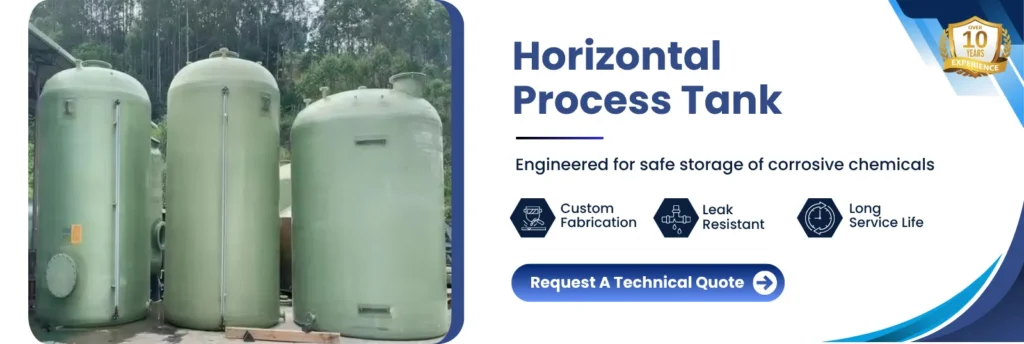
Horizontal Process Tank
A Horizontal Process Tank is a cylindrical vessel installed with its long axis parallel. Horizontal Process Tanks are typically supported by cradles and saddles. Horizontal Process Tanks are unlike the vertical tanks, designed to sit low and make them ideal for areas with a limited vertical height or for storing liquids at low pressure. Horizontal Process Tanks are commonly utilized in the oil, gas, chemical, and pharmaceutical industries to store, transport and process materials.
The Horizontal Process Tank is designed to provide enhanced stability, easy installation, and convenient liquid transfer. Horizontal Process Tanks are making tanks suitable for industries requiring efficient processes for handling and low-height installations. Horizontal process tanks are commonly mounted on saddles and supported by structures for secure operation and proper load distribution. To ensure excellent durability, chemical resistance, and long service life. Petron Thermoplast deals with a high-quality Horizontal Process Tank that depends on precise manufacturing and matches quality materials and adherence to standards.


Material of Construction
HDPE, PPH, FRP, PVDF, Stainless Steel (SS 304/SS 316)

Temperature Resistance
-10°C to 120°C (depends on material used)

Corrosion-Free Construction
No rusting when exposed to chemicals & moisture.

Long Service Life
Excellent durability and can operate for many years

ASTM, ISO, DIN, and IS Certified
Manufactured to international quality standards
-10°C to 120°C
Operating Temperature
100 L – 50K L
Capacity (Customizable)
10–25 years
Service Life
ASTM D1998 & ISO
Certified quality standards
5 mm – 50 mm
Wall Thickness

Excellent chemical and corrosion resistance

Suitable for storage, mixing, and processing applications

Strong and durable construction for long service life

Leak-proof and maintenance-friendly structure
Technical Details
| Parameter | Details |
| Product Name | Horizontal Process Tank |
| Tank Orientation | Horizontal |
| Material of Construction | HDPE, PPH, FRP, PVDF, Stainless Steel (SS 304/SS 316) |
| Shape | Cylindrical Horizontal |
| Capacity Range | 100 Liters to 50,000 Liters |
| Storage/Application | Chemical Processing, Mixing, Liquid Storage, Industrial Processing |
| Wall Thickness | 5 mm to 50 mm (depending on capacity and chemical compatibility) |
| Diameter Range | 500 mm to 3500 mm |
| Length Range | 1000 mm to 12000 mm |
| Operating Temperature | -10°C to 120°C (depends on material used) |
| Pressure Rating | Atmospheric to 3 Bar |
| Density Handling Capacity | Up to 1.8 SG |
| Tank Type | Single Wall / Double Wall |
| Mounting Type | Saddle Mounted / Skid Mounted |
| Surface Finish | Smooth Internal & External Finish |
| Color Options | Natural, Black, White, Blue, Customized |
| Fabrication Method | Butt Welding, Extrusion Welding, Molding |
| Chemical Resistance | Excellent resistance to acids, alkalis, and corrosive chemicals |
| UV Protection | Available with UV Stabilized Material |
| Inlet/Outlet Connections | Flanged, Threaded, Socket Type |
| Accessories | Manhole, Level Indicator, Vent Nozzle, Drain Valve, Agitator Mounting |
| Insulation Option | Thermal Insulation Available |
| Agitator Provision | Optional |
| Mobility | Fixed Installation |
| Leak Proof Design | Yes |
| Maintenance Requirement | Low Maintenance |
| Service Life | 10–25 Years (depending on operating conditions) |
| Compliance Standards | ASTM, ISO, DIN, and IS Standards |
| Testing | Hydro Test, Spark Test, Leak Test, Dimensional Inspection |
| Customization | Available as per drawing and industrial requirement |
Chemical compatibility refers to the ability of a horizontal process tank to safely store, transport, or process chemicals without suffering from corrosion, swelling, cracking, leakage, or structural deterioration. Proper chemical compatibility is essential for ensuring safety, maintaining product quality, and extending tank service life.
Why Chemical Compatibility is Important
Selecting the correct tank material helps:
- Prevent chemical attack and corrosion
- Avoid leaks and environmental hazards
- Maintain product purity
- Reduce maintenance costs
- Extend equipment life
- Ensure safe operation
Common Materials Used for Horizontal Process Tanks
| Material | Characteristics |
| HDPE | Excellent resistance to many chemicals and water treatment solutions |
| Polypropylene (PP) | High resistance to acids and alkalis |
| FRP | Strong structural performance with excellent corrosion resistance |
| PVDF | Superior resistance to highly aggressive chemicals |
| Stainless Steel | Suitable for hygienic and selected chemical applications |
Compatibility with Common Chemicals
| Chemical | HDPE | PPH | FRP | PVDF | Stainless Steel |
| Hydrochloric Acid (HCl) | Good | Excellent | Excellent | Excellent | Poor |
| Sulfuric Acid (H₂SO₄) | Good* | Excellent | Excellent | Excellent | Good* |
| Nitric Acid (HNO₃) | Moderate | Good | Good | Excellent | Good |
| Phosphoric Acid | Excellent | Excellent | Excellent | Excellent | Good |
| Sodium Hydroxide (NaOH) | Excellent | Excellent | Good | Excellent | Moderate |
| Potassium Hydroxide (KOH) | Excellent | Excellent | Good | Excellent | Moderate |
| Sodium Hypochlorite | Excellent | Good | Good | Excellent | Poor |
| Ferric Chloride | Good | Excellent | Excellent | Excellent | Poor |
| Alum Solution | Excellent | Excellent | Excellent | Excellent | Good |
| Process Water | Excellent | Excellent | Excellent | Excellent | Excellent |
Compatibility depends on chemical concentration, operating temperature, and exposure conditions.
Quality inspection and testing are essential steps in the manufacturing of a horizontal process tank to ensure safety, durability, leak-proof performance, and compliance with industrial standards. Comprehensive inspections are carried out from raw material verification through final testing before dispatch.
1. Raw Material Inspection
All incoming materials are inspected to verify compliance with design specifications.
Inspection Parameters
- Material grade verification
- Sheet thickness measurement
- Surface quality inspection
- Chemical resistance suitability
- Material Test Certificate (MTC) verification
- HDPE
- Polypropylene (PP)
- FRP
- PVDF lining materials
- Stainless Steel
2. Dimensional Inspection
Dimensional checks ensure that the tank is manufactured according to approved drawings.
| Inspection Item | Purpose |
| Tank Length | Verify overall dimensions |
| Tank Diameter | Confirm storage volume |
| Wall Thickness | Ensure structural strength |
| Nozzle Location | Verify piping compatibility |
| Support Position | Confirm installation requirements |
3. Visual Inspection
Visual inspection is performed throughout fabrication to identify:
- Surface defects
- Cracks
- Scratches
- Material damage
- Fabrication irregularities
- Weld discontinuities
This helps ensure overall workmanship quality.
4. Welding Quality Inspection
The quality of welds is critical for leak-free and long-lasting tank performance.
Thermoplastic Tanks
Inspection includes:
- Butt fusion weld inspection
- Extrusion weld examination
- Hot gas weld verification
Stainless Steel Tanks
Inspection includes:
- TIG/MIG weld inspection
- Weld penetration assessment
- Surface finish evaluation
- Strong joints
- Leak-proof construction
- Improved durability
5. Hydrostatic Testing
Hydrostatic testing is one of the most important acceptance tests.
Procedure
The tank is filled with water and maintained for a specified duration.
Purpose
- Detect leakage
- Verify weld integrity
- Confirm structural stability
- Check deformation resistance
6. Spark Testing (Holiday Testing)
For lined or coated tanks, spark testing is used to identify defects.
Applicable For
- PVDF-lined tanks
- FRP-lined tanks
- Coated tanks
- Pinholes
- Surface discontinuities
- Lining defects
- Coating imperfections
7. Thickness Measurement
Thickness verification ensures compliance with design requirements.
Areas Measured
- Tank shell
- End sections
- Bottom plates
- Lining thickness
- Reinforcement sections
- Structural reliability
- Consistent quality
- Long service life
8. Nozzle & Fitting Inspection
All process connections are checked for:
- Proper alignment
- Dimensional accuracy
- Welding quality
- Leak-proof sealing
Common Components
- Inlet nozzles
- Outlet nozzles
- Drain connections
- Overflow nozzles
- Vent pipes
Industries We Serve

Petrochemical and Fuel Storage
They are commonly used at fueling sites. service stations, and oil refineries due to their ease of installation and ability to store the light and heavy petroleum products.
Chemical Manufacturing
Used in the chemical plants for storing aggressive and hazardous solutions, such as acids, bases, and solvents.
Water Treatment and Fire Suppression
Used as water storage tanks, including fire tanks for safety compliance.

Industrial Manufacturing Processes
Supports process fluid storage and transfer operations in manufacturing and production plants.
Agitator & Mixing Applications
Can be integrated with agitators or mixers for blending and homogenizing liquids and chemicals.

Chemical Dosing Systems
Functions as a process tank for controlled chemical feeding and dosing operations.

Bulk Liquid Storage
Suitable for storing large volumes of industrial liquids where horizontal installation is preferred.

Customized Industrial Applications
Widely used in power plants, textile industries, pulp & paper industries, and specialty process systems.
Features of Horizontal Process Tank
Strong and durable construction for long service life
Excellent chemical and corrosion resistance

Horizontal design for easy installation and space optimization
Suitable for storage, mixing, and processing applications
Available in HDPE, PPH, FRP, PVDF, and Stainless Steel materials

High mechanical strength and impact resistance

Leak-proof and maintenance-friendly structure

Smooth internal surface for easy cleaning and reduced scaling
Available in customized capacities and dimensions

UV stabilized material option for outdoor installation

Compatible with acids, alkalis, solvents, and industrial liquids

Low maintenance and cost-effective operation
Manufacturing Process of Horizontal Process Tank
The manufacturing process of a horizontal process tank involves engineering design, material selection, fabrication, welding, assembly, reinforcement, testing, and final inspection. These tanks are designed to safely store, process, and transport liquids, chemicals, and industrial solutions while ensuring durability, leak-proof performance, and long service life.
The manufacturing process begins with detailed engineering calculations based on:
- Tank capacity(100 Liters to 50,000 Liters)
- Chemical compatibility
- Operating temperature(-10°C to 120°C (depends on material used))
- Process requirements
- Liquid density
- Installation conditions
- Tank diameter
- Tank length
- Wall thickness
- Nozzle locations
- Support saddle design
- Reinforcement requirements
The tank material is selected according to the application and chemical resistance requirements.
Common Materials Used
- HDPE (High-Density Polyethylene)
- Polypropylene (PP)
- FRP (Fiber Reinforced Plastic)
- PVDF-lined materials
- Stainless Steel
- Corrosion resistance
- Mechanical strength
- Long service life
Raw material sheets are cut into required dimensions using:
- CNC cutting machines
- Laser cutting systems
- Circular saws
- Thermoplastic cutting tools
- Shell sections
- End caps
- Reinforcement elements
- Saddle support components
The cut sheets are rolled into cylindrical shapes using rolling machines.
This process ensures:
- Accurate diameter
- Uniform curvature
- Proper fit-up during assembly
The rolled sections form the main body of the tank.
The cylindrical shell sections are joined using approved welding techniques.
Thermoplastic Tanks
Common welding methods:
- Butt fusion welding
- Extrusion welding
- Hot gas welding
Stainless Steel Tanks
Common welding methods:
- TIG welding
- MIG welding
- Arc welding
These methods provide:
- Strong joints
- Leak-proof construction
- High structural integrity
The tank ends are fabricated and attached to the shell.
Common end configurations include:
- Flat ends
- Dish ends
- Semi-elliptical ends
- Torispherical ends
The choice depends on process and structural requirements.
Horizontal tanks require support structures to distribute the load safely.
Common support systems:
- Saddle supports
- Steel frames
- Reinforced mounting structures
Proper support prevents deformation during operation.
Additional reinforcement may be provided for:
- Large-capacity tanks
- Elevated temperatures
- Agitated applications
- Heavy process loads
- External ribs
- Stiffening rings
- Structural frames
Required fittings are installed according to the approved design.
Typical Accessories
- Inlet nozzles
- Outlet nozzles
- Overflow nozzles
- Drain connections
- Vent pipes
- Manholes
- Level indicators
- Sampling ports
All fittings are accurately aligned and securely welded.
For mixing applications, provisions may include:
- Agitator mounting pads
- Mixer support structures
- Motor mounting arrangements
- Reinforced equipment platforms
This ensures stable operation under dynamic loads.
How to Select the Right Horizontal Process Tank
Selecting the right horizontal process tank is essential for ensuring safe operation, efficient process performance, and long-term durability. Horizontal process tanks are widely used in chemical processing, water treatment, dosing system, pharmaceuticals, and industrial liquid storage applications where height restrictions or process requirements make a horizontal design preferable.
Identify the intended use of the tank:
- Chemical storage
- Process mixing
- Dosing applications
- Water treatment
- Effluent treatment
- Food processing
- Pharmaceutical processing
The application determines the tank material, design, and accessories required.
The tank material must be compatible with the liquid being stored or processed.
Common materials include:
- HDPE
- Polypropylene (PP)
- FRP
- PVDF-lined construction
- Stainless Steel
- Corrosion
- Leakage
- Product contamination
- Material degradation
Tank capacity should be selected based on:
- Daily consumption
- Process volume
- Batch requirements
- Storage duration
- Future expansion needs
Common capacities range from a few hundred liters to several thousand liters.
Temperature significantly affects material selection.
Consider:
- Process temperature
- Ambient temperature
- Heating requirements
For elevated temperatures, materials such as PP, PVDF, or Stainless Steel may be more suitable.
Material | Suitable Applications |
HDPE | Water treatment and mild chemicals |
PP | Acids, alkalis, and process chemicals |
FRP | Large industrial chemical storage |
PVDF | High-temperature corrosive chemicals |
Stainless Steel | Pharmaceutical, and hygienic applications |
Horizontal tanks are often selected when:
- Vertical space is limited
- Low-profile installation is required
- Transportability is important
- Available floor area
- Access routes
- Maintenance clearance
- Foundation requirements
The tank should be designed to withstand:
- Liquid load
- Process conditions
- Transportation loads
- Environmental conditions
Important structural elements include:
- Saddle supports
- Reinforcement ribs
- Support frames
- Mounting brackets
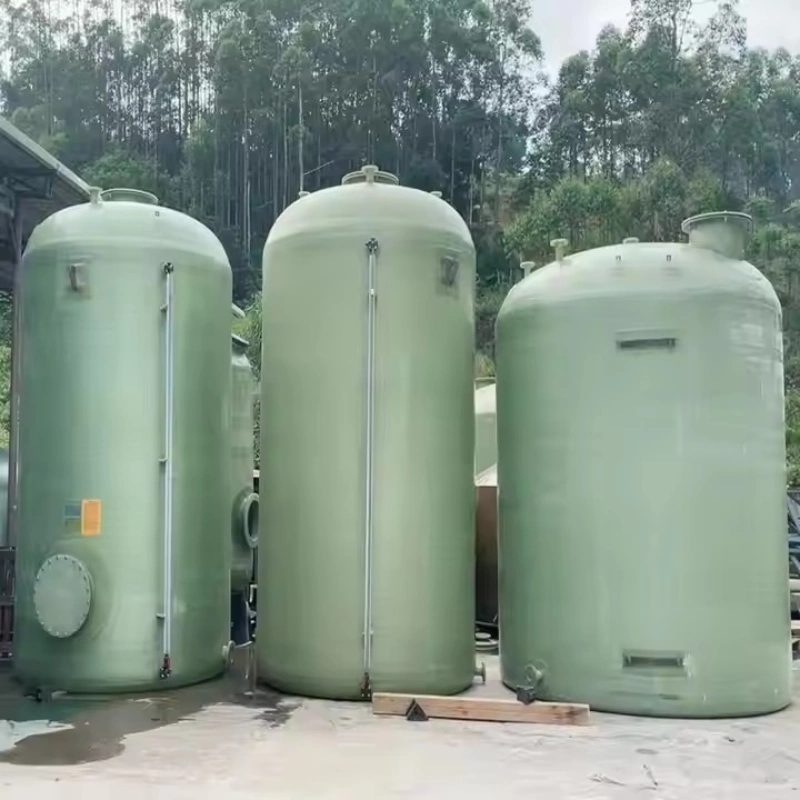

Custom Product Manufacturing Available
If you are searching for customized product designs that meet your requirements, don’t worry. Petron Thermoplast also offers custom product manufacturing services to meet the unique needs of various industries. Work with our expert engineers to create custom designs suited for your application.
Why Choose Petron Thermoplast?
Petron Thermoplast deals with a high-quality Horizontal Process Tank that depends on precise manufacturing and matches quality materials and adherence to standards. Working with trusted manufacturers like Petron Thermoplast to ensure the Horizontal Process Tank delivers consistent performance in demanding environments. With experience in producing standard and custom designs. Petron Thermoplast provides solutions tailored to the needs of the diverse industries worldwide.
Frequently Asked Questions
A horizontal process tank is a cylindrical tank installed in a horizontal position and used for storing, mixing, processing, or transporting liquids and chemicals in industrial applications.
Horizontal process tanks are commonly used for:
- Chemical storage
- Process mixing
- Water treatment
- Dosing systems
- Effluent treatment
- Pharmaceutical applications
Common materials include:
- HDPE (High-Density Polyethylene)
- Polypropylene (PP)
- FRP (Fiber Reinforced Plastic)
- PVDF-lined materials
- Stainless Steel
The material selection depends on chemical compatibility and operating conditions.
Key advantages include:
- Ideal for locations with height restrictions
- Easy transportation and installation
- Convenient maintenance access
- Suitable for process applications requiring a low-profile design
Horizontal process tanks can be manufactured in various capacities ranging from:
- 100 liters
- 500 liters
- 1,000 liters
- 5,000 liters
- 10,000 liters and above
Custom capacities are also available.
Yes. When manufactured using chemically resistant materials such as PPH, FRP, HDPE, or PVDF lining, they can safely handle corrosive acids, alkalis, and industrial chemicals.
Material selection depends on:
- Chemical type
- Chemical concentration
- Operating temperature
- Process requirements
- Installation environment
Yes. Horizontal process tanks can be customized with:
- Special dimensions
- Additional nozzles
- Agitator supports
- Heating systems
- Level indicators
- Sampling ports
Yes. Horizontal process tanks can be designed with:
- Top-mounted agitators
- Side-entry mixers
- Internal mixing systems
- Reinforced support structures