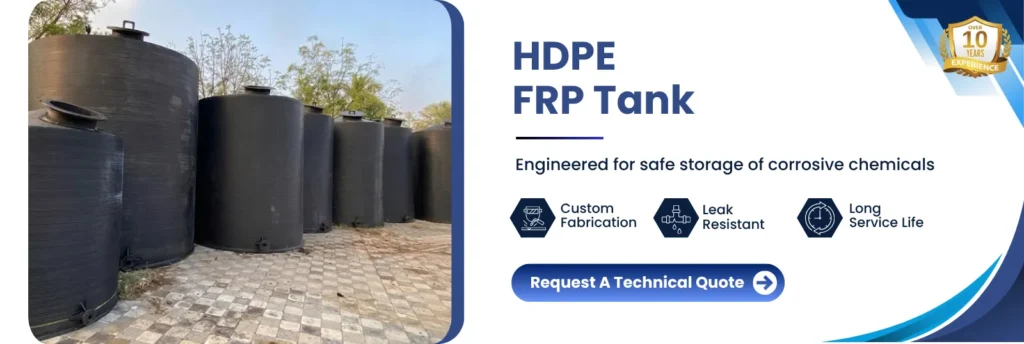






HDPE FRP Tank
An HDPE FRP Tank is an dual-layer storage system in which a corrosion-resistant. HDPE liner is the internally fused and fitted within the strong FRP outer shell. They provide both chemical resistance and mechanical strength for the storage of the aggressive liquids. An HDPE FRP tank is used to storage tank that combines the chemical resistance of HDPE (High-Density Polyethylene) with the mechanical strength of FRP (Fiber Reinforced Plastic). It can be offered the superior corrosion resistance against acids/alkalis and structural durability, commonly used for the chemical processing, water treatment, and wastewater.
An HDPE FRP Tank is a composite to industrial storage tank made by the combining two materials. HDPE (High-Density Polyethylene) is used as the inner lining, and FRP (Fiber Reinforced Plastic). They are used as the outer structural layer. An HDPE FRP tank is a dual-layer composite industrial storage vessel combining a chemical-resistant inner liner of the High-Density Polyethylene (HDPE) with a high-strength outer shell of Fiberglass Reinforced Plastic (FRP). At Petron Thermoplast, offered a HDPE FRP Tank to highly efficient solution for the streamlining. That is control the flow to meet the needs in various industrial applications. They are from their space-saving design to their reliable performance.
Excellent Chemical Resistance
Resistant to Acids, Alkalis, Corrosive, Industrial solvents
Corrosion-Free Performance
Unlike metal tanks, HDPE FRP tanks do not rust or corrode, even in highly corrosive industrial environments.
Leak-Proof Construction
Advanced thermoplastic welding and FRP lamination to create the strong, leak-resistant joints for safe liquid containment.
Long Service Life
Excellent durability and can operate for many years
ASTM / DVS / IS Certified
Manufactured to international quality standards
-5°C to 70°C
Operating Temperature
100 L to 100 KL+
Capacity (Customizable)
10–20 years
Service Life
ASTM / DVS / IS
Certified Design standards
3 mm to 20 mm
HDPE Liner Thickness

Excellent Chemical Resistance
HDPE FRP tanks provide an outstanding resistance against Acids, Alkalis, Corrosive chemicals & Industrial solvents

Temperature Resistance
Operating Temperature - Approx. -5°C to 70°C Pressure Condition - Atmospheric / Low Pressure

Advantages
Lightweight, Durable, Chemical Resistant, Low Maintenance

Safety Features
Corrosion Resistant, Impact Resistant, Leak Resistant

Technical Details
| Parameter | Technical Details |
| Tank Type | Composite Chemical Storage Tank |
| Inner Material | High-Density Polyethylene (HDPE) |
| Outer Reinforcement | Fiber Reinforced Plastic (FRP) |
| Tank Shape | Vertical, Horizontal, Rectangular, Cylindrical |
| Storage Capacity | 100 Liters to 100 KL or Above |
| HDPE Liner Thickness | 3 mm to 20 mm |
| FRP Layer Thickness | 3 mm to 12 mm |
| Manufacturing Method | HDPE Fabrication with FRP Lamination |
| Welding Process | Butt Fusion Welding, Extrusion Welding, Hot Gas Welding |
| FRP Lamination Process | Hand Lay-Up / Filament Winding |
| Operating Temperature | Approx. -5°C to 70°C |
| Pressure Condition | Atmospheric / Low Pressure |
| Chemical Compatibility | Acids, Alkalis, Corrosive Chemicals, Water Treatment Chemicals |
| Corrosion Resistance | Excellent |
| UV Resistance | Available with UV Stabilized Material |
| Leak Protection | Leak-Proof Welded Construction |
| Structural Reinforcement | FRP Stiffeners / Reinforcement Rings |
| Surface Finish | Smooth Internal Surface with FRP Outer Finish |
| Tank Mounting Type | Above Ground / Indoor / Outdoor |
| Available Top Designs | Flat Top, Dome Top, Open Top |
| Bottom Design Options | Flat Bottom / Conical Bottom |
| Nozzle Material | HDPE / PP / FRP |
| Connection Type | Flanged / Threaded / Stub End |
| Standard Accessories | Manhole, Vent Nozzle, Drain Valve, Level Indicator |
| Agitator Provision | Available on Request |
| Ladder & Platform | Optional |
| Testing Methods | Hydro Test, Spark Test, Weld Inspection |
| Installation Method | Base Mounted / Saddle Supported |
| Service Life | Long Operational Life |
| Maintenance Requirement | Low |
| Applications | Chemical Storage, Water Treatment, ETP, Pharmaceutical, Textile |
| Design Standards | ASTM / DVS / IS Standards |
| Color Options | Natural, Black, Customized |
| Fabrication Type | Custom Fabricated as per Requirement |
| Safety Features | Corrosion Resistant, Impact Resistant, Leak Resistant |
| Advantages | Lightweight, Durable, Chemical Resistant, Low Maintenance |
Chemical compatibility is one of the most important factors, when selecting an HDPE FRP tank. The HDPE FRP Tank inner liner provides to excellent resistance to a wide range of chemicals, while the FRP outer layer offers additional structural strength and environmental protection.
| Chemical Type | Compatibility Status | Typical Applications |
| Hydrochloric Acid (HCl) | Excellent | Chemical processing, pickling |
| Sulfuric Acid | Good to Excellent* | Industrial chemical storage |
| Nitric Acid | Moderate to Good* | Process industries |
| Caustic Soda (NaOH) | Excellent | Water treatment, chemical plants |
| Sodium Hypochlorite | Excellent | Water treatment systems |
| Alum Solution | Excellent | Water treatment plants |
| Phosphoric Acid | Good | Fertilizer and chemical industry |
| Acetic Acid | Good | Food and chemical processing |
| Citric Acid | Excellent | Food and pharmaceutical industries |
| Hydrogen Peroxide | Moderate* | Chemical dosing systems |
| Liquid Fertilizers | Excellent | Agrochemical industry |
| Brine Solutions | Excellent | Industrial process storage |
| Detergent Chemicals | Excellent | Cleaning and process plants |
| Process Water | Excellent | Industrial water systems |
| Wastewater Treatment Chemicals | Excellent | ETP and STP plants |
Chemicals Generally Not Recommended Without Special Design
Strong oxidizing agents
Highly concentrated nitric acid
Chlorinated solvents
Aromatic hydrocarbons
Extremely high-temperature chemicals
Compatibility should always be confirmed before use.
Quality of HDPE FRP Tank
Raw Material Quality
Use of high-grade HDPE (PE80/PE100) and premium FRP resins with glass fiber reinforcement
Manufacturing Standards
Fabrication follows standards such as ASTM, IS, or DIN with controlled welding and lamination processes
Dimensional Accuracy
Ensuring correct thickness, diameter, and capacity as per design
Surface Finish
Smooth inner HDPE lining and defect-free FRP outer surface.
| Test Type | Purpose / Description |
| Visual Inspection | Checks for cracks, bubbles, voids, and surface defects |
| Hydrostatic Test | The tank is filled with water to check for leakage and structural integrity |
| Spark Test (Holiday Test) | Detects pinholes or cracks in HDPE lining using a high-voltage spark tester |
| Ultrasonic Thickness Test | Measures the thickness of HDPE and FRP layers to ensure design compliance |
| Pressure / Vacuum Test | Verifies tank performance under internal/external pressure conditions |
| Chemical Resistance Test | Confirms compatibility of HDPE liner with stored chemicals |
| Leak Test | Ensures no seepage through joints or walls |
| Load / Structural Test | Evaluates strength and stability under operating conditions |
Industries We Serve

Chemical Processing Industry
HDPE FRP tanks are widely used for storing and handling:
Acids
Alkalis
Corrosive chemicals
Industrial solvents
Process liquids

Water Treatment Plants
These tanks are commonly used in water treatment systems for storing:
Sodium hypochlorite
Alum
Caustic soda
Hydrochloric acid
Chlorine solutions

Effluent Treatment Plants (ETP)
HDPE FRP tanks are extensively used in ETP systems for:
Neutralization chemical storage
Wastewater treatment chemicals
Sludge treatment solutions
Chemical dosing applications

Pharmaceutical Industry
In pharmaceutical plants, HDPE FRP tanks are used for:
Process chemical storage
Purified water systems
Intermediate liquid storage
Chemical mixing applications

Electroplating Industry
HDPE FRP tanks are widely used in electroplating operations for:
Acid dipping solutions
Metal treatment chemicals
Surface finishing chemicals

Pickling & Surface Treatment Plants
The tanks are used for:
Acid pickling baths
Chemical cleaning solutions
Surface preparation chemicals

Power Plants
Power generation industries use HDPE FRP tanks for:
Boiler treatment chemicals
Cooling tower chemicals
DM water treatment chemicals
Acid and alkali storage

Mining Industry
Mining operations use HDPE FRP tanks for:
Chemical reagent storage
Corrosive slurry handling
Process liquid containment
Their strong composite structure supports harsh industrial environments.

Petrochemical Industry
These tanks are used in petrochemical plants for:
Additive storage
Chemical transfer systems
Corrosive fluid handling

Chemical Dosing Systems
HDPE FRP tanks are integrated into:
Dosing skids
Metering systems
Chemical injection systems
for controlled chemical handling operations.

Marine & Coastal Applications
The corrosion-resistant design makes these tanks suitable for:
Coastal industrial plants
Saltwater environments
Marine chemical storage systems

Hazardous Chemical Storage
HDPE FRP tanks are ideal for safely storing:
Hazardous liquids
Reactive chemicals
Toxic industrial fluids
with reliable leak-proof protection.

Bulk Industrial Liquid Storage
These tanks are also used for:
Bulk liquid storage
Process water handling
Industrial chemical distribution systems
Features of HDPE FRP Tanks

Dual-Layer Composite Construction
HDPE FRP tanks are manufactured with:
Inner HDPE liner for chemical resistance
Outer FRP layer for the structural strength

Excellent Chemical Resistance
Acids
Alkalis
Corrosive chemicals
Industrial solvents
Structural stability
Load-bearing capacity
Impact resistance
Pressure handling capability

Corrosion-Free Performance
Unlike metal tanks, HDPE FRP tanks do not rust or corrode, even in highly corrosive industrial environments.

Leak-Proof Construction
Advanced thermoplastic welding and FRP lamination to create the strong, leak-resistant joints for safe liquid containment.

Lightweight Design
Easy transportation
Faster installation
Reduced handling cost
Lower structural load

Long Service Life
High durability
Resistance to environmental damage
Extended operational life with minimal maintenance

UV & Weather Resistance
Sunlight exposure
Weather damage
Outdoor environmental conditions

Low Maintenance Requirement
Maintenance frequency
Repair costs
Surface treatment requirements

Excellent Structural Stability
Tank shape
Dimensional stability
Mechanical reliability

Customizable Design
Storage capacity
Shape and dimensions
Chemical application
Nozzle arrangement
Thickness requirements

Smooth Internal Surface
Reduces chemical deposits
Improves cleaning efficiency
Supports hygienic storage
Prevents contamination

Temperature Resistance
These tanks can safely to handle the moderate industrial operating temperatures in chemical storage systems.

Suitable for Hazardous Chemical Storage
HDPE FRP tanks are designed for safe storage of:
Hazardous chemicals
Reactive liquids
Corrosive process fluids

Cost-Effective Storage Solution
Their long life, low maintenance, and corrosion resistance make HDPE FRP tanks an economical industrial storage option.
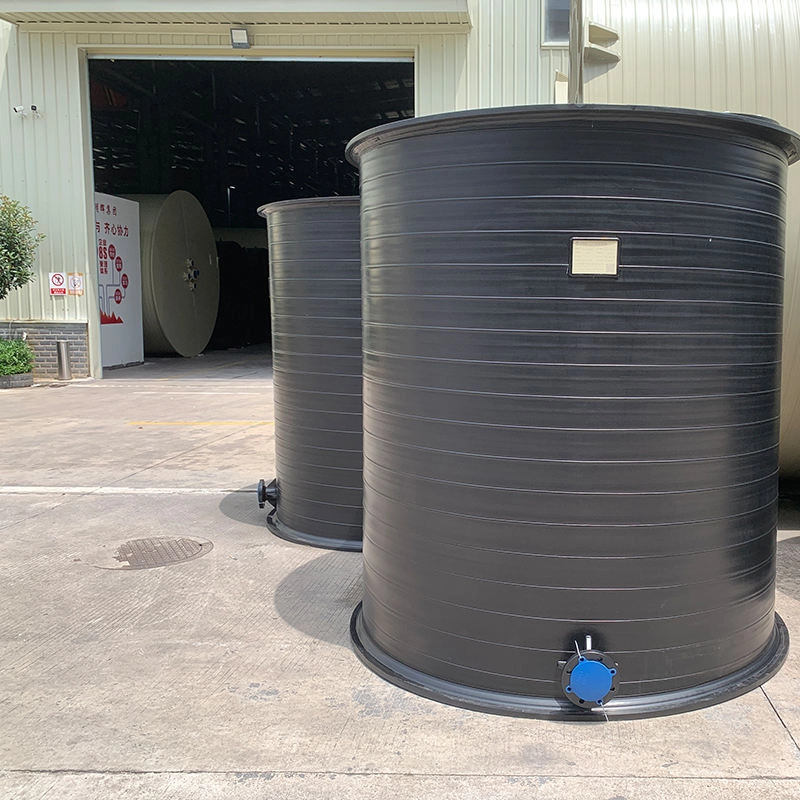
Manufacturing Process of HDPE FRP Tank
The manufacturing process begins with detailed engineering and design calculations based on:
- Tank capacity (100 Liters to 100 KL or Above)
- Chemical compatibility
- Operating temperature (Approx. -5°C to 70°C)
- Liquid density
- Installation conditions
- Pressure and load requirements
- HDPE liner thickness
- FRP reinforcement thickness
- Structural supports
- Nozzle locations
HDPE Material
- Chemical resistance
- Leak-proof performance
- Weldability
- Long service life
FRP Materials
- Glass fiber mat
- Woven roving
- Surface tissue
- Resin systems
- Vinyl ester resin
- Epoxy resin
- Isophthalic resin
HDPE sheets are cut into required dimensions using:
- CNC cutting machines
- Circular saws
- Precision cutting tools
- Tank shell
- Bottom plate
- Roof section
- Reinforcement components
The HDPE sheets are rolled into cylindrical or customized shapes using the rolling machines.
- Vertical shell body
- Horizontal shell structure
- Conical sections
- Dome covers
The HDPE sections are joined to using thermoplastic welding techniques such as:
- Butt fusion welding
- Extrusion welding
- Hot gas welding
HDPE welding rods are used to create
- Strong joints
- Leak-proof seams
- Chemically resistant connections
Critical welded areas include:
- Shell joints
- Bottom joints
- Nozzle areas
- Support sections
The tank bottom and top sections are welded to the shell body.
- Flat top
- Dome top
- Conical top
- Open-top configuration
- Inlet nozzles
- Outlet nozzles
- Drain connections
- Vent pipes
- Manholes
- Level indicators
- Sampling ports
Proper welding ensures leak-proof performance.
Before FRP lamination:
- The HDPE surface is cleaned
- Surface treatment is performed
- Bonding areas are prepared
An outer FRP reinforcement layer is applied over the HDPE tank using:
- Hand lay-up process
- Filament winding process
- Resin impregnation techniques
FRP layer includes:
- Glass fiber reinforcement
- Resin coating
- Structural strengthening layers
Stage improves:
- Mechanical strength
- Structural rigidity
- External protection
Additional strengthening components may include:
- FRP stiffeners
- Reinforcement rings
- External supports
- Saddle supports (for horizontal tanks)
These reinforcements improve tank stability.
After FRP lamination, the tank undergoes curing to:
- Harden the resi
- Improve structural integrity
- Achieve full mechanical strength
- At room temperature
- Under controlled heating conditions
Final finishing includes:
- Surface smoothing
- Edge trimming
- Cleaning
- UV coating application
- Protective finishing
How to Select the Right HDPE FRP Tank?
The first and most important step is to determine the
- Chemical name
- Chemical concentration
- Corrosive nature
- Reactivity level
Different chemicals required to specific HDPE liner thickness and FRP reinforcement designs.
Always verify whether the tank material is compatible with the stored chemical.
Important factors are include:
- Acid or alkali resistance
- Oxidizing properties
- Solvent compatibility
- Temperature effects on material
- Safe storage
- Longer tank life
- Reduced failure risk
Select the tank size according to:
- Daily consumption
- Process requirement
- Backup storage requirement
- Available installation space
The storage temperature directly affects tank material performance.
- Maximum operating temperature
- Ambient environmental conditions
- Chemical reaction temperature
- Increased wall thickness
- Special resin selection
- Additional reinforcement
Installation location plays a major role in tank selection.
Indoor Installation
- Less UV exposure
- Lower environmental stress
Outdoor Installation
- UV stabilization
- Weather-resistant FRP coating
- Additional structural suppor
- Vertical tanks
- Horizontal tanks
- Rectangular tanks
- Conical bottom tanks
- Space availability
- Drainage requirement
- Process flow system
Most HDPE FRP tanks are designed for atmospheric pressure applications.
- Pressure conditions
- Vacuum conditions
- Agitation loads
- Tank size
- Liquid density
- Chemical aggressiveness
- Operating temperature
- Structural safety
- Mechanical strength
- Long-term reliability
Consider required accessories such as:
- Inlet nozzles
- Outlet nozzles
- Vent pipes
- Drain valves
- Manholes
- Level indicators
The FRP outer layer should provide:
- High mechanical strength
- UV resistance
- Structural stability
- Resin quality
- Glass fiber reinforcement
- Lamination thickness
- Agitator mounting provision
- Load-bearing support
- Reinforced top structure
- Verify transport limitations
- Check site access area
- Confirm foundation requirements
- Plan lifting and installation methods

Custom Product Manufacturing Available
If you are searching for customized product designs that meet your requirements, don’t worry. Petron Thermoplast also offers custom product manufacturing services to meet the unique needs of various industries. Work with our expert engineers to create custom designs suited for your application.
Why Choose Petron Thermoplast?
At Petron Thermoplast, HDPE FRP Tank offered a highly efficient solution for the streamlining. That is control the flow to meet the needs in various industrial applications. They are from their space-saving design to their reliable performance. HDPE FRP Tanks are a versatile option for ensuring precise control over fluid flow. By investing in the HDPE FRP Tank, businesses can be improve efficiency, reduce maintenance costs, and enhance the overall system performance. Whether used in the oil and gas industry, chemical processing plants, or water treatment facilities.
HDPE FRP Tank offered a practical and reliable solution for managing the flow control requirements. The efficiency of HDPE FRP Tank made it an essential component for any organisation looking to optimize their flow control processes and achieve greater operational success.
Frequently Asked Questions
An HDPE FRP Tank is a dual-layer storage tank made with an HDPE inner lining for chemical resistance and an FRP outer layer for strength and durability.
They offer excellent corrosion resistance, high strength, leak-proof design, long lifespan, and low maintenance.
These tanks are suitable for acids, alkalis, solvents, and other corrosive chemicals, depending on compatibility with HDPE.
With proper installation and maintenance, the lifespan is usually 10–20 years or more
HDPE FRP Tanks are available from 500 liters to over 100,000 liters, and can be customized as per requirement.
Yes, the FRP outer layer provides UV resistance, making it suitable for outdoor installations.
They are made by welding HDPE sheets to form the inner liner and then applying FRP through filament winding or hand lay-up for external reinforcement.
They require minimal maintenance, mainly periodic inspection for joints and surface condition.
Yes, but they must be specially designed and reinforced for underground installation.