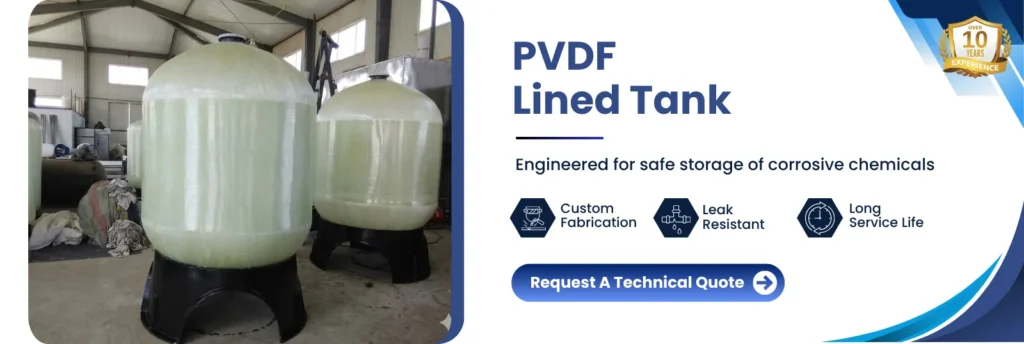






PVDF Lined Tank
A PVDF Lined tank is a type of industrial storage tank. The features of an internal lining made of PVDF (Polyvinylidene Fluoride) are a high-performance fluoropolymer known for its exceptional to chemical resistance, thermal stability, and purity. A PVDF lined tank is a high-performance industrial storage vessel featuring an inner protective barrier. It is designed to handle the extremely aggressive chemicals at high temperatures. A PVDF lined tank is a corrosion-resistant storage tank. A PVDF lined tank is used in highly corrosive, high-purity, and high-temperature chemicals industries where they need to be stored safely. PVDF (Polyvinylidene Fluoride) offered a excellent chemical resistance, thermal stability, and long service life to make it suitable for demanding industrial applications.
The lining in which is often bonded to a structural outer shell. Which is like Fiberglass Reinforced Plastic (FRP), acts as a corrosion-resistant barrier to protect the tank structure and prevent to contamination of the stored material. Petron Thermoplast’s offers PVDF lined tank to robust distribution network and, combined with best-in-class technology, is set to create a strong & sustainable partnership in the chemical Industry.
Excellent Chemical Resistance
Resistant to Strong Acids, Alkalis, Solvents, High-Purity Chemicals
Temperature Resistance
Approx. -20°C to 140°C
Corrosion-Free Construction
No rusting when exposed to chemicals & moisture.
Long Service Life
Excellent durability and can operate for many years
ASTM / IS / ASME Guidelines
Manufactured to international quality standards
-20°C to 140°C
Operating Temperature
100 L to 100 KL+
Capacity (Customizable)
15–25 years
Service Life
ASTM / IS / ASME
Certified Design Guidelines
2 mm to 10 mm
PVDF Lining Thickness

Excellent Chemical Resistance
Resistant to a wide range of corrosive chemicals, including the sulfuric acid and nitric acid to make them ideal for high-corrosion environments.

Temperature Resistance
Handles operating temperatures up to -20°C to 140°C

Long Service Life
The non-stick surface resists fouling, while the robust design allows for a long service life, often 20-30+ years.

Leak-Proof Welded Joints
Advanced thermoplastic welding techniques provide a Strong welded joints, Leak-resistant lining and Safe chemical containment for hazardous of liquid storage.

Technical Details
| Parameter | Technical Details |
| Tank Type | PVDF Lined Chemical Storage Tank |
| Lining Material | PVDF (Polyvinylidene Fluoride) |
| Outer Shell Material | FRP / MS / SS / HDPE (as per design) |
| Tank Shape | Vertical, Horizontal, Cylindrical, Rectangular |
| Storage Capacity | 100 Liters to 100 KL or Above |
| PVDF Lining Thickness | Typically 2 mm to 10 mm |
| Outer Shell Thickness | As per structural design requirement |
| Manufacturing Method | Thermoplastic Lining with Structural Outer Shell |
| Fabrication Technique | Butt Welding, Extrusion Welding, Hot Gas Welding |
| Operating Temperature | Approx. -20°C to 140°C |
| Pressure Rating | Atmospheric / Low Pressure / Custom Design |
| Chemical Compatibility | Strong Acids, Alkalis, Solvents, High-Purity Chemicals |
| Corrosion Resistance | Excellent |
| UV Resistance | High |
| Thermal Stability | Excellent High-Temperature Resistance |
| Leak Protection | Leak-Proof Welded Lining |
| Structural Reinforcement | FRP Lamination / Steel Reinforcement |
| Surface Finish | Smooth, Non-Reactive Internal Surface |
| Installation Type | Indoor / Outdoor / Above Ground |
| Top Design Options | Flat Top, Dome Top, Open Top |
| Bottom Design Options | Flat Bottom / Conical Bottom |
| Nozzle Material | PVDF / PP / FRP / SS |
| Connection Type | Flanged / Threaded / Stub End |
| Standard Accessories | Manhole, Vent, Drain Valve, Level Indicator |
| Agitator Provision | Available on Request |
| Ladder & Platform | Optional |
| Testing Methods | Spark Test, Hydro Test, Vacuum Test, Weld Inspection |
| Welding Standards | DVS / International Thermoplastic Welding Standards |
| Design Standards | ASTM / IS / ASME Guidelines |
| Color Options | Natural / Customized |
| Service Life | Long Operational Life |
| Maintenance Requirement | Low |
| Applications | Chemical Storage, Semiconductor, Pharmaceutical, Electroplating |
| Suitable Chemicals | HCl, H₂SO₄, NaOH, Chlorine Chemicals, Solvents |
| Mechanical Strength | High Structural Stability |
| Purity Level | Suitable for High-Purity Applications |
| Safety Features | Corrosion Resistant, Leak Resistant, Chemical Resistant |
| Advantages | High Chemical Resistance, Thermal Stability, Long Life |
PVDF (Polyvinylidene Fluoride) lined tanks are specially designed for storing highly corrosive, reactive, and high-purity chemicals. PVDF offers outstanding resistance to acids, oxidizing agents, solvents, and aggressive industrial chemicals, making it one of the most reliable fluoropolymer lining materials for demanding industrial applications.
Proper chemical compatibility helps ensure:
- Safe chemical storage
- Long service life
- Leak prevention
- Reduced maintenance
- Reliable industrial performance
Common Chemicals Compatible with PVDF-Lined Tanks
| Chemical | Compatibility | Typical Applications |
| Hydrochloric Acid (HCl) | Excellent | Chemical processing plants |
| Sulfuric Acid (H₂SO₄) | Excellent* | Acid storage systems |
| Nitric Acid (HNO₃) | Excellent | Semiconductor & pharma industry |
| Phosphoric Acid | Excellent | Fertilizer plants |
| Hydrofluoric Acid (HF) | Good to Excellent* | Specialized chemical handling |
| Caustic Soda (NaOH) | Excellent | Water treatment systems |
| Sodium Hypochlorite | Excellent | Chlorination systems |
| Chlorine-Based Chemicals | Excellent | Chlor-alkali industry |
| Hydrogen Peroxide | Excellent | Oxidizing chemical storage |
| Acetic Acid | Excellent | Food & chemical processing |
| Citric Acid | Excellent | Pharmaceutical applications |
| Solvent Solutions | Good to Excellent* | Industrial process systems |
| Brine Solutions | Excellent | Process industries |
| Process Water | Excellent | High-purity water systems |
| Wastewater Chemicals | Excellent | ETP & STP systems |
- Spark Testing (Holiday Detection): Conducted to ensure the liner is completely free from pinholes and defects. A high-voltage dielectric spark tester is used over the entire inner surface.
- Hydrostatic Testing: The tank is filled with water to test for leaks and verify structural integrity under pressure, as per guidelines like DIN EN 14879-1.
- Weld Testing: PVDF sheets are joined using hot gas string bead welding or butt fusion, frequently adhering to German standards (DVS), which offer a higher, more reliable welding factor than traditional rod welding.
- Adhesion/Bond Testing: For sheet-lined tanks, the bond strength between the PVDF sheet (often glass-backed) and the substrate is verified, typically ensuring a minimum adhesion of 5 N/mm².
- Thickness Measurement: Ultrasonic testing is often used to ensure the PVDF liner meets specified thickness requirements (e.g., 60, 90, or 120 mils).
- Visual Inspection: A thorough inspection for smooth surfaces, proper adhesion, and lack of blisters or voids, especially after fabrication.
- Welding Quality: High-quality thermoplastic welding on European Butt welding machines provides a better long-term welding factor.
- Material Certification: Ensuring the use of high-grade, pure PVDF resin, with MTC/COA (Material Test Certificate/Certificate of Analysis) provided.
- Chemical Compatibility: The lining is checked for compatibility with intended chemicals (acids, alkali, solvents) using data from sources like Arkema.
- Manufacturing Standards: Adherence to standards such as ISO 9001, ASTM (American Society for Testing and Materials), and DIN standards.
Industries We Serve

Chemical Industry
PVDF-lined tanks are extensively to used for storing and handling:
Strong acids
Alkalis
Corrosive chemicals
Reactive solvents
Process chemicals
Their superior chemical resistance to ensure the safe and reliable operation.

Semiconductor Industry
These tanks are widely used in semiconductor manufacturing for:
Ultra-pure chemical storage
Electronic-grade chemical handling
Acid storage systems
High-purity water applications
The non-reactive PVDF surface helps to maintain contamination-free processing

Pharmaceutical Industry
PVDF-lined tanks are suitable for:
High-purity liquid storage
Process chemical handling
Purified water systems
Hygienic pharmaceutical applications
Their smooth internal surface supports clean processing environments.

Electroplating Industry
These tanks are commonly used for:
Acid dipping baths
Electroplating chemicals
Surface treatment solutions
Corrosive metal finishing chemicals
PVDF lining provides excellent resistance to aggressive plating solutions.
Water Treatment Plants
PVDF-lined tanks are used for storing:
Sodium hypochlorite
Hydrochloric acid
Caustic soda
Chlorine-based chemicals
Water treatment solutions
They provide safe and corrosion-resistant chemical containment.

Pickling & Metal Treatment Plants
These tanks are ideal for:
Acid pickling systems
Metal cleaning chemicals
Surface preparation processes
due to their excellent acid resistance.

Petrochemical Industry
In petrochemical plants, PVDF-lined tanks are used for:
Corrosive chemical storage
Process fluid handling
Solvent storage systems
Chemical transfer applications

Chlor-Alkali Industry
These tanks are widely used in chlor-alkali applications involving:
Chlorine chemicals
Caustic solutions
Corrosive industrial fluids

High-Temperature Chemical Storage
PVDF lining performs well in:
Heated chemical systems
High-temperature process tanks
Thermal chemical storage applications
where conventional plastics may fail.

Effluent Treatment Plants (ETP)
PVDF-lined tanks are used in wastewater
treatment systems for:
Neutralization chemicals
Corrosive wastewater liquids
Hazardous treatment chemicals

Electronics & Battery Industry
These tanks are suitable for:
Battery chemical handling
Electrolyte storage
Specialty electronic chemicals
where high purity and corrosion resistance are required.

Mining Industry
Mining operations use PVDF-lined tanks for:
Chemical reagent storage
Corrosive slurry systems
Mineral processing chemicals

Specialty Chemical Industry
These tanks are ideal for handling:
High-purity specialty chemicals
Reactive process liquids
Sensitive industrial compounds

Hazardous Chemical Storage
PVDF-lined tanks provide safe containment for:
Toxic chemicals
Highly corrosive liquids
Reactive industrial fluids
with excellent leak protection and durability.

Features of PVDF Lined Tanks

Outstanding Chemical Resistance
Resistant to a wide range of corrosive chemicals, including the sulfuric acid and nitric acid to make them ideal for high-corrosion environments.

Temperature Resistance
Handles operating temperatures up to -20°C to 140°C

Dual-Layer Strength (PVDF+FRP):
Combines the chemical resistance of a PVDF liner with the superior mechanical strength and rigidity of an FRP shell.

Low Permeability
Exceptional resistance to permeation by liquids and gases, preventing hazardous leaks.
High Purity/Non-Contaminating
Ideal for pharmaceutical, semiconductor, and food processing applications due to its inert and hygienic nature.

Durability and Low Maintenance
The non-stick surface resists fouling, while the robust design allows for a long service life, often 20-30+ years.

Customizable Designs
Available in various sizes (50 to 50,000+ liters) and types (vertical, horizontal, conical bottom).

UV and Weather Resistance
Suitable for outdoor installation due to strong resistance to UV radiation

Superior Corrosion Protection
The PVDF lining protects the tank from Chemical corrosion, Rust formation, Surface degradation and Chemical attack to ensure the long-term operational reliability.

Leak-Proof Construction
Advanced thermoplastic welding techniques provide a Strong welded joints, Leak-resistant lining and Safe chemical containment for hazardous of liquid storage.
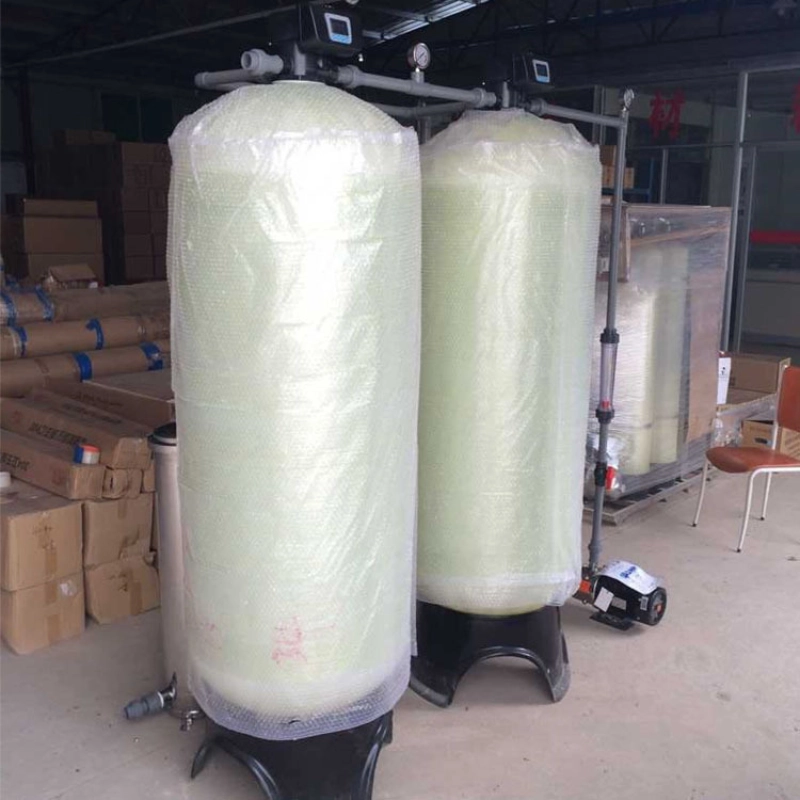
Manufacturing Process of PVDF-Lined Tank?
The manufacturing process of a PVDF-lined tank to involves combining a strong structural outer shell with a highly chemical-resistant PVDF (Polyvinylidene Fluoride) inner lining. These tanks are specially to designed for storing highly corrosive, reactive, and high-purity chemicals in demanding the industrial applications.
The manufacturing process begins with detailed engineering calculations based on:
- Chemical compatibility
- Tank capacity (100 Liters to 100 KL or Above)
- Operating temperature
- Pressure conditions
- Structural load requirements
- Installation environment
- PVDF lining thickness
- Structural shell thickness
- Reinforcement requirements
- Nozzle arrangement
PVDF Lining Material
High-quality PVDF sheets are selected for:
- Excellent chemical resistance
- High-temperature stability
- Low permeability
- Long service life
Structural Shell Material
The outer shell may be manufactured using:
- FRP (Fiber Reinforced Plastic)
- Mild Steel (MS)
- Stainless Steel (SS)
- HDPE
Depending on application requirements.
The outer shell is fabricated first using:
- Rolling machines
- Welding equipment
- Structural forming tools
- Tank body
- Bottom section
- Roof structure
- Reinforcement supports
Before PVDF lining installation:
- Internal surfaces are cleaned
- Surface finishing is performed
- Bonding areas are prepared
Proper preparation improves lining adhesion and durability
PVDF sheets are cut according to tank dimensions using:
- CNC cutting machines
- Precision cutting tools
- Thermoplastic fabrication equipment
The sheets are prepared for:
- Tank shell lining
- Bottom lining
- Roof lining
- Nozzle lining
The PVDF sheets are installed inside the tank shell using:
- Thermoplastic welding techniques
- Heat forming methods
- Precision fitting procedures
This creates a continuous corrosion-resistant lining layer.
PVDF sheets are joined using:
- Butt welding
- Extrusion welding
- Hot gas welding
These welding methods ensure:
- Strong joints
- Leak-proof seams
- Chemical-resistant connections
Critical welded areas include:
- Shell joints
- Bottom joints
- Corner joints
- Nozzle areas
Various process fittings are installed, including:
- Inlet nozzles
- Outlet nozzles
- Vent connections
- Drain nozzles
- Manholes
- Sampling ports
The nozzles are lined and welded carefully to maintain the complete corrosion resistance.
Additional support systems may include:
- FRP reinforcement
- Steel stiffeners
- Structural support rings
- Saddle supports (for horizontal tanks)
- Mechanical strength
- Structural stability
- Load-bearing capacity
The PVDF lining is tested using spark testing to detect:
- Pinholes
- Weld defects
- Lining discontinuities
- Leakage points
This ensures lining integrity.
How to Select the Right PVDF-Lined Tank?
Selecting the correct HDPE PVDF-lined chemical tank is an essential for ensuring to safe chemical storage, long service life, corrosion resistance, and reliable industrial performance. The selection process should be consider for chemical properties, operating conditions, tank design, and installation requirements.
The first step is to determine:
- Chemical name
- Chemical concentration
- Corrosive nature
- Reactivity level
- Purity requirement
Different chemicals may required to specific PVDF lining thickness and tank construction.
Always verify the compatibility of:
- PVDF lining
- HDPE structure
- Nozzle materials
- Gasket materials
with the chemical being stored.
- Acid resistance
- Alkali resistance
- Solvent compatibility
- Oxidizing chemical behavior
- Chemical attack
- Tank failure
- Leakage
- Material degradation
4. Determine Required Storage Capacity
5. Select Proper Tank Shape
Choose tank configuration according to application needs.
Common options:
- Vertical tanks
- Horizontal tanks
- Cylindrical tanks
- Rectangular tanks
- Conical bottom tanks
- Floor space
- Drainage requirement
- Process flow system
Indoor Installation
- Lower UV exposure
- Reduced environmental stress
Outdoor Installation
- UV-resistant outer protection
- Weatherproof design
- Structural reinforcement
Most chemical storage tanks operate under atmospheric pressure.
- Internal pressure
- Vacuum conditions
- Agitator loads
Additional reinforcement and engineering design may be necessary.
Tank wall and lining thickness depend on:
- Chemical aggressiveness
- Operating temperature
- Tank size
- Liquid density
Proper thickness improves:
- Structural safety
- Corrosion resistance
- Long-term durability
Consider required fittings such as:
- Inlet nozzles
- Outlet nozzles
- Vent pipes
- Drain valves
- Manholes
- Level indicators
- Sampling ports
Correct arrangement improves operational efficiency.
High-quality PVDF lining should provide:
- Uniform thickness
- Strong welded joints
- Smooth internal finish
- Leak-proof construction
Verify welding methods such as:
- Butt welding
- Extrusion welding
- Hot gas welding

Custom Product Manufacturing Available
If you are searching for customized product designs that meet your requirements, don’t worry. Petron Thermoplast also offers custom product manufacturing services to meet the unique needs of various industries. Work with our expert engineers to create custom designs suited for your application.
Why Choose Petron Thermoplast?
Petron Thermoplast is the world’s largest supplier and the inventor of the PVDF Lined Tank, which compounds give us a sharp competitive edge among companies. As we are exclusively bringing the Petron thermoplast to the market, the first choice of globally for potable chemical applications. Petron Thermoplast’s robust distribution network to combined with best-in-class technology, is set to create a strong & sustainable partnership in the chemical Industry.
Frequently Asked Questions
A PVDF-lined tank is a storage tank with an internal lining made of PVDF (Polyvinylidene Fluoride), designed to resist highly corrosive chemicals and high temperatures.
They offer excellent chemical resistance, high thermal stability, high purity, long lifespan, and low maintenance.
They are suitable for strong acids, oxidizing agents, halogens, and high-purity chemicals, depending on compatibility.
Typically, PVDF-lined tanks can handle temperatures from -20°C to +140°C.
The average lifespan is 15–25 years, depending on operating conditions and maintenance.
The outer shell is usually made of Mild Steel (MS), FRP, or Stainless Steel for structural support.
Yes, PVDF provides high purity and low contamination, making it ideal for pharmaceutical and semiconductor industries.
The lining is applied using sheet welding, thermoforming, or extrusion welding techniques.
They require minimal maintenance, mainly routine inspections for lining integrity and joints.
Yes, PVDF has good UV resistance, making it suitable for outdoor installations.