HDPE Rods
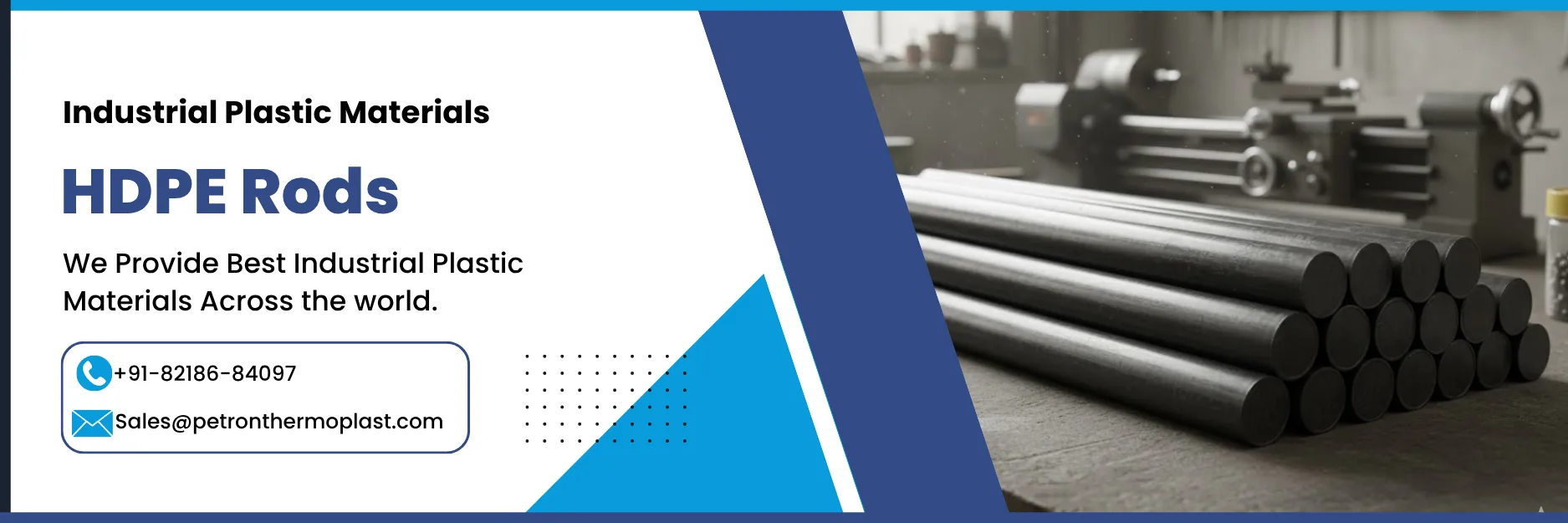
An HDPE rod (High-Density Polyethylene rod) is a solid cylindrical plastic bar made from high-density polyethylene, a thermoplastic polymer known for its strength, durability, and chemical resistance. It is manufactured through extrusion processes and is widely used in industrial, mechanical, and fabrication applications. HDPE (High-Density Polyethylene) Rod is a thermoplastic made from petroleum. It is known for its high strength-to-density ratio, lightweight properties, and exceptional chemical resistance. Available in various diameters and lengths.
An HDPE rod is a tough, lightweight plastic rod used for machining, fabrication, and structural purposes.Manufacturing of plastic components and parts to Industrial machinery components and wear strips, guides, and rollers.HDPE rods are widely used in CNC machining, fabrication, and component manufacturing across industries.

HDPE Rod Details
| Property | Details / Range |
| Material Type | High-Density Polyethylene (HDPE) |
| Density | 0.94 – 0.97 g/cm³ |
| Molecular Structure | Linear polymer with minimal branching |
| Color Options | Natural (white), black, blue, green, custom colors |
| Diameter Range | 10 mm to 300 mm (can vary as per requirement) |
| Length | Standard: 1 m, 2 m, 3 m (custom lengths available) |
| Melting Point | 120°C – 135°C |
| Working Temperature | -50°C to +80°C |
| Tensile Strength | 20 – 37 MPa |
| Flexural Modulus | 700 – 1400 MPa |
| Impact Strength | High (excellent shock absorption) |
| Hardness (Shore D) | 60 – 70 |
| Water Absorption | < 0.01% |
| Chemical Resistance | Excellent (resistant to acids, alkalis, solvents) |
| UV Resistance | Moderate (better in black/UV-stabilized grades) |
| Electrical Insulation | Excellent dielectric properties |
| Thermal Conductivity | 0.4 – 0.5 W/m·K |
| Machinability | Easy to cut, drill, weld, and machine |
| Surface Finish | Smooth, low friction |
| Friction Coefficient | Low (self-lubricating property) |
| Nominal Size (DN / Inch) | SCH 40 Max Pressure @ 20°C | SCH 40 Max Pressure @ 60°C | SCH 80 Max Pressure @ 20°C | SCH 80 Max Pressure @ 60°C | Typical Application |
| ½” (15 mm) | 17 bars (~246 psi) | 10 bar (~145 psi) | 26 bar (~377 psi) | 15 bar (~218 psi) | Domestic hot/cold water |
| ¾” (20 mm) | 15 bar (~218 psi) | 9 bar (~130 psi) | 24 bar (~348 psi) | 14 bar (~203 psi) | Hot water & industrial |
| 1″ (25 mm) | 14 bar (~203 psi) | 8 bar (~116 psi) | 22 bar (~319 psi) | 13 bar (~189 psi) | Industrial, chemical lines |
| 1¼” (32 mm) | 13 bar (~189 psi) | 7 bar (~102 psi) | 20 bar (~290 psi) | 12 bar (~174 psi) | Hot/cold water supply |
| 1½” (40 mm) | 12 bar (~174 psi) | 7 bar (~102 psi) | 19 bar (~276 psi) | 11 bar (~160 psi) | Industrial piping |
| 2″ (50 mm) | 11 bar (~160 psi) | 6 bar (~87 psi) | 18 bar (~261 psi) | 11 bar (~160 psi) | Industrial & commercial |
| 2½” (65 mm) | 10 bar (~145 psi) | 6 bar (~87 psi) | 16 bar (~232 psi) | 10 bar (~145 psi) | Hot water pipelines |
| 3″ (80 mm) | 10 bar (~145 psi) | 5 bar (~73 psi) | 16 bar (~232 psi) | 10 bar (~145 psi) | Industrial water systems |
| 4″ (100 mm) | 9 bar (~130 psi) | 5 bar (~73 psi) | 14 bar (~203 psi) | 9 bar (~130 psi) | Hot/cold water supply |
| 6″ (150 mm) | 8 bar (~116 psi) | 4 bar (~58 psi) | 12 bar (~174 psi) | 8 bar (~116 psi) | Industrial piping |
| 8″ (200 mm) | 8 bar (~116 psi) | 4 bar (~58 psi) | 12 bar (~174 psi) | 8 bar (~116 psi) | Large-diameter systems |
| Property | Value / Range |
| Melting Temperature | 120°C – 135°C |
| Continuous Working Temperature | -50°C to +80°C |
| Short-Term Maximum Temperature | Up to 100°C |
| Softening Point (Vicat) | 120°C – 130°C |
| Brittle Temperature | Below -50°C |
| Thermal Expansion | High (expands with heat) |
| Property | Value / Range |
| Density | 0.94 – 0.97 g/cm³ |
| Standard Grade Density | ~0.95 g/cm³ |
| Density (kg/m³) | 940 – 970 kg/m³ |
| Nominal Diameter (mm) | Tolerance (mm) | Standard Length (mm) | Remarks |
| 10 mm | +0.1 to +0.6 | 1000 / 2000 / 3000 | Small rods (precision parts) |
| 12 mm | +0.2 to +0.7 | 1000 / 2000 / 3000 | Light-duty applications |
| 15 mm | +0.2 to +0.8 | 1000 / 2000 / 3000 | Machining use |
| 20 mm | +0.2 to +1.0 | 1000 / 2000 / 3000 | General industrial |
| 25 mm | +0.2 to +1.1 | 1000 / 2000 / 3000 | Medium-duty parts |
| 30 mm | +0.2 to +1.2 | 1000 / 2000 / 3000 | Structural use |
| 40 mm | +0.2 to +1.5 | 1000 / 2000 / 3000 | Heavy machining |
| 50 mm | +0.3 to +2.0 | 1000 / 2000 / 3000 | Industrial applications |
| 75 mm | +0.4 to +3.0 | 1000 / 2000 / 3000 | Heavy-duty components |
| 100 mm | +0.6 to +3.8 | 1000 / 2000 / 3000 | High load applications |
| 150 mm | +1.0 to +5.8 | 1000 / 2000 / 3000 | Large fabrication |
| 200 mm | +1.3 to +8.5 | 1000 / 2000 / 3000 | Bulk engineering use |
| 250 mm | +1.3 to +9.0 | 1000 / 2000 / 3000 | Custom industrial |
| 300 mm | +1.3 to +10 | 1000 / 2000 / 3000 | Maximum standard size |
User Manual for HDPE Rod
1. Material Inspection
- Check for surface defects, cracks, or warping before use
- Verify diameter and length tolerances as per requirement
2. Cutting & Machining
- Use standard tools like:
- Lathe machines
- Band saws
- CNC machines
- Ensure sharp cutting tools to avoid melting or deformation
- Maintain low cutting speed to reduce heat generation
3. Drilling & Shaping
- Use proper drill bits designed for plastics
- Apply moderate pressure to avoid cracking
- Allow space for thermal expansion during design
4. Welding & Joining
Methods used:
- Butt welding
- Extrusion welding
- Ensure:
- Clean surfaces before welding
- Correct temperature control (approx. 200°C – 220°C for welding)
5. Fixing & Assembly
- Use mechanical fasteners (bolts, screws) or press fitting
- Avoid over-tightening (HDPE is softer than metals)
- Use support structures for long rods to prevent bending
6. Installation Environment
- Avoid direct exposure to high heat (>80°C)
- For outdoor use, prefer UV-stabilized HDPE rods
- Ensure proper alignment to prevent stress concentration
Maintenance of HDPE Rod
1. Regular Inspection
- Check for:
- Wear and tear
- Surface damage
- Deformation under load
2. Cleaning
- Clean using:
- Mild detergent and water
- Avoid:
- Harsh chemicals (though HDPE is resistant, additives may be affected)
3. Lubrication
- Usually not required (HDPE has low friction)
- Optional in high-load applications
4. Temperature Monitoring
- Ensure operating temperature remains within -50°C to +80°C
- Avoid prolonged exposure to high temperatures
5. UV Protection
- For outdoor applications:
- Use black or UV-stabilized rods
- Periodically check for color fading or brittleness
6. Replacement Guidelines
- Replace rods if:
- Significant wear or deformation occurs
- Cracks or structural weakness is visible
Installation & maintenance
Step 1: Measure & Cut the Pipe
- CPVC pipe fittings are used to measure the length of pipe according to need.
- Use a pipe cutter or fine-toothed saw to make a straight and clean cut.
- Avoid angled or jagged cuts.
Step 2: Deburr & Clean
- Remove burrs and rough edges from the cut due to using a deburring tool or sandpaper.
- Firstly, clean the pipe end and fit the socket with a dry cloth to remove the dust or moisture.
Step 3: Dry Fit
- Insert the pipe into the fitting without cement to check the alignment.
- Ensuring the pipe got fully inside the socket and the system layout works.
Step 4: Apply Primer (if required)
- Some standards required for CPVC pipe fittings are primer before solvent cement.
- Apply primer to the outside of the pipe end and inside the fitting socket.
Step 5: Apply Solvent Cement
- Apply CPVC pipe fitting solvent cement evenly to the pipe end and fitting socket.
- Work quickly, and cement sets fast.
Step 6: Assemble
- Insert the CPVC pipe fully into the fitting with a slight twisting motion.
- Hold in position for 15–30 seconds to allow initial bonding.
Step 7: Wipe Excess Cement
- Remove the excess cement around the joint using a clean cloth.
Step 8: Allow to Cure
- Let the joint cure according to manufacturer instructions (typically 15–30 minutes for handling, 24 hours for full pressure testing).
Step 9: Pressure Test
- Once cured, perform a pressure test to check for leaks before putting the system into operation.
Maintenance
1. Regular Inspection
- Firstly, check the joints and fittings for leaks or cracks.
- Look for discoloration or deformation, which may indicate chemical or heat damage.
- Inspect supports and clamps to ensure pipes are properly secured.
2. Cleaning
- Wipe the cpvc pipe fittings and visible pipes with a soft cloth to remove dust or deposits.
- For chemical lines, flush the system periodically to prevent scaling or sediment buildup.
3. Avoid Excessive Heat
- CPVC is resistant to high temperatures (up to ~90°C), but exposure to open flames or heat sources can damage fittings.
- Keep pipes away from direct sunlight if outdoors, and use UV protection.
4. Check for Mechanical Stress
- Ensuring the CPVC pipes and fittings are not under tension, bending, or twisting.
- Check clamps and brackets — loose supports can stress joints.
5. Pressure Monitoring
- Operate within the manufactured to recommended pressure limits.
- Avoid water hammer or sudden pressure spikes, as these can damage fittings over time.
6. Chemical Compatibility
- Ensure that the chemicals passing through the CPVC pipe fitting system are compatible.
- Avoid exposure to solvents, ketones, or other aggressive chemicals that can weaken the material.
7. Replace Damaged Fittings
- If a fitting shows cracks, leaks, or deformation, replace it immediately.
- Never attempt to repair a cracked CPVC pipe fitting with glue or tape.
8. Periodic System Testing
- Conduct hydrostatic or pressure tests at intervals to ensure the system’s integrity.
- Confirm that joints remain leak-proof after testing.
1. Size & Dimension Customization
- Diameter range: Typically from 10 mm to 500 mm+
- Length: Standard (1–3 meters) or cut-to-size as per requirement
- Tolerances: Tight machining tolerances for precision components
2. Color Customization
- Standard: Natural (milky white), Black
- Custom colors: Blue, Green, Red, Yellow (for identification or branding)
3. Material Grade Selection
- Virgin HDPE: High purity, food-grade applications
- Reprocessed HDPE: Cost-effective for non-critical uses
- UV Stabilized HDPE: For outdoor exposure
- Anti-static HDPE: For electronic environments
4. Surface Finish
- Smooth finish for low friction applications
- Textured or matte finish for grip or aesthetic needs
5. Additives & Modifications
- UV stabilizers
- Flame retardants
- Anti-oxidants
- Glass-filled HDPE for improved strength
Processing of HDPE Rod
Processing includes manufacturing and shaping the rod into usable components:
1. Extrusion Process
- Most common method for producing HDPE rods
- Molten HDPE is pushed through a die to form cylindrical shapes
- Ensures uniform diameter and smooth surface
2. Machining Operations
HDPE rods are easy to machine using conventional tools:
- Turning (lathe work)
- Milling
- Drilling
- Cutting / sawing
- Threading
- Bushings
- Rollers
- Gears
- Wear strips
3. Welding & Fabrication
- Methods: Butt fusion, hot plate welding, extrusion welding
- Used to join rods with sheets or other plastic parts
4. Thermoforming
- Heating the rod and shaping it into required forms
- Limited use compared to sheets but possible for bending
5. CNC Processing
- High-precision machining for complex parts
- Ideal for industrial and engineering components
6. Surface Treatment
- Polishing for smoother finish
- Flame treatment for improved adhesion (if bonding required)
1. Chemical Industry
- Used for manufacturing:
- Chemical tank components
- Scrubber parts
- Valve seats and seals
- Excellent resistance to acids, alkalis, and corrosive chemicals
2. Water Treatment Industry
- Pipe fittings
- Pump components
- Filtration system parts
- Non-toxic, corrosion-resistant, and suitable for potable water
3.Marine Industry
- Dock fenders
- Wear strips
- Boat components
- Resistant to saltwater, UV rays, and moisture
4. Automotive Industry
- Used for:
- Bushings
- Gears
- Wear pads
- Lightweight, reduces friction and noise
5. Construction Industry
- Ground protection mats
- Spacer blocks
- Structural supports
- High impact strength and weather resistance
6. Electrical & Electronics Industry
- Used in:
- Insulators
- Cable supports
- Electrical housings
- Excellent electrical insulation properties
7. Textile Industry
- Machine components
- Guide rollers
- Smooth surface reduces friction and wear
8. Packaging Industry
- Used for:
- Machine parts
- Conveyor components
- Durable and resistant to wear and tear
1. Density Test
- Determines material consistency and purity
- Typical range: 0.94 – 0.97 g/cm³
- Method: Water displacement or density gradient column
2. Melt Flow Index (MFI) Test
- Measures flowability of molten HDPE
- Indicates processing quality and molecular weight
- Lower MFI → higher strength, higher MFI → better flow
3. Tensile Strength Test
- Evaluates resistance to pulling forces
- Ensures the rod can withstand mechanical loads
- Conducted using a universal testing machine
4. Impact Strength Test
- Measures resistance to sudden shocks or impacts
- Common method: Izod or Charpy impact test
5. Hardness Test
- Determines surface resistance to indentation
- Usually measured on the Shore D scale
6. Thermal Testing
- Includes:
- Vicat Softening Temperature (VST)
- Heat Deflection Temperature (HDT)
- Ensures performance at elevated temperatures
7. Chemical Resistance Test
- Exposes HDPE rod to acids, alkalis, and solvents
- Checks for swelling, cracking, or degradation
8. Dimensional Accuracy Test
- Measures diameter, length, and roundness
- Tools: Vernier caliper, micrometer
9. Environmental Stress Crack Resistance (ESCR)
- Evaluates resistance to cracking under stress and chemicals
- Important for long-term durability
10. Ultraviolet (UV) Resistance Test
- Assesses performance under sunlight exposure
- Important for outdoor applications
Quality Control of HDPE Rod
1. Raw Material Inspection
- Verification of HDPE resin grade
- Checking for contamination or impurities
2. In-Process Quality Checks
- Monitoring extrusion temperature and pressure
- Ensuring uniform diameter and smooth surface
3. Final Product Inspection
- Visual inspection for defects (cracks, bubbles, voids)
- Mechanical and dimensional testing
1. High-Density Polyethylene (HDPE) Resin
- The core raw material used to produce HDPE rods
- Derived from polymerization of ethylene (C₂H₄)
- Available in the form of granules or pellets
2. UV Stabilizers
- Protect rods from sunlight degradation
- Essential for outdoor applications
3. Antioxidants
- Prevent thermal degradation during processing
- Improve lifespan of the rod
4. Color Masterbatches
- Provide color (black, blue, green, etc.)
- Black HDPE often contains carbon black for UV resistance
5. Processing Aids
- Improve melt flow during extrusion
- Ensure smooth surface finish
6. Anti-static Agents
- Reduce static charge buildup
- Used in electronic or dust-sensitive environments
7. Glass Fiber (Optional)
- Added for increased stiffness and strength
- Used in heavy-duty industrial applications

Custom Product Manufacturing Available
If you are searching for customized product designs that meet your requirements, don’t worry. Petron Thermoplast also offers custom product manufacturing services to meet the unique needs of various industries. Work with our expert engineers to create custom designs suited for your application.
Benefits of HDPE Rods
1. Durability and Longevity
Experts agree that one of the main advantages of HDPE plastic rods is their durability. They are known to withstand wear and tear in demanding environments, ensuring longevity even when exposed to physical stressors.
2. Chemical Resistance
Bob Brown, a chemical engineer, emphasizes, “The intrinsic resistance of HDPE to various chemicals makes it an essential material in industries involving hazardous substances.” This enables safe handling and storage in chemical processing plants and similar applications.
3. Cost-Effectiveness
Furthermore, Sarah Wilson, a financial analyst in manufacturing, points out, “Investing in HDPE plastic rods can lead to significant cost savings in the long run due to their low maintenance requirements and extended service life.” This aspect is particularly beneficial for businesses focused on sustainability and efficiency.
4. Eco-Friendly Options
In addition, as the demand for sustainable materials rises, HDPE plastic rods stand out for being recyclable. Michael Green, an environmentalist, mentions, “Using HDPE allows companies to adopt eco-friendly practices without sacrificing quality.” This makes HDPE plastic rods a responsible choice for businesses looking to minimize their environmental footprint.
Types of HDPE Rods
1. Virgin HDPE Rod
- Made from 100% pure (new) raw material
- High strength and durability
- Excellent chemical resistance
- Suitable for food-grade and medical applications
2. Reprocessed (Recycled) HDPE Rod
- Manufactured from recycled HDPE material
- More economical than virgin grade
- Slightly lower mechanical properties
- Used in general industrial and non-critical applications
3. UV Stabilized HDPE Rod
- Contains UV inhibitors
- Resistant to sunlight and weathering
- Ideal for outdoor applications like tanks, marine parts, and playground equipment
4. Food Grade HDPE Rod
- Non-toxic and safe for food contact applications
- Complies with food safety standards
- Used in food processing equipment, cutting boards, and packaging machinery
5. Colored HDPE Rod
- Available in black, white (natural), blue, green, red, etc.
- Color additives may improve UV resistance (especially black)
- Used for identification and aesthetic purposes
6. Anti-Static HDPE Rod
- Designed to reduce static electricity buildup
- Used in electronic and sensitive industrial environments
7. Glass-Filled HDPE Rod
- Reinforced with glass fibers
- Increased stiffness and strength
- Used in high-load structural applications
8. Flame-Retardant HDPE Rod
- Treated with flame-retardant additives
- Slows down burning and improves safety
- Used in electrical and construction applications
9. High Molecular Weight (HMW-HDPE) Rod
- Higher molecular weight than standard HDPE
- Better wear resistance and impact strength
- Used in heavy-duty industrial applications
10. Ultra High Molecular Weight (UHMW-PE) Rod
- Extremely high molecular weight
- Superior abrasion resistance and low friction
- Ideal for conveyor systems, liners, and wear strips
Why Choose Petron Thermoplast?
Petron Thermoplast specialises in manufacturing world-class chemical systems for industrial and commercial applications, and HDPE Rod or industrial applications, including infrastructure projects. As a leading HDPE Rod manufacturer, Petron Thermoplast also serves the sector through products in different categories. As we exclusively bring Petron Thermoplast HDPE chemical systems to the market, we are the first choice globally for portable chemical applications. Petron Thermoplast’s robust distribution network, combined with best-in-class technology, is set to create a strong & sustainable presence in the chemical Industry.
The core differences of HDPE Rod lie in their connection method, applicable scenarios, and cost-effectiveness. The former is characterized by its lightweight and low cost, making it suitable for small pipelines and low-pressure conditions; the latter, with its high strength and ease of maintenance, dominates medium to large-scale industrial projects.
Conclusion
In summary, HDPE plastic rods are integral to a wide range of industries, showcasing remarkable benefits and applications that cater to modern demands. From manufacturing to construction and marine environments, the insights from various industry experts demonstrate the numerous advantages these rods offer, including durability, chemical resistance, and cost-effectiveness. As industries continue to evolve, the significance of HDPE plastic rods will only increase, establishing them as a cornerstone material for future innovations. Proper testing and quality control ensure that HDPE rods deliver reliable performance, long service life, and safety in demanding industrial applications.
Frequently Asked Questions
An HDPE rod is a solid cylindrical plastic product made from high-density polyethylene, known for its strength, chemical resistance, and durability.
They are used in:
- Bushings and bearings
- Rollers and gears
- Chemical tank components
- Food processing equipment
- Marine and construction applications
- Diameter: Typically 10 mm to 500 mm+
- Length: Standard 1–3 meters or customized as per requirement
- Working temperature: -50°C to +80°C (approx.)
- Softening point: Around 120–130°C
Yes, HDPE rods have excellent resistance to:
- Acids
- Alkalis
- Many solvents
This makes them ideal for chemical and industrial use.
Yes, they are easy to machine using:
- Turning
- Milling
- Drilling
- CNC machining
Yes, virgin HDPE grades are food-safe and widely used in food processing industries.
Typically ranges from 0.94 to 0.97 g/cm³.
- Standard HDPE: Limited UV resistance
- UV-stabilized HDPE: Suitable for outdoor applications
- Standard: Natural (white), Black
- Custom: Blue, Green, Red, Yellow
Yes, they can be welded using:
- Butt fusion
- Hot plate welding
- Extrusion welding
- Lightweight
- Corrosion resistant
- High impact strength
- Low friction
- Long service life