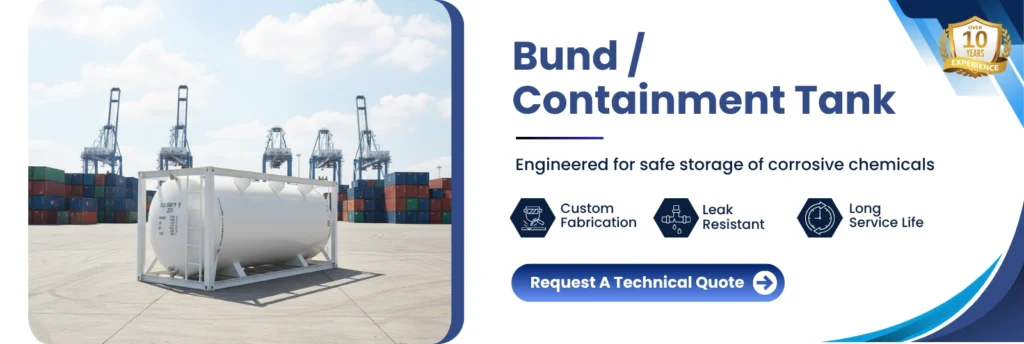
Bund / Containment Tank
A Bund / Containment Tank is specially designed to protect the storage system. Bund / Containment Tank used to safely the contain chemicals, liquids, oils, or hazardous substances by providing secondary spill containment. It consists of an primary storage tank is surrounded by the outer containment structure and bund. That is prevent the leakage, overflow, and environmental contamination.
In case of an accidental spills and tank failure, Bund / Containment Tanks widely used in the chemical industries, water treatment plants, petrochemical facilities, pharmaceuticals, and industrial processing applications. Bund / Containment Tank are manufactured by using the materials such as HDPE, PPH, FRP, PVDF, and Stainless Steel. Containment Tanks ensuring the excellent chemical resistance, durability, and long operational life. Petron Thermoplast, a bund / Containment Tank is used to prevent the leakage, spillage, or overflow of hazardous liquids, chemicals, oils, and industrial fluids.


Material of Construction
HDPE, PP, FRP, PVDF, SS 304, SS 316

Temperature Resistance
Safely handle moderate operating temperatures.

Corrosion-Free Construction
No rusting when exposed to chemicals & moisture.

Long Service Life
Excellent durability and can operate for many years

ASTM, ISO, DIN, & IS
Manufactured to international quality standards
-10°C to 120°C
Operating Temperature
100 L – 100K L
Capacity (Customizable)
10–25 years
Service Life
ASTM, ISO, DIN & IS
Certified quality standards
5 mm – 60 mm
Wall Thickness

Impermeable Materials
Bunds are constructed from non-porous materials such as concrete and reinforced plastic to prevent the spilled hazardous substances from seeping into the ground.

110% Capacity Rule
The most critical feature is the outer bund. They must hold at least 110% of the capacity of the largest internal tank to ensure full containment during a total vessel failure.

Dual-Layer Structure
It consists of a primary tank surrounded by a secondary shell or wall. They provide a failsafe against the inner tank leaks.

Rainwater Management
For open-topped bunds, provisions are made for removing rain, and roofs are added to prevent contamination of the collected water.
Technical Details
| Parameter | Details |
| Product Name | Bund / Containment Tank |
| Tank Type | Secondary Containment / Spill Containment Tank |
| Construction Design | Primary Tank with External Bund Wall |
| Material of Construction | HDPE, PP, FRP, PVDF, SS 304, SS 316 |
| Capacity Range | 100 Liters to 100,000 Liters |
| Tank Orientation | Vertical / Horizontal |
| Shape | Cylindrical / Rectangular |
| Wall Thickness | 5 mm to 60 mm |
| Containment Capacity | 100% to 110% of Inner Tank Capacity |
| Operating Temperature | -10°C to 120°C |
| Pressure Rating | Atmospheric to 3 Bar |
| Density Handling Capacity | Up to 2.0 SG. |
| Chemical Compatibility | Acids, Alkalis, Solvents, Hazardous Liquids |
| Surface Finish | Smooth Internal & External Finish |
| Diameter Range | 500 mm to 5000 mm |
| Height Range | 1000 mm to 15000 mm |
| Mounting Type | Floor Mounted / Skid Mounted |
| Leak Prevention System | Secondary Containment Protection |
| UV Stabilization | Available for Outdoor Use |
| Insulation Option | Optional |
| Inlet/Outlet Connections | Flanged / Threaded / Socket Type |
| Accessories | Manhole, Vent Nozzle, Drain Valve, Level Indicator, Ladder |
| Fabrication Method | Butt Welding / Extrusion Welding / FRP Lamination |
| Corrosion Resistance | Excellent |
| Maintenance Requirement | Low Maintenance |
| Testing | Hydro Test, Leak Test, Spark Test, Weld Inspection |
| Compliance Standards | ASTM, ISO, DIN, and IS Standards |
A Bund Tank or Containment Tank is designed to safely store hazardous liquids and provide secondary containment in case of leakage or tank failure. Chemical compatibility is one of the most important factors when selecting a bund tank, as the stored chemical must not react with the tank material or containment structure.
Why Chemical Compatibility Matters
Proper chemical compatibility ensures:
- Safe storage of hazardous chemicals
- Prevention of tank degradation, cracking, or corrosion
- Longer service life of the tank system
- Compliance with environmental and safety regulations
- Reduced risk of leaks, spills, and contamination
Common Bund Tank Materials and Their Chemical Compatibility
HDPE (High-Density Polyethylene) Bund Tanks
HDPE offers excellent resistance to a wide range of chemicals, including:
- Sulfuric Acid (various concentrations)
- Hydrochloric Acid
- Sodium Hydroxide (Caustic Soda)
- Ferric Chloride
- Sodium Hypochlorite
- Phosphoric Acid
- Water Treatment Chemicals
Suitable for: Acid storage, alkali storage, chemical dosing systems, and wastewater treatment applications.
PPH (Polypropylene Homopolymer) Bund Tanks
PPH provides excellent chemical resistance and performs well at elevated temperatures.
Compatible with:
- Strong acids
- Strong alkalis
- Salt solutions
- Corrosive industrial chemicals
- Chemical process liquids
Suitable for: Chemical processing plants, plating industries, and high-temperature chemical applications.
FRP-Lined Bund Tanks
FRP-lined containment tanks offer resistance to:
- Corrosive acids
- Industrial solvents
- Process chemicals
- Wastewater treatment chemicals
Compatibility depends on the resin system used within the FRP construction.
Typical Chemical Compatibility Guide
| Chemical | HDPE | PPH | Notes |
| Sulfuric Acid | Excellent | Excellent | Widely stored in both materials |
| Hydrochloric Acid | Excellent | Excellent | Suitable for most concentrations |
| Nitric Acid | Good to Excellent* | Good to Excellent* | Depends on concentration and temperature |
| Phosphoric Acid | Excellent | Excellent | Common industrial application |
| Sodium Hydroxide | Excellent | Excellent | Highly compatible |
| Sodium Hypochlorite | Excellent | Excellent | UV protection recommended for outdoor use |
| Ferric Chloride | Excellent | Excellent | Suitable for dosing and storage |
| Acetic Acid | Good | Excellent | Concentration dependent |
| Ammonia Solution | Excellent | Excellent | Commonly stored in HDPE tanks |
*Compatibility should always be verified for specific concentrations and operating conditions.
Ensuring the quality and reliability of a Bund / Containment Tank is critical for the safe storage of hazardous and corrosive chemicals. Comprehensive testing and quality control procedures are carried out throughout the manufacturing process to verify structural integrity, leak resistance, dimensional accuracy, and long-term performance.
Importance of Quality Testing
Quality testing helps to:
- Ensure safe chemical storage
- Prevent leaks and environmental contamination
- Verify structural strength and durability
- Confirm compliance with design specifications
- Extend service life and operational reliability
- Meet industry and regulatory requirements
Raw Material Inspection
Quality control begins with the inspection of incoming raw materials.
Material Verification
- Confirmation of HDPE, PPH, PP, or other specified materials
- Verification of material grade and certification
- Inspection for surface defects, cracks, or contamination
Thickness Verification
- Measurement of sheet thickness
- Compliance with approved engineering drawings
In-Process Quality Checks
During fabrication, continuous inspections are performed to ensure manufacturing accuracy.
Dimensional Inspection
- Tank diameter, height, and capacity verification
- Bund dimensions and containment volume checks
- Nozzle location and orientation verification
Welding Inspection
- Visual examination of weld seams
- Verification of weld uniformity and penetration
- Inspection for porosity, cracks, gaps, or defects
Reinforcement Inspection
- Verification of stiffeners and support structures
- Confirmation of proper alignment and installation
Hydrostatic Leak Test
Hydrostatic testing is one of the most important quality procedures.
Procedure
- The tank is filled with water to the designated test level.
- The tank remains under observation for a specified period.
- Weld seams, nozzles, and joints are inspected for leakage.
- Verify leak-proof construction
- Confirm structural stability under load
- Validate welding quality
Bund Containment Leak Test
The secondary containment area is tested independently.
- Confirm the bund floor and walls are leak-free
- Verify containment integrity
- Ensure spill retention capability
This test ensures that the bund can safely contain chemical spills if the primary tank fails.
- 110% Capacity Rule:
The most critical feature is the outer bund. They must hold at least 110% of the capacity of the largest internal tank to ensure full containment during a total vessel failure. - Dual-Layer Structure:
It consists of a primary tank surrounded by a secondary shell or wall. They provide a failsafe against the inner tank leaks. - Impermeable Materials:
Bunds are constructed from non-porous materials such as concrete and reinforced plastic to prevent the spilled hazardous substances from seeping into the ground. - Environmental Protection & Safety:
Designed to prevent the contamination of groundwater, soil, and nearby waterways, while also protecting surrounding infrastructure. - Overfill Protection & Detection:
Many modern units feature alarm systems to monitor the equipment to check for the fluid in the bund, and sometimes automated dewatering pumps to remove the rainwater. - Corrosion Resistance:
The materials used are chosen based on their ability to resist the degradation from the specific liquids being stored. - Rainwater Management:
For open-topped bunds, provisions are made for removing rain, and roofs are added to prevent contamination of the collected water.
Industries We Serve
Fuel Storage & Distribution
They are used in construction and commercial settings to the safely store diesel, kerosene, and gas oil for the machinery and heating.

Chemical Containment
Essential in the industrial facilities to store hazardous, flammable, or toxic chemicals in the tanks and drums.
Transformer Protection
Modular containment bunds to protect the high-voltage transformers and prevent the oil leaks from polluting the environment.

Emergency Spill Control
Temporary bunds are used on-site for immediate spill containment, such as the drum storage, generators, and maintenance activities.

Industrial Wastewater Processing
Used to manage and contain the potentially polluting run-off and liquids in the manufacturing plants.
Manufacturing Process of Bund/Containment Tank
A Bund Tank or Containment Tank is a specialized storage system designed with an integrated secondary containment structure to safely store hazardous, corrosive, or environmentally sensitive liquids. The manufacturing process focuses on structural integrity, chemical resistance, leak prevention, and compliance with industry safety standards.
The manufacturing process begins with detailed engineering and design based on:
- Chemical type and concentration
- Storage capacity requirements (100 Liters to 100,000 Liters)
- Operating temperature and pressure
- Secondary containment volume requirements
- Installation location (indoor or outdoor)
- Industry regulations and safety standards
Engineers prepare detailed drawings, wall thickness calculations, and reinforcement requirements to ensure the safe operation.
The appropriate thermoplastic material is selected according to the chemical compatibility and operating conditions.
Common materials include:
- HDPE (High-Density Polyethylene)
- PPH (Polypropylene Homopolymer)
- PP (Polypropylene)
- FRP-lined thermoplastics for specialized applications
Raw materials are inspected to verify quality and compliance with project specifications.
High-quality thermoplastic sheets are cut according to the approved fabrication drawings.
This stage includes:
- Base plate cutting
- Sidewall panel preparation
- Bund wall fabrication pieces
- Reinforcement and stiffener components
- Nozzle and fitting preparation
Precision cutting ensures proper fit-up and dimensional accuracy.
The primary storage tank is fabricated using thermoplastic welding techniques.
Sidewall Formation
- Sheets are rolled into cylindrical or rectangular shapes.
- Joints are aligned accurately before welding.
Bottom Assembly
- The tank bottom is welded to the sidewall structure.
- Continuous welding ensures leak-proof construction.
Top Structure
- Tank roof, access covers, and inspection openings are installed as required.
The secondary containment structure (bund) is fabricated around the primary tank.
The process includes:
- Constructing containment walls
- Welding containment floor panels
- Installing reinforcement ribs and supports
- Creating a leak-proof containment chamber
The bund is designed to retain spilled chemicals in the event of primary tank failure.
Advanced thermoplastic welding techniques are used throughout fabrication:
Extrusion Welding
- Used for structural joints and reinforcement attachments
- Produces strong, chemically resistant welds
Butt Fusion Welding
- Applied to larger sheet joints
- Provides uniform and high-strength connections
Certified welders perform all critical welding operations.
Required accessories are installed according to customer specifications:
- Inlet and outlet nozzles
- Vent connections
- Overflow arrangements
- Level indicators
- Drain systems
- Sampling points
- Access manways
- Lifting lugs and support brackets
All fittings are welded and sealed to maintain system integrity.
How to Select the Right Bund/Containment Tank
Selecting the right bund or containment tank is essential for preventing chemical spills, protecting the environment, and ensuring compliance with industrial safety regulations. A bund tank is designed to contain accidental leaks, overflows, or spills from primary storage tanks and process equipment.
Before selecting a bund tank, determine:
- Chemical name
- Chemical concentration
- Specific gravity
- Corrosive properties
- Hazard classification
The containment tank material must be compatible with the stored chemicals
The bund tank should resist corrosion and degradation from any chemical it may need to contain.
Common Materials
Material | Suitable For |
HDPE | Water treatment chemicals, mild acids, alkalis |
Polypropylene (PP) | Strong acids and alkalis |
FRP | Corrosive industrial chemicals |
PVDF-Lined Tanks | Highly aggressive chemicals |
Stainless Steel | Specialized chemical and hygienic applications |
The bund tank must be capable of containing accidental leaks from the primary storage tank.
- Primary tank volume
- Multiple tank installations
- Regulatory requirements
- Emergency spill scenarios
The containment capacity should be determined according to applicable safety standards and site regulations.
The density of the stored liquid affects:
- Wall thickness requirements
- Structural reinforcement
- Tank design strength
Higher specific gravity liquids require stronger containment structures.
Temperature influences:
- Material performance
- Chemical resistance
- Structural stability
For elevated temperatures, materials such as PP, FRP, or PVDF-lined systems may be more suitable.
Rectangular Bund Tanks
- Efficient use of floor space
- Common for indoor installations
Cylindrical Bund Tanks
- High structural strength
- Suitable for larger capacities
Custom Containment Systems
- Designed for specific equipment layouts
- Suitable for multiple tank installations
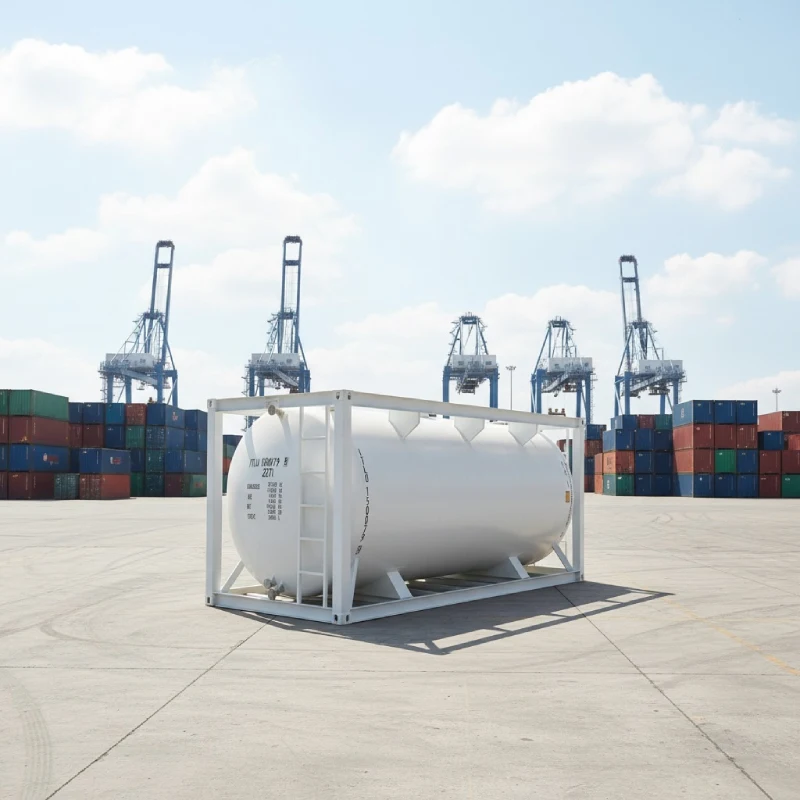

Custom Product Manufacturing Available
If you are searching for customized product designs that meet your requirements, don’t worry. Petron Thermoplast also offers custom product manufacturing services to meet the unique needs of various industries. Work with our expert engineers to create custom designs suited for your application.
Why Choose Petron Thermoplast?
Petron Thermoplast offers a Bund / Containment Tank to safety storage system. In Petron Thermoplast, a bund / Containment Tank is used to prevent the leakage, spillage, or overflow of hazardous liquids, chemicals, oils, and industrial fluids. It consist the primary storage tank to surrounded by a secondary containment structure called a bund. This acts as a protective barrier in the case that the main tank fails or leaks.
Frequently Asked Questions
A Bund / Containment Tank is a storage tank with an integrated secondary containment system designed to capture and contain leaks, spills, or overflows from the primary tank. It is commonly used for storing hazardous, corrosive, and environmentally sensitive chemicals.
Secondary containment helps prevent chemical spills from reaching the environment, protects personnel and equipment, and ensures compliance with environmental and safety regulations.
Bund Tanks can store a wide range of chemicals, including:
- Sulfuric Acid
- Hydrochloric Acid
- Nitric Acid
- Phosphoric Acid
- Sodium Hydroxide (Caustic Soda)
- Sodium Hypochlorite
- Ferric Chloride
- Water Treatment Chemicals
Chemical compatibility should always be verified before tank selection.
Common materials include:
- HDPE (High-Density Polyethylene)
- PPH (Polypropylene Homopolymer)
- PP (Polypropylene)
- FRP-lined Thermoplastics
The material is selected based on the chemical, temperature, and operating conditions.
The bund area acts as a protective containment zone that collects leaked or spilled liquid if the primary tank is damaged or overfilled, reducing environmental and safety risks.
In most applications, the bund is designed to hold at least 100% of the primary tank capacity or as required by local regulations and site-specific safety standards.
Yes. Bund Tanks can be installed outdoors and are often manufactured with UV-stabilized materials to withstand sunlight, weather exposure, and varying environmental conditions.
Bund Tanks are available in a wide range of capacities, from small dosing tanks of a few hundred liters to large industrial storage tanks exceeding several thousand liters.
Bund Tanks are typically fabricated using thermoplastic sheet welding techniques such as:
- Extrusion Welding
- Butt Fusion Welding
- Thermoplastic Fabrication
These methods provide strong, leak-proof joints and excellent chemical resistance.
Typical quality tests include:
- Hydrostatic Leak Testing
- Bund Containment Testing
- Weld Inspection
- Dimensional Verification
- Visual Inspection
- Spark Testing (where applicable)
These tests ensure safety, durability, and leak-free performance.