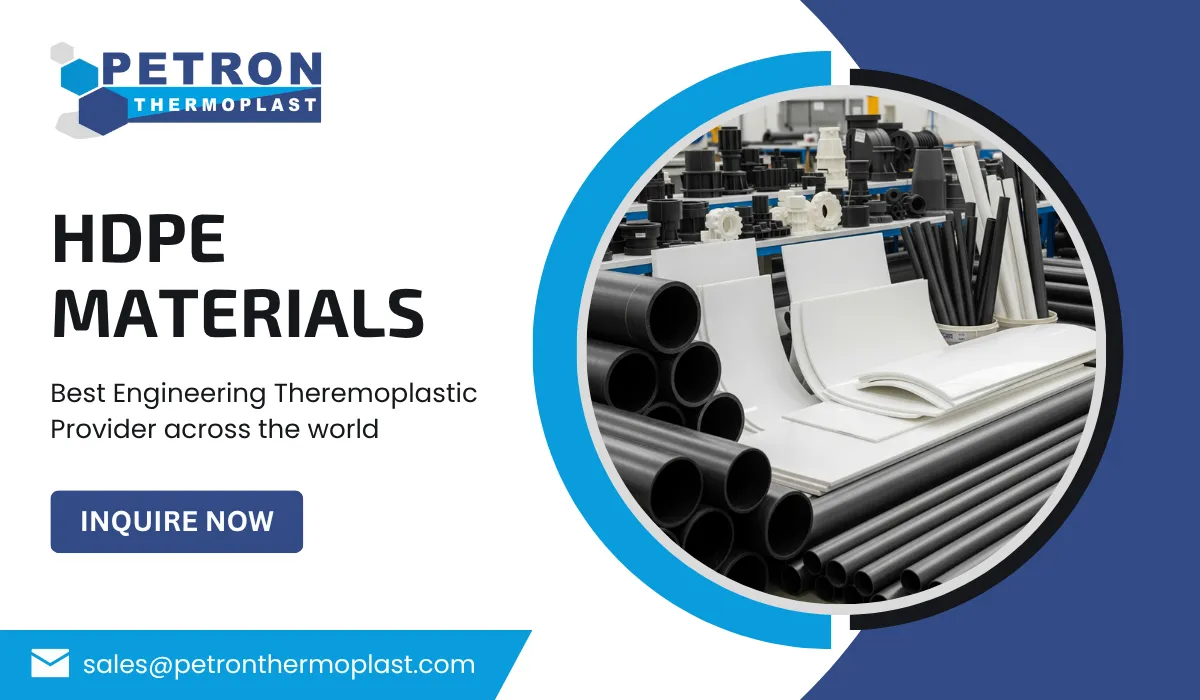
HDPE Materials
HDPE materials are high-density polyethylene polymers produced through the polymerization of ethylene. They have a linear molecular structure with minimal branching, which results in higher density, greater tensile strength, and improved rigidity compared to other polyethylene types. HDPE Materials (High-Density Polyethylene Materials) refer to a class of thermoplastic polymers made from petroleum, known for their high strength-to-density ratio, durability, and chemical resistance.
HDPE materials are versatile, durable, and cost-effective polymers widely used in piping, packaging, and industrial applications due to their strength, flexibility, and resistance to environmental factors. High Strength-to-Density Ratio – Strong yet lightweight, Excellent Chemical Resistance, they are resistant to acids, alkalis, and solvents and Low Moisture Absorption. They are Ideal for water handling applications and good Impact Resistance to Perform well under stress and impact to Corrosion-Free. They does not rust or degrade like metal. Thermoplastic Nature can be melted and reshaped multiple times.

HDPE Materials Details
| Property | Details |
| Material Type | Thermoplastic polymer (High-Density Polyethylene) |
| Chemical Formula | (C₂H₄)ₙ |
| Density | 0.941 – 0.965 g/cm³ |
| Molecular Structure | Linear structure with minimal branching |
| Tensile Strength | 20 – 37 MPa |
| Elongation at Break | 100% – 1000% |
| Flexural Modulus | 600 – 1500 MPa |
| Impact Resistance | High (excellent resistance to shock and stress) |
| Hardness | Shore D 55 – 70 |
| Melting Point | 120°C – 135°C |
| Working Temperature | -40°C to +60°C (can vary by grade) |
| Thermal Conductivity | 0.4 – 0.5 W/m·K |
| Water Absorption | < 0.01% |
| Chemical Resistance | Excellent (resistant to acids, alkalis, salts, and many solvents) |
| UV Resistance | Moderate (improved with carbon black additives) |
| Electrical Properties | Good insulator (high dielectric strength) |
| Abrasion Resistance | Very good |
| Permeability | Low for water, moderate for gases |
| Joining Methods | Butt fusion, electrofusion, socket fusion, compression fittings |
| Standards | ISO 4427, ASTM D3350, DIN standards |
1. High Durability
- HDPE fittings are extremely tough and long-lasting.
- They can perform efficiently for 50+ years without cracking or failure.
2. Corrosion & Chemical Resistance
- Resistant to acids, alkalis, salts, and chemicals.
- Do not rust or corrode like metal fittings.
3. Leak-Proof Joints
- Joined using butt fusion or electrofusion, creating a homogeneous joint.
- Joints are as strong as the pipe itself and prevent leakage.
4. Lightweight & Easy Installation
- Much lighter than metal fittings.
- Easy to transport, handle, and install, reducing labor cost.
5. High Flexibility
- Can bend without breaking, suitable for uneven or shifting soil.
- Reduces need for extra fittings and joints.
6. Excellent Impact Resistance
- Performs well under low temperatures and high pressure.
- Resistant to cracking, stress, and sudden impacts.
7. Smooth Inner Surface
- Provides low friction and high flow efficiency.
- Minimizes scaling, deposits, and pressure loss.
8. Non-Toxic & Safe
- Suitable for drinking water systems.
- Does not contaminate water or support bacterial growth.
9. Weather & UV Resistance
- Can withstand harsh environmental conditions.
- Suitable for both underground and outdoor applications.
10. Low Maintenance & Cost-Effective
- Requires minimal maintenance over time.
- Long service life reduces replacement costs.
| OD (mm) | Wall Thickness (mm) |
| 20 | 1.8 |
| 25 | 2.3 |
| 32 | 2.9 |
| 40 | 3.7 |
| 50 | 4.6 |
| 63 | 5.8 |
| 75 | 6.8 |
| 90 | 8.2 |
| 110 | 10.0 |
| 160 | 14.6 |
| 200 | 18.2 |
| 250 | 22.7 |
| 315 | 28.6 |
| SDR | PN Rating (Bar) | Pressure (MPa) |
| SDR 41 | PN 4 | 0.4 MPa |
| SDR 33 | PN 5 | 0.5 MPa |
| SDR 26 | PN 6.3 / PN 5 | 0.63 MPa / N/A |
| SDR 21 | PN 8 / PN 6 | 0.8 MPa / N/A |
| SDR 17 | PN 10 / PN 8 | 1.0 MPa / N/A |
| SDR 13.6 | PN 12.5 / PN 10 | 1.25 MPa / N/A |
| SDR 11 | PN 16 / PN 12.5 | 1.6 MPa / N/A |
| SDR 9 | PN 20 / PN 16 | 2.0 MPa / N/A |
User Manual for HDPE Materials
| Parameter | Details |
| Operating Temperature Range | -10°C to 60°C |
| Recommended Working Temperature | 0°C to 40°C |
| Maximum Short-Term Temperature | Up to 80°C (limited duration) |
| Melting Temperature | ~120°C to 135°C |
| Density of HDPE Material | 0.94 – 0.97 g/cm³ |
Preparation
- Site Inspection: Ensure trench or installation area is clean and level
- Material Check: Inspect pipes/fittings for damage, cracks, or contamination
- Tools Required: Fusion machine, cutter, alignment clamps, measuring tools
Common Installation Methods
1. Butt Fusion Jointing
- Ends of HDPE pipes are heated and fused together
- Provides strong, leak-proof joints
- Used for large diameter and high-pressure pipelines
2. Electrofusion Jointing
- Uses fittings with built-in heating coils
- Electric current melts and joins pipe and fitting
- Ideal for gas and critical water systems
3. Compression Fittings
- Mechanical joining without heat
- Quick and easy installation
- Suitable for small diameter and low-pressure systems
4. Flange Connection
- Used to connect HDPE pipes with valves or metal pipes
- Allows easy dismantling and maintenance
C. Installation Steps
- Cutting: Cut pipe ends square and clean
- Cleaning: Remove dust, oil, and moisture
- Alignment: Ensure proper alignment of pipes
- Joining: Apply selected jointing method
- Cooling Time: Allow proper cooling before handling
- Testing: Perform pressure/leak test before commissioning
D. Installation Precautions
- Avoid installation in extreme temperatures without protection
- Prevent bending beyond allowable limits
- Provide proper bedding (sand layer) in trenches
- Protect from sharp objects and heavy loads
Maintenance of HDPE Materials
A. Routine Maintenance
- Regular inspection for leaks, cracks, or deformation
- Check joints and fittings periodically
- Clean external surfaces if exposed
B. Preventive Maintenance
- Avoid excessive pressure beyond rated limits
- Protect pipes from prolonged UV exposure (use covers or coatings)
- Ensure proper support and anchoring
C. Repair Methods
- Small Damage: Use repair clamps or electrofusion saddles
- Major Damage: Cut and replace the damaged section
- Leakage Issues: Re-fuse or tighten connections
D. Long-Term Care
- Maintain operating temperature within recommended limits
- Avoid chemical exposure beyond resistance limits
- Conduct periodic pressure testing
Customization of HDPE Materials
A. Size & Dimensions
- Custom diameters and wall thickness (SDR) for pipes
- Sheets, rods, and components available in tailored sizes
- Large-diameter pipes for industrial and municipal projects
B. Material Grade Selection
- PE80 / PE100 selection based on pressure and application
- High-performance grades for gas, chemicals, and high-pressure systems
C. Color Customization
- Black (standard): UV resistant (carbon black added)
- Blue: Potable water pipelines
- Yellow: Gas distribution
- Custom colors available for identification and branding
D. Additives & Modifications
- UV Stabilizers: For outdoor use
- Antioxidants: Improve lifespan
- Anti-static agents: For hazardous environments
- Flame retardants: For safety applications
E. Design Customization
- Custom fittings, bends, tees, reducers, couplers
- Fabricated tanks, liners, and special components
- CNC-machined HDPE parts for industrial use
Processing of HDPE Materials
A. Extrusion
- Most common process for pipes, sheets, and films
- Melted HDPE is pushed through a die to form continuous shapes
B. Injection Molding
- Used for fittings, caps, valves, and small components
- Provides high precision and repeatability
C. Blow Molding
- Used to manufacture bottles, containers, and tanks
- Produces hollow products with uniform thickness
D. Rotational Molding (Rotomolding)
- Used for large hollow items like water tanks and storage containers
- Ensures uniform wall thickness without joints
E. Compression Molding
- Used for thick and heavy-duty HDPE components
- Provides high strength and durability
F. Thermoforming
- Heating HDPE sheets and shaping them into desired forms
- Used in packaging and industrial linings
G. Machining & Fabrication
- Cutting, drilling, welding, and bending of HDPE sheets and rods
- Used for custom industrial parts and assemblies
Joining & Fabrication Techniques
- Butt Fusion Welding – strong and permanent joints
- Electrofusion Welding – precise and leak-proof
- Socket Fusion – for small diameter pipes
- Mechanical Fastening – bolts, flanges, and compression fittings
Key Advantages of Customization & Processing
- Flexibility in design and application
- Cost-effective manufacturing
- High durability and corrosion resistance
- Suitable for complex industrial requirements
A. Physical Tests
• Density Test
- Measures material density (0.941–0.965 g/cm³)
- Ensures proper material grade and consistency
• Melt Flow Index (MFI) Test
- Determines flow characteristics of molten HDPE
- Indicates processability and uniformity
• Tensile Strength Test
- Measures resistance to pulling forces
- Ensures mechanical strength of the material
• Elongation at Break
- Determines flexibility and ductility
- Important for stress and impact conditions
B. Mechanical Tests
• Impact Resistance Test
- Checks ability to withstand sudden shocks
- Important for transportation and installation
• Hardness Test
- Measured using Shore D scale
- Indicates surface strength and rigidity
• Creep Test
- Evaluates long-term deformation under constant load
- Critical for pipelines under pressure
C. Thermal Tests
• Vicat Softening Temperature Test
- Determines temperature at which material softens
- Helps define working temperature limits
• Thermal Stability Test
- Assesses resistance to heat degradation over time
D. Chemical Tests
• Chemical Resistance Test
- Evaluates resistance to acids, alkalis, and solvents
• Environmental Stress Crack Resistance (ESCR)
- Measures resistance to cracking under stress and chemicals
E. Hydrostatic Pressure Test (For Pipes)
- Pipes are subjected to internal pressure for a specified time
- Ensures pressure-bearing capacity and leak-proof performance
F. Non-Destructive Tests (NDT)
• Visual Inspection
- Checks for surface defects, cracks, or irregularities
• Ultrasonic Testing
- Detects internal flaws or inconsistencies
2. Quality Standards of HDPE Materials
HDPE materials are manufactured and tested according to international standards:
- IS 4984 (India – HDPE pipes for water supply)
- ISO 4427 (Water supply systems)
- ASTM D3350 (Material classification)
- DIN Standards (European specifications)
3. Quality Control Measures
- Strict raw material selection (PE80/PE100 grades)
- In-process quality checks during manufacturing
- Dimensional accuracy (OD, thickness, SDR)
- Pressure and leak testing before dispatch
- Certification and batch traceability
1. Base Material
• Ethylene (C₂H₄)
- The main raw material derived from petroleum or natural gas
- Polymerized to form polyethylene chains
- Creates the core structure of HDPE with high density and strength
2. Polymer Structure
- Linear chains with minimal branching
- High crystallinity (typically 70–90%)
- Responsible for strength, rigidity, and chemical resistance
3. Additives Used in HDPE
• Carbon Black
- Added (2–3%) for UV resistance
- Protects material from sunlight degradation
• Antioxidants
- Prevent oxidation during processing and service life
- Improve long-term durability
• UV Stabilizers
- Enhance resistance to ultraviolet radiation
- Used in outdoor applications
• Heat Stabilizers
- Maintain stability at elevated temperatures
- Prevent thermal degradation
• Anti-static Agents
- Reduce static electricity buildup
- Used in electrical or hazardous environments
• Color Masterbatch
- Provides color coding (black, blue, yellow, etc.)
- Helps identify application (water, gas, etc.)
4. Optional Reinforcements / Modifiers
• Glass Fiber (in special grades)
- Increases stiffness and strength
- Used in industrial applications
• Recycled HDPE (Blended)
- Sometimes mixed with virgin material (non-critical applications)
- Reduces cost and supports sustainability

Custom Product Manufacturing Available
If you are searching for customized product designs that meet your requirements, don’t worry. Petron Thermoplast also offers custom product manufacturing services to meet the unique needs of various industries. Work with our expert engineers to create custom designs suited for your application.
Benefits of HDPE Materials
Durability and Strength
HDPE has a high strength-to-density ratio, which means it is both strong and lightweight. This makes it suitable for products that require durability without excessive weight, such as containers, pipes, and packaging materials.
Chemical Resistance
HDPE is resistant to a wide range of chemicals, including acids and bases, making it an excellent choice for chemical containers and industrial applications. Its chemical stability ensures that it does not easily react with the substances it holds, preserving product integrity.
Moisture Resistance
With very low moisture absorption, HDPE maintains its mechanical properties even in humid environments. This characteristic is particularly beneficial for applications like water pipes and storage tanks.
Lightweight
The lightweight nature of HDPE makes it easy to handle and transport, reducing shipping costs and making it a practical choice for various products, from consumer goods to industrial applications.
Recyclability
HDPE is widely accepted in recycling programs, allowing it to be repurposed into new products. This recyclability contributes to sustainability efforts and reduces environmental impact.
Safety
HDPE is non-toxic and does not leach harmful chemicals into food or beverages, making it a safe choice for food packaging and containers. Its BPA-free nature adds to its appeal in consumer products.
Cost-Effectiveness
The standardized production process of HDPE allows for mass production at relatively low costs, making it an economical choice for manufacturers.
Versatility
HDPE can be molded into various shapes and sizes, making it suitable for a wide range of applications, including packaging, construction, and consumer products. Its ability to be colored and customized further enhances its usability.
Types of HDPE Materials
PE63
- Older generation HDPE material
- Lower strength and pressure resistance
- Now mostly obsolete
PE80
- Medium-density and strength
- Good for water supply and low to medium pressure systems
- Cost-effective and widely used
PE100
- High-performance HDPE
- Higher strength and durability
- Suitable for high-pressure pipelines (water, gas, industrial use)
Pipe Grade HDPE
- Used in water supply, gas distribution, and drainage systems
- High strength and long service life
Blow Molding Grade
- Used for bottles, containers, and tanks
- Good impact resistance
Injection Molding Grade
- Used for fittings, caps, crates, and industrial components
- Excellent moldability
Film Grade HDPE
- Used in plastic bags, liners, and packaging films
- Flexible and lightweight
Standard HDPE
- Linear structure with minimal branching
- High density and strength
Cross-Linked HDPE (PEX)
- Chemically cross-linked structure
- Higher temperature and pressure resistance
- Used in hot water systems
HDPE Granules (Raw Material)
- Used as feedstock for manufacturing plastic products
UV Stabilized HDPE
- Contains carbon black or additives
- Resistant to sunlight and outdoor conditions
Anti-Static HDPE
- Prevents static charge buildup
- Used in electrical and hazardous environments
HDPE Sheets
- Used for lining, tanks, and fabrication work
HDPE Pipes
- Used in fluid and gas transportation
HDPE Rods
- Used in machining and industrial components
Food-Grade HDPE
- Safe for potable water and food storage
- Non-toxic and hygienic
Why Choose Petron Thermoplast?
At Petron Thermoplast, HDPE Materials are critical components in piping systems, ensuring smooth flow transitions and efficient use of space. Understanding the dimensions and applications of short radius bends is essential for designing reliable and efficient piping systems. By adhering to standards such as ASME B16.9, engineers can ensure compatibility and performance across various industries.
Conclusion
HDPE Materials plays a crucial role in daily life by providing a versatile, durable, and eco-friendly material solution. Its widespread use in packaging, construction, and consumer products, combined with its recyclability and cost-effectiveness, makes HDPE a top choice in various industries. With continuous innovations improving its performance and sustainability, HDPE materials remain a key material for modern applications.
Frequently Asked Questions
HDPE materials are high-density polyethylene thermoplastics known for their strength, durability, and resistance to chemicals and moisture.
HDPE is widely used in:
- Water supply and drainage pipes
- Gas distribution pipelines
- Plastic bottles and containers
- Industrial tanks and liners
- Cable insulation
The density of HDPE typically ranges from 0.941 to 0.965 g/cm³, making it strong yet lightweight.
- Minimum: حوالي -40°C
- Maximum (continuous): 60°C to 80°C
- Short-term: Up to 100°C
HDPE pipes generally range from PN 4 to PN 20, depending on SDR and material grade (PE80, PE100).
HDPE materials have a service life of 50 years or more under proper installation and operating conditions.
Yes, HDPE is non-toxic and safe for potable water applications, meeting international standards.
- Corrosion and chemical resistance
- Lightweight and flexible
- Leak-proof joints (fusion welding)
- Long service life
- Low maintenance
- Not suitable for very high temperatures
- Can degrade under prolonged UV exposure (unless stabilized)
- Lower stiffness compared to metals
Common methods include:
- Butt fusion
- Electrofusion
- Compression fittings
- Flange connections
Yes, HDPE is 100% recyclable and widely reused in manufacturing plastic products.
SDR (Standard Dimension Ratio) is the ratio of pipe diameter to wall thickness, which determines pressure capacity.
HDPE is more flexible and impact-resistant, while PVC is more rigid. The choice depends on the application.
Yes, HDPE has excellent resistance to acids, alkalis, and many chemicals, making it suitable for industrial use.