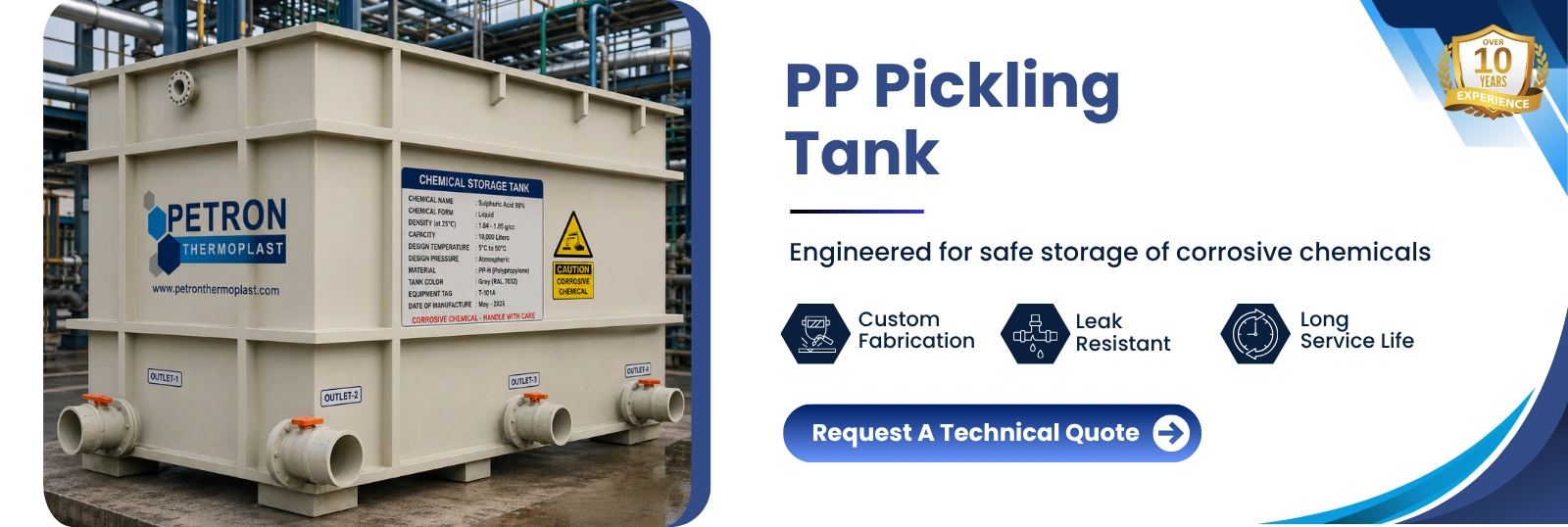






PP Pickling Tank
A PP Pickling Tank is a chemical-resistant process tank is manufactured from the Polypropylene (PP) and specifically they designed for pickling operations, where the metal surfaces are cleaned using for acidic solutions to remove rust, scale, oxides, and other surface contaminants before of further processing.
Polypropylene is widely used for pickling tanks because of its excellent resistance to corrosive chemicals. Particularly the PP Pickling tank acids is commonly used in pickling processes such as hydrochloric acid, sulfuric acid, phosphoric acid, and mixed acid solutions. At Petron Thermoplast, we specialize in the design and manufacturing of PP (Polypropylene) Pickling Tanks that offers excellent resistance to corrosive chemicals used in metal treatment processes.
Excellent Chemical Resistance
Suitable for acids, alkalis, and pickling solutions
Temperature Resistance
Up to 90°C (depending on chemical compatibility)
Corrosion-Free Construction
No rusting when exposed to chemicals & moisture.
Long Service Life
Excellent durability and can operate for many years
DVS, ASTM, DIN, ISO Certified
Manufactured to international quality standards
Up to 90°C
Operating Temperature
100 L – 100K L
Capacity (Customizable)
DVS, ASTM, DIN, ISO
Certified quality standards
5 mm – 25 mm
Wall Thickness

Corrosion-Free Construction
Leak-Proof Fabrication

Temperature Resistance
PP material offers excellent toughness and impact resistance, helping the tank withstand industrial operating conditions.

Long Service Life
The excellent chemical resistance and durable construction contribute to an extended operational lifespan.

Leak-Proof Fabrication
Advanced thermoplastic welding techniques such as butt fusion and extrusion welding create strong, homogeneous, and leak-tight joints.

Technical Details
| Parameter | Technical Details |
| Product Type | PP Pickling Tank |
| Material of Construction | Polypropylene (PP) |
| Tank Configuration | Rectangular, Square, Cylindrical, Custom Fabricated |
| Storage/Process Capacity | 100 Liters to 100,000 Liters or Customized |
| Tank Length | As per process requirements |
| Tank Width | Customized |
| Tank Height/Depth | Customized according to immersion requirements |
| Wall Thickness | Typically 8 mm to 50 mm (depending on tank size and chemical load) |
| Bottom Thickness | Designed according to operating conditions |
| Operating Temperature Range | Up to 90°C (depending on chemical compatibility) |
| Design Temperature | Up to 100°C |
| Operating Pressure | Atmospheric |
| Specific Gravity Design | Up to 1.8 SG or higher as required |
| Corrosion Resistance | Excellent |
| Chemical Resistance | Suitable for acids, alkalis, and pickling solutions |
| Fabrication Method | Thermoplastic Sheet Fabrication |
| Welding Method | Butt Fusion Welding, Extrusion Welding, Hot Gas Welding |
| Tank Shape | Rectangular, Square, Vertical, Horizontal |
| Top Design | Open Top, Covered Top |
| Bottom Design | Flat Bottom, Sloped Bottom |
| Reinforcement Type | PP Structural Stiffeners, MS/FRP External Supports (if required) |
| Drain Connection | Bottom Drain or Side Drain |
| Overflow Connection | Available |
| Vent Connection | Available |
| Fume Extraction Connection | Optional |
| Level Monitoring System | Sight Glass, Float Gauge, Ultrasonic Sensor |
| Manhole Access | Optional |
| Agitator Provision | Optional |
| Lifting Arrangement | Available as required |
| Surface Finish | Smooth Internal and External Surface |
| Leak-Proof Construction | Yes |
| UV Protection | Available for outdoor installation |
| Testing Standards | Hydrostatic Test, Leak Test, Visual Inspection |
| Manufacturing Standards | DVS, ASTM, DIN, ISO, Customer Specifications |
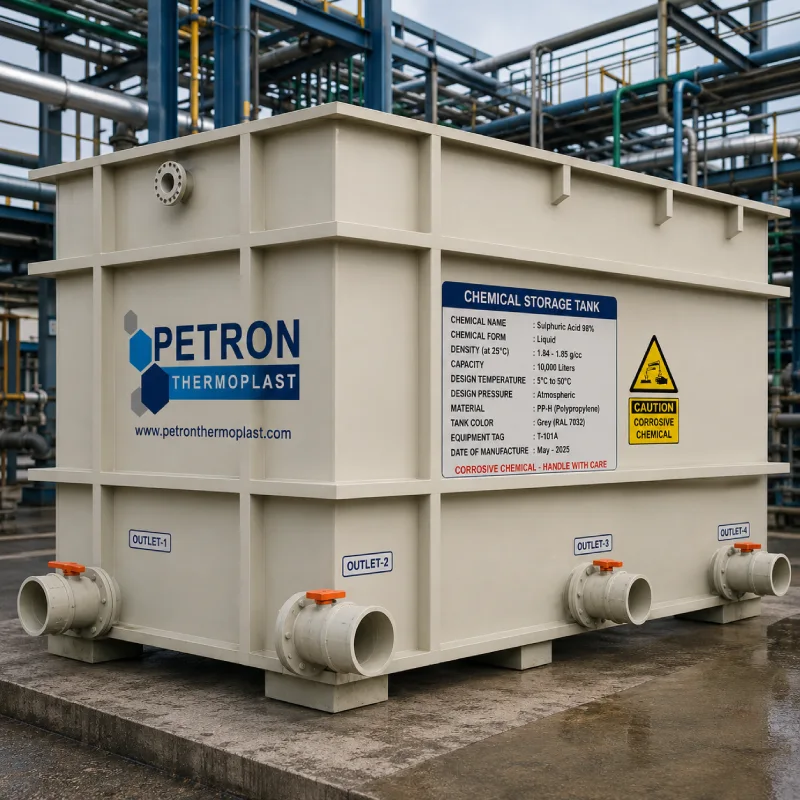
PP Pickling Tanks Polypropylene Pickling Tanks are specifically designed to handle the corrosive pickling solutions which is used in metal cleaning, descaling, rust removal, and the surface treatment processes.
Understanding the chemical compatibility is an essential for ensuring the safe operation, maximizing the tank life, and preventing the material degradation. Polypropylene (PP) offers excellent resistance to many acids, alkalis, and industrial chemicals, to make it one of the most widely used materials for pickling tank fabrication.
Why Chemical Compatibility is Important
Proper chemical compatibility helps to:
- Prevent tank damage and corrosion
- Maintain structural integrity
- Ensure safe chemical containment
- Avoid leaks and spills
- Extend service life
- Reduce maintenance costs
- Improve process reliability
Chemical Resistance of Polypropylene (PP)
Polypropylene exhibits excellent resistance to a wide range of chemicals commonly used in pickling and metal treatment operations.
Hydrochloric Acid (HCl)
PP Pickling Tanks are widely used for storing and processing hydrochloric acid solutions.
Compatibility: Excellent
Applications:
- Steel pickling
- Rust removal
- Scale removal
- Surface preparation
Sulfuric Acid (H₂SO₄)
PP tanks are suitable for many sulfuric acid pickling applications, depending on concentration and operating temperature.
Compatibility: Good to Excellent (application dependent)
Applications:
- Metal cleaning
- Descaling operations
- Surface treatment processes
Phosphoric Acid (H₃PO₄)
Polypropylene offers excellent resistance to phosphoric acid.
Compatibility: Excellent
Applications:
- Surface conditioning
- Rust removal
- Metal preparation before coating
Acetic Acid
PP demonstrates good resistance to acetic acid under many operating conditions.
Compatibility: Excellent
Citric Acid
Frequently used in specialized cleaning applications.
Compatibility: Excellent
Compatibility with Alkalis
Polypropylene also provides excellent resistance to alkaline solutions.
Suitable chemicals include:
- Sodium Hydroxide (Caustic Soda)
- Potassium Hydroxide
- Ammonium Hydroxide
- Alkaline Cleaning Solutions
Compatibility: Excellent
Common Pickling Chemicals Compatible with PP Tanks
The following chemicals are commonly handled in PP Pickling Tanks:
- Hydrochloric Acid
- Sulfuric Acid
- Phosphoric Acid
- Metal Cleaning Solutions
- Descaling Chemicals
- Rust Removal Chemicals
- Surface Treatment Chemicals
Chemicals Requiring Special Evaluation
Certain chemicals may require additional compatibility verification before use.
These include:
- Concentrated Nitric Acid
- Chromic Acid
- Strong Oxidizing Agents
- High-Concentration Hydrogen Peroxide
- Mixed Acid Formulations at Elevated Temperatures
For these applications, alternative materials such as PVDF or specialized dual-laminate tanks may be considered.
Effect of Temperature on Compatibility
Chemical resistance can change significantly with temperature.
As temperature increases:
- Chemical attack rates may increase
- Material strength may decrease
- Service life may be reduced
Compatibility evaluations should always be based on the maximum operating temperature.
Effect of Chemical Concentration
Chemical concentration has a direct impact on compatibility.
Examples:
- Dilute acid solutions may be fully compatible
- Highly concentrated acids may require special evaluation
- Compatibility may vary significantly with concentration changes
Always specify the exact concentration during tank selection.
Compatibility of Tank Components
All tank accessories should also be compatible with the pickling solution.
Recommended Gasket Materials
- PTFE (Teflon)
- EPDM
- FKM (Viton), where suitable
Recommended Piping Materials
- PP
- PPH
- PVDF
- CPVC (depending on chemical service)
General Chemical Compatibility Guide
| Chemical | Compatibility with PP Pickling Tank |
| Hydrochloric Acid (HCl) | Excellent |
| Phosphoric Acid ($H_3PO_4$) | Excellent |
| Acetic Acid | Excellent |
| Citric Acid | Excellent |
| Sodium Hydroxide (NaOH) | Excellent |
| Potassium Hydroxide | Excellent |
| Ferric Chloride | Excellent |
| Alum Solution | Excellent |
| Sulfuric Acid | Good to Excellent* |
| Hydrogen Peroxide | Requires Evaluation |
| Nitric Acid | Requires Detailed Evaluation |
| Chromic Acid | Requires Detailed Evaluation |
| Strong Oxidizers | Requires Detailed Evaluation |
Testing and quality assurance are essential for ensuring that a PP Pickling Tank (Polypropylene Pickling Tank) performs safely and reliably in corrosive pickling and metal treatment applications. Comprehensive inspections and testing procedures are conducted throughout the manufacturing process to verify material quality, weld integrity, dimensional accuracy, structural strength, and leak-proof performance.
1. Raw Material Inspection
Quality control begins with the inspection of all incoming raw materials.
Inspection Parameters
- Polypropylene grade verification
- Sheet thickness measurement
- Surface quality inspection
- Material Test Certificate (MTC) verification
- Batch traceability confirmation
- Dimensional accuracy checks
Only approved materials are released for fabrication.
2. Visual Inspection
Visual inspections are performed during every stage of manufacturing to identify:
- Surface defects
- Scratches and dents
- Fabrication irregularities
- Material damage
- Welding imperfections
- Workmanship issues
This helps maintain consistent product quality.
3. Dimensional Inspection
The tank dimensions are verified against approved fabrication drawings.
Parameters Checked
- Tank length
- Tank width
- Tank depth/height
- Wall thickness
- Bottom thickness
- Nozzle orientation
- Nozzle dimensions
- Reinforcement placement
Accurate dimensions ensure proper installation and process performance.
4. PP Weld Inspection
The integrity of thermoplastic welds is a critical quality factor.
Inspection Criteria
- Uniform weld appearance
- Proper fusion
- Joint alignment
- Weld continuity
- Absence of cracks
- Absence of porosity
- Absence of incomplete fusion
All welds must comply with approved fabrication procedures.
5. Welding Quality Verification
The welding processes used in PP Pickling Tank fabrication include:
- Butt Fusion Welding
- Extrusion Welding
- Hot Gas Welding
These welding methods are monitored to ensure strong and leak-proof joints.
6. Reinforcement Inspection
Structural reinforcements are inspected for:
- Correct positioning
- Proper installation
- Weld quality
- Structural stability
This is especially important for large-capacity tanks.
7. Nozzle and Fitting Inspection
All nozzles and fittings are checked for:
- Correct size
- Proper location
- Alignment accuracy
- Secure installation
- Leak-tight construction
This ensures reliable process connections.
8. Surface Finish Inspection
The tank surfaces are inspected to verify:
- Smooth internal finish
- Uniform external appearance
- Clean weld profiles
- Proper fabrication quality
A smooth finish helps prevent residue buildup and simplifies cleaning.
9. Leak Testing
Leak testing is performed to verify the integrity of:
- Welded joints
- Nozzle connections
- Drain fittings
- Overflow connections
The objective is to ensure complete leak-proof performance before commissioning.
10. Hydrostatic Testing
Hydrostatic testing is one of the most important quality tests.
Purpose of Hydrostatic Testing
- Verify structural integrity
- Confirm leak-tightness
- Evaluate weld performance
- Assess tank stability
The tank is filled with water and maintained under controlled conditions for inspection.
1. Visual Inspection
- Surface defects (cracks, pinholes, bubbles)
- Welding uniformity
- Finishing quality
2. Hydrostatic Leak Test
- The tank is filled with water and kept under observation
- Detects leakage or structural weakness
- Mandatory for all storage tanks
3. Ultrasonic Thickness Testing (UTT)
- Measures wall thickness at multiple points
- Ensures compliance with design specifications
4. Spark Testing
- Detects pinholes or discontinuities in welded joints
- Ensures leak-proof construction in fabricated tanks
5. Pressure / Vacuum Testing
- Conducted for tanks used in pressurized or vacuum conditions
- Verifies mechanical strength under operating conditions
6. Impact Resistance Testing
- Assesses the tank’s ability to withstand mechanical shocks
- Important during transport and installation
7. Environmental Stress Crack Resistance (ESCR) Test
- Determines resistance to cracking under stress and chemical exposure
- Ensures long-term durability
8. Chemical Resistance Testing
- Samples are exposed to specific chemicals
- Observes changes like swelling, weight loss, or degradation
9. UV Stabilization Testing
- Ensures resistance to sunlight degradation
- Important for outdoor tanks
10. Dimensional and Capacity Check
- Tank dimensions
- Volume capacity
- No deformation after testing
Features of PP Pickling Tanks

Excellent Chemical Resistance
PP Pickling Tanks provide outstanding resistance to:
Hydrochloric Acid (HCl)
Sulfuric Acid (H₂SO₄)
Phosphoric Acid (H₃PO₄)
Metal Cleaning Chemicals
Descaling Solutions
Acid-Based Pickling Formulations
This makes them ideal for handling corrosive pickling solutions.

Corrosion-Free Construction
Unlike metal tanks, polypropylene does not rust, corrode, or deteriorate when exposed to compatible chemicals, ensuring long-term reliability.

Leak-Proof Fabrication
Advanced thermoplastic welding techniques such as butt fusion and extrusion welding create strong, homogeneous, and leak-tight joints.

High Impact Strength
PP material offers excellent toughness and impact resistance, helping the tank withstand industrial operating conditions.

Lightweight Design
Polypropylene tanks are significantly lighter than steel or concrete tanks, making transportation, handling, and installation easier and more economical.

Long Service Life
The excellent chemical resistance and durable construction contribute to an extended operational lifespan.

Smooth Internal Surface
The smooth inner surface:
Minimizes chemical residue buildup
Improves cleaning efficiency
Enhances process hygiene
Reduces maintenance requirements

Customizable Design
PP Pickling Tanks can be manufactured with:
Rectangular or square designs
Open-top or covered-top configurations
Custom dimensions
Multiple nozzle arrangements
Fume extraction connections
Drainage systems

Fume Extraction Compatibility
PP Pickling Tanks can be integrated with:
Exhaust hoods
Ducting systems
Scrubbers
Fume extraction units
for improved workplace safety.
Industries We Serve

Steel Manufacturing Industry
PP Pickling Tanks are extensively used in steel plants for:
Removal of mill scale
Rust removal from steel surfaces
Surface preparation before rolling
Cleaning of fabricated steel components
Pre-treatment before galvanizing
These processes improve product quality and surface finish.

Stainless Steel Industry
In stainless steel manufacturing, PP Pickling Tanks are used for:
Weld scale removal
Surface passivation preparation
Oxide layer removal
Stainless steel sheet treatment
Cleaning fabricated stainless steel equipment
The tanks withstand aggressive pickling solutions used in stainless steel processing.

Pipe and Tube Manufacturing Industry
PP Pickling Tanks play a vital role in:
Surface cleaning of pipes and tubes
Removal of oxidation layers
Pre-treatment before coating
Preparation for galvanizing and painting
Weld cleaning operations
This ensures improved adhesion and product quality.

Wire Processing Industry
Wire manufacturers use PP Pickling Tanks for: Wire descaling Rust removal Surface conditioning Preparation before drawing operations Cleaning prior to coating or plating The process improves wire quality and manufacturing efficiency.

Galvanizing Industry
Before galvanizing, metal components must be thoroughly cleaned.
PP Pickling Tanks are used for:
Acid cleaning of steel components
Removal of surface contaminants
Scale and rust removal
Surface activation before zinc coating
Proper pickling enhances galvanizing quality and coating adhesion.

Metal Fabrication Industry
Fabrication workshops use PP Pickling Tanks for:
Cleaning fabricated structures
Weld scale removal
Surface preparation before painting
Corrosion removal
Maintenance cleaning of fabricated parts
This improves appearance and product durability.

Electroplating Industry
PP Pickling Tanks are commonly installed in electroplating plants for:
Pre-plating cleaning
Surface activation
Oxide removal
Acid treatment processes
Component preparation before plating
Proper pickling ensures high-quality plating results.

Metal Finishing Industry
Applications include:
Surface treatment operations
Descaling processes
Cleaning of machined parts
Oxide layer removal
Pre-coating preparation
The corrosion-resistant PP construction ensures long-term performance.

Leak-Proof Welded Joints
PP Pickling Tanks are used in automotive component manufacturing for:
Cleaning metal parts
Surface preparation before coating
Rust removal
Component treatment before assembly
Quality finishing operations
These processes improve product reliability and appearance.

Engineering and Heavy Machinery Industry
Heavy engineering facilities use PP Pickling Tanks for:
Cleaning fabricated equipment
Descaling large components
Surface conditioning
Corrosion removal
Maintenance operations
The tanks provide reliable chemical containment for large-scale operations.
Manufacturing Process of PP Pickling Tanks
The manufacturing of a PP Pickling Tank (Polypropylene Pickling Tank) involves precision thermoplastic fabrication techniques to produce a durable, leak-proof, and chemically resistant tank capable of handling corrosive pickling solutions. The process includes design, material selection, fabrication, welding, reinforcement, testing, and quality inspection to ensure long-term performance and safety.
The manufacturing process begins with detailed engineering based on:
- Pickling chemical type
- Chemical concentration
- Tank capacity(100 Liters to 100,000 Liters or Customized)
- Component dimensions
- Operating temperature(Up to 90°C (depending on chemical compatibility)
- Production requirements
- Installation conditions
- Structural load calculations
Engineering documents typically include:
- General Arrangement (GA) Drawings
- Fabrication Drawings
- Nozzle Layout Drawings
- Reinforcement Details
- Bill of Materials (BOM)
High-quality polypropylene materials are selected to ensure excellent chemical resistance and structural integrity.
Materials Used
- Polypropylene (PP) Sheets
- PP Welding Rods
- PP Nozzles and Fittings
- Reinforcement Components
- Support Structures (if required)
Material grades are selected according to chemical compatibility and operating conditions.
Incoming materials are inspected for:
- Material grade verification
- Sheet thickness
- Surface quality
- Dimensional accuracy
- Material Test Certificates (MTC)
- Traceability requirements
Only approved materials proceed to fabrication.
Polypropylene sheets are cut according to approved fabrication drawings using:
- CNC Cutting Machines
- Circular Saws
- Panel Saws
- Thermoplastic Cutting Equipment
Precision cutting ensures accurate assembly and fit-up.
The cut PP sheets are prepared into:
- Side walls
- Bottom panels
- End walls
- Top covers (if required)
- Reinforcement sections
Panel preparation is performed according to the tank design.
The fabricated panels are aligned and assembled to form the tank structure.
This stage includes:
- Positioning of side walls
- Alignment of bottom panels
- Corner joint preparation
- Temporary fixing for welding
Proper alignment is critical for dimensional accuracy.
The tank components are permanently joined using specialized thermoplastic welding techniques.
Butt Fusion Welding
Used for joining large PP sheets and structural sections.
Extrusion Welding
Used for corner joints, reinforcement welds, and structural assembly.
Hot Gas Welding
Used for detailed fabrication and finishing work.
The welded joints provide excellent strength and leak-proof performance.
Depending on tank size and operating conditions, reinforcements may include:
- PP External Stiffeners
- Structural Support Frames
- Steel Reinforcement Structures
- FRP Reinforcement Systems
These reinforcements prevent deformation under chemical loads.
Required process connections are installed, including:
- Inlet Nozzles
- Outlet Nozzles
- Overflow Connections
- Vent Connections
- Drain Connections
- Sampling Ports
- Instrumentation Ports
All fittings are welded and inspected for leak-tightness.
For pickling applications, provisions may be incorporated for:
- Exhaust Hoods
- Ventilation Ducts
- Fume Extraction Systems
- Scrubber Connections
These systems improve operational safety.
How to Select the Right PP Pickling Tanks
Selecting the right PP Pickling Tank Polypropylene Pickling Tank is an essential for ensuring the safe operation, effective metal cleaning, long service life, and the maximum process efficiency. The tank must be designed to withstand the specific pickling chemicals, operating temperatures, production requirements, and installation conditions.
The first step is to determine the type of chemical used in the pickling process.
Common pickling chemicals include:
- Hydrochloric Acid (HCl)
- Sulfuric Acid (H₂SO₄)
- Phosphoric Acid (H₃PO₄)
- Mixed Acid Solutions
- Metal Cleaning Chemicals
- Descaling Solutions
Different chemicals may require different design considerations.
Polypropylene offers excellent resistance to many acids; however, compatibility should always be verified based on:
- Chemical type
- Chemical concentration
- Operating temperature
- Exposure duration
Proper compatibility ensures long-term tank performance and safety.
Tank size should be selected according to:
- Production volume
- Size of components being processed
- Batch quantity
- Future expansion requirements
Common capacities range from:
- 100 Liters
- 500 Liters
- 1,000 Liters
- 5,000 Liters
- 10,000 Liters and above
The tank must accommodate the largest workpiece being treated.
Consider:
- Length of components
- Width of components
- Immersion depth
- Handling clearance
Adequate dimensions improve productivity and ease of operation.
Temperature significantly affects both chemical compatibility and tank design.
Evaluate:
- Normal operating temperature
- Maximum operating temperature
- Heating requirements
PP tanks are commonly used for pickling applications up to approximately 90°C, depending on chemical compatibility.
Rectangular Tanks
Ideal for:
- Long components
- Structural steel
- Pipes and tubes
- Batch processing
Square Tanks
Suitable for:
- Small components
- Compact installations
- General pickling applications
Custom Tanks
Designed for specialized production requirements.
Wall thickness depends on:
- Tank dimensions
- Chemical load
- Liquid specific gravity
- Operating temperature
Proper thickness ensures structural stability and long service life.
Large pickling tanks may require:
- PP External Stiffeners
- Steel Support Structures
- FRP Reinforcements
- Structural Frames
Reinforcement helps prevent deformation under load.

Custom Product Manufacturing Available
If you are searching for customized product designs that meet your requirements, don’t worry. Petron Thermoplast also offers custom product manufacturing services to meet the unique needs of various industries. Work with our expert engineers to create custom designs suited for your application.
Why Choose Petron Thermoplast?
At Petron Thermoplast, we specialize in the design and manufacturing of PP Polypropylene Pickling Tanks that offer excellent resistance to corrosive chemicals used in metal treatment processes. Built from high-grade polypropylene material, our pickling tanks are engineered for superior durability, chemical resistance, and long service life to make them an ideal solution for demanding the industrial environments. Whether you’re involved in metal finishing, galvanizing, or surface preparation, our PP pickling tanks are ensure to safe, efficient, and cost-effective operation.
Frequently Asked Questions
A PP Pickling Tank is a chemical-resistant tank manufactured from Polypropylene (PP) and designed for pickling, descaling, rust removal, and metal surface treatment processes using acidic solutions.
Pickling is a chemical cleaning process used to remove:
- Rust
- Mill scale
- Oxides
- Surface contaminants
from metal surfaces before further processing such as galvanizing, plating, painting, or coating.
Polypropylene is preferred because it offers:
- Excellent acid resistance
- Corrosion-free performance
- High durability
- Leak-proof fabrication
- Long service life
- Low maintenance requirements
PP Pickling Tanks are commonly used with:
- Hydrochloric Acid (HCl)
- Sulfuric Acid (H₂SO₄)
- Phosphoric Acid (H₃PO₄)
- Metal Cleaning Chemicals
- Descaling Solutions
- Acid-Based Pickling Formulations
Chemical compatibility should always be verified before use.
PP Pickling Tanks are widely used in:
- Steel Processing Plants
- Stainless Steel Industries
- Galvanizing Plants
- Electroplating Facilities
- Metal Finishing Industries
- Pipe Manufacturing Units
- Wire Processing Industries
- Automotive Industries
Key advantages include:
- Excellent chemical resistance
- Corrosion-free construction
- Leak-proof design
- Lightweight structure
- Long service life
- Easy maintenance
- Cost-effective operation
PP Pickling Tanks can be manufactured in capacities ranging from:
- 100 Liters
- 500 Liters
- 1,000 Liters
- 5,000 Liters
- 10,000 Liters
- 50,000 Liters and above
Custom sizes are also available.
Common configurations include:
- Rectangular Tanks
- Square Tanks
- Cylindrical Tanks
- Custom Fabricated Tanks
Rectangular tanks are most commonly used for pickling applications.
Yes. PP Pickling Tanks can be installed outdoors with appropriate UV protection and structural support.
Typically, PP Pickling Tanks can operate up to approximately 90°C, depending on:
- Chemical type
- Chemical concentration
- Tank design
- Process conditions