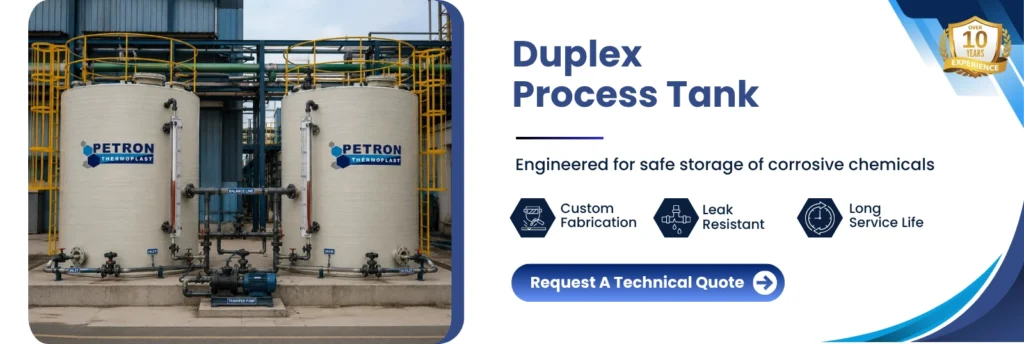
Duplex Process Tank
Duplex Process Tanks are industrial tanks manufactured using duplex stainless steel, a high-strength material. That is combine to the properties of the both austenitic and ferritic stainless steel. These tanks are specially designed for the processing, storing, and handling of corrosive chemicals. The high-temperature fluids and the demanding of industrial media require severe the operating conditions.
Duplex Process Tanks provide excellent corrosion resistance and superior mechanical strength. The high pressure handling capability enhances the durability compared to conventional stainless steel materials. Because of these properties, Duplex Process Tanks are widely used in the chemical processing, petrochemical plants, pharmaceuticals, marine industries, and wastewater treatment applications. Petron Thermoplast is proving that the Duplex Process Tanks are an excellent choice for chemical industries, that is required to have high mechanical strength, superior corrosion resistance and reliable performance in the demanding operating conditions.


Material Grade
Duplex SS 2205, Duplex SS 2304, Super Duplex SS 2507

Temperature Resistance
Up to 300°C (Depending on Application)

Corrosion-Free Construction
Excellent Resistance to Chlorides, Chemicals & Seawater

Long Service Life
Excellent durability and can operate for many years

ASME, ASTM, DIN, IS Certified
Manufactured to international quality standards
Up to 300°C
Operating Temperature
100 L –200K L
Capacity (Customizable)
ASME, ASTM, DIN, IS
Certified quality standards
3 mm – 25 mm
Wall Thickness

Excellent Chemical Resistance
They are highly resistant to the sulfuric, phosphoric, and nitric acids, as well as hydrogen sulfide.

Temperature Resistance
They are perform well at varying temperatures, typically with a working range.

Excellent Cost-Efficiency
Despite the higher raw material costs, the high strength permits less material usage, reducing transportation, fabrication, and overall project costs.

Low Maintenance
Their are inherent resistance to the corrosion, often eliminating the need for an expensive coatings and reduces the maintenance and inspection costs over the lifespan of the tank.
Technical Details
| Parameter | Details |
| Product Type | Duplex Stainless Steel Process Tank |
| Material Grade | Duplex SS 2205, Duplex SS 2304, Super Duplex SS 2507 |
| Tank Type | Storage Tank / Process Tank / Mixing Tank |
| Tank Orientation | Vertical / Horizontal |
| Shape | Cylindrical / Conical / Rectangular |
| Capacity Range | 100 Liters to 200 KL or Customized |
| Thickness Range | 3 mm to 25 mm (Depending on Design) |
| Operating Temperature | Up to 300°C (Depending on Application) |
| Pressure Rating | Atmospheric to High Pressure Applications |
| Corrosion Resistance | Excellent Resistance to Chlorides, Chemicals & Seawater |
| Surface Finish | Mirror Finish / Matte Finish / Pickled Finish |
| Fabrication Method | TIG / MIG / Arc Welding |
| Welding Standard | ASME / ASTM / IS Standards |
| Internal Finish | Smooth Hygienic Finish Available |
| Agitator Provision | Available as per Process Requirement |
| Insulation Option | PU / Mineral Wool / Rock Wool |
| Heating Arrangement | Steam Coil / Electrical Heater / Jacketed System |
| Cooling Arrangement | Cooling Jacket / Coil System |
| Nozzle Connections | Flanged / Threaded / Tri-Clamp |
| Accessories Available | Manhole, Ladder, Level Indicator, Vent Filter, Sight Glass |
| Design Standards | ASME, ASTM, DIN, IS Standards |
| Mounting Type | Skid Mounted / Leg Supported / Saddle Mounted |
| Testing | Hydro Test, Dye Penetrant Test, Radiography |
| Maintenance Requirement | Low Maintenance |
| Service Life | Long Operational Life |
| Applications | Chemical Processing, Pharmaceutical, Marine, Petrochemical, Food Processing |
Duplex Process Tanks are fabricated from Duplex Stainless Steel, a material that combines the benefits of austenitic and ferritic stainless steels. Duplex grades offered the excellent resistance to corrosion, high mechanical strength, and superior durability compared to conventional stainless steels. These properties to make Duplex Process Tanks are ideal for handling the aggressive chemicals, chloride-containing solutions, and demanding the industrial processes.
Chemical compatibility is influenced by factors such as chemical concentration, operating temperature, pressure, and exposure duration.
Why Duplex Stainless Steel is Chemically Resistant
Duplex stainless steel provides:
- Excellent resistance to pitting corrosion
- Superior resistance to crevice corrosion
- High resistance to stress corrosion cracking
- Improved resistance to chloride attack
- Good performance in acidic and alkaline environments
- Enhanced durability in harsh industrial conditions
Common Duplex Stainless Steel Grades
Duplex 2205
The most widely used duplex grade for process tanks.
Features:
- Excellent corrosion resistance
- Good mechanical strength
- Suitable for a broad range of chemicals
Super Duplex 2507
Designed for highly aggressive environments.
- Exceptional chloride resistance
- Superior pitting resistance
- Excellent seawater performance
Lean Duplex Grades
Used where moderate corrosion resistance is sufficient.
- Cost-effective solution
- Good structural strength
- Suitable for less demanding applications
Chemical Compatibility with Acids
Compatible Acids
Duplex Process Tanks generally perform well with:
- Phosphoric Acid
- Acetic Acid
- Citric Acid
- Organic Acids
- Dilute Sulfuric Acid
- Chemical manufacturing
- Fertilizer production
- Food processing
- Pharmaceutical processing
Chemical Compatibility with Alkalis
Duplex stainless steel has good resistance to many alkaline solutions.
Compatible Chemicals
- Sodium Hydroxide (moderate concentrations)
- Potassium Hydroxide
- Ammonia Solutions
- Cleaning Chemicals
- Chemical dosing systems
- Industrial cleaning processes
- Water treatment facilities
Compatibility with Water Treatment Chemicals
Duplex Process Tanks are commonly used for:
- Ferric Chloride
- Alum Solutions
- Sodium Hypochlorite (under controlled conditions)
- Coagulants
- Flocculants
- Treated water storage
Proper concentration and temperature limits should be evaluated.
Testing and quality assurance are critical aspects of Duplex Process Tank to manufacturing. Duplex Stainless Steel tanks are often used in corrosive, high-pressure, and demanding the industrial applications, thorough inspection and testing are essential to ensure the safety, reliability, and long service life. Quality control begins with raw material verification and continues through fabrication, welding, testing, and final inspection.
Importance of Quality Testing
Comprehensive testing helps to:
- Verify structural integrity
- Ensure leak-proof performance
- Confirm material compliance
- Detect fabrication defects
- Improve operational safety
- Ensure corrosion resistance
- Meet customer and industry specifications
1. Raw Material Inspection
Quality assurance starts with verifying the Duplex Stainless Steel materials.
Inspection Parameters:
- Material grade verification
- Material Test Certificate (MTC) review
- Chemical composition confirmation
- Plate thickness measurement
- Surface quality inspection
- Traceability marking verification
Only certified materials are approved for production.
2. Dimensional Inspection
Dimensional checks are performed throughout fabrication.
Parameters Checked:
- Tank diameter
- Height and length
- Shell roundness
- Plate thickness
- Nozzle orientation
- Support alignment
- Manhole dimensions
Accurate dimensions ensure proper installation and operation.
3. Welding Quality Inspection
Weld quality is crucial in Duplex Process Tanks because improper welding can reduce corrosion resistance and mechanical properties.
Visual Inspection (VT)
Checks for:
- Weld appearance
- Uniform bead profile
- Surface cracks
- Undercuts
- Porosity
- Incomplete fusion
Weld Measurement
Verification of:
- Weld size
- Reinforcement height
- Root penetration
- Joint alignment
4. Dye Penetrant Testing (PT)
Dye Penetrant Testing is used to detect surface-breaking defects.
Detects:
- Cracks
- Pinholes
- Porosity
- Surface discontinuities
- Non-destructive
- Highly sensitive
- Suitable for stainless steel welds
5. Radiographic Testing (RT)
Radiographic Testing may be performed on critical weld joints.
Purpose:
- Detect internal weld defects
- Verify weld penetration
- Assess weld integrity
- Slag inclusions
- Internal porosity
- Lack of fusion
- Cracks
6. Ultrasonic Testing (UT)
Ultrasonic inspection is often used as an alternative or supplement to radiography.
- Weld inspection
- Thickness measurement
- Internal defect detection
- Accurate results
- Non-destructive
- Suitable for thick sections
7. Ferrite Content Measurement
Maintaining the correct ferrite-to-austenite balance is important in Duplex Stainless Steel.
- Verify metallurgical structure
- Ensure corrosion resistance
- Confirm welding quality
Improper ferrite levels can negatively affect tank performance.
Industries We Serve

Chemical Processing Industry
They are used for the pressure vessels, processing, and chemical storage tanks. Due to the superior resistance to stress and corrosion cracking to particularly with chlorides.

Oil & Gas Sector
Ideal for the upstream and downstream the applications on offshore platforms for the storing products that are prone to cracking and pitting.

Marine & Desalination
Super Duplex tanks are the ideal for handling high-salinity seawater, desalination plants, and seawater systems.

Petrochemical Industries
Used in high-temperature and corrosive process environments requiring superior material strength.

Power Plants
Supports utility systems, chemical treatment processes, and industrial fluid handling operations.

Electroplating & Surface Treatment Plants
Ideal for corrosive chemical storage and plating solution processing.
Features of Duplex Process Tank

Superior Corrosion Resistance
They are offered to high resistance to pitting, crevice corrosion, and stress corrosion cracking (SCC). Particularly in the chloride-containing of environments. They are often outperformed in harsh environments.

High Structural Strength
Duplex stainless steel has nearly double to the yield strength of the conventional austenitic steels. This allows for the thinner wall. thicknesses and reduced. There lighter-weight construction without an sacrificing integrity.

Excellent Cost-Efficiency
Despite the higher raw material costs, the high strength permits less material usage, reducing transportation, fabrication, and overall project costs.
Broad Chemical Resistance
They are highly resistant to the sulfuric, phosphoric, and nitric acids, as well as hydrogen sulfide.
Thermal Stability
They are perform well at varying temperatures, typically with a working range.

Low Maintenance
Their are inherent resistance to the corrosion, often eliminating the need for an expensive coatings and reduces the maintenance and inspection costs over the lifespan of the tank.
Manufacturing Process of Duplex Process Tank
Duplex Process Tanks are high-performance vessels fabricated from Duplex Stainless Steel, a material known for its excellent corrosion resistance, high mechanical strength, and durability. These tanks are widely used in chemical processing, pharmaceuticals, food and beverage production, water treatment, oil and gas, and marine industries.
The manufacturing process of Duplex Process Tanks requires specialized fabrication techniques, controlled welding procedures, and stringent quality inspections to maintain the unique metallurgical properties of the Duplex stainless steel.ejnu
The manufacturing process begins with detailed engineering and design calculations based on the application requirements.
Design Considerations:
- Tank capacity and dimensions(100 Liters to 200 KL or Customized)
- Operating temperature(Up to 300°C (Depending on Application))
- Internal pressure or vacuum conditions
- Chemical compatibility
- Agitator and process loads
- Nozzle locations
- Support structure design
- Industry standards and customer specifications
The appropriate Duplex Stainless Steel grade is selected according to the service conditions.
Common Grades:
- Duplex 2205
- Super Duplex 2507
- Lean Duplex Grades
Material Verification:
- Material Test Certificates (MTC)
- Chemical composition verification
- Mechanical property review
- Thickness confirmation
- Surface quality inspection
Only certified materials are approved for fabrication.
Stainless steel plates are cut according to the approved fabrication drawings.
Cutting Methods:
- CNC Plasma Cutting
- Laser Cutting
- Water Jet Cutting
- Mechanical Shearing
Edges are cleaned and prepared for welding to ensure high-quality joints.
Cut plates are rolled into the required tank shape.
Forming Operations:
- Cylindrical shell rolling
- Cone fabrication
- Dish-end forming
- Bottom plate shaping
Precision forming ensures proper alignment and dimensional accuracy.
The shell sections, heads, and bottom plates are assembled before welding.
Activities:
- Alignment verification
- Tack welding
- Dimensional checking
- Joint preparation
Proper fit-up is critical to achieving strong and defect-free welds.
Welding is one of the most critical stages in Duplex tank fabrication.
Common Welding Processes:
- GTAW (TIG Welding)
- GMAW (MIG Welding)
- SMAW (Stick Welding)
- SAW (Submerged Arc Welding)
Welding Requirements:
- Qualified welding procedures
- Controlled heat input
- Correct filler metal selection
- Interpass temperature control
Proper welding preserves the balance between ferrite and austenite phases, ensuring optimal corrosion resistance and mechanical strength.
Various process connections and accessories are installed.
Typical Components:
- Inlet nozzles
- Outlet nozzles
- Drain connections
- Vent connections
- Manholes
- Sampling ports
- Instrument nozzles
- Agitator mountings
All attachments are welded and inspected according to approved procedures.
After fabrication, the tank surface is cleaned and finished.
Surface Treatment Methods:
- Grinding
- Mechanical polishing
- Pickling
- Passivation
These treatments remove contaminants and enhance corrosion resistance.
Depending on design specifications and application requirements, post-fabrication treatments may be performed.
Purpose:
- Improve corrosion resistance
- Remove surface contamination
- Restore passive layer
Critical dimensions are checked throughout fabrication.
Inspection Items:
- Diameter
- Height
- Shell roundness
- Nozzle orientation
- Wall thickness
- Support alignment
Dimensional accuracy ensures proper installation and operation.
NDT methods are used to verify weld quality and structural integrity.
Common NDT Techniques:
- Visual Testing (VT)
- Dye Penetrant Testing (PT)
- Radiographic Testing (RT)
- Ultrasonic Testing (UT)
These inspections help identify defects without damaging the tank.
How to Select the Right Duplex Process Tank
Selecting the right Duplex Process Tank are required to careful evaluation of process conditions, material requirements, and operational needs.
The first step is understanding how the tank will be used.
Common Applications:
- Chemical processing
- Mixing and blending
- Reaction processes
- Storage of corrosive liquids
- Water treatment systems
- Pharmaceutical manufacturing
- Food and beverage processing
The application determines the tank design, material grade, and accessories required.
The stored or processed media must be compatible with Duplex Stainless Steel.
Suitable Media:
- Chloride-containing solutions
- Acids (certain concentrations)
- Alkalis
- Industrial chemicals
- Seawater and brine solutions
For highly aggressive chemicals, verify compatibility based on:
- Chemical concentration
- Operating temperature
- Exposure duration
Different Duplex stainless steel grades offer varying levels of corrosion resistance.
Common Grades:
Grade | Typical Applications |
Duplex 2205 | General chemical processing, water treatment |
Super Duplex 2507 | Highly corrosive environments, marine applications |
Lean Duplex | Cost-effective, moderate corrosion resistance |
The grade should be selected based on process requirements and environmental conditions.
Calculate the required storage or process volume.
Consider:
- Production requirements
- Batch size
- Future expansion plans
- Safety reserve capacity
Tank capacities can range from a few hundred liters to several thousand cubic meters.
Temperature affects material performance and tank design.
Considerations:
- Maximum operating temperature
- Minimum operating temperature
- Thermal cycling conditions
- Heating or cooling requirements
Duplex stainless steel generally performs well in a wide range of temperatures.
Determine whether the tank will operate under:
- Atmospheric conditions
- Internal pressure
- Full vacuum
- Cyclic pressure conditions
Pressure-rated tanks require additional engineering and reinforcement.
Choose a design suitable for the process.
Common Configurations:
- Vertical cylindrical tanks
- Horizontal tanks
- Mixing tanks
- Reactor vessels
- Cone-bottom tanks
- Open-top process tanks
The configuration should optimize process efficiency and maintenance access.
If the process requires mixing, determine:
Agitator Requirements:
- Mixing speed
- Impeller type
- Motor power
- Shaft design
- Mounting arrangement
Proper agitation improves process consistency and product quality.

Custom Product Manufacturing Available
If you are searching for customized product designs that meet your requirements, don’t worry. Petron Thermoplast also offers custom product manufacturing services to meet the unique needs of various industries. Work with our expert engineers to create custom designs suited for your application.
Why Choose Petron Thermoplast?
Petron Thermoplast is proving that the Duplex Process Tanks are an excellent choice for chemical industries. That is required to have high mechanical strength, superior corrosion resistance and reliable performance in the demanding operating conditions. Manufactured from the duplex stainless steel. Petron Thermoplast provides tanks that combine the advantages of the both austenitic and ferritic stainless steel to offer enhanced durability and long service life.
These tanks are specially designed to handle aggressive chemicals, chlorides, high-pressure fluids, and high-temperature applications. Where the conventional tanks may not perform effectively. There are excellent resistance to pitting, crevice corrosion, and the stress corrosion cracking, making them the highly suitable for harsh industrial environments.
Frequently Asked Questions
A Duplex Process Tank is a storage or processing vessel fabricated from Duplex Stainless Steel, which combines the properties of austenitic and ferritic stainless steels. It offers excellent corrosion resistance, high strength, and long service life for demanding industrial applications.
Key advantages include:
- Superior corrosion resistance
- High mechanical strength
- Excellent resistance to chloride-induced corrosion
- Long service life
- Reduced maintenance costs
- Better stress corrosion cracking resistance
- Higher load-bearing capability than conventional stainless steel
Common grades include:
- Duplex 2205
- Super Duplex 2507
- Lean Duplex Grades
The grade selection depends on the process conditions and corrosion environment.
Duplex Process Tanks are widely used in:
- Chemical Processing
- Pharmaceuticals
- Food and Beverage Manufacturing
- Water and Wastewater Treatment
- Oil and Gas Industry
- Marine and Offshore Applications
- Fertilizer Plants
- Power Generation
They are suitable for handling:
- Phosphoric Acid
- Acetic Acid
- Organic Acids
- Alkaline Solutions
- Brine Solutions
- Process Water
- Various Industrial Chemicals
Chemical compatibility should always be evaluated based on concentration and operating temperature.
Yes. Duplex Stainless Steel provides excellent resistance to chloride-induced pitting, crevice corrosion, and stress corrosion cracking, making it ideal for chloride-rich environments.
Yes. Duplex and Super Duplex grades are widely used for seawater storage, desalination plants, offshore platforms, and marine processing systems due to their superior corrosion resistance.
Duplex Process Tanks can be custom-fabricated in a wide range of capacities, from small process vessels to large industrial storage tanks containing thousands of liters or cubic meters.
Yes. Tanks can be customized with:
- Manholes
- Nozzles
- Agitators
- Sight glasses
- Level indicators
- Sampling ports
- Pressure gauges
- Ladders and platforms
- CIP systems
Common configurations include:
- Vertical Cylindrical Tanks
- Horizontal Tanks
- Mixing Tanks
- Reactor Vessels
- Cone-Bottom Tanks
- Open-Top Process Tanks