SS and Hybrid Assemblies for Industrial Process Applications
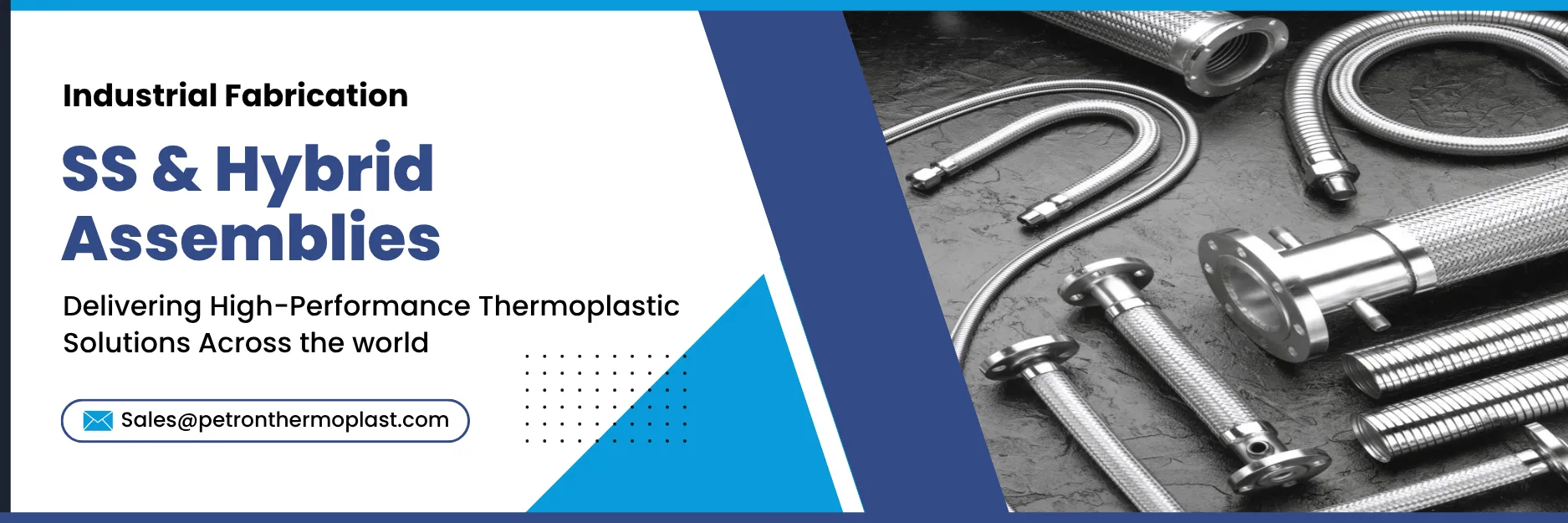
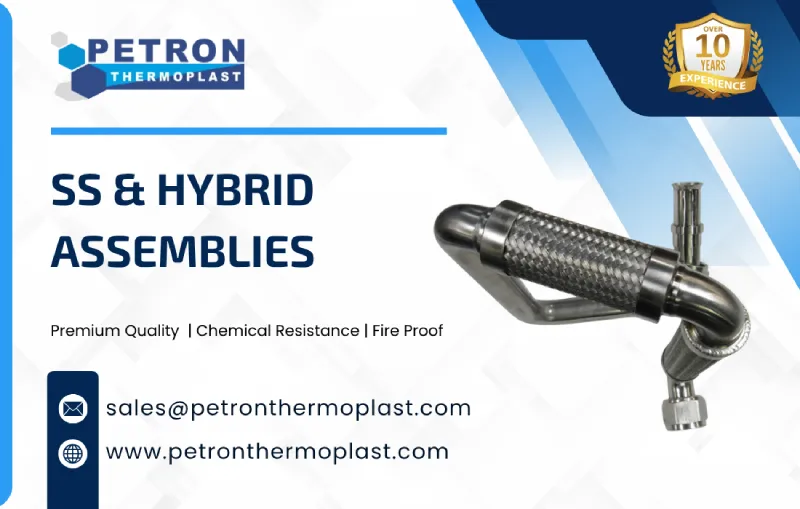
SS & Hybrid Assemblies are for industrial fabrication systems and components manufactured using Stainless Steel (SS). SS and Hybrid Assemblies are used alone and in combination with other materials such as HDPE, PP, FRP, PVC, and CPVC to achieve enhanced corrosion resistance, mechanical strength, chemical compatibility, and operational efficiency.
- SS Assemblies are fabricated entirely from stainless steel materials
- Hybrid Assemblies combine stainless steel with thermoplastics, FRP, rubber, and other engineered materials
SS and Hybrid Assemblies are widely used in industrial piping systems, chemical processing plants, water treatment systems, storage tanks, ducting systems, and custom industrial applications. These assemblies are manufactured according to industry standards and customer specifications to ensure precision, reliability, and long service life in demanding environments.

SS & Hybrid Assemblies Details
| Parameter | SS Assemblies | Hybrid Assemblies |
| Material Composition | Stainless Steel (SS 304, SS 316, SS 316L) | Combination of SS, HDPE, FRP, PP, PVDF, or other materials |
| Manufacturing Process | Fabrication, welding, machining, polishing | Multi-material fabrication, joining, welding, fastening |
| Surface Finish | Matte, Mirror, Buffed, Pickled | Customized as per material combination |
| Corrosion Resistance | Excellent | Very high depending on material selection |
| Mechanical Strength | High tensile and structural strength | Balanced strength with chemical resistance |
| Temperature Resistance | Up to 800°C (grade dependent) | Varies from -20°C to 150°C depending on materials |
| Pressure Handling Capacity | Medium to high-pressure applications | Customized for low, medium, or high pressure |
| Chemical Resistance | Resistant to acids, alkalis, and chemicals | Enhanced chemical compatibility |
| Density | Approx. 7.9–8.0 g/cm³ | Depends on combined materials |
| Welding Compatibility | TIG, MIG, Arc welding supported | Specialized joining techniques required |
| Durability | Long service life | High durability with optimized performance |
| Weight | Heavier than thermoplastics | Reduced weight compared to full SS assemblies |
| Hygienic Properties | Excellent for sanitary applications | Suitable for hygienic and industrial applications |
| Customization | Highly customizable | Fully customizable for specific applications |
| Leak Resistance | High precision sealing | Enhanced sealing with hybrid construction |
| Maintenance Requirement | Low maintenance | Low to moderate maintenance |
| UV Resistance | Excellent | Depends on outer material layer |
| Abrasion Resistance | Good | Improved in selected hybrid combinations |
| Thermal Conductivity | Moderate to high | Controlled thermal performance |
| Electrical Conductivity | Conductive | Can be conductive or non-conductive |
| Application Areas | Chemical, pharma, dairy, food, water treatment | Chemical plants, corrosive environments, industrial processing |
| Fabrication Standards | ASTM, ASME, DIN, ISO | Customized industrial standards |
| Available Shapes | Tanks, ducts, fittings, frames, manifolds | Composite tanks, pipelines, mixed-material systems |
| Service Life | 15–30 years | 10–25 years depending on application |
- Excellent corrosion and chemical resistance
- High mechanical and structural strength
- Durable and long-lasting performance
- Suitable for high-temperature applications
- Capable of handling medium and high-pressure operations
- Leak-proof and precision-engineered construction
- Hygienic and easy-to-clean surfaces
- Smooth internal finish for efficient flow
- Excellent wear and abrasion resistance
- High dimensional accuracy and stability
- Lightweight options available in hybrid constructions
- Custom-designed as per industrial requirements
- Strong welding and joint integrity
- Low maintenance and operational cost
- Resistant to rust, oxidation, and environmental exposure
- Compatible with aggressive chemicals and process fluids
- Excellent thermal stability and performance
- Available in various material combinations and grades
- Easy installation and integration with existing systems
- UV and weather-resistant options available
- Suitable for indoor and outdoor industrial applications
- Improved operational efficiency and safety
- Available in modular and compact designs
- Manufactured according to industrial quality standards
| Assembly Type | Material Used | Typical Pressure Rating |
| SS 304 Assemblies | Stainless Steel 304 | Up to 10–40 Bar |
| SS 316 / SS 316L Assemblies | Stainless Steel 316 / 316L | Up to 10–60 Bar |
| Heavy-Duty SS Fabricated Assemblies | Thick-wall Stainless Steel | Up to 100 Bar |
| HDPE + SS Hybrid Assemblies | SS with HDPE Lining | 2–16 Bar |
| FRP + SS Hybrid Assemblies | FRP Reinforced with SS | 3–20 Bar |
| PP / PVDF + SS Hybrid Assemblies | Thermoplastic with SS Support | 2–15 Bar |
| Industrial Process Pipe Assemblies | SS / Hybrid Combination | Customized as per system design |
| Vacuum Service Assemblies | SS & Composite Structures | Full Vacuum to Positive Pressure |
| High-Temperature SS Assemblies | SS 316L / Special Grades | Pressure varies with temperature |
| Chemical Transfer Assemblies | Corrosion-resistant Hybrid Design | Application-specific pressure ratings |
| Assembly Type | Material Composition | Operating Temperature Range | Approx. Density |
| SS 304 Assemblies | Stainless Steel 304 | -50°C to 870°C | 7.9 g/cm³ |
| SS 316 Assemblies | Stainless Steel 316 | -50°C to 925°C | 8.0 g/cm³ |
| SS 316L Assemblies | Low Carbon Stainless Steel | -50°C to 870°C | 8.0 g/cm³ |
| HDPE + SS Hybrid Assemblies | HDPE with SS Reinforcement | -40°C to 80°C | 1.0–7.9 g/cm³ |
| FRP + SS Hybrid Assemblies | FRP with SS Structure | -20°C to 120°C | 1.5–7.9 g/cm³ |
| PP + SS Hybrid Assemblies | Polypropylene with SS | 0°C to 100°C | 0.9–7.9 g/cm³ |
| PVDF + SS Hybrid Assemblies | PVDF with SS Support | -20°C to 140°C | 1.7–7.9 g/cm³ |
| Industrial Composite Assemblies | Multi-material Combination | Customized as per application | Variable |
User Manual for SS & Hybrid Assemblies
- Chemical processing and storage systems
- Acid and alkali handling plants
- Pharmaceutical manufacturing units
- Water treatment and wastewater treatment plants
- Petrochemical and oil & gas industries
- Industrial piping and process lines
- Corrosion-resistant transfer systems
- High-temperature industrial applications
- Pressure handling and fluid control systems
- Industrial ducting and ventilation systems
- Effluent treatment plants (ETP)
- Electroplating and metal finishing plants
- Power generation industries
- Marine and coastal applications
- Semiconductor and electronics industries
- Mining and mineral processing plants
- Industrial fabrication and structural support systems
- Customized process equipment manufacturing
1. Material Customization
Manufacturers provide different material grades based on application requirements.
Common SS Grades:
- SS 304
- SS 316
- SS 316L
- Duplex Stainless Steel
Hybrid Material Combinations:
- SS + HDPE
- SS + PTFE
- SS + FRP
- SS + PVDF
- SS + Rubber Lining
2. Size & Dimension Customization
Assemblies can be fabricated in customized dimensions such as:
- Pipe diameter
- Length and thickness
- Flange sizes
- Hose lengths
- Connector dimensions
3. Pressure & Temperature Customization
Assemblies are designed according to operating conditions.
Customization Includes:
- High-pressure assemblies
- Vacuum-resistant systems
- High-temperature resistant designs
- Cryogenic application assemblies
4. Surface Finish Customization
Different finishing options are available for industrial and hygienic applications.
Surface Finishes:
- Mirror finish
- Matte finish
- Electro-polished finish
- Pickled and passivated finish
5. End Connection Customization
Various connection types can be integrated according to system requirements.
Available Connections:
- Flanged ends
- Threaded ends
- Tri-clamp fittings
- Socket weld ends
- Butt weld connections
6. Design & Fabrication Customization
Assemblies can be manufactured according to customer drawings and industrial standards.
Custom Features:
- Compact design
- Multi-layer protection
- Flexible configurations
- Anti-vibration support
- Corrosion-resistant lining
Processing of SS & Hybrid Assemblies
1. Material Selection
Raw materials are selected based on:
- Chemical compatibility
- Pressure requirements
- Temperature conditions
- Mechanical strength
2. Cutting Process
Precision cutting methods are used for accurate dimensions.
Techniques Used:
- Laser cutting
- Plasma cutting
- Water jet cutting
- CNC cutting
3. Forming & Fabrication
Components are shaped and fabricated according to design specifications.
Processes Include:
- Bending
- Rolling
- Welding
- Machining
- Drilling
4. Welding Process
High-quality welding ensures leak-proof and strong joints.
Common Welding Methods:
- TIG welding
- MIG welding
- Arc welding
- Orbital welding
5. Lining & Coating
Hybrid assemblies may include internal protective linings.
Lining Materials:
- PTFE lining
- HDPE lining
- Rubber lining
- FRP coating
- PVDF coating
6. Surface Treatment
Surface finishing enhances durability and appearance.
Treatment Methods:
- Polishing
- Passivation
- Electro-polishing
- Sandblasting
- Anti-corrosion coating
7. Assembly & Integration
Different components are assembled with precision to ensure operational reliability.
Integrated Components:
- Valves
- Flanges
- Sensors
- Gaskets
- Fastener
1. Site Preparation
Before installation, the installation area should be properly prepared.
Important Checks:
- Ensure clean and level mounting surface
- Verify pipeline alignment
- Remove dust, debris, and moisture
- Check availability of required tools and fittings
2. Inspection Before Installation
All assemblies should be inspected carefully before use.
Inspection Includes:
- Visual inspection for damage
- Checking dimensions and specifications
- Verifying flange and connector compatibility
- Inspecting gaskets, seals, and fasteners
3. Proper Handling
SS & Hybrid Assemblies should be handled carefully to avoid damage to surfaces and linings.
Handling Guidelines:
- Use lifting equipment for heavy assemblies
- Avoid dragging on rough surfaces
- Protect PTFE, HDPE, FRP, or rubber linings from impact
- Store components in dry and clean conditions
4. Alignment & Positioning
Correct alignment helps prevent stress and leakage.
Installation Tips:
- Align flanges properly before tightening
- Avoid excessive bending or twisting
- Ensure proper pipe support spacing
- Maintain expansion allowances for thermal movement
5. Connection Installation
Assemblies may use different connection systems depending on application requirements.
Common Connection Types:
- Flanged connections
- Threaded joints
- Butt weld joints
- Socket weld connections
- Tri-clamp fittings
- Use suitable gaskets and sealing materials
- Tighten bolts uniformly in cross pattern
- Avoid over-tightening
- Follow recommended torque values
6. Welding Precautions
For welded assemblies, proper welding procedures are essential.
Welding Guidelines:
- Use compatible filler materials
- Maintain proper welding temperature
- Prevent contamination during welding
- Perform post-weld cleaning and passivation
7. Pressure & Leak Testing
After installation, assemblies should be tested before operation.
Testing Methods:
- Hydrostatic testing
- Pneumatic testing
- Leak detection inspection
- Pressure holding test
8. Commissioning
Before starting operation:
- Flush the system properly
- Check valve operations
- Verify pressure and flow conditions
- Monitor for vibration or leakage
Maintenance of SS & Hybrid Assemblies
1. Routine Inspection
Periodic inspection helps identify early signs of wear or damage.
Inspect For:
- Corrosion
- Leakage
- Loose fasteners
- Surface cracks
- Lining damage
2. Cleaning Procedures
Assemblies should be cleaned regularly to avoid contamination and scaling.
Cleaning Methods:
- Water flushing
- Chemical cleaning (compatible chemicals only)
- Non-abrasive cleaning tools
- Steam cleaning for hygienic systems
3. Corrosion Protection
Although stainless steel is corrosion resistant, preventive maintenance is still necessary.
Protection Measures:
- Regular passivation
- Protective coatings
- Avoid chloride contamination
- Maintain dry external surfaces
4. Maintenance of Hybrid Linings
Hybrid assemblies with HDPE, PTFE, FRP, or rubber linings require special attention.
- Inspect lining integrity regularly
- Avoid sharp mechanical impacts
- Prevent excessive temperature exposure
- Replace damaged lining sections immediately
5. Fastener & Gasket Maintenance
Fasteners and gaskets should be checked periodically.
Recommended Actions:
- Retighten loose bolts
- Replace worn gaskets
- Inspect flange sealing surfaces
- Use corrosion-resistant fasteners
6. Lubrication of Moving Parts
Valve and mechanical assemblies may require lubrication.
Components Requiring Lubrication:
- Valve stems
- Hinges
- Bearings
- Mechanical joints
1. Raw Material Inspection
The quality process begins with inspection of raw materials used in manufacturing.
Inspection Includes:
- Verification of stainless steel grade
- Chemical composition analysis
- Mechanical property testing
- Surface quality inspection
- Certification verification
- SS 304
- SS 316 / 316L
- Duplex SS
- HDPE
- PTFE
- FRP
- PVDF
- Rubber linings
2. Dimensional Quality Check
All fabricated components are inspected for dimensional accuracy.
Parameters Checked:
- Diameter
- Thickness
- Length
- Flange dimensions
- Alignment accuracy
- Tolerance levels
- Vernier calipers
- Micrometers
- Ultrasonic thickness gauges
- Coordinate measuring machines (CMM)
3. Welding Quality Inspection
Weld joints are critical in SS & Hybrid Assemblies and require strict inspection.
Welding Checks:
- Weld penetration
- Weld strength
- Surface finish
- Porosity detection
- Crack inspection
Welding Standards:
- ASME standards
- ASTM standards
- ISO welding specifications
Testing of SS & Hybrid Assemblies
1. Hydrostatic Pressure Testing
Hydrostatic testing checks the pressure holding capability of assemblies.
- Detect leakage
- Verify structural strength
- Ensure pressure resistance
2. Pneumatic Testing
Compressed air or gas is used for leak testing in sensitive applications.
- Detects micro leaks
- Suitable for gas handling systems
- High sensitivity testing
3. Leak Testing
Leak testing ensures leak-proof performance of joints and connections.
- Soap solution testing
- Vacuum leak testing
- Helium leak detection
- Air pressure leak testing
4. Non-Destructive Testing (NDT)
NDT methods inspect assemblies without damaging the product.
Common NDT Methods:
| NDT Method | Purpose |
| Dye Penetrant Test (DPT) | Surface crack detection |
| Radiographic Test (RT) | Internal weld inspection |
| Ultrasonic Test (UT) | Thickness & defect detection |
| Magnetic Particle Test (MPT) | Surface flaw inspection |
| Visual Testing (VT) | External inspection |
5. Corrosion Resistance Testing
Hybrid assemblies are tested for chemical and corrosion resistance.
Testing Includes:
- Acid resistance test
- Alkali resistance test
- Salt spray test
- Chemical compatibility testing
6. Temperature Resistance Testing
Assemblies are tested under extreme temperature conditions.
- Verify thermal stability
- Check expansion behavior
- Ensure high/low temperature performance
7. Mechanical Strength Testing
Mechanical tests ensure structural integrity and load-bearing capacity.
- Tensile strength test
- Impact resistance test
- Hardness testing
- Bend testing
8. Lining Adhesion Testing
For hybrid assemblies with internal lining, adhesion quality is verified.
- Spark testing
- Peel adhesion testing
- Vacuum testing
- Holiday testing
9. Surface Finish Inspection
Surface quality affects corrosion resistance and hygiene performance.
Surface Checks:
- Roughness measurement
- Polishing quality
- Passivation inspection
- Coating thickness measurement

Custom Product Manufacturing Available
If you are searching for customized product designs that meet your requirements, don’t worry. Petron Thermoplast also offers custom product manufacturing services to meet the unique needs of various industries. Work with our expert engineers to create custom designs suited for your application.
Types of SS & Hybrid Assemblies
1. Pipe Assemblies
These assemblies are manufactured using stainless steel pipes, bends, tees, reducers, and connectors for fluid transportation systems.
Chemical plants, water treatment systems, food processing, and pharmaceutical industries.
2. Hose Assemblies
Flexible stainless steel hoses combined with end fittings and flanges for handling high-pressure fluids and gases.
- Corrosion resistant
- High temperature tolerance
- Leak-proof design
3. Flanged Assemblies
Assemblies equipped with stainless steel flanges for secure pipeline connections.
Oil & gas, petrochemical, and industrial piping systems.
4. Valve Assemblies
Complete units containing SS valves, actuators, seals, and connectors for flow control applications.
- Ball valve assemblies
- Butterfly valve assemblies
- Gate valve assemblies
5. Instrumentation Assemblies
Precision SS assemblies used in pressure gauges, sensors, and instrumentation systems.
Chemical, pharmaceutical, and laboratory applications.
6. Structural SS Assemblies
Fabricated stainless steel structures used in industrial equipment and support systems.
- Frames
- Supports
- Brackets
- Platforms
7. SS + HDPE Hybrid Assemblies
Combination of stainless steel strength with HDPE corrosion resistance.:
Chemical transfer systems, storage tanks, and pipelines.
8. SS + PTFE Hybrid Assemblies
Assemblies lined or combined with PTFE for superior chemical resistance.:
- Anti-corrosive
- Non-reactive surface
- High-temperature resistance
9. SS + FRP Hybrid Assemblies
Stainless steel reinforced with FRP components for lightweight and durable industrial systems.
Used In:
Chemical processing plants and wastewater treatment systems.
10. SS + Rubber Lined Assemblies
Stainless steel assemblies lined with rubber to handle abrasive and corrosive materials.
Suitable For:
Slurry handling and mining industries.
11. SS + Thermoplastic Hybrid Assemblies
Assemblies combining stainless steel with thermoplastics like PP, PVC, or PVDF.
- Excellent chemical resistance
- Reduced maintenance
- Longer service life
12. Composite Hybrid Assemblies
Advanced assemblies made from multiple materials for customized industrial requirements.
- Lightweight
- High mechanical strength
- Corrosion resistance
- Cost-effective performance
Why Choose Petron Thermoplast?
SS 304 Assemblies are composed of Stainless Steel 304 with an operating temperature range of -50°C to 870°C and an approximate density of 7.9 g/cm³; SS 316 Assemblies consist of Stainless Steel 316, operating between -50°C to 925°C with a density of 8.0 g/cm³; SS 316L Assemblies use Low Carbon Stainless Steel, maintaining a temperature range of -50°C to 870°C and a density of 8.0 g/cm³; HDPE + SS Hybrid Assemblies combine HDPE with SS Reinforcement to handle -40°C to 80°C with a variable density of 1.0–7.9 g/cm³; FRP + SS Hybrid Assemblies utilize an FRP with SS Structure for temperatures from -20°C to 120°C and a density spanning 1.5–7.9 g/cm³; PP + SS Hybrid Assemblies feature Polypropylene with SS, supporting a 0°C to 100°C range and a density of 0.9–7.9 g/cm³; PVDF + SS Hybrid Assemblies pair PVDF with SS Support for operations between -20°C to 140°C and a density of 1.7–7.9 g/cm³; and Industrial Composite Assemblies rely on a customized multi-material combination, offering temperature ranges customized as per application and a variable density.
Conclusion
Stainless Steel and Hybrid Assemblies are essential components in industrial systems due to their corrosion resistance, excellent strength, durability, and operational reliability. SS and Hybrid Assemblies are the perfect combination of efficiency, durability, safety, and long-term value for a wide range of industrial applications. Stainless steel (SS) assemblies provide the superior mechanical strength, hygienic properties, and long service life, while the hybrid assemblies combine SS with advanced materials like HDPE, PTFE, FRP, PVDF, and rubber to achieve enhanced chemical resistance, lightweight construction, and cost-effective performance.
Frequently Asked Questions
SS & Hybrid Assemblies are industrial systems and fabricated components made using stainless steel alone or in combination with other materials such as HDPE, PTFE, FRP, PVDF, or rubber for improved performance and corrosion resistance.
SS stands for Stainless Steel, a corrosion-resistant metal widely used in industrial fabrication and piping systems.
Hybrid Assemblies are combinations of stainless steel and non-metallic materials designed to achieve better chemical resistance, lightweight construction, and cost efficiency.
Commonly used stainless steel grades include:
- SS 304
- SS 304L
- SS 316
- SS 316L
- Duplex Stainless Steel
Hybrid assemblies may include:
- HDPE
- PTFE
- FRP
- PVDF
- PP
- Rubber lining
Major Benefits:
- Excellent corrosion resistance
- High mechanical strength
- Long service life
- Leak-proof performance
- Chemical resistance
- Low maintenance
- Customizable designs
These assemblies are widely used in:
- Chemical industries
- Pharmaceutical plants
- Food processing units
- Water treatment systems
- Oil & gas industries
- Power plants
Yes, they are designed to handle corrosive chemicals, acids, alkalis, solvents, and industrial fluids depending on the material combination used.
Yes, stainless steel assemblies can withstand high temperatures, while hybrid assemblies are designed according to specific temperature and pressure requirements.
Common connection types include:
- Flanged connections
- Threaded fittings
- Butt weld joints
- Socket weld fittings
- Tri-clamp connections
Yes, SS & Hybrid Assemblies can be fully customized based on:
- Size
- Thickness
- Pressure rating
- Chemical compatibility
- Connection type
- Industrial application