HDPE Fabrication
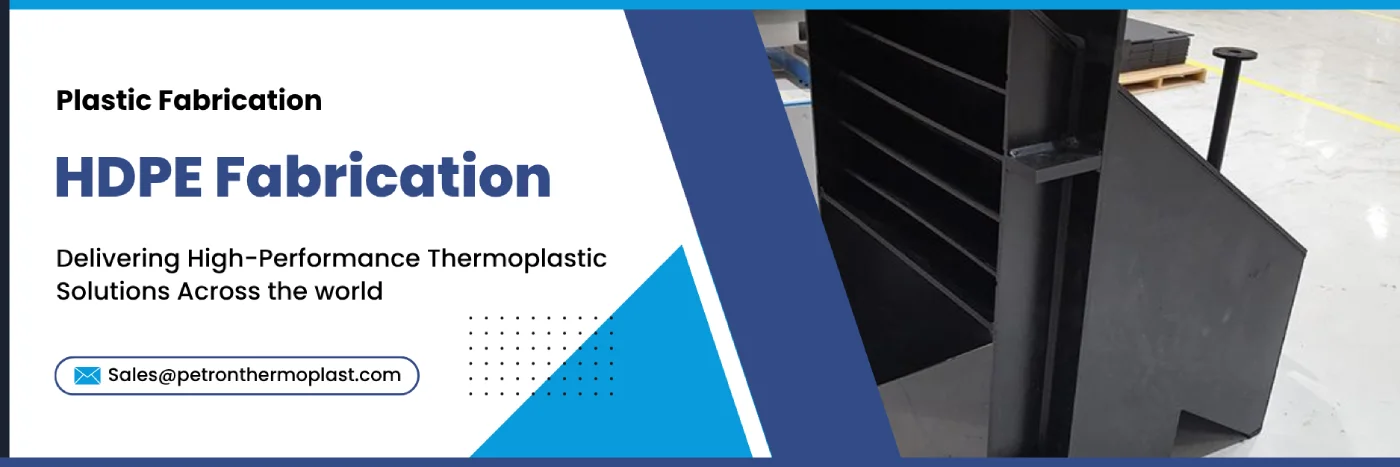
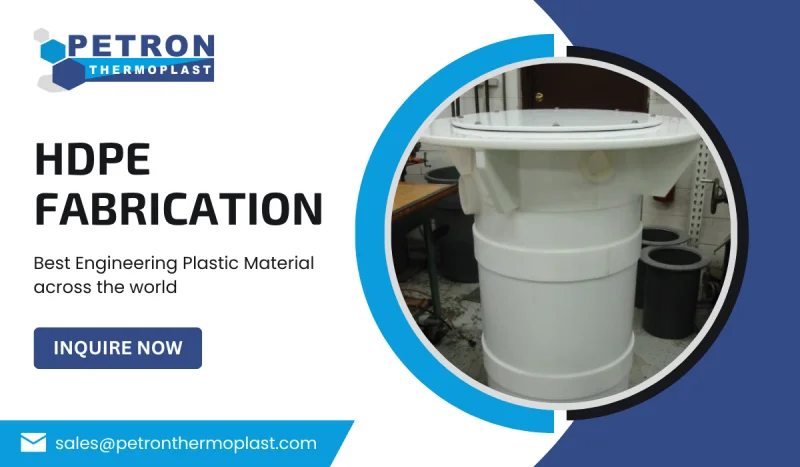
HDPE Fabrication refers to the process of cutting, shaping, joining, and assembling High-Density Polyethylene (HDPE) materials into finished products or customized components for various applications. High-density polyethylene, often referred to as HDPE, stands as a robust, semi-flexible, and enduring thermoplastic substance. Distinguished by its elevated crystalline structure, HDPE showcases the subsequent attributes.
HDPE fabrication is the manufacturing and customization process that transforms HDPE raw materials into durable, corrosion-resistant, and application-specific products used across industrial and infrastructure sectors.It involves converting raw HDPE forms such as sheets, pipes, and rods into usable products like Tanks, Piping systems, Industrial components and Liners and structures.

HDPE Fabrication Details
| Parameter | Details |
| Material Type | Thermoplastic (High-Density Polyethylene) |
| Fabrication Methods | Butt fusion, electrofusion, extrusion welding, hot gas welding, machining |
| Processing Temperature | 180°C – 220°C (for welding and forming) |
| Melting Point | 120°C – 135°C |
| Joining Strength | Up to 90–100% of base material (if properly welded) |
| Machinability | Excellent (easy to cut, drill, and shape) |
| Weldability | Excellent (fusion welding provides leak-proof joints) |
| Thermal Expansion | High (requires allowance in design) |
| Standards | ISO 21307, DVS 2207, ASTM standards |
| Tolerance Control | Moderate (depends on machining and welding precision) |
| Density | 0.941 – 0.965 g/cm³ |
| Tensile Strength | 20 – 37 MPa |
| Elongation at Break | 100% – 1000% |
| Flexibility | High (can bend without cracking) |
| Impact Resistance | Excellent |
| Hardness | Shore D 55 – 70 |
| Water Absorption | < 0.01% |
| Chemical Resistance | Excellent (resistant to acids, alkalis, salts) |
| UV Resistance | Moderate (improved with additives) |
| Surface Finish | Smooth, low friction |
1. High Durability
- HDPE fittings are extremely tough and long-lasting.
- They can perform efficiently for 50+ years without cracking or failure.
2. Corrosion & Chemical Resistance
- Resistant to acids, alkalis, salts, and chemicals.
- Do not rust or corrode like metal fittings.
3. Leak-Proof Joints
- Joined using butt fusion or electrofusion, creating a homogeneous joint.
- Joints are as strong as the pipe itself and prevent leakage.
4. Lightweight & Easy Installation
- Much lighter than metal fittings.
- Easy to transport, handle, and install, reducing labor cost.
5. High Flexibility
- Can bend without breaking, suitable for uneven or shifting soil.
- Reduces need for extra fittings and joints.
6. Excellent Impact Resistance
- Performs well under low temperatures and high pressure.
- Resistant to cracking, stress, and sudden impacts.
7. Smooth Inner Surface
- Provides low friction and high flow efficiency.
- Minimizes scaling, deposits, and pressure loss.
8. Non-Toxic & Safe
- Suitable for drinking water systems.
- Does not contaminate water or support bacterial growth.
9. Weather & UV Resistance
- Can withstand harsh environmental conditions.
- Suitable for both underground and outdoor applications.
10. Low Maintenance & Cost-Effective
- Requires minimal maintenance over time.
- Long service life reduces replacement costs.
| OD (mm) | Thickness Range (mm) | Common Use |
| 20 – 63 | 2 – 6 | Small piping, fittings |
| 75 – 160 | 4 – 15 | Water systems, fabrication works |
| 200 – 315 | 6 – 30 | Industrial pipelines |
| 355 – 630 | 10 – 60 | Large tanks and structures |
| 710 – 1200+ | 20 – 100 | Heavy-duty industrial fabrication |
User Manual for HDPE Fabrication
| Process | Temperature Range |
| Extrusion | 160°C – 220°C |
| Butt Fusion Welding | 200°C – 220°C |
| Electrofusion | ~200°C (internal heating) |
| Hot Gas Welding | 220°C – 300°C |
| Thermoforming | 140°C – 180°C |
| Property | Temperature |
| Melting Point | 120°C – 135°C |
| Softening Temperature | ~110°C |
| Max Continuous Use | 60°C – 80°C |
| Min Service Temperature | -40°C |
| Property | Value |
| Density Range | 0.941 – 0.965 g/cm³ |
| Typical Density | ~0.95 g/cm³ |
| In kg/m³ | 941 – 965 kg/m³ |
1. Installation of HDPE Fabrication
A. Pre-Installation Preparation
- Inspect all fabricated HDPE components for damage or defects
- Verify dimensions, pressure ratings, and specifications
- Ensure proper tools and welding equipment are available
- Clean surfaces to remove dust, or contaminants
B. Handling & Storage
- Store HDPE materials on flat, साफ surfaces
- Avoid sharp objects to prevent scratches or punctures
- Protect from excessive sunlight (UV exposure) before installation
- Use proper lifting tools (slings, not chains)
C. Jointing & Welding Methods
Proper joining is critical for leak-proof performance:
- Butt Fusion Welding
- Most common for pipes and fittings
- Ends are heated and fused together
- Creates strong, homogeneous joints
- Electrofusion Welding
- Uses embedded heating coils
- Ideal for repair work and confined spaces
- Extrusion Welding
- Used for sheet fabrication and tanks
- Suitable for thick sections
- Hot Air (Hot Gas) Welding
- Used for light fabrication work
D. Installation Process
- Align components accurately before welding
- Maintain correct तापमान and pressure during fusion
- Allow proper cooling time (do not disturb joints)
- Ensure proper support and anchoring of structures
- Use expansion joints or flexibility for thermal expansion
E. Testing & Commissioning
- Perform hydrostatic pressure testing for pipelines
- Check for leaks in joints and seams
- Inspect weld quality visually and with testing tools
- Ensure system meets design standards before operation
2. Maintenance of HDPE Fabrication
A. Routine Inspection
- Check for:
- Cracks or deformation
- Joint leakage
- Surface wear or abrasion
- Inspect periodically depending on application
B. Cleaning
- Clean with mild detergents and water
- Avoid harsh chemicals that may damage the surface
- Remove deposits, scaling, or sludge in tanks/pipes
C. Repair & Troubleshooting
- Minor damage can be repaired using:
- Extrusion welding
- Patch welding
- Replace severely damaged sections
- Use electrofusion fittings for pipeline repair
D. Protection Measures
- Protect from UV exposure (use UV-stabilized HDPE or coatings)
- Avoid mechanical impacts and overloading
- Ensure proper support to prevent sagging
E. Preventive Maintenance
- Monitor pressure and temperature limits
- Avoid exposure beyond design conditions
- Maintain proper alignment in pipelines
- Schedule periodic maintenance checks
F. Long-Term Care
- HDPE systems typically last 20–50 years with proper maintenance
- Keep records of inspections and repairs
- Upgrade components when required
A. Design Customization
- Products are designed as per:
- Drawings, CAD models, or site requirements
- Pressure, temperature, and chemical compatibility
- Common customized products:
- Storage tanks (vertical/horizontal)
- Scrubbers and chemical vessels
- Ducting and ventilation systems
- Pipe fittings and manifolds
B. Size & Shape Customization
- Fabrication available in:
- Various diameters and thicknesses
- Complex shapes (cylindrical, rectangular, conical)
- Modular designs for easy transport and installation
C. Material Grade Selection
- Different HDPE grades used based on application:
- PE63, PE80, PE100
- Selection depends on:
- Pressure rating
- Chemical resistance
- Temperature conditions
D. Thickness & Strength Customization
- Thickness adjusted as per:
- Load-bearing requirements
- Internal/external pressure
- Reinforcements added for heavy-duty applications
E. Functional Customization
- Additional features can be integrated:
- Flanges, nozzles, valves
- Level indicators and inspection windows
- Agitator mounting provisions
- Drain systems and overflow connections
F. Surface & Finish Customization
- Smooth internal surfaces for better flow
- Anti-slip or textured outer surfaces
- UV-stabilized or colored HDPE for outdoor use
2. Processing of HDPE Fabrication
- Methods include:
- CNC cutting
- Saw cutting
- Laser or router cutting
- Ensures precise dimensions and smooth edges
B. Welding Techniques
Key processes used in HDPE fabrication:
- Butt Fusion Welding
- Used for pipes and thick sections
- Produces strong, leak-proof joints
- Extrusion Welding
- Ideal for joining sheets and tanks
- Provides high-strength seams
- Hot Air (Hot Gas) Welding
- Used for light fabrication work
- Electrofusion Welding
- Used in pipelines and repair work
C. Forming Processes
- Thermoforming: Heating sheets and shaping into molds
- Bending: Controlled heating for angle formation
- Rolling: Used to create cylindrical shapes
D. Machining
- HDPE blocks are machined using:
- Drilling
- Milling
- Turning
- Used for precision components like gears and fittings
E. Assembly & Fabrication
- Components are assembled using:
- Welding
- Mechanical fastening (bolts, clamps)
- Ensures structural integrity and leak-proof design
F. Finishing & Quality Checks
- Surface finishing for smoothness and uniformity
- Inspection of weld joints and dimensions
- Testing methods:
- Leak testing
- Pressure testing
- Visual inspection
Fabrication Quality Testing
A. Visual Inspection
- First level of quality check
- Identifies:
- Surface defects
- Improper welds
- Misalignment
B. Dimensional Inspection
- Verifies:
- Thickness
- Diameter
- Length
- Ensures compliance with design specifications
C. Weld Joint Testing
Critical for fabricated HDPE products:
- Visual Weld Inspection
- Checks bead uniformity and surface finish
- Destructive Testing
- Bend test
- Tensile test of welded joints
- Non-Destructive Testing (NDT)
- Ultrasonic testing
- Spark testing (for liners)
Quality Control Procedures
A. In-Process Quality Control
- Monitoring during fabrication
- Checking welding temperature, pressure, and time
B. Final Inspection
- Complete product verification before dispatch
C. Documentation
- Test reports and certificates
- Material traceability records
Standards & Certifications
HDPE fabrication is tested as per:
- ISO Standards (e.g., ISO 4427 for pipes)
- ASTM Standards
- DIN Standards
- BIS standards (in India)
1. Water Supply Systems
- Fabricated HDPE pipes and fittings are extensively used in:
- Drinking water distribution
- Irrigation systems
- Borewell and underground piping
- Leak-proof joints, corrosion resistance, long lifespan
2. Chemical & Process Industries
- Used for handling aggressive chemicals and acids
- Common fabricated products:
- Chemical storage tanks
- Scrubbers
- Reaction vessels
- Acid pickling tanks
- Ideal due to high chemical resistance
3. Wastewater & Sewage Management
- HDPE fabrication is widely used in:
- Sewage pipelines
- Effluent treatment plants (ETP)
- Drainage systems
- Resistant to corrosion and biological growth
4. Mining & Slurry Transport
- Used for transporting abrasive materials like slurry and tailings
- Applications:
- Slurry pipelines
- Mining ducts
- High abrasion resistance and flexibility
5. Irrigation
- Fabricated HDPE systems are used in:
- Drip irrigation
- Sprinkler systems
- Canal lining
- Lightweight, easy installation, UV resistance
6. Industrial Ducting & Ventilation
- HDPE ducts are used for:
- Fume extraction systems
- Ventilation ducts
- Air handling systems
- Common in chemical plants and factories
7. Marine & Aquaculture
- Used in harsh marine environments:
- Floating docks
- Fish farming cages
- Marine pipelines
- Resistant to saltwater and weathering
8. Construction & Infrastructure
- Applications include:
- Cable protection ducts
- Underground piping systems
- Geomembrane liners for landfills
- Durable and weather-resistant

Custom Product Manufacturing Available
If you are searching for customized product designs that meet your requirements, don’t worry. Petron Thermoplast also offers custom product manufacturing services to meet the unique needs of various industries. Work with our expert engineers to create custom designs suited for your application.
Benefits of HDPE Fabrication
1. Excellent Chemical Resistance
HDPE fabrication products can withstand a wide range of chemicals, including acids, alkalis, and corrosive substances, making them ideal for chemical storage and piping systems.
2. Corrosion & Rust Free
Unlike metal components, HDPE does not rust, corrode, or degrade due to moisture or environmental exposure, ensuring long service life.
3. Lightweight & Easy Handling
HDPE fabricated items are much lighter than traditional materials like steel, making transportation, installation, and handling easier and more cost-effective.
4. High Strength & Durability
Despite being lightweight, HDPE offers excellent impact resistance and mechanical strength, ensuring durability even in harsh conditions.
5. Leak-Proof Joints
HDPE fabrication allows for seamless welding (butt fusion or electrofusion), resulting in leak-proof and highly reliable joints.
6. Long Service Life
HDPE fabricated products typically last 20–50 years or more, depending on usage and environmental conditions.
7. Customization Flexibility
HDPE can be easily fabricated into custom shapes and sizes, including tanks, fittings, ducts, and liners, to meet specific project requirements.
8. UV & Weather Resistance
With proper stabilization, HDPE products can withstand outdoor exposure, including sunlight and varying weather conditions.
9. Low Maintenance
HDPE systems require minimal maintenance due to their corrosion resistance and durability, reducing long-term operational costs.
10. Environmentally Friendly
- Recyclable material
- Non-toxic and safe for water and food applications
- Lower carbon footprint compared to many traditional materials
11. Cost-Effective Solution
Reduced installation, maintenance, and replacement costs make HDPE fabrication an economical choice over time.
Types of HDPE Fabrications
1. Sheet Fabrication
- Uses flat HDPE sheets as raw material
- Sheets are cut, bent, and welded to create structures
- Common products:
- Chemical storage tanks
- Liners
- Containers
- Methods used: CNC cutting, hot air welding, extrusion welding
2. Pipe Fabrication
- Involves manufacturing and joining HDPE pipes
- Used in water supply, gas distribution, and drainage systems
- Fabrication techniques include:
- Butt fusion
- Electrofusion
- Socket fusion
3. Custom Fabrication
- Tailor-made HDPE products based on specific industrial needs
- Designed as per client drawings and specifications
- Examples:
- Scrubbers
- Ducting systems
- Machine parts
4. Welded Fabrication
- HDPE parts are joined using heat welding techniques
- Provides strong, leak-proof joints
- Types of welding:
- Hot gas welding
- Extrusion welding
- Butt welding
5. Rotational Molding Fabrication (Rotomolding)
- Powdered HDPE is molded into hollow shapes
- Used for large, seamless products
- Common applications:
- Water tanks
- Chemical storage vessels
6. Thermoforming Fabrication
- HDPE sheets are heated and molded into desired shapes
- Suitable for lightweight and thin products
- Used in packaging, trays, and covers
7. Machined HDPE Components
- Solid HDPE blocks are machined using tools
- Ensures high precision and accuracy
- Applications:
- Industrial components
- Gears and bushings
8. Lined Fabrication
- HDPE is used as a lining material inside metal or concrete structures
- Protects against corrosion and chemicals
- Examples:
- Tanks
- Pipelines
- Reactors
9. Modular Fabrication
- Pre-fabricated HDPE parts assembled on-site
- Reduces installation time and cost
- Used in large industrial setups
10. Injection Molded Fabrication
- Molten HDPE is injected into molds
- Suitable for mass production
- Products include:
- Fittings
- Caps
- Small components
Why Choose Petron Thermoplast?
Petron Thermoplast is a seasoned name in the manufacturing and supply of high-quality HDPE fabrication, built on a foundation of reliability and technical expertise. The company distinguishes itself through the use of premium quality materials and a commitment to long-lasting designs that withstand demanding industrial environments. By providing customized solutions tailored to suit the specific needs of every industry, Petron Thermoplast ensures that each project meets precise functional requirements. This dedication to excellence is further supported by a focus on timely delivery and consistent, reliable service, making them a trusted partner for complex thermoplastic fabrication needs.
Conclusion
HDPE (High-Density Polyethylene) fabrication has become a highly reliable and versatile solution across modern industries. Its unique combination of strength, flexibility, corrosion resistance, and chemical stability makes it an ideal material for manufacturing a wide range of products such as tanks, pipes, ducts, and custom-engineered systems. From water management and chemical processing to construction, and marine applications, HDPE fabrication provides long-lasting performance with minimal maintenance requirements. Advanced fabrication techniques like butt fusion, electrofusion, and extrusion welding ensure strong, leak-proof joints and high structural integrity. Additionally, the ability to customize designs, sizes, and thicknesses allows HDPE to meet specific operational and environmental conditions. Its lightweight nature simplifies installation, while its durability ensures a service life of 20–50 years or more when properly installed and maintained.
Overall, HDPE fabrication stands out as a cost-effective, sustainable, and efficient engineering solution, making it a preferred choice for industries requiring reliable and high-performance material systems.
Frequently Asked Questions
HDPE fabrication is the process of cutting, shaping, welding, and assembling HDPE materials into products like tanks, pipes, ducts, and custom industrial components.
- High chemical and corrosion resistance
- Lightweight and durable
- Long service life (20–50 years)
- Leak-proof joints
- Low maintenance cost
HDPE fabrication is used in industries such as:
- Water treatment
- Chemical processing
- Irrigation
- Oil & gas
- Mining and construction
- Butt fusion welding
- Electrofusion welding
- Extrusion welding
- Thermoforming
- CNC machining
HDPE typically operates between -40°C to +60°C, depending on the grade and application.
Pressure ratings vary based on material grade (PE63, PE80, PE100) and thickness but commonly range from PN6 to PN16 or higher.
Yes, HDPE is highly resistant to many acids, alkalis, and chemicals, making it ideal for chemical tanks and processing equipment.
HDPE joints are made leak-proof using fusion welding techniques, which create a homogeneous bond stronger than the base material.
Yes, food-grade HDPE is safe and widely used for potable water systems.
With proper installation and maintenance, HDPE products can last 20–50 years or more.
Standard HDPE may degrade under UV exposure, but UV-stabilized HDPE is available for outdoor applications.`