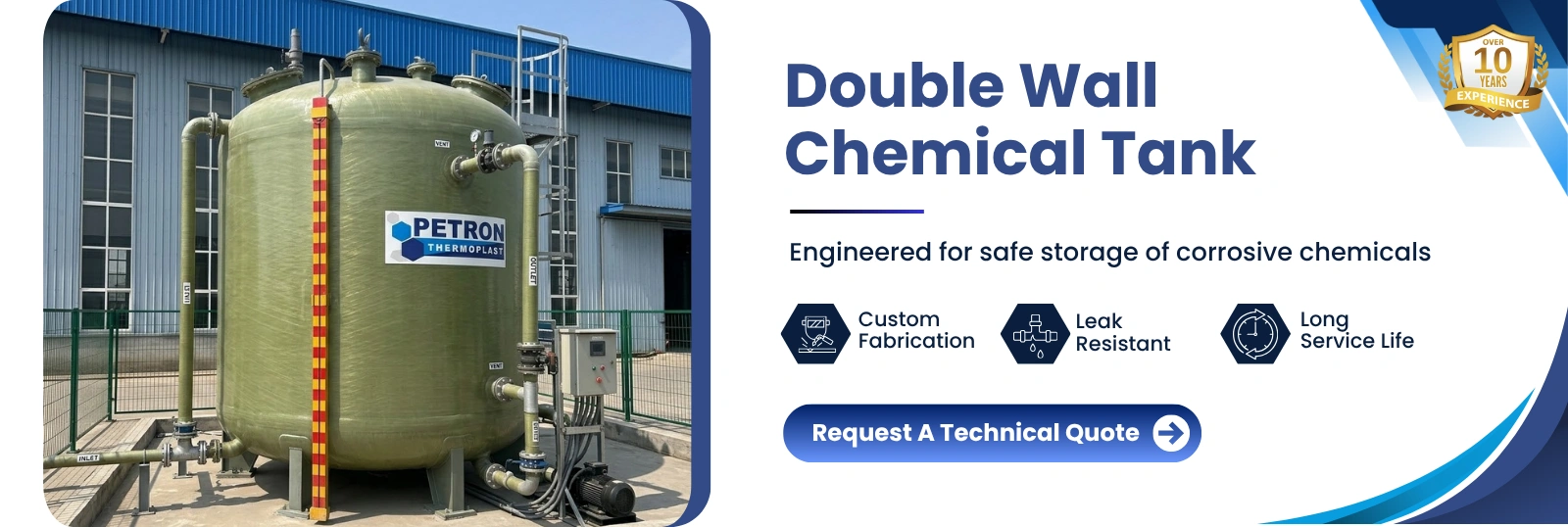
Double Wall Chemical Tank
A Double Wall Chemical Tank is a specially designed storage tank. Double Wall Chemical Tank are consisting of an inner tank and an outer protective wall. That is provide the secondary containment for safe chemical storage. The inner tank stores the chemical, and while the outer wall acts as a protective barrier to prevent leakage, spills, and environmental contamination. In case of inner tank failure, Double Wall Chemical. Tanks are widely used in chemical, pharmaceutical, water treatment, petrochemical, and industrial processing applications. The Double Wall Chemical Tanks are manufactured using materials such as HDPE, PPH, FRP, and PVDF to ensure excellent chemical resistance, durability, and long service life.
A Double Wall Chemical Tank is a “tank-within-a-tank” storage system. It is designed for storing hazardous liquids. The feature of the primary inner tank for holding the chemicals and an outer shell that provides the 110%–120% secondary containment. This design prevents leaks, protects the environment, and eliminates the need for separate concrete containment basins. Petron Thermoplast, Double Wall Chemical Tanks are designed with an inner storage tank and an outer protective wall and offering the secondary containment for hazardous and corrosive chemicals.


Material of Construction
HDPE, PP, FRP, PVDF, SS 304, SS 316

Temperature Resistance
Safely handle moderate operating temperatures.

Corrosion-Free Construction
No rusting when exposed to chemicals & moisture.

Long Service Life
Excellent durability and can operate for many years

ISO / ASTM / DVS Certified
Manufactured to international quality standards
-10°C to 120°C
Operating Temperature
100 L – 100K L
Capacity (Customizable)
10–25 years
Service Life
ASTM D1998 & ISO
Certified quality standards
5 mm – 60 mm
Wall Thickness

Safe storage of hazardous and corrosive chemicals

Excellent resistance to corrosive chemicals, acids, and alkalis

Strong and durable structure for long service life

Leak-proof and maintenance-friendly design
Technical Details
| Parameter | Details |
| Product Name | Double Wall Chemical Tank |
| Tank Type | Double Wall / Secondary Containment Tank |
| Construction Design | Inner Tank with Outer Protective Wall |
| Material of Construction | HDPE, PP, FRP, PVDF, SS 304, SS 316 |
| Capacity Range | 100 Liters to 100,000 Liters |
| Tank Orientation | Vertical / Horizontal |
| Shape | Cylindrical |
| Wall Thickness | 5 mm to 60 mm |
| Inner Tank Function | Primary Chemical Storage |
| Outer Wall Function | Secondary Leak Containment |
| Operating Temperature | -10°C to 120°C |
| Pressure Rating | Atmospheric to 3 Bar |
| Density Handling Capacity | Up to 2.0 SG |
| Chemical Compatibility | Acids, Alkalis, Solvents, Corrosive Liquids |
| Diameter Range | 500 mm to 5000 mm |
| Height Range | 1000 mm to 15000 mm |
| Mounting Type | Leg Mounted / Saddle Mounted / Skid Mounted |
| Surface Finish | Smooth Internal & External Finish |
| Leak Detection System | Optional |
| UV Stabilization | Available for Outdoor Installation |
| Insulation Option | Available |
| Inlet/Outlet Connections | Flanged / Threaded / Socket Type |
| Accessories | Manhole, Vent Nozzle, Level Indicator, Drain Valve, Ladder |
| Fabrication Method | Butt Welding / Extrusion Welding / FRP Lamination |
| Corrosion Resistance | Excellent |
| Safety Feature | Secondary Containment Protection |
| Maintenance Requirement | Low Maintenance |
| Testing | Hydro Test, Leak Test, Spark Test, Weld Inspection |
| Compliance Standards | ASTM, ISO, DIN, and IS Standards |
| Service Life | 10–25 Years |
| Customization | Available as per Industrial Requirement |
- Double-wall construction for enhanced safety and leak protection
- Secondary containment system prevents chemical spills and environmental contamination
- Excellent resistance to corrosive chemicals, acids, and alkalis
- Strong and durable structure for long service life
- Manufactured using high-quality HDPE, PP, FRP, PVDF, and Stainless Steel materials
- Leak-proof and maintenance-friendly design
- Suitable for hazardous and high-risk chemical storage applications
- High mechanical strength and impact resistance
- UV-stabilized options are available for outdoor installations
- Smooth internal surface for easy cleaning and reduced residue buildup
- Available in vertical and horizontal tank configurations
- Customizable sizes, capacities, and connection arrangements
- Compatible with a wide range of industrial chemicals and solvents
- Low maintenance and cost-effective operation
- Optional leak detection and monitoring systems are available
- Excellent weather and environmental resistance
- Safe storage solution for chemical processing industries
Chemical compatibility is one of the most important factors when selecting a double-wall chemical tank. It refers to the ability of both the inner storage tank and the outer containment wall to safely withstand chemical exposure without corrosion, swelling, cracking, permeation, or structural degradation.
Proper chemical compatibility ensures:
- Safe chemical storage
- Environmental protection
- Leak prevention
- Longer tank life
- Reduced maintenance costs
- Compliance with safety regulations
Why Chemical Compatibility is Important
An incompatible tank material can result in:
- Chemical attack on tank walls
- Cracking or deformation
- Product contamination
- Leakage into secondary containment
- Equipment failure
- Safety hazards
Therefore, both the primary tank and secondary containment system must be manufactured from suitable materials.
Common Materials Used in Double-Wall Chemical Tanks
| Material | Characteristics |
| HDPE | Excellent resistance to many acids, alkalis, and water treatment chemicals |
| Polypropylene (PP) | Superior resistance to aggressive acids and alkalis |
| FRP | High structural strength and corrosion resistance |
| PVDF-Lined Construction | Exceptional resistance to highly corrosive chemicals |
| Stainless Steel | Suitable for selected chemicals and hygienic applications |
Chemical Compatibility Chart
| Chemical | HDPE | PP | FRP | PVDF | Stainless Steel |
| Hydrochloric Acid (HCl) | Good | Excellent | Excellent | Excellent | Poor |
| Sulfuric Acid (H₂SO₄) | Good* | Excellent | Excellent | Excellent | Good* |
| Nitric Acid (HNO₃) | Moderate | Good | Good | Excellent | Good |
| Phosphoric Acid | Excellent | Excellent | Excellent | Excellent | Good |
| Sodium Hydroxide (NaOH) | Excellent | Excellent | Good | Excellent | Moderate |
| Potassium Hydroxide (KOH) | Excellent | Excellent | Good | Excellent | Moderate |
| Sodium Hypochlorite | Excellent | Good | Good | Excellent | Poor |
| Ferric Chloride | Good | Excellent | Excellent | Excellent | Poor |
| Alum Solution | Excellent | Excellent | Excellent | Excellent | Good |
| Process Water | Excellent | Excellent | Excellent | Excellent | Excellent |
Compatibility depends on chemical concentration, operating temperature, and service conditions.
Quality inspection and testing are critical steps in the manufacturing of a double-wall chemical tank. Since these tanks are designed to provide both primary storage and secondary containment, rigorous testing ensures safety, leak prevention, chemical resistance, and long-term reliability.
1. Raw Material Inspection
The quality process begins with the inspection of all raw materials.
Inspection Parameters
- Material grade verification
- Thickness measurement
- Surface quality inspection
- Chemical compatibility verification
- Material Test Certificate (MTC) review
Materials Inspected
- HDPE
- Polypropylene (PP)
- FRP
- PVDF lining materials
- Stainless Steel
2. Dimensional Inspection
Dimensional checks ensure that the tank is manufactured according to approved engineering drawings.
| Inspection Item | Purpose |
| Tank Diameter | Verify design dimensions |
| Tank Height | Confirm storage capacity |
| Wall Thickness | Ensure structural strength |
| Containment Gap | Verify secondary containment design |
| Nozzle Location | Ensure piping compatibility |
3. Visual Inspection
Visual inspections are conducted throughout fabrication.
Checks Include
- Surface defects
- Cracks
- Scratches
- Material damage
- Fabrication irregularities
- Weld appearance
This helps identify defects before final testing.
4. Welding Inspection
All welded joints are inspected to ensure strength and leak-proof performance.
Thermoplastic Tanks
Inspection includes:
- Butt fusion welds
- Extrusion welds
- Hot gas welds
Stainless Steel Tanks
Inspection includes:
- TIG welds
- MIG welds
- Weld penetration quality
- Strong joints
- Leak-free construction
- Long service life
5. Hydrostatic Testing of Inner Tank
The primary storage tank is filled with water and tested under controlled conditions.
Purpose
- Detect leakage
- Verify weld integrity
- Confirm structural stability
- Check deformation resistance
This is one of the most important acceptance tests.
6. Secondary Containment Testing
The outer containment wall is inspected and tested to verify:
- Structural integrity
- Leak-tight construction
- Adequate containment capacity
- Secondary protection effectiveness
This confirms the functionality of the double-wall design.
- Safe storage of hazardous and corrosive chemicals
- Chemical processing and manufacturing industries
- Acid and alkali storage applications
- Water treatment and wastewater treatment plants
- Pharmaceutical and laboratory chemical storage
- Petrochemical and refinery industries
- Electroplating and surface treatment plants
- Paint, ink, and coating industries
- Oil, lubricant, and solvent storage applications
- Bulk chemical handling and transfer systems
- Industrial liquid containment systems
- Storage of high-purity and reactive chemicals
- Environmental protection and spill prevention applications
Manufacturing Process of Double Wall Chemical Tank
The manufacturing process of a double-wall chemical tank involves the fabrication of an inner storage tank and an outer containment tank, creating a secondary containment system that provides enhanced to safety against the leaks and chemical spills. These tanks are widely used for storing corrosive chemicals, acids, alkalis, and hazardous liquids in industrial facilities.
The manufacturing process begins with detailed engineering and design calculations based on:
- Chemical type
- Storage capacity(100 Liters to 100,000 Liters)
- Specific gravity
- Operating temperature(-10°C to 120°C)
- Installation conditions
- Secondary containment requirements
- Tank diameter and height
- Wall thickness
- Containment volume
- Nozzle locations
- Reinforcement requirements
The appropriate material is selected according to chemical compatibility and operating conditions.
Common Materials
Material | Typical Application |
HDPE | Water treatment and chemical storage |
Polypropylene (PP) | Strong acids and alkalis |
FRP | Corrosive industrial chemicals |
PVDF-Lined Construction | Highly aggressive chemicals |
Stainless Steel | Specialized industrial applications |
The inner and outer walls may be manufactured from the same or different materials, depending on the application.
Before fabrication, all materials undergo inspection for:
- Material grade verification
- Thickness verification
- Surface quality inspection
- Chemical resistance suitability
Only approved materials proceed to manufacturing.
Material sheets are cut according to engineering drawings using:
- CNC cutting machines
- Laser cutting systems
- Thermoplastic cutting equipment
- Circular saws
Components prepared include:
- Inner tank shell sections
- Outer containment shell sections
- Bottom plates
- Roof sections
- Reinforcement components
The primary storage tank is fabricated first.
Process Includes
- Sheet rolling
- Shell forming
- Section alignment
- Temporary assembly
The shell is manufactured to precise dimensions to ensure proper fit within the containment tank.
The inner tank sections are joined using approved welding techniques.
Thermoplastic Tanks
- Butt fusion welding
- Extrusion welding
- Hot gas welding
Stainless Steel Tanks
- TIG welding
- MIG welding
- Arc welding
The objective is to create a strong and leak-proof primary storage vessel.
The tank bottom and roof are manufactured and attached.
Common Bottom Designs
- Flat bottom
- Cone bottom
- Dish bottom
Common Roof Designs
- Flat roof
- Dome roof
- Conical roof
The design depends on process and storage requirements.
The secondary containment shell is fabricated around the inner tank.
The outer wall is designed to:
- Contain leaks
- Provide environmental protection
- Meet safety regulations
The containment volume is generally designed to hold the contents of the primary tank.
How to Select the Right Double Wall Chemical Tank
Selecting the right double-wall chemical tank is essential for safe chemical storage, environmental protection, regulatory compliance, and long-term operational reliability. Double-wall tanks consist of a primary inner tank and a secondary outer containment wall that provides a additional protection against leaks and spills.
The first step is to determine:
- Chemical name
- Chemical concentration
- Specific gravity
- Corrosive properties
- Oxidizing characteristics
The stored chemical directly influences material selection and tank design
The tank material must be compatible with the chemical being stored.
Common Tank Materials
Material | Suitable Applications |
HDPE | Water treatment chemicals, mild acids, alkalis |
Polypropylene (PP) | Strong acids and alkalis |
FRP | Corrosive industrial chemicals |
PVDF-Lined Tanks | Highly aggressive chemicals |
Stainless Steel | Selected chemicals and hygienic applications |
Proper compatibility prevents:
- Corrosion
- Material degradation
- Leakage
- Product contamination
Select the tank size based on:
- Daily chemical consumption
- Storage duration
- Delivery frequency
- Future expansion plans
Common capacities range from:
- 500 liters
- 1,000 liters
- 5,000 liters
- 10,000 liters
- 50,000 liters and above
The outer wall serves as secondary containment.
- Containment volume requirements
- Local environmental regulations
- Spill prevention standards
The containment space should safely retain the contents of the primary tank in case of leakage.
Temperature affects both chemical compatibility and tank performance.
- Chemical storage temperature
- Ambient temperature
- Outdoor exposure
- Process heating requirements
Higher temperatures may require PPH, PVDF, or specialized materials.
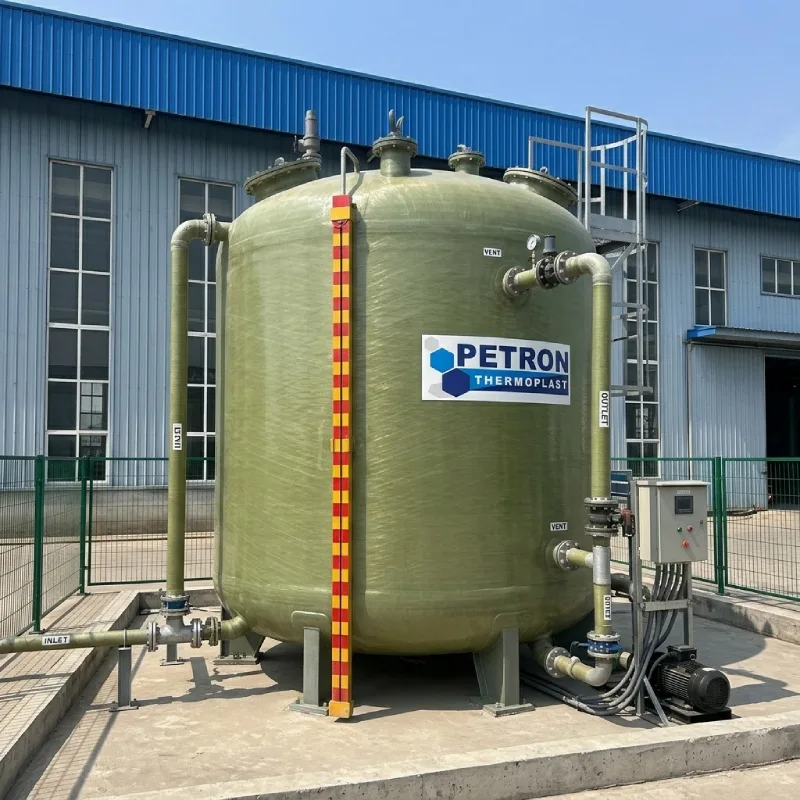

Custom Product Manufacturing Available
If you are searching for customized product designs that meet your requirements, don’t worry. Petron Thermoplast also offers custom product manufacturing services to meet the unique needs of various industries. Work with our expert engineers to create custom designs suited for your application.
Why Choose Petron Thermoplast?
Petron Thermoplast has selected the right HDPE chemical storage tank to meet the balancing material quality, actuation needs, and system compatibility. For high-performance applications involving steam, chemicals, and automated control. The certification of the HDPE chemical storage tank to deliver optimal reliability. While the entry level of the options exists for the non-critical uses, investing in a well-engineered saddle reduces the downtime and maintenance costs over time.
Frequently Asked Questions
A double-wall chemical tank consists of an inner storage tank and an outer containment wall. The outer wall acts as secondary containment, providing additional protection against leaks, spills, and environmental contamination.
Double-wall tanks are used to:
- Improve chemical storage safety
- Prevent environmental contamination
- Provide secondary containment
- Reduce spill risks
- Meet regulatory requirements
Secondary containment is the outer tank structure designed to contain the contents of the inner tank if a leak or failure occurs.
Double-wall tanks can store:
- Hydrochloric Acid (HCl)
- Sulfuric Acid (H₂SO₄)
- Sodium Hydroxide (NaOH)
- Sodium Hypochlorite
- Ferric Chloride
- Phosphoric Acid
- Process chemicals
- Water treatment chemicals
Material compatibility should always be verified before use.
Common materials include:
- HDPE (High-Density Polyethylene)
- Polypropylene (PP)
- FRP (Fiber Reinforced Plastic)
- PVDF-lined construction
- Stainless Steel
- Enhanced leak protection
- Improved environmental safety
- Reduced risk of chemical spills
- Increased operational reliability
- Compliance with safety regulations
- Lower containment infrastructure requirements
Many double-wall tanks include:
- Leak detection ports
- Monitoring chambers
- Leak sensors
- Inspection points
These systems help identify leakage between the inner and outer walls.
Double-wall chemical tanks are available in capacities ranging from:
- 100 liters
- 500 liters
- 1,000 liters
- 5,000 liters
- 10,000 liters
- 50,000 liters and above
Custom capacities can also be manufactured.
Yes. Double-wall tanks can be installed outdoors and may include:
- UV-resistant materials
- Weather-resistant construction
- Structural reinforcements
for long-term outdoor service.
Yes. When manufactured from chemically resistant materials such as PPH, FRP, HDPE, or PVDF-lined construction, they can safely store many corrosive chemicals.