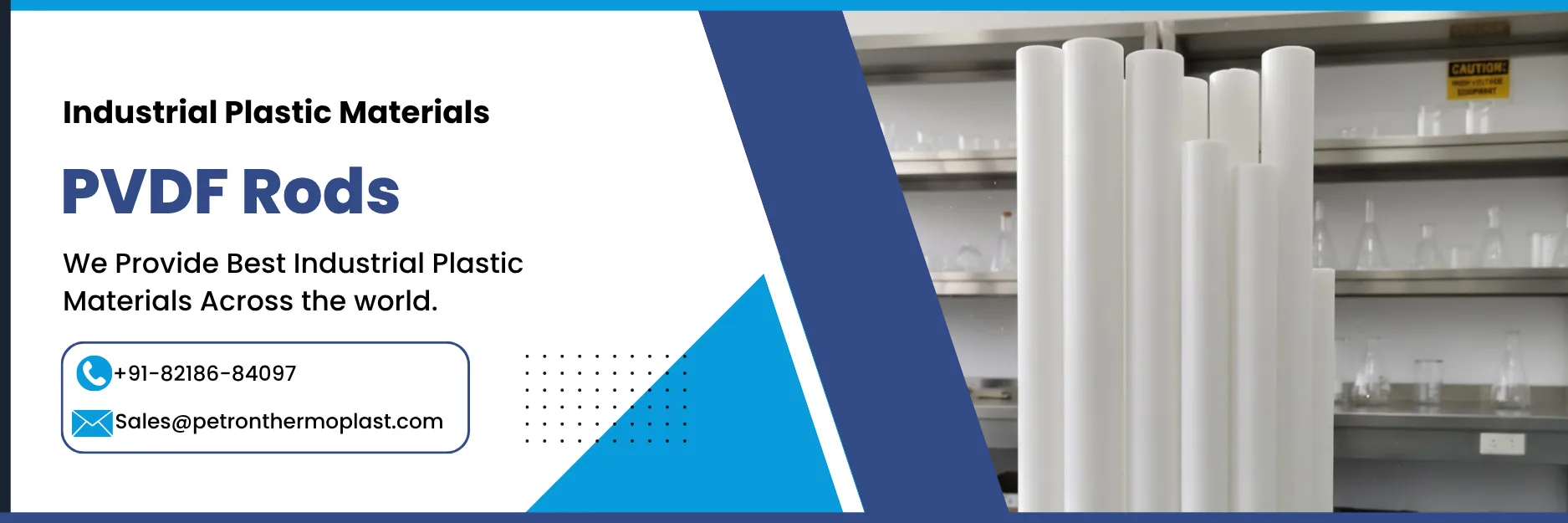
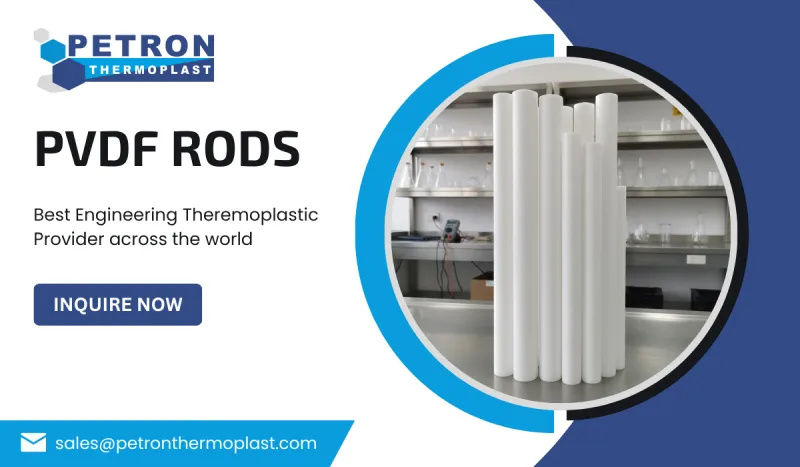
PVDF Rod
A PVDF rod refers to a solid cylindrical form made of Polyvinylidene Fluoride (PVDF), which is a high-performance thermoplastic polymer. PVDF is known for its excellent chemical resistance, thermal stability, and mechanical strength, making PVDF rods suitable for demanding industrial applications. A PVDF rod is essentially a durable, chemically resistant plastic rod used in environments where metals or other plastics might corrode or degrade. PVDF is a specialty plastic material in the fluoropolymer family: it is used generally in applications requiring the highest purity, strength, and resistance to solvents, acids, bases, and heat and low smoke generation during a fire event.
Compared to other fluoropolymers, it has an easier melt process because of its relatively low melting point of around 177°C.
It has a low density (1.78) and low cost compared to the other fluoropolymers. It is available as piping products, sheet, tubing, films, plate, and an insulator for premium wire. It can be injected, molded or welded and is commonly used in the chemical, semiconductor, medical and defense industries, as well as in lithium-ion batteries. It is also available as a crosslinked closed cell foam, used increasingly in aviation and aerospace applications.

- Chemical Resistance
- Low Maintenance Requirement
- Low Thermal Conductivity
- Long Service Life
- Easy Installation
- Corrosion Resistance
PVDF Rod Details
| Property | Typical Value / Description |
| Material | PVDF (Polyvinylidene Fluoride) |
| Form | Rod / Solid Bar (Cylindrical) |
| Diameter Range | Ø6 mm – Ø200 mm (standard commercial sizes) |
| Length Range | 1 m – 3 m (can be cut to size) |
| Color | Natural White / Translucent |
| Density | 1.75 – 1.78 g/cm³ |
| Melting Point | 165 – 175 °C |
| Glass Transition Temperature (Tg) | ~ –35 °C |
| Max Continuous Service Temp | ~140 °C (depending on application and grade) |
| Min Service Temperature | ~ –40 °C |
| Tensile Strength | 40 – 55 MPa |
| Elongation at Break | 30 – 50% |
| Flexural Strength | 50 – 80 MPa |
| Hardness (Shore D) | 70 – 80 |
| Impact Strength (Notched Izod) | 5 – 8 kJ/m² |
| Thermal Conductivity | 0.17 – 0.19 W/m·K |
| Coefficient of Thermal Expansion | 100 – 150 ×10⁻⁶ /°C |
| Water Absorption (24 h) | < 0.04% |
| Chemical Resistance | Excellent against strong acids, bases, organic solvents, and halogens |
| UV Resistance | Moderate; may require stabilizers for outdoor exposure |
| Flammability | UL 94 V-0 (self-extinguishing) |
| Surface Finish | Smooth and glossy; suitable for machining |
| Machinability | Excellent — can be turned, milled, drilled, or shaped |
| Applications | Shafts, spacers, chemical handling parts, valves, wear strips |
| Outer Diameter (mm) | Length (mm) | Tolerance | Remarks |
| 6 | 1000–2000 | ±0.1 mm | Small rods for lab or prototype parts |
| 10 | 1000–2000 | ±0.1 mm | Common for small mechanical components |
| 12 | 1000–2000 | ±0.1 mm | Industrial applications, pump parts |
| 16 | 1000–2000 | ±0.1 mm | Chemical processing components |
| 20 | 1000–2000 | ±0.1 mm | Valves, bushings, and fittings |
| 25 | 1000–2000 | ±0.1 mm | Structural components in corrosive environments |
| 30 | 1000–2000 | ±0.1 mm | High-strength mechanical parts |
| 40 | 1000–2000 | ±0.2 mm | Heavy-duty industrial applications |
| 50 | 1000–2000 | ±0.2 mm | Large pump or chemical equipment components |
| 60 | 1000–2000 | ±0.2 mm | Large structural rods in chemical plants |
| 80 | 1000–2000 | ±0.2 mm | Custom engineering parts |
| 100 | 1000–2000 | ±0.3 mm | Heavy industrial applications |
| Temperature Property | Value / Range |
| Melting Point | 170–175 °C |
| Maximum Continuous Service Temperature | 40 to 140 °C |
| Short-Term Service Temperature | Up to 160–165 °C |
| Glass Transition Temperature (Tg) | ~–35 °C |
| Minimum Service Temperature | –40 °C (maintains properties at low temps) |
| Density | 1.75 – 1.78 g/cm³ |
| Thermal Decomposition | > 350 °C |
| PVDF Rod Diameter (mm) | Safe Working Pressure (bar) | Notes / Temperature Effect |
| 6 | 150 | At 23 °C; pressure decreases with temperature |
| 10 | 140 | At 23 °C; pressure decreases with temperature |
| 12 | 130 | At 23 °C; pressure decreases with temperature |
| 16 | 120 | At 23 °C; pressure decreases with temperature |
| 20 | 110 | At 23 °C; pressure decreases with temperature |
| 25 | 100 | At 23 °C; pressure decreases with temperature |
| 32 | 90 | At 23 °C; pressure decreases with temperature |
| 40 | 80 | At 23 °C; pressure decreases with temperature |
| 50 | 70 | At 23 °C; pressure decreases with temperature |
| 63 | 60 | At 23 °C; pressure decreases with temperature |
| 75 | 50 | At 23 °C; pressure decreases with temperature |
1. Chemical Resistance
- Highly resistant to strong acids, alkalis, and organic solvents.
- Ideal for use in corrosive environments like chemical processing and water treatment.
2. Thermal Stability
- Can withstand continuous temperatures up to 150°C (302°F).
- Retains mechanical and chemical properties under high-temperature conditions.
3. Mechanical Strength
- Offers high tensile strength, impact resistance, and rigidity.
- Suitable for load-bearing and structural components.
4. Low Moisture Absorption
- Absorbs very little water, which ensures dimensional stability and consistent performance in humid or wet environments.
5. UV and Weather Resistance
- Resistant to UV radiation and environmental degradation.
- Can be used in outdoor applications like architectural panels and coatings.
6. Electrical Insulation
- Excellent dielectric properties.
- Suitable for electronic components, bushings, and insulating parts.
7. Wear Resistance and Low Friction
- Exhibits low friction and good wear resistance, making it ideal for sliding components, gears, and bearings.
8. Lightweight
- Lighter than metals while maintaining strength.
- Beneficial for applications where weight reduction is important
9. Easy Machinability
- Can be cut, drilled, turned, or milled into precise shapes.
- Allows for custom fabrication of complex parts.
More About PVDF Rod
A. Mechanical Testing
- Tensile Strength Test: Measures rod’s resistance to pulling forces.
- Flexural Strength Test: Determines resistance to bending.
- Impact Test (Notched Izod or Charpy): Evaluates resistance to sudden shocks.
- Hardness Test (Rockwell R): Assesses surface hardness and wear resistance.
B. Thermal Testing
- Heat Deflection Temperature (HDT): Determines the temperature at which the rod deforms under load.
- Melting Point Analysis: Ensures correct crystallinity and thermal stability (~170–175 °C).
- Thermal Expansion Test: Measures linear expansion to allow proper installation and tolerances.
C. Chemical Resistance Testing
- Immersion in acids, bases, and solvents to ensure no swelling, cracking, or degradation.
- Ensures suitability for chemical processing and water treatment applications.
D. Electrical Testing
- Dielectric Strength Test: Confirms insulating ability.
- Volume & Surface Resistivity Tests: Measures electrical resistivity for electronic applications.
E. Physical & Dimensional Testing
- Density Measurement: Confirms consistency of material composition.
- Dimensional Accuracy: Verifies diameter, length, and straightness.
- Water Absorption Test: Ensures low moisture uptake.
F. Visual & Surface Inspection
- Check for surface defects, scratches, cracks, or inclusions.
- Ensures a smooth surface for sliding parts or aesthetic applications.
Quality Standards
- Conformance to ASTM standards (e.g., ASTM D3299 for PVDF resin).
- ISO certification may apply to manufacturing and testing processes.
- Material certificates (Mill Test Certificates) are usually provided for chemical, mechanical, and thermal properties.
- Batch testing ensures uniformity and reliability across production.
Customization
PVDF rods can be customized in size, shape, and properties to suit specific industrial needs:
- Diameter & Length:
- Standard rods range from 10 mm to 300 mm in diameter and can be cut to required lengths.
- Standard rods range from 10 mm to 300 mm in diameter and can be cut to required lengths.
- Coloring:
- Additives or masterbatches allow custom colors for identification or aesthetic purposes.
- Additives or masterbatches allow custom colors for identification or aesthetic purposes.
- Grade Selection:
- Homopolymer PVDF for higher chemical and thermal resistance.
- Copolymer PVDF for better impact resistance and flexibility.
- Mechanical Properties:
- Can be tailored via heat treatment, annealing, or compounding to achieve desired hardness, tensile strength, or wear resistance.
- Can be tailored via heat treatment, annealing, or compounding to achieve desired hardness, tensile strength, or wear resistance.
Processing
PVDF rods are highly machinable and compatible with standard fabrication methods:
a. Machining
- Turning, Milling, Drilling, and Grinding
- Can be machined using conventional tools with proper cooling and feed rates.
- Produces precision components like bearings, bushings, and gears.
b. Welding & Joining
- Thermal Welding: PVDF rods can be joined to sheets or other rods using hot plate or extrusion welding.
- Adhesive Bonding: Special fluoropolymer adhesives can be used for bonding.
c. Extrusion & Casting
- Extrusion: PVDF rods are originally formed via extrusion of PVDF resin.
- Casting: Some custom shapes require casting for complex geometries.
d. Heat Treatment & Annealing
- Annealing reduces internal stresses from extrusion and machining.
- Improves dimensional stability and mechanical properties.
Installation
A. Handling and Preparation
- Handle rods with care to avoid scratches or dents.
- Ensure the surface and edges are clean before installation.
- Use proper supports or clamps when positioning heavy or long rods.
B. Cutting & Machining
- Cut or machine rods to exact size using sharp tools.
- Use moderate feed rates to avoid overheating or surface melting.
- Deburr edges after cutting to prevent stress concentration.
C. Fixing & Mounting
- PVDF rods can be mounted using:
- Mechanical fasteners (bolts, clamps) – allow for slight expansion.
- Welding (hot plate or extrusion welding) – for permanent joins.
- Adhesives – use compatible fluoropolymer adhesives for bonding.
- Ensure there is space for thermal expansion (coefficient of thermal expansion ~80–100×10⁻⁶ /°C).
D. Environment Considerations
- Avoid prolonged exposure to direct flame or extreme heat above 150 °C.
- Ensure rods are protected from abrasive contact during installation.
Maintenance
A. Cleaning
- Clean using mild detergents, water, or isopropyl alcohol.
- Avoid harsh abrasive cleaners that can scratch or damage the surface.
B. Inspection
- Periodically inspect for:
- Cracks or surface damage
- Signs of chemical attack (discoloration, swelling)
- Excessive wear in moving parts
C. Repair & Replacement
- Minor scratches or surface wear can often be polished out.
- Severely damaged or cracked rods should be replaced immediately.
- For welded or joined sections, inspect the joint integrity periodically.
D. Lubrication
- For moving or sliding components, use compatible lubricants (e.g., PTFE-based) to reduce wear.
- Primary Material:
- Polyvinylidene Fluoride (PVDF)
- Semi-crystalline fluoropolymer made from the polymerization of vinylidene fluoride monomer (CH₂=CF₂).
- Grades:
- Homopolymer PVDF: Offers higher mechanical strength and chemical resistance.
- Copolymer PVDF: Slightly lower mechanical properties but better impact resistance and processability.
- Additives (Optional):
- UV stabilizers – for outdoor durability
- Lubricants – for easier machining
- Colorants – for aesthetic or identification purposes
1. Chemical Industry
- Used for piping, valves, pumps, and fittings in chemical processing plants.
- Handles strong acids, alkalis, and organic solvents.
- Ideal for corrosion-resistant components.
2. Pharmaceutical & Food Industry
- Employed in tubing, valves, fittings, and processing equipment.
- Non-toxic, FDA-compliant, and safe for food and drug contact.
3. Water Treatment & Marine Industry
- Used in filter components, membranes, pipe systems, and pumps.
- Resistant to corrosion, UV, and saltwater, suitable for marine environments.
4. Electrical & Electronics Industry
- Serves as insulating rods, bushings, cable guides, and electronic components.
- Excellent dielectric properties make it suitable for high-voltage applications.
5. Mechanical & Engineering Applications
- Machined into bearings, gears, wear pads, sliding components, and structural parts.
- Low friction and high wear resistance for moving parts.
6. Architectural & Construction Industry
- Used in cladding, protective panels, and coatings.
- UV and weather-resistant properties make it ideal for outdoor applications.
7. Automotive & Aerospace Industry
- Used for fuel system components, high-temperature insulation parts, and lightweight mechanical parts.
- Thermal stability and chemical resistance suit engine and under-hood applications.
Benefits of PVDF Rods
PVDF (Polyvinylidene Fluoride) is a high-performance thermoplastic with exceptional chemical resistance, thermal stability, and mechanical strength, making it suitable for a wide range of industrial applications. Below are the key uses:
1. Chemical Resistance
- PVDF rods are highly resistant to a broad range of chemicals including acids, bases, and organic solvents.
- This makes them ideal for use in chemical processing equipment, piping, and valves.
2. High Mechanical Strength
- PVDF rods offer good tensile and impact strength.
- They maintain their structural integrity even under mechanical stress, making them suitable for structural components, bearings, and wear parts.
3. Thermal Stability
- They can withstand continuous temperatures up to 150°C (302°F).
- PVDF maintains its properties over a wide temperature range, making it ideal for applications exposed to heat.
4. Low Moisture Absorption
- PVDF has low water absorption, which helps maintain dimensional stability and mechanical properties even in humid environments.
5. UV and Weather Resistance
- PVDF rods are resistant to ultraviolet (UV) radiation and environmental degradation.
- This makes them suitable for outdoor applications, such as architectural components and protective coatings.
6. Electrical Insulation
- PVDF is an excellent electrical insulator.
- This property is valuable for electronic and electrical components, including insulating rods and bushings.
7. Ease of Machining
- PVDF rods can be easily machined into complex shapes using conventional tools.
- This allows flexibility in custom component fabrication.
8. Low Friction and Wear
- PVDF exhibits good wear resistance and low friction, making it useful for sliding parts, gears, and bearings.
9. Lightweight
- PVDF rods are lighter than metals, which is advantageous for applications where weight reduction is important.
Applications of PVDF Rods
1. Chemical Industry
- Used to manufacture piping, valves, pumps, and fittings that handle aggressive chemicals.
- Ideal for acid and alkali resistant components in chemical processing plants.
2. Electrical & Electronics
- PVDF rods act as insulators, bushings, and cable guides.
- Their excellent dielectric properties make them suitable for high-voltage and sensitive electronics.
3. Mechanical & Engineering Components
- Machined into gears, bearings, wear pads, and sliding parts because of low friction and high wear resistance.
- Used in mechanical assemblies requiring chemical and thermal stability.
4. Pharmaceutical & Food Industry
- Employed for tubing, valves, and fittings in pharmaceutical and food processing equipment.
- Its non-toxic and non-reactive nature ensures compliance with hygiene standards.
5. Water Treatment & Marine Applications
- PVDF rods are used in filter components, membranes, and pipe systems for water and wastewater treatment.
- Resistant to corrosion and UV, suitable for marine environments.
6. Architectural & Outdoor Applications
- Used in cladding, protective coatings, and panels.
- UV resistance and weather durability make PVDF ideal for outdoor structures.
7. Aerospace & Automotive
- Lightweight and strong, PVDF rods are used for fuel system components, insulation, and high-performance parts.
- Its thermal stability suits engine compartments and under-hood applications.
Advantages of PVDF Rod
1. Excellent Chemical Resistance
- Resistant to acids, bases, and most organic solvents.
- Suitable for corrosive environments like chemical processing plants.
2. High Mechanical Strength
- Maintains tensile and impact strength even under stress.
- Can be used for structural components, bearings, and wear parts.
3. Thermal Stability
- Can withstand continuous temperatures up to 150°C (302°F).
- Remains stable under heat, ideal for high-temperature applications.
4. Low Moisture Absorption
- Absorbs very little water, keeping its shape and mechanical properties intact in humid or wet environments.
5. UV & Weather Resistance
- Resistant to ultraviolet radiation and environmental degradation.
- Perfect for outdoor and architectural applications.
6. Electrical Insulation
- Excellent dielectric properties, making it suitable for insulating rods, bushings, and electronic components.
7. Easy Machining
- Can be cut, drilled, and shaped into complex parts using conventional tools.
- Allows for custom fabrication without specialized equipment.
8. Low Friction and Wear
- Offers low coefficient of friction, making it ideal for bearings, gears, and sliding parts.
9. Lightweight
- Lighter than metals, reducing overall weight in assemblies.
10. Non-Toxic & Food-Safe
- Safe for pharmaceutical and food processing applications, compliant with hygiene standards.
Why Choose Petron Thermoplast?
At Petron Thermoplast, PVDF Rods are versatile, reliable solutions for flow regulation in demanding environments. Their unique combination of chemical resistance and ease of use makes them indispensable across many industries requiring durable and inert materials.
Longevity
- PVDF rods resist wear and tear. They withstand harsh chemicals and high temperatures without degrading. This durability translates into fewer replacements over time.
Low Maintenance
- I appreciate that PVDF rods require minimal maintenance. Their resistance to corrosion means I don’t have to worry about frequent upkeep. This saves both time and money.
Versatile Applications
- PVDF rods in various industries, from aerospace to automotive. Their adaptability means I can rely on them for multiple projects, reducing the need to stock different materials.
Conclusion
Polyvinylidene fluoride (PVDF) rods are high-performance engineering plastics widely used across chemical, pharmaceutical, electrical, water treatment, mechanical, and aerospace industries. Their unique combination of chemical resistance, thermal stability, mechanical strength, and electrical insulation makes them versatile and reliable for demanding applications.
Durable and Resistant
PVDF rods withstand harsh chemicals, high temperatures, and UV exposure.
Mechanically Strong
They provide excellent tensile and flexural strength while being lightweight.
Customizable & Machinable
Rods can be cut, machined, welded, or colored to suit specific applications.
Low Maintenance
Easy to install, clean, and maintain, with long service life.
Quality Assured
Conforms to industry standards through rigorous mechanical, thermal, chemical, and electrical testing.
Polyvinylidene fluoride (PVDF) rods are high-performance engineering plastics widely used across chemical, pharmaceutical, electrical, water treatment, mechanical, and aerospace industries. Their unique combination of chemical resistance, thermal stability, mechanical strength, and electrical insulation makes them versatile and reliable for demanding applications.
Frequently Asked Questions
A PVDF rod is a solid cylindrical material made from Polyvinylidene Fluoride (PVDF), a high-performance thermoplastic fluoropolymer known for chemical resistance, thermal stability, and mechanical strength.
- Excellent chemical resistance to acids, bases, and solvents.
- High mechanical strength and impact resistance.
- Thermally stable up to 150 °C.
- Low moisture absorption and UV resistant.
- Good electrical insulation properties.
- Chemical industry: Pipes, valves, pumps, and fittings.
- Pharmaceutical and food processing: Tubing, valves, and hygienic equipment.
- Water treatment & marine: Filters, membranes, and corrosion-resistant components.
- Electrical & electronics: Insulators, bushings, cable guides.
- Mechanical components: Bearings, gears, wear pads.
- Construction & architecture: Panels, cladding, coatings.
- Automotive & aerospace: Fuel system components, lightweight parts.
Yes. PVDF rods are easy to machine using conventional tools like lathes, drills, and milling machines. Proper cooling and feed rates are recommended to avoid melting or surface damage.
Yes. PVDF rods resist strong acids, alkalis, and most organic solvents, making them ideal for corrosive and harsh chemical environments.
PVDF rods can generally operate continuously up to 150 °C (302 °F) without losing mechanical or chemical performance.
Yes. PVDF rods are UV and weather-resistant, so they are suitable for outdoor applications. UV-stabilized grades provide long-term durability.
Yes. PVDF rods are non-toxic, chemically inert, and compliant with FDA standards, making them suitable for food, pharmaceutical, and medical applications.
- Store in a cool, dry place, away from direct sunlight.
- Keep rods vertically or on racks to prevent bending or warping.
- Avoid prolonged exposure to strong oxidizing agents or extreme heat.