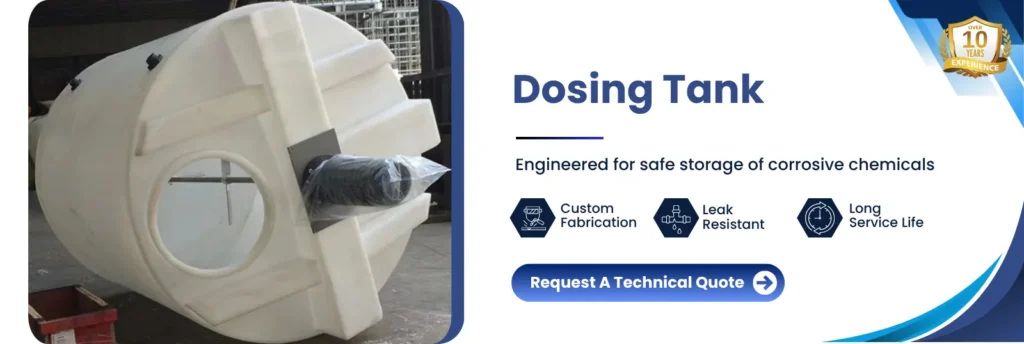






Dosing Tanks Graphics Banner
Dosing Tanks Graphics

Dosing Tank -High-Quality for Chemical Dosing Applications

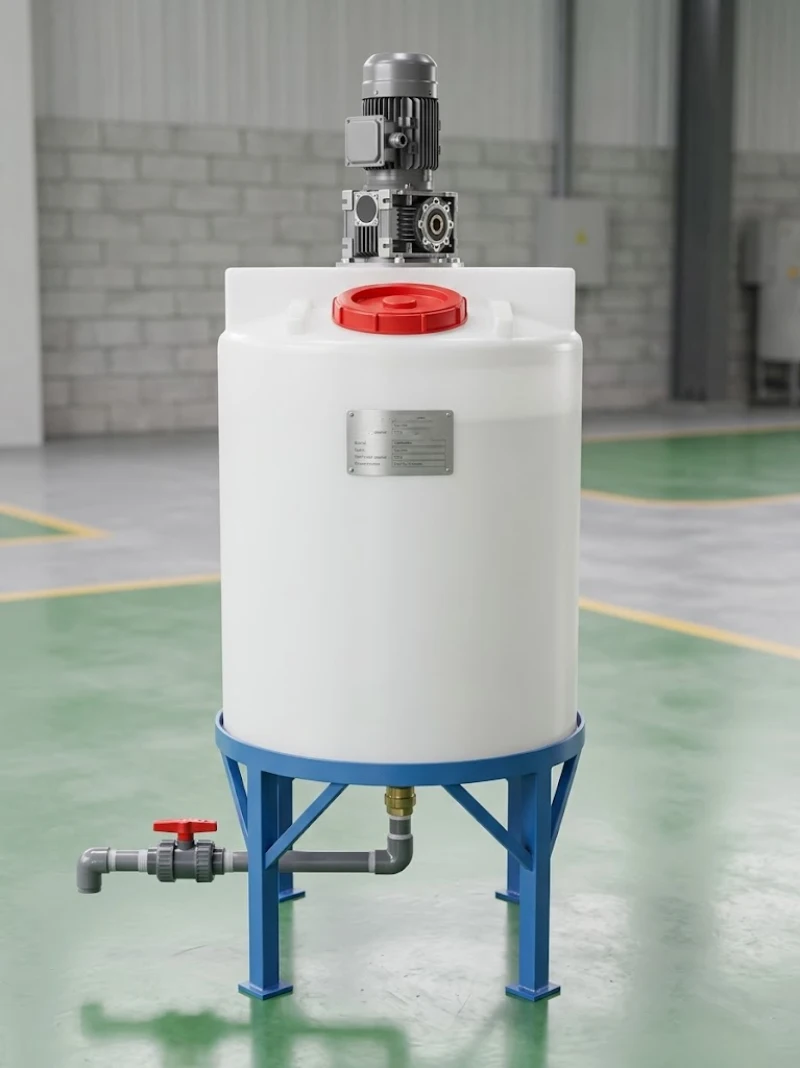
A dosing tank is a kind of container to specialized for the storing, mixing, and adding chemicals. They are usually used in the water treatment, wastewater treatment, environmental engineering, and the other fields. Dosing tanks can designed to be manufactured in the different materials. Their capacities and forms are according to different needs and their applications. A dosing tank is a specially designed to container used to store, prepare, and supply the chemicals in the controlled quantities for a specific process. 

A dosing tank is a tank used to store the liquid chemicals and solutions. These are accurately measured and injected (dosed) into a system to achieve the desired concentration or effect. Typically made from materials like HDPE, FRP, or PVC for chemical resistance. 

Dosing Tank Details

ParameterDetails
Material of ConstructionHDPE (High-Density Polyethylene), FRP (Fiber Reinforced Plastic), PVC, PP
Capacity Range50 Liters to 10,000 Liters (custom sizes available)
ShapeCylindrical (Vertical/Horizontal), Rectangular
Wall Thickness3 mm to 12 mm (depends on capacity and material)
Design TypeOpen top / Closed top
ColorNatural, White, Black, Yellow (custom colors available)
Operating Temperature-5°C to 60°C (varies based on material used)
Chemical CompatibilitySuitable for acids, alkalis, and various chemicals (depends on material)
Agitator ProvisionOptional (for mixing chemicals uniformly)
Level IndicatorFloat type / Transparent tube / Digital sensor (optional)
Calibration ColumnProvided for accurate dosing measurement (optional)
Mounting TypeSkid-mounted / Floor-mounted
Outlet ConnectionFlanged / Threaded / Socket type
Inlet ConnectionStandard pipe connection with a vent
Manhole / LidScrew-type lid or bolted manhole
UV ResistanceYes (for outdoor applications)
Pressure RatingGenerally atmospheric (not designed for high pressure)
Stand / SupportMild steel (MS) stand or integrated base support
Standards ComplianceAs per ISO / ASTM / DIN (depending on manufacturer)
AccessoriesDosing pump, agitator, level switch, flow meter, control panel

1. Chemical Resistance

  • Made from materials like HDPE, FRP, PP, or PVC
  • Resistant to acids, alkalis, and corrosive chemicals

2. Durable Construction

  • Strong and impact-resistant body
  • Long service life even in harsh industrial environments

3. Leak-Proof Design

  • Seamless or welded construction prevents leakage
  • Ensures safe handling of hazardous chemicals

4. Accurate Dosing Support

  • Compatible with dosing pumps for precise chemical injection
  • Often includes a calibration column for measurement accuracy

5. Agitator Provision

  • Optional agitator for proper mixing of chemicals
  • Ensures uniform solution concentration

6. Level Indication System

  • Equipped with level indicators (float type, tube, or digital sensors)
  • Helps monitor chemical levels easily

7. Compact & Space-Saving

  • Designed to occupy minimal floor space
  • Available in vertical and skid-mounted designs

8. Easy Installation & Maintenance

  • Lightweight (especially HDPE tanks)
  • Simple installation with low maintenance requirements

9. UV Stabilized (Optional)

  • Suitable for outdoor use without degradation
  • Protects against sunlight exposure

10. Customizable Design

  • Available in different capacities, shapes, and colors
  • Can be customized with fittings, manholes, and accessories

11. Corrosion-Free Operation

  • Non-metallic construction eliminates rusting issues
  • Ideal for long-term chemical storage

12. Safety Features

  • Venting systems to release gases
  • Secure lids or manholes for safe operation

1. Raw Material Testing

  • Verification of material grade (HDPE, FRP, PP, PVC)
  • Density, melt flow index (for plastics), and chemical resistance tests
  • Ensures compliance with ISO/ASTM standards

2. Visual Inspection

  • Checking for surface defects like cracks, bubbles, or uneven thickness
  • Inspection of weld joints and finishing quality

3. Dimensional Accuracy Test

  • Measurement of tank thickness, diameter, and height
  • Ensures conformity with design specifications

4. Hydrostatic / Leak Testing

  • The tank is filled with water to check for leakage
  • Ensures the tank is completely leak-proof

5. Pressure Testing

  • Conducted for tanks designed to handle slight internal pressure
  • Confirms structural integrity under operating conditions

6. Load & Strength Testing

  • Evaluates the tank’s ability to withstand mechanical stress
  • Includes impact resistance and load-bearing tests

7. Chemical Resistance Testing

  • Tank material is tested against specific chemicals
  • Ensures long-term durability without degradation

8. UV Stability Test

  • For outdoor tanks, exposure to UV light is tested
  • Prevents material cracking and color fading

9. Agitator & Accessories Testing

  • Functional testing of agitators, level indicators, and dosing systems
  • Ensures proper working of all components

10. Calibration Check

  • Verification of calibration column accuracy
  • Ensures precise chemical dosing

11. Quality Standards & Certifications

  • Manufactured as per ISO, ASTM, or DIN standards
  • Quality assurance through documented inspection procedures

12. Final Inspection & Documentation

  • Complete inspection before dispatch
  • Test certificates and quality reports provided
Repairing Service

Custom Product Manufacturing Available

If you are searching for customized product designs that meet your requirements, don’t worry. Petron Thermoplast also offers custom product manufacturing services to meet the unique needs of various industries. Work with our expert engineers to create custom designs suited for your application.

Application of Dosing Tank

1. Water Treatment Plants

  • Used for dosing chemicals like chlorine, alum, and lime
  • Helps in disinfection, coagulation, and pH adjustment
  • Common in municipal and industrial water treatment systems

2. Wastewater Treatment

  • Dosing of flocculants, coagulants, and neutralizing agents
  • Controls toxic substances and sludge formation
  • Ensures compliance with environmental discharge standards

3. Chemical Processing Industries

  • Used for adding precise quantities of chemicals in reactions
  • Maintains consistent product quality and process control

4. Pharmaceutical Industry

  • Ensures accurate dosing of liquid chemicals in formulations
  • Maintains high hygiene and quality standards

5. Oil & Gas Industry

  • Used for injecting corrosion inhibitors, biocides, and demulsifiers
  • Enhances equipment life and process efficiency

Why Choose Petron Thermoplast?

Petron Thermoplast provides specially designed dosing tanks for chemical industries. They used for storing, mixing, and supplying the chemicals in controlled quantities during the industrial and water treatment processes. It works together with the dosing pumps and controls the systems to ensure the accurate chemical injection into pipelines, reactors, or treatment systems.

Petron Thermoplast manufactures Dosing Tanks to using the corrosion-resistant materials such as HDPE, PP, FRP, PVDF to safely the handle acids, alkalis, and other industrial chemicals. These tanks may also include the accessories such as agitators, level indicators, dosing pumps, and control panels for efficient operation.

Conclusion

Dosing Tanks are the essential part in the industrial chemical systems. They are providing the safe storage, accurate mixing, and controlling the chemical dosing for the efficient process operations. Their are the precision-designed construction to help and ensuring the reliable chemical handling while the minimizing wastage, leakage, and operational risks.

Manufactured using the high-quality corrosion-resistant materials such as HDPE, PP, FRP, PVDF. Dosing Tanks are offered to excellent durability, chemical resistance, and the long service life even in demanding industrial environments. Their compatibility with the dosing pumps, agitators, and automated control the systems to make them highly effective for modern process applications.

Dosing Tanks improve the process of efficiency and enhance the operational safety, and deliver the dependable performance across a wide range of the industries including water treatment, chemicals, and industrial manufacturing.

Frequently Asked Questions

1. What is a dosing tank?

A dosing tank is a container used to store, mix, and supply chemicals in controlled quantities for various industrial processes.

2. What materials are used to manufacture dosing tanks?

Dosing tanks are commonly made from HDPE, FRP, PVC, and PP, depending on the chemical compatibility and application.

3. What is the capacity range of a dosing tank?

They are available in capacities ranging from 50 liters to 10,000 liters or more, with customization options.

4. Where are dosing tanks used?

They are widely used in:

  • Water and wastewater treatment
  • Chemical industries
  • Pharmaceuticals
  • Food & beverage processing
  • Power plants
5. How does a dosing tank work?

The tank stores the chemical solution, and a dosing pump draws and injects the chemical into the system in a controlled manner.

6. Can dosing tanks handle corrosive chemicals?

Yes, when made from suitable materials like HDPE or FRP, they can safely store and handle corrosive chemicals.

7. Is an agitator necessary in a dosing tank?

An agitator is optional but recommended when uniform mixing of chemicals is required.

8. What is a calibration column in a dosing tank?

A calibration column is used to measure and adjust the dosing rate accurately.

9. Are dosing tanks suitable for outdoor use?

Yes, many dosing tanks are UV-stabilized, making them suitable for outdoor applications.