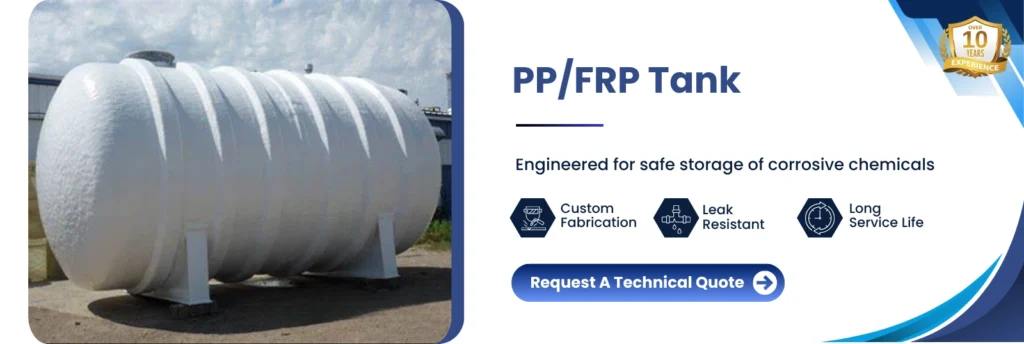






Chemical Storage Tank banner Final (2)

PP/FRP Storage Tank

A PP/FRP Tank is an dual-laminate storage tank constructed using an inner layer of PP Polypropylene and an outer structural layer of FRP Fiberglass Reinforced Plastic. This combination are providing excellent chemical resistance from the PP liner and high mechanical strength from the FRP outer shell, to make the tank ideal for storing corrosive chemicals and industrial process fluids.

The inner PP layer acts as an corrosion-resistant barrier that comes into direct contact with the stored chemical, while the FRP layer is providing the structural support, impact resistance, and the ability to withstand the external loads. This dual-construction design offers superior performance are compared to conventional single-material tanks. Petron Thermoplast specializes in manufacturing and supplying PP FRP (Polypropylene-Fiberglass Reinforced Plastic) storage tanks is designed for superior chemical resistance, structural strength, and long-term durability.

defence

Excellent Chemical Resistance

Suitable for a range of acids, alkalis, and chemical solutions

weather (1)

Temperature Resistance

0°C to 100°C (depending on chemical and design conditions)

layer

Corrosion-Free Construction

No rusting when exposed to chemicals & moisture.

grade

Long Service Life

Excellent durability and can operate for many years

guarantee

ASTM, DIN, DVS, ISO Certified

Manufactured to international quality standards

0°C to 100°C

Operating Temperature

100 L – 500K L

Capacity (Customizable)

ASTM, DIN, DVS, ISO

Certified quality standards

Up to 2.2 SG

Specific Gravity Design

corrosion

Excellent Chemical Resistance

The PP liner offers outstanding resistance to: Acids Alkalis Water treatment chemicals Industrial process fluids This ensures safe storage of aggressive chemicals.

fire

Temperature Resistance

With appropriate design and protection, PP/FRP tanks can be installed outdoors and withstand harsh environmental conditions.

accuracy

Long Service Life

The combination of corrosion resistance and structural durability results in an extended operational lifespan.

shield

Leak-Proof Welded Joints

Advanced thermoplastic welding and FRP lamination techniques create strong, durable, and leak-tight structures.

Technical Details

ParameterTechnical Details
Product TypePP/FRP Dual Laminate Tank
ConstructionPolypropylene (PP) Inner Liner with FRP Structural Shell
Tank ConfigurationVertical, Horizontal, Cylindrical, Rectangular, Custom Design
Storage Capacity100 Liters to 500,000 Liters or Customized
Tank DiameterCustomized as per design requirements
Tank HeightCustomized according to storage volume
Operating Temperature Range0°C to 100°C (depending on chemical and design conditions)
Design TemperatureUp to 110°C (application dependent)
Operating PressureAtmospheric or Low Pressure
Specific Gravity DesignUp to 2.2 SG or higher as required
Inner Liner MaterialPolypropylene (PP)
Outer Structural LayerFiberglass Reinforced Plastic (FRP)
Corrosion ResistanceExcellent
Chemical ResistanceSuitable for a wide range of acids, alkalis, and chemical solutions
Wall ThicknessDesigned according to tank capacity, SG, and operating conditions
Tank OrientationVertical or Horizontal
Top DesignOpen Top, Flat Top, Dome Top, Conical Top
Bottom DesignFlat Bottom, Cone Bottom, Sloped Bottom, Dish Bottom
Jointing MethodButt Fusion Welding, Extrusion Welding, Thermoplastic Welding
Reinforcement MethodFRP Structural Lamination
Nozzle ConnectionsFlanged, Threaded, Stub-End, Customized
Vent ConnectionsAs per process requirements
Overflow ConnectionsOptional
Drain ArrangementBottom or Side Drain
Level MonitoringSight Glass, Float Gauge, Ultrasonic Sensor, Radar Sensor
Manhole AccessStandard or Customized Sizes
Agitator ProvisionAvailable
UV ProtectionAvailable for outdoor installations
Surface FinishSmooth Internal Surface, FRP Finished Exterior
Leak-Proof ConstructionYes
Service LifeLong-term industrial service under recommended conditions
Testing StandardsHydrostatic Test, Leak Test, Visual Inspection, Dimensional Inspection
Manufacturing StandardsASTM, DIN, DVS, ISO, Customer Specifications

PP/FRP Tanks Polypropylene/Fiberglass Reinforced Plastic Tanks are widely used for storing the corrosive chemicals because they combine the excellent chemical resistance of Polypropylene (PP) with the structural strength of FRP (Fiberglass Reinforced Plastic). The PP inner liner provides the primary chemical barrier, while the FRP outer shell provides the mechanical support and durability.

Why Chemical Compatibility is Important

Proper chemical compatibility helps:

  • Prevent corrosion and chemical attack
  • Maintain structural integrity
  • Avoid leaks and spills
  • Protect personnel and equipment
  • Extend tank service life
  • Reduce maintenance costs
  • Ensure environmental safety

Chemical Resistance of the PP Inner Liner

The PP liner is the component that comes into direct contact with the stored chemical. Polypropylene offers are excellent resistance to a broad range of industrial chemicals.

Compatible Acids

PP/FRP tanks are commonly used for storing:

  • Hydrochloric Acid (HCl)
  • Sulfuric Acid (selected concentrations)
  • Phosphoric Acid (H₃PO₄)
  • Acetic Acid (dilute concentrations)
  • Citric Acid
  • Formic Acid

These applications are common in chemical processing and water treatment industries.

Compatible Alkalis

PP exhibits excellent resistance to alkaline solutions such as:

  • Sodium Hydroxide (Caustic Soda)
  • Potassium Hydroxide
  • Ammonium Hydroxide
  • Sodium Carbonate Solutions
  • Alkaline Cleaning Chemicals

This makes PP/FRP tanks ideal for alkali storage applications.

Water Treatment Chemicals

PP/FRP tanks are widely used for storing:

  • Sodium Hypochlorite
  • Ferric Chloride
  • Alum
  • Caustic Soda
  • Hydrochloric Acid
  • Polyelectrolytes

Their corrosion resistance makes them a preferred choice for treatment facilities.

Chemicals with Excellent Compatibility

The following chemical groups generally exhibit excellent compatibility with PP/FRP tanks:

  • Mineral Acids (selected concentrations)
  • Alkalis
  • Process Water
  • Water Treatment Chemicals
  • Industrial Cleaning Solutions
  • Many Organic Chemicals

Chemicals Requiring Careful Evaluation

Certain chemicals require detailed compatibility analysis based on concentration, temperature, and exposure conditions:

  • Concentrated Nitric Acid
  • Strong Oxidizing Agents
  • Chromic Acid
  • High-Concentration Hydrogen Peroxide
  • Concentrated Sulfuric Acid at Elevated Temperatures
  • Mixed Chemical Formulations

For these applications, materials such as PVDF or specialized dual-laminate constructions may be recommended.

Effect of Temperature on Compatibility

Temperature has a significant impact on chemical resistance.

As temperature increases:

  • Chemical attack rates may increase
  • Material properties may change
  • Service life may decrease

Compatibility should always be evaluated at the maximum operating temperature.

Effect of Chemical Concentration

Chemical concentration directly affects material performance.

Examples:

  • Dilute acids may be fully compatible
  • Highly concentrated acids may require additional evaluation
  • Compatibility can vary significantly with concentration changes

Always provide accurate concentration data during tank selection.

Compatibility of Tank Accessories

Accessories must also be chemically compatible with the stored media.

Recommended Materials

Gaskets and Seals

  • PTFE (Teflon)
  • EPDM
  • FKM (Viton) where appropriate

Fasteners and Hardware

  • Corrosion-resistant materials
  • Protected metal components
  • Chemically resistant thermoplastic fittings

General Chemical Compatibility Guide


Chemical

Compatibility with PP/FRP Tank

Hydrochloric Acid

Excellent

Phosphoric Acid

Excellent

Sodium Hydroxide

Excellent

Potassium Hydroxide

Excellent

Ferric Chloride

Excellent

Alum Solution

Excellent

Salt Solutions

Excellent

Process Water

Excellent

Sodium Hypochlorite

Good to Excellent

Acetic Acid (Dilute)

Excellent

Hydrogen Peroxide

Requires Evaluation

Nitric Acid

Requires Detailed Evaluation

Strong Oxidizers

Requires Detailed Evaluation

Testing and quality assurance are critical to ensuring that a PP/FRP Tank (Polypropylene/Fiberglass Reinforced Plastic Tank) delivers safe, reliable, and long-term performance in demanding chemical storage and process applications. Comprehensive inspections and testing procedures are carried out throughout the manufacturing process to verify material quality, weld integrity, FRP lamination quality, structural strength, and leak-proof performance.

1. Raw Material Inspection

Quality assurance begins with the inspection of all incoming materials.

PP Materials Inspection

  • Material grade verification
  • Sheet thickness measurement
  • Surface quality inspection
  • Material certification review
  • Batch traceability verification

FRP Materials Inspection

  • Resin quality verification
  • Fiberglass reinforcement inspection
  • Catalyst and additive verification
  • Material compliance checks

Only approved materials are released for production.

2. Visual Inspection

Visual inspections are performed throughout manufacturing to identify:

  • Surface defects
  • Scratches or damage
  • Fabrication irregularities
  • Lamination defects
  • Material contamination
  • Workmanship issues

Early detection helps prevent quality problems in later stages.

3. Dimensional Inspection

Dimensional verification ensures compliance with approved drawings and specifications.

Parameters inspected include:

  • Tank diameter
  • Tank height
  • Wall thickness
  • Nozzle orientation
  • Nozzle dimensions
  • Manhole dimensions
  • Overall geometry

Accurate dimensions are essential for proper installation and operation.

4. PP Weld Inspection

The quality of thermoplastic welds is carefully evaluated.

Inspection criteria include:

  • Weld appearance
  • Fusion quality
  • Joint alignment
  • Weld continuity
  • Absence of cracks
  • Absence of porosity
  • Absence of incomplete fusion

All welds must comply with approved fabrication procedures.

5. Welding Quality Verification

Welding methods such as:

  • Butt Fusion Welding
  • Extrusion Welding
  • Hot Gas Welding

are monitored and inspected to ensure strong, homogeneous, and leak-proof joints.

6. FRP Lamination Inspection

The FRP shell is inspected to verify:

  • Proper resin distribution
  • Uniform reinforcement placement
  • Laminate thickness
  • Absence of air pockets
  • Absence of dry spots
  • Proper curing

The quality of the FRP shell directly affects structural performance.

7. Laminate Thickness Measurement

FRP laminate thickness is measured at multiple locations to confirm compliance with design requirements.

This ensures:

  • Structural strength
  • Mechanical stability
  • Load-bearing capability

8. Bonding Integrity Inspection

The interface between the PP liner and FRP shell is inspected to verify:

  • Proper adhesion
  • Mechanical bonding effectiveness
  • Structural compatibility

This is a critical quality parameter in dual-laminate construction.

9. Nozzle and Fitting Inspection

All nozzles and fittings are checked for:

  • Correct size
  • Proper location
  • Alignment accuracy
  • Secure installation
  • Leak-tight assembly

This ensures reliable process connections.

10. Hydrostatic Testing

Hydrostatic testing is one of the most important quality tests performed on a PP/FRP tank.

The test verifies:

  • Structural integrity
  • Leak-tightness
  • Tank strength
  • Weld performance
  • Overall stability

The tank is filled with water and maintained under controlled test conditions.

Industries We Serve

chemical

Chemical Processing Industry

PP/FRP tanks are extensively used for:
Storage of acids and alkalis
Chemical reaction processes
Intermediate chemical storage
Raw material storage
Process liquid containment
Their excellent chemical resistance makes them ideal for handling corrosive chemicals.
water-filter

Water Treatment Plants

In water treatment plants, PP/FRP tanks are used for storing:
Sodium Hypochlorite
Ferric Chloride
Alum Solution
Hydrochloric Acid
Caustic Soda
Polyelectrolytes
These chemicals are used for disinfection, coagulation, and pH adjustment.

sewage-plant

Wastewater Treatment Industry

Applications include:
Chemical dosing systems
Neutralization chemical storage
Coagulant storage
Flocculant preparation tanks
Sludge treatment chemical storage
The tanks provide reliable performance in aggressive wastewater environments.

pharmaceutical

Pharmaceutical Industry

PP/FRP tanks are used for:
Process chemical storage
Utility chemical storage
CIP (Clean-in-Place) chemical storage
Water treatment systems
Chemical preparation tanks
Their smooth inner surfaces help maintain cleanliness and product quality.

electrophoresis

Electroplating Industry

PP/FRP tanks are commonly used for:
Acid storage
Pickling tanks
Electroplating process tanks
Chemical preparation tanks
Rinse solution storage
They withstand highly corrosive operating conditions.

tank

Metal Finishing Industry

Applications include:
Surface treatment chemical storage
Pickling acid tanks
Cleaning solution tanks
Chemical process tanks
Waste chemical collection tanks
The dual-laminate construction provides both strength and chemical protection.

Power Generation Industry

Power plants use PP/FRP tanks for:
Boiler water treatment chemicals
Demineralization chemicals
Cooling water treatment chemicals
Acid and alkali storage
Process chemical systems
These tanks contribute to reliable plant operation.

mining

Mining and Mineral Processing Industry

Applications include:
Leaching chemical storage
Process reagent storage
Neutralization chemical storage
Water treatment systems
Chemical dosing tanks
PP/FRP tanks perform well in harsh mining environments.

wafer-probing-test

Semiconductor and Electronics Industry

Applications include:
Process chemical storage
Chemical distribution systems
Utility chemical tanks
Water treatment chemicals
High-purity process applications
The chemically resistant liner helps maintain product integrity.

eye

General Industrial Manufacturing

PP/FRP tanks support:
Chemical storage
Process liquid handling
Chemical dosing systems
Utility chemical storage
Production support operations
Their versatility makes them suitable for numerous industrial sectors.

Features of PP/FRP Tank

A PP/FRP Tank (Polypropylene/Fiberglass Reinforced Plastic Tank) is a dual-laminate storage vessel that combines the excellent chemical resistance of Polypropylene (PP) with the superior structural strength of Fiberglass Reinforced Plastic (FRP). This unique construction makes PP/FRP tanks an ideal choice for storing corrosive chemicals, acids, alkalis, and industrial process fluids.

tube

Dual-Laminate Construction

PP/FRP tanks consist of:
Inner PP liner for chemical resistance
Outer FRP shell for structural strength
This combination provides both corrosion protection and mechanical durability.

high-temperature

Excellent Chemical Resistance

The PP liner offers outstanding resistance to:
Acids
Alkalis
Water treatment chemicals
Industrial process fluids
This ensures safe storage of aggressive chemicals.

determination

High Structural Strength

The FRP outer shell provides:
Excellent mechanical strength
Load-bearing capability
Impact resistance
Structural stability
making the tank suitable for large-capacity storage applications.

lock

Corrosion-Free Performance

Unlike conventional metal tanks, PP/FRP tanks are resistant to rust, corrosion, and chemical attack, ensuring long-term reliability.

purity

Leak-Proof Construction

Advanced thermoplastic welding and FRP lamination techniques create strong, durable, and leak-tight structures.

deadline

Lightweight Design

PP/FRP tanks are considerably lighter than steel or concrete tanks, simplifying transportation, handling, and installation.

switch

Long Service Life

The combination of corrosion resistance and structural durability results in an extended operational lifespan.

weather

Customizable Design

PP/FRP tanks can be customized with:
Various capacities
Vertical or horizontal configurations
Flat or cone bottoms
Multiple nozzle arrangements
Agitator provisions
Instrumentation systems

leak

Smooth Internal Surface

The PP liner provides a smooth, non-reactive surface that:
Reduces residue build-up
Improves cleanliness
Simplifies maintenance

construction

UV and Weather Resistance

With appropriate design and protection, PP/FRP tanks can be installed outdoors and withstand harsh environmental conditions.
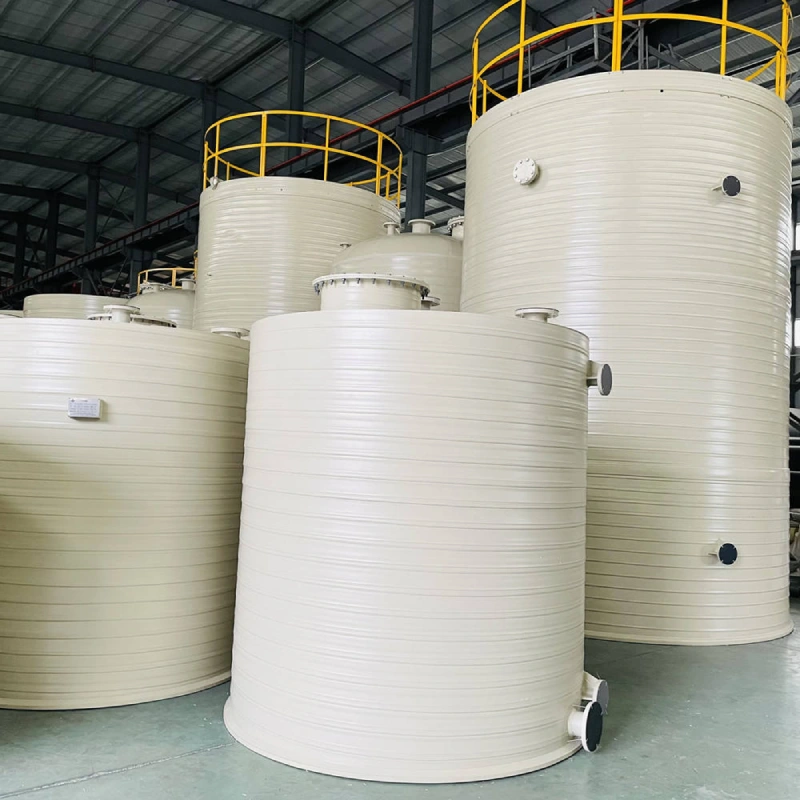
Manufacturing Process of PP/FRP Tank

The manufacturing process of a PP/FRP Tank (Polypropylene/Fiberglass Reinforced Plastic Tank) involves the fabrication of a Polypropylene (PP) inner liner followed by the application of a Fiberglass Reinforced Plastic (FRP) structural shell. This dual-laminate construction provides excellent chemical resistance, high mechanical strength, and long-term durability for storing corrosive chemicals and industrial process fluids.

Stage 1
Design and Engineering

The manufacturing process begins with detailed engineering and design based on:

    • Chemical compatibility 
  • Storage capacity(100 Liters to 500,000 Liters or Customized)
    • Specific gravity of the liquid
  • Operating temperature(0°C to 100°C (depending on chemical and design conditions))
  • Pressure conditions
  • Installation environment
  • Wind and seismic loads
  • Customer specifications

Engineering documents typically include:

  • General Arrangement (GA) Drawings
  • Fabrication Drawings
  • Design Calculations
  • Nozzle Layout Drawings
  • Reinforcement Details
  • Bill of Materials (BOM)
1
Stage 2
Raw Material Selection

High-quality materials are selected for both the liner and structural shell.

PP Liner Materials

  • Polypropylene Sheets
  • PP Welding Rods
  • PP Nozzles and Fittings

FRP Materials

  • Fiberglass Mat
  • Woven Roving
  • Chopped Strand Mat (CSM)
  • Vinyl Ester Resin
  • Isophthalic Resin (as required)
  • Catalyst and Additives

All materials are sourced from approved suppliers and accompanied by quality certifications.

2
Stage 3
Raw Material Inspection

Incoming materials are inspected for:

  • Material grade verification
  • Thickness measurement
  • Surface quality
  • Dimensional accuracy
  • Material Test Certificates (MTCs)
  • Traceability compliance

Only approved materials proceed to fabrication.

3
Stage 4
PP Sheet Cutting

PP sheets are cut according to fabrication drawings using:

  • CNC Cutting Machines
  • Circular Saws
  • Panel Saws
  • Thermoplastic Cutting Equipment

Accurate cutting ensures proper fit-up during assembly.

4
Stage 5
PP Liner Fabrication

The PP liner is fabricated by:

  • Rolling sheets into cylindrical sections
  • Forming tank bottoms and roofs
  • Preparing nozzle openings
  • Aligning fabricated components

The liner serves as the primary chemical-resistant barrier.

5
Stage 6
Thermoplastic Welding

The PP liner components are joined using specialized thermoplastic welding techniques.

Butt Fusion Welding

Used for joining large PP sections and shell components.

Extrusion Welding

Used for reinforcement welds and component assembly.

Hot Gas Welding

Used for detailed fabrication and finishing work.

All welding is performed by qualified thermoplastic fabricators

6
Stage 7
Nozzle and Fitting Installation

The following components are installed into the PP liner:

  • Inlet Nozzles
  • Outlet Nozzles
  • Overflow Connections
  • Vent Connections
  • Drain Nozzles
  • Sampling Ports
  • Instrumentation Connections

All nozzle locations are verified against approved drawings.

7
Stage 8
Liner Inspection

The completed PP liner is inspected for:

  • Weld quality
  • Dimensional accuracy
  • Surface finish
  • Alignment
  • Fabrication integrity

This inspection ensures the liner is ready for FRP lamination.

8
Stage 9
Surface Preparation for FRP Lamination

The outer surface of the PP liner is specially prepared to promote mechanical bonding with the FRP shell.

Preparation may include:

  • Surface treatment
  • Mechanical anchoring methods
  • Bonding layer application

Proper preparation is critical for dual-laminate performance.

9
Stage 10
FRP Lamination Process

The structural FRP shell is applied over the PP liner.

The lamination process typically includes:

Resin Application

Resin is applied to the prepared surface.

Fiberglass Reinforcement Placement

Layers of fiberglass reinforcement are applied, including:

  • Chopped Strand Mat (CSM)
  • Woven Roving
  • Surface Tissue

Layer-by-Layer Build-Up

Multiple FRP layers are built up to achieve the required structural thickness.

The FRP shell provides:

  • Mechanical strength
  • Structural rigidity
  • Load-bearing capability
10

How to Select the Right PP/FRP Tank

Selecting the right PP/FRP Tank Polypropylene/Fiberglass Reinforced Plastic Tank is crucial for ensuring safe chemical storage, long service life, and reliable process performance. The tank should be designed according to the chemical properties, operating conditions, structural requirements, and installation environment.

1. Identify the Chemical to be Stored

The first and most important step is to determine:

  • Chemical name
  • Chemical concentration
  • Chemical composition
  • Hazard classification
  • Specific gravity

Different chemicals require different liner materials and design considerations.

Common Chemicals Stored in PP/FRP Tanks

  • Hydrochloric Acid
  • Sulfuric Acid
  • Phosphoric Acid
  • Sodium Hydroxide
  • Ferric Chloride
  • Sodium Hypochlorite
  • Alum Solution
  • Process Chemicals
2. Verify Chemical Compatibility

The PP liner must be compatible with the stored chemical under actual operating conditions.

Consider:

  • Chemical concentration
  • Operating temperature
  • Exposure duration
  • Chemical purity

Proper compatibility ensures long-term performance and prevents material degradation.

3. Determine Required Storage Capacity

Tank capacity should be selected based on:

  • Daily consumption rate
  • Delivery schedule
  • Emergency storage requirements
  • Future expansion plans

Typical capacities range from:

  • 100 Liters
  • 500 Liters
  • 1,000 Liters
  • 10,000 Liters
  • 100,000 Liters and above
4. Consider Specific Gravity (SG)

The specific gravity of the stored liquid directly affects tank wall loading.

Examples:

  • Water = 1.0 SG
  • Ferric Chloride = Higher SG
  • Sulfuric Acid = Higher SG

The tank must be designed for the maximum expected SG.

5. Evaluate Operating Temperature

Temperature significantly influences chemical resistance and tank design.

Important factors include:

  • Normal operating temperature
  • Maximum temperature
  • Ambient temperature conditions

PP/FRP tanks are commonly used for elevated-temperature chemical applications.

6. Select the Appropriate Tank Configuration

Choose the tank design based on process requirements and available space.

Vertical Tanks

Advantages:

  • Smaller footprint
  • Higher storage volume
  • Easier level monitoring

Horizontal Tanks

Advantages:

  • Lower installation height
  • Easier transportation
  • Suitable for restricted-height locations
7. Choose the Right Tank Top Design

Available options include:

  • Open Top
  • Flat Top
  • Dome Top
  • Conical Top

Selection depends on process requirements and operating conditions.

8. Select the Appropriate Bottom Design

Bottom configurations include:

  • Flat Bottom
  • Cone Bottom
  • Sloped Bottom
  • Dish Bottom

Cone-bottom tanks are often preferred where complete drainage is required.

9. Evaluate Structural Requirements

The FRP shell provides structural strength, but additional considerations may include:

  • Wind loads
  • Seismic loads
  • Platform loads
  • Agitator loads
  • External piping loads

Proper engineering ensures long-term structural stability.

10. Assess Installation Environment

Consider:

  • Indoor installation
  • Outdoor installation
  • UV exposure
  • Corrosive atmosphere
  • Coastal environments
  • Temperature extremes

Environmental conditions influence tank design and protection requirements.

pvdf frp tank image
Repairing Service

Custom Product Manufacturing Available

If you are searching for customized product designs that meet your requirements, don’t worry. Petron Thermoplast also offers custom product manufacturing services to meet the unique needs of various industries. Work with our expert engineers to create custom designs suited for your application.

Why Choose Petron Thermoplast?

At Petron Thermoplast, we rely on honesty, discipline and hard work and believe our success can be attributed to upholding a simple set of core values that date back to the beginning of the company. A PP/FRP Tank Polypropylene/Fiberglass Reinforced Plastic Tank is an excellent choice for storing the corrosive chemicals, acids, alkalis, and industrial process of liquids. Its dual-laminate construction are combine the superior chemical resistance of Polypropylene (PP) with the high structural strength of Fiberglass Reinforced Plastic (FRP), providing a reliable and long-lasting storage solution for demanding the industrial applications. 

Frequently Asked Questions

1. What is a PP/FRP Tank?

A PP/FRP Tank is a dual-laminate chemical storage tank consisting of a Polypropylene (PP) inner liner and a Fiberglass Reinforced Plastic (FRP) outer shell. The PP liner provides chemical resistance, while the FRP shell provides structural strength.

2. What does PP/FRP stand for?
  • P – Polypropylene
  • FRP – Fiberglass Reinforced Plastic

Together, they create a durable and corrosion-resistant storage solution for industrial chemicals.

3. What are the main advantages of a PP/FRP Tank?

Key advantages include:

  • Excellent chemical resistance
  • High structural strength
  • Corrosion-free construction
  • Leak-proof performance
  • Long service life
  • Low maintenance requirements
  • Lightweight design
  • Cost-effective operation
4. What chemicals can be stored in a PP/FRP Tank?

PP/FRP tanks are commonly used for storing:

  • Hydrochloric Acid (HCl)
  • Sulfuric Acid (selected concentrations)
  • Phosphoric Acid
  • Sodium Hydroxide (Caustic Soda)
  • Ferric Chloride
  • Sodium Hypochlorite
  • Alum Solution
  • Water Treatment Chemicals

Chemical compatibility should always be verified before use.

5. How does a PP/FRP Tank work?

The PP liner comes into contact with the stored chemical and prevents corrosion, while the FRP shell supports the tank structurally and withstands mechanical loads.

6. What capacities are available for PP/FRP Tanks?

PP/FRP tanks can be manufactured in capacities ranging from:

  • 100 Liters
  • 500 Liters
  • 1,000 Liters
  • 10,000 Liters
  • 50,000 Liters
  • 100,000 Liters and above

Custom capacities are also available.

7. Are PP/FRP Tanks suitable for outdoor installation?

Yes. PP/FRP tanks can be designed for outdoor use and may include UV-resistant coatings or protective measures for long-term weather exposure.

8. What temperature range can a PP/FRP Tank handle?

Typically, PP/FRP tanks can operate up to approximately 90°C–100°C, depending on the stored chemical, concentration, and design conditions.

9. Are PP/FRP Tanks corrosion-resistant?

Yes. The PP liner provides excellent resistance to corrosion from many acids, alkalis, and industrial chemicals.

10. What types of PP/FRP Tanks are available?

Common types include:

  • Vertical Tanks
  • Horizontal Tanks
  • Open-Top Tanks
  • Closed-Top Tanks
  • Cone-Bottom Tanks
  • Flat-Bottom Tanks
  • Mixing Tanks
  • Process Tanks