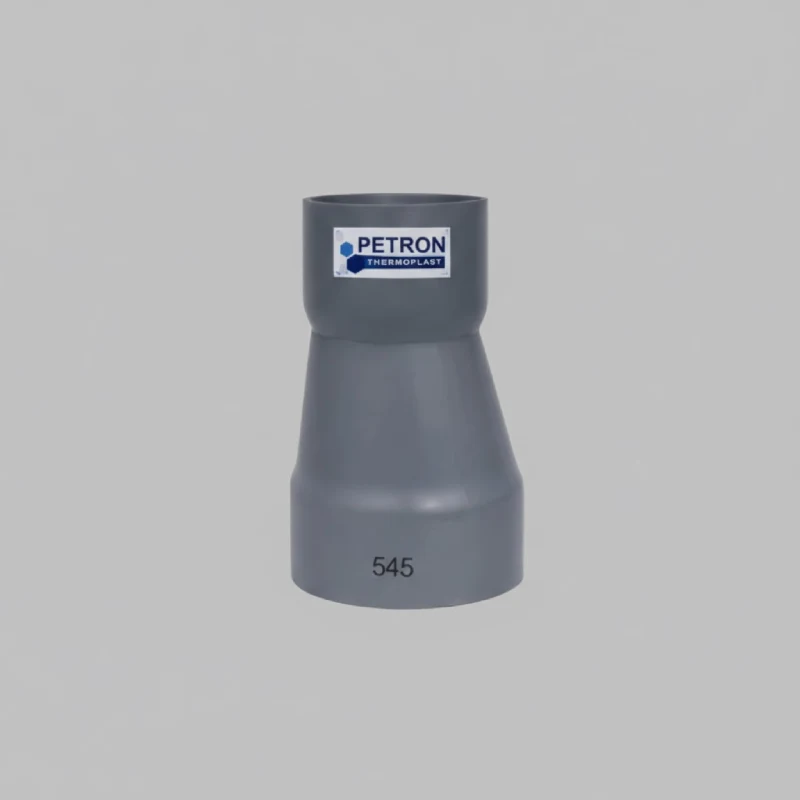
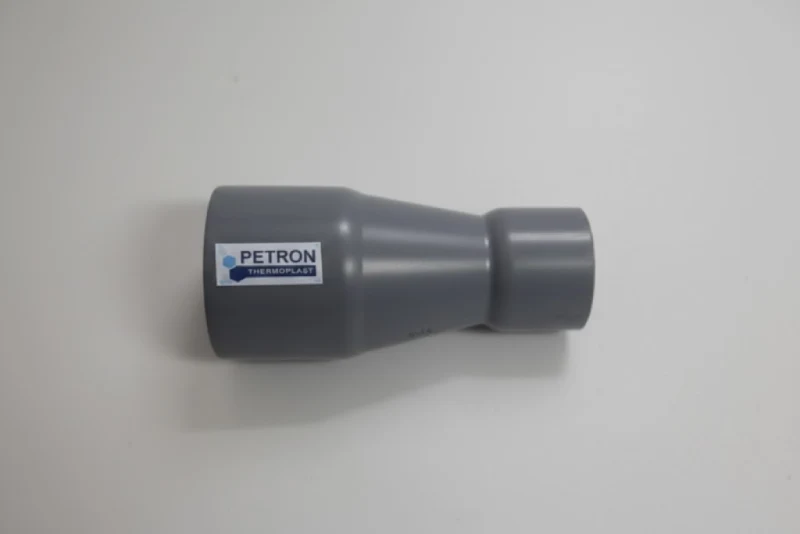
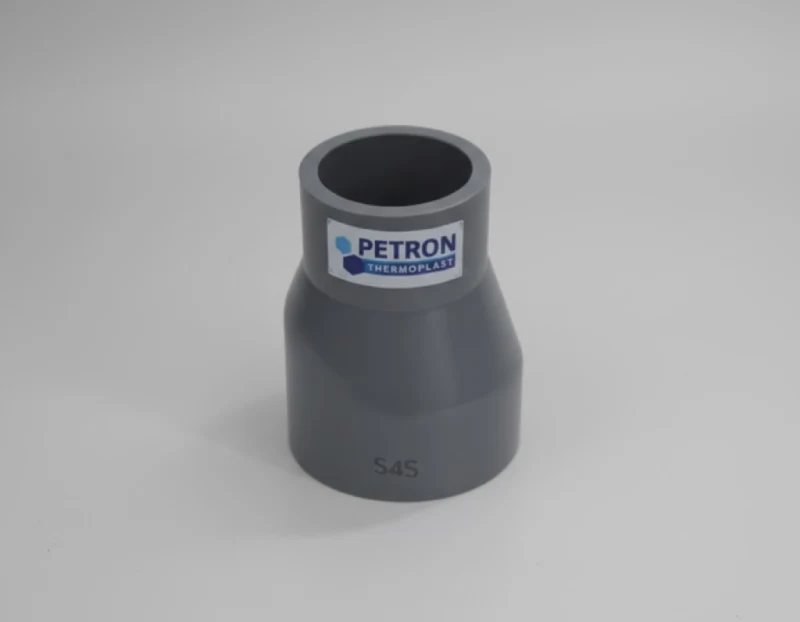
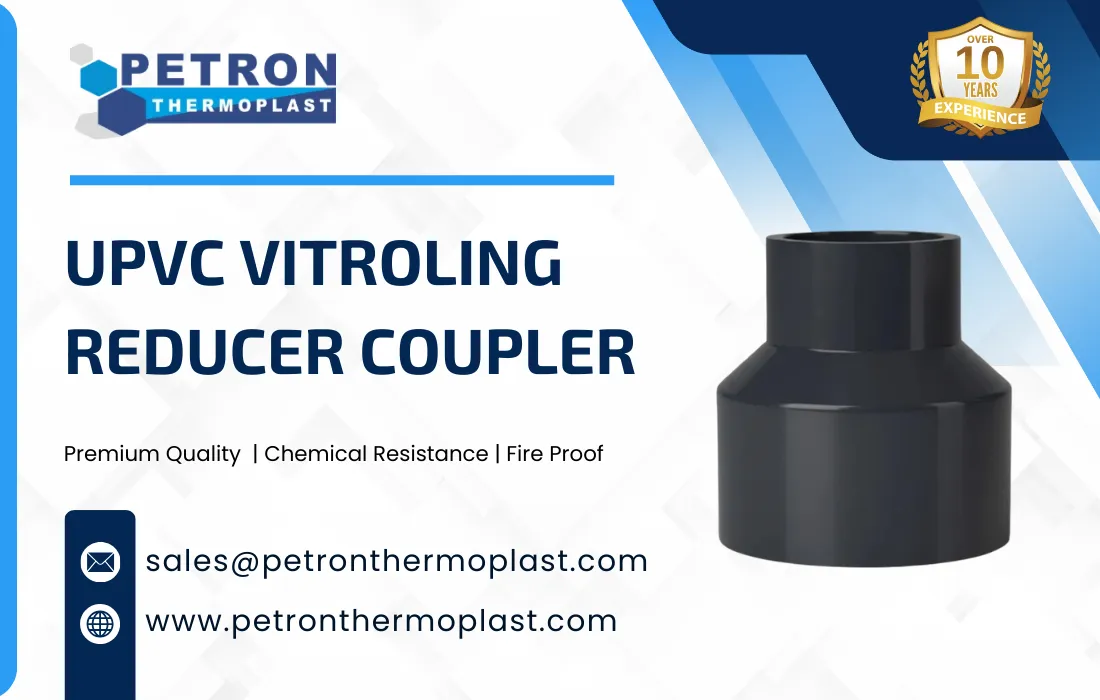
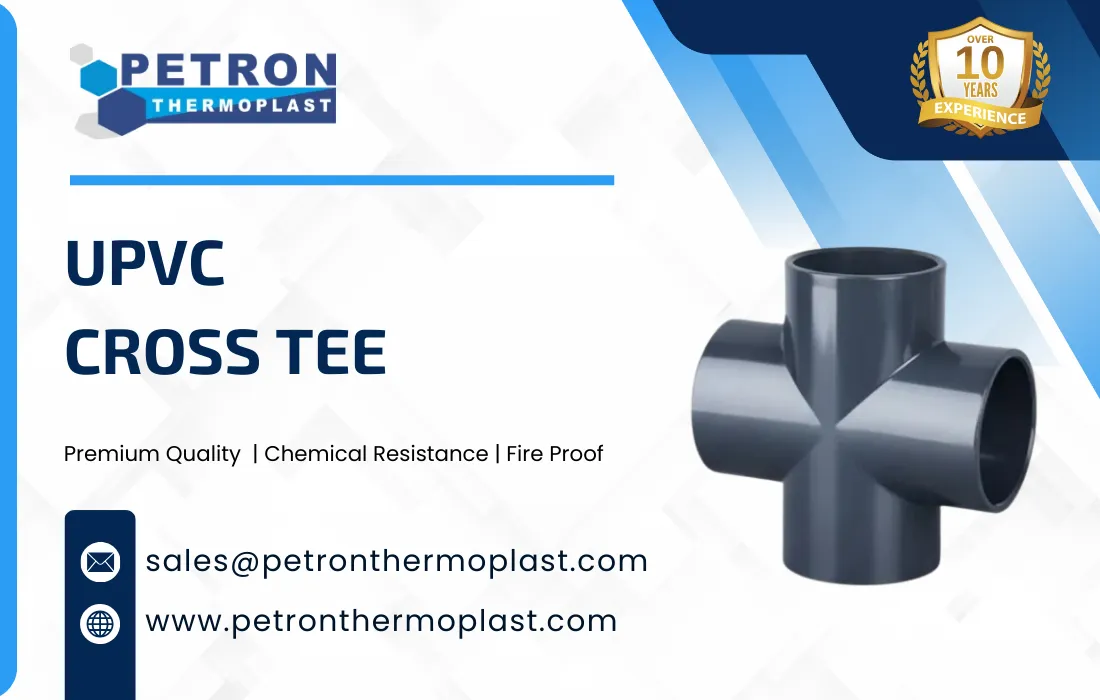
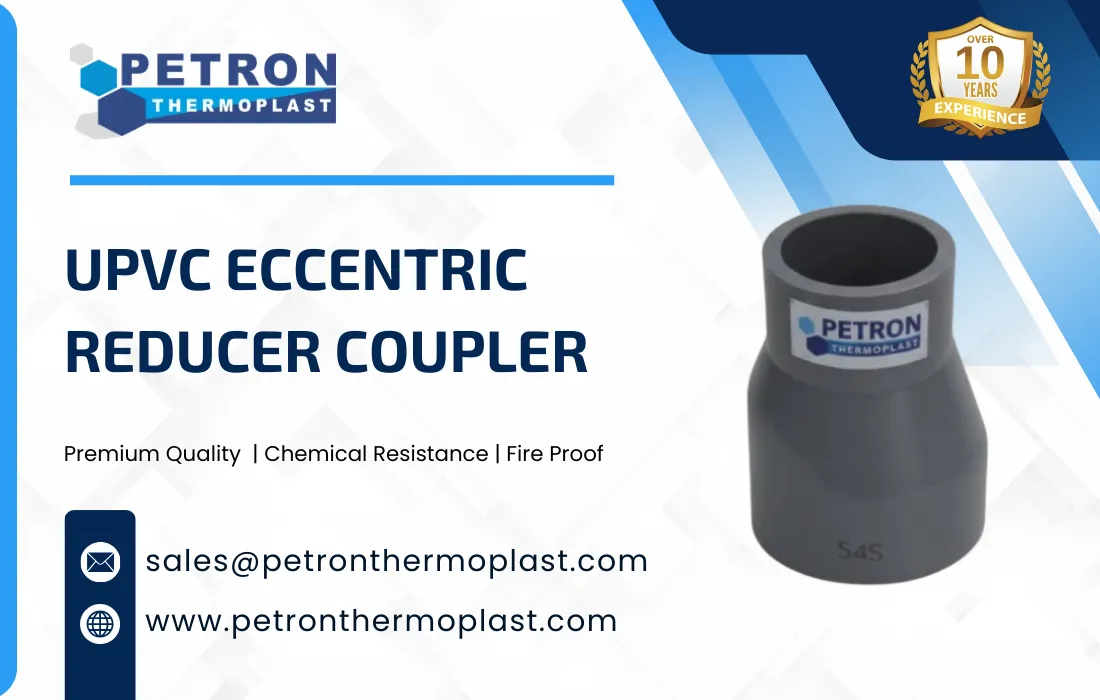
UPVC Eccentric Reducer Coupler Image UPVC Eccenetric Reducer Images UPVC Eccentric Reducer image

UPVC Eccentric Reducer Coupler

An eccentric reducer is a pipe that connects pipes of different diameters, but with one important difference: the smaller end is not centered. This results in a flat edge on one side of the reducer.

Eccentric reducers are suitable for applications where it is necessary to ensure that the top or bottom of the pipe remains flat, especially in horizontal flow systems. This design ensures a smooth transition of fluid flow while preventing air or gas accumulation in the pipeline.

UPVC Eccentric Reducer Coupler Details

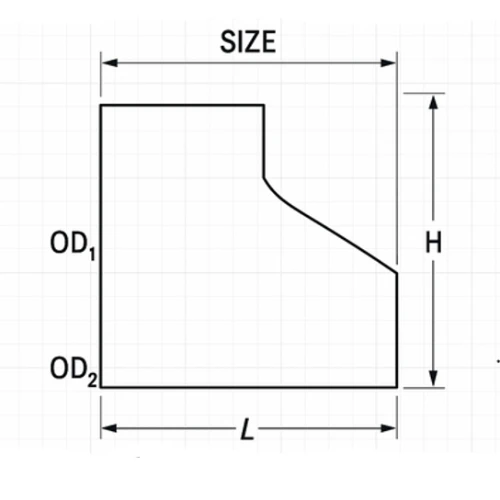
UPVC-Eccentric-Reducer-Coupler-Diagram

OD₁ – Outer Diameter of Larger End
OD₂ – Outer Diameter of Smaller End
ID₁ – Inner Diameter of Larger End
L – Length of the Reducer
H – Height (or Body Height)

Size (NB)OD₁ (mm)OD₂ (mm)ID₁ (mm)L (mm)H (mm)
1¼″ × 1″42.1633.4035.09013
1½″ × 1¼″48.2642.1640.99514
2″ × 1½″60.3348.2652.510016
2½″ × 2″73.0360.3364.111018
3″ × 2½″88.9073.0377.912020
4″ × 3″114.3088.90100.814024
6″ × 4″168.28114.30152.216030
8″ × 6″219.08168.28202.718035
10″ × 8″273.05219.08254.520042
ParameterSpecification
MaterialuPVC (Unplasticized Polyvinyl Chloride)
TypeEccentric Reducer Coupler
Size Range1″ × ¾” to 6″ × 4″ (25 mm × 20 mm to 160 mm × 110 mm)
Connection TypeSolvent Weld Socket Ends
Operating PressureUp to 10 bar (150 psi)
Temperature Range0°C to 60°C (32°F to 140°F)
ColorTypically Grey
Application AreasWater Supply, Chemical Pipelines, Industrial Drainage
Standards ComplianceASTM, ISO, DIN

Offset Design: Maintains consistent flow level, ideal for horizontal piping to prevent air locking.
Smooth Flow Transition: Minimizes turbulence and pressure drops when reducing pipe size.
High Chemical Resistance: Suitable for aggressive and corrosive fluids.
Strong and Lightweight: Offers high mechanical strength while being easy to handle and install.
Leak-Free Connection: Compatible with solvent weld joints for secure sealing.
Low Maintenance: Non-corrosive and resistant to scaling and deposits.

Typical Pressure Ratings (at 20 °C)

PN ClassMax Working Pressure (bar)Max Working Pressure (psi)Common Application
PN 66 bar87 psiLow-pressure drainage, gravity lines
PN 1010 bar145 psiChemical supply, irrigation
PN 12.512.5 bar181 psiIndustrial Chemical Systems
PN 1616 bar232 psiHigh-pressure Chemical process piping

Size-Based Typical Ratings (Solvent Cement Type)

Larger End Size × Smaller End Size (mm)Typical PN Rating
110 × 90PN 6 – PN 10
90 × 75PN 10
75 × 63PN 10 – PN 16
63 × 50PN 16
50 × 40PN 16
40 × 32PN 16


1. Material Composition

  • Made from Unplasticized Polyvinyl Chloride (UPVC)
  • Rigid, non-flexible thermoplastic
  • Free from plasticizers (gives higher strength and stiffness)

2. Color & Appearance

  • Common colors: grey, white, off-white
  • Smooth internal and external surface
  • Uniform wall thickness (except offset geometry due to eccentric design)

3. Density

  • Approximate density: 1.38 – 1.45 g/cm³
  • Lightweight compared to metal fittings

4. Mechanical Strength

  • High rigidity and hardness
  • Good impact resistance under normal ambient temperatures
  • Resistant to deformation under normal operating pressure

5. Surface Finish

  • Smooth bore reduces friction losses
  • Non-porous surface prevents scaling and deposition
  • Good dimensional stability

6. Thermal Properties

  • Operating temperature range: 0 °C to 60 °C
  • Softening temperature (Vicat): ~80–85 °C
  • Low thermal conductivity

7. Electrical Properties

  • Excellent electrical insulation
  • Non-conductive material

8. Chemical Resistance

  • Resistant to Acids, Alkalis, Salts and most inorganic chemicals
  • Not affected by corrosion or electrolysis

9. Weight

  • Lightweight, easy to handle, and install
  • Reduces overall piping system load

10. Durability

  • Long service life (typically 25–50 years under normal conditions)
  • Resistant to rust, rot, and biological growth

Benefits of UPVC Eccentric Reducer Coupler

1. Prevents Air Entrapment

  • The flat top (or flat bottom) design maintains a constant pipe level.
  • Helps avoid air pockets in horizontal pipelines, improving flow efficiency.
  • Especially beneficial in pump suction lines and gravity systems.

2. Smooth Flow Transition

  • Provides a gradual, offset reduction in diameter, minimizing turbulence.
  • Reduces pressure loss, cavitation risk, and vibration compared to abrupt reducers.

3. Lightweight & Easy Installation

  • uPVC is significantly lighter than metal fittings, making handling and alignment easier.
  • Requires no welding or threading—simple solvent cement jointing.

4. Corrosion & Chemical Resistance

  • Excellent resistance to corrosion, rust, scale, and many chemicals.
  • Ideal for chemical treatment, chemical processing, irrigation, and chemical systems.

5. Cost-Effective Solution

  • Lower material and installation costs compared to metal eccentric reducers
  • Minimal maintenance requirements over the system’s service life.

6. High Hydraulic Efficiency

  • Maintains consistent flow velocity at the top or bottom of the pipe.
  • Reduces energy losses, improving overall system efficiency.

7. Suitable for Pump Suction Applications

Flat-top eccentric reducers help ensure uniform fluid entry into pumps,
reducing cavitation and pump wear.

8. Long Service Life

Resistant to scaling, biofouling, and internal deposits. Typical service life exceeds 25–50 years under normal operating conditions.
9. Good Pressure Handling

Available in PN 6 to PN 16 ratings, suitable for most chemical and industrial piping needs.

10. Environmentally Friendly

uPVC is recyclable and has a lower carbon footprint than many metal alternatives.

Types of UPVC Eccentric Reducer Coupler

 1. By Connection Type

Socket (Slip-On) Eccentric Reducer Coupler

  • Pipes slide into the fitting and are typically solvent-welded (glued) for a leak-free joint.
  • The most common type of UPVC systems.

Threaded Eccentric Reducer Coupler

  • Has internal threads on one or both ends to screw onto threaded pipe ends.
  • Useful when pipes need to be disassembled for maintenance.

2. By Application Orientation

Eccentric reducers can be installed with the flat side up or down, depending on flow needs:

Flat Side Up

  • Useful for lines where you want to avoid trapping air at the top (e.g., pump suction lines).

 Flat Side Down

  • Helps avoid solid accumulation or ensure drainage in sloped horizontal pipes.

3. By Pipe Size Transition (Diameter Combination)

Eccentric reducers come in many pairings of larger → smaller pipe sizes, e.g.:

  • 50 mm × 40 mm (2″ × 1½″)
  • 40 mm × 25 mm (1½″ × 1″)
  • 32 mm × 25 mm (1¼″ × 1″)
  • 25 mm × 20 mm (1″ × ¾″)

4. Material Variants 

Although your focus is UPVC, note related materials that also use eccentric reducers:

  • UPVC Eccentric Reducer — for higher temperature or corrosive service (heat resistant).
  • PP (Polypropylene) Eccentric Reducer — used in chemical or industrial fluid handling

Common uses of UPVC Eccentric Reducer Coupler

Suction side of the pump (facing upwards)

Drainage or inclined pipe systems

Chemical treatment or slurry transport pipelines.

Why Choose Us?

Petron Thermoplast is a trusted manufacturer and supplier of UPVC Eccentric Reducer Couplers designed for reliable flow control, corrosion resistance, and long-term performance in industrial and utility systems. Our quality materials, precision engineering, and practical design meet diverse application needs.