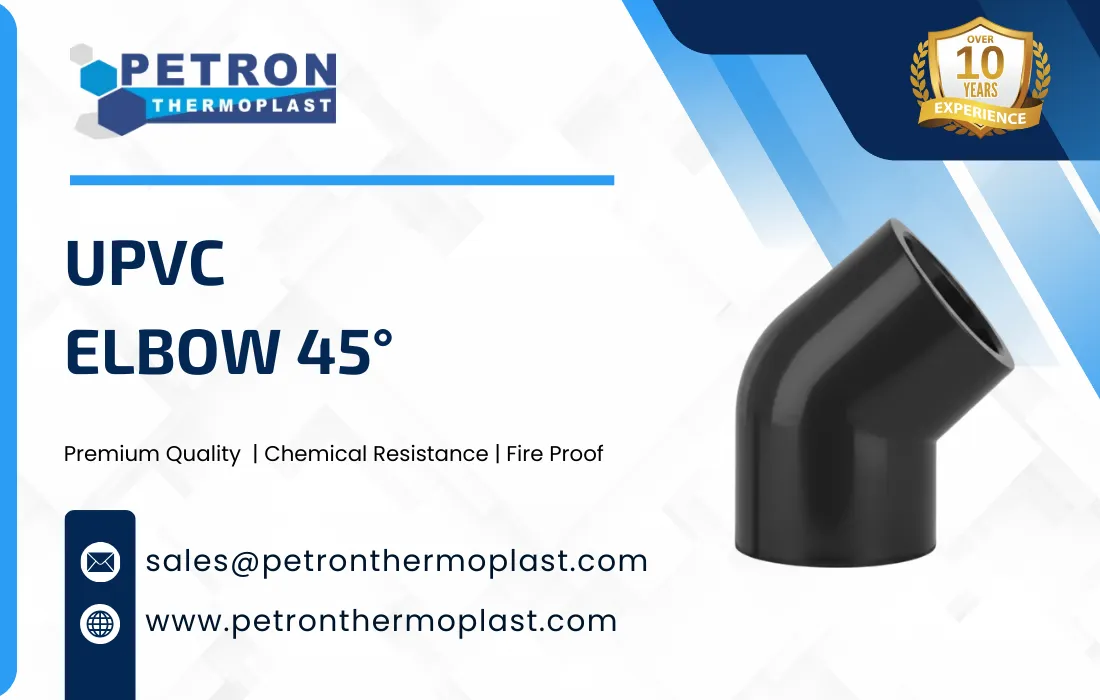
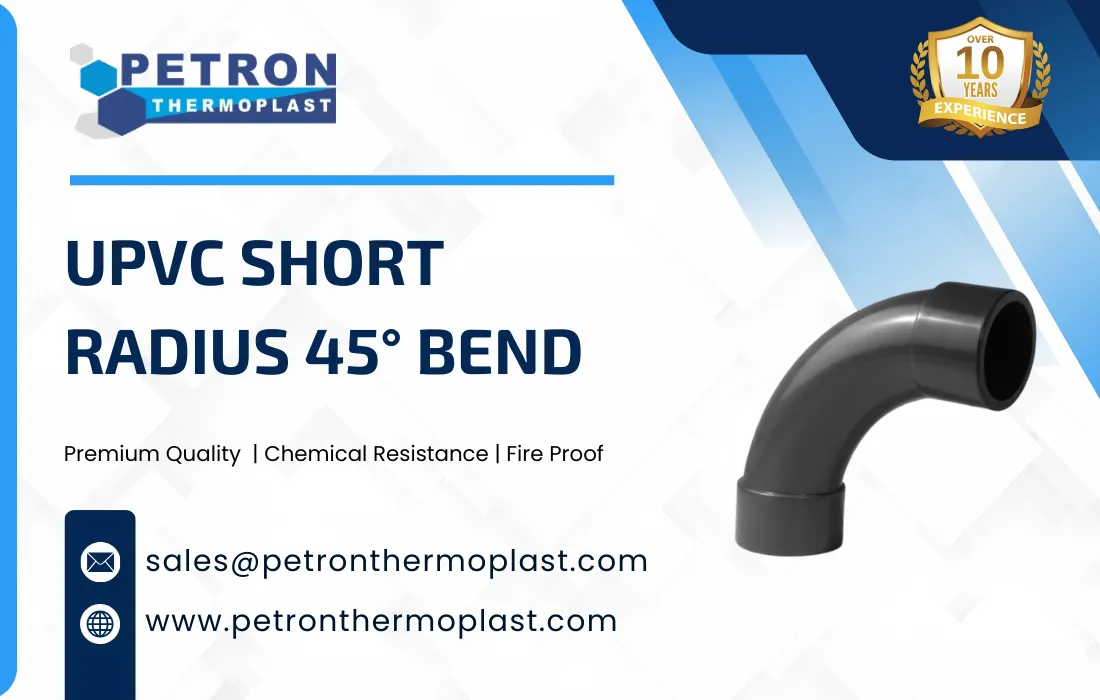
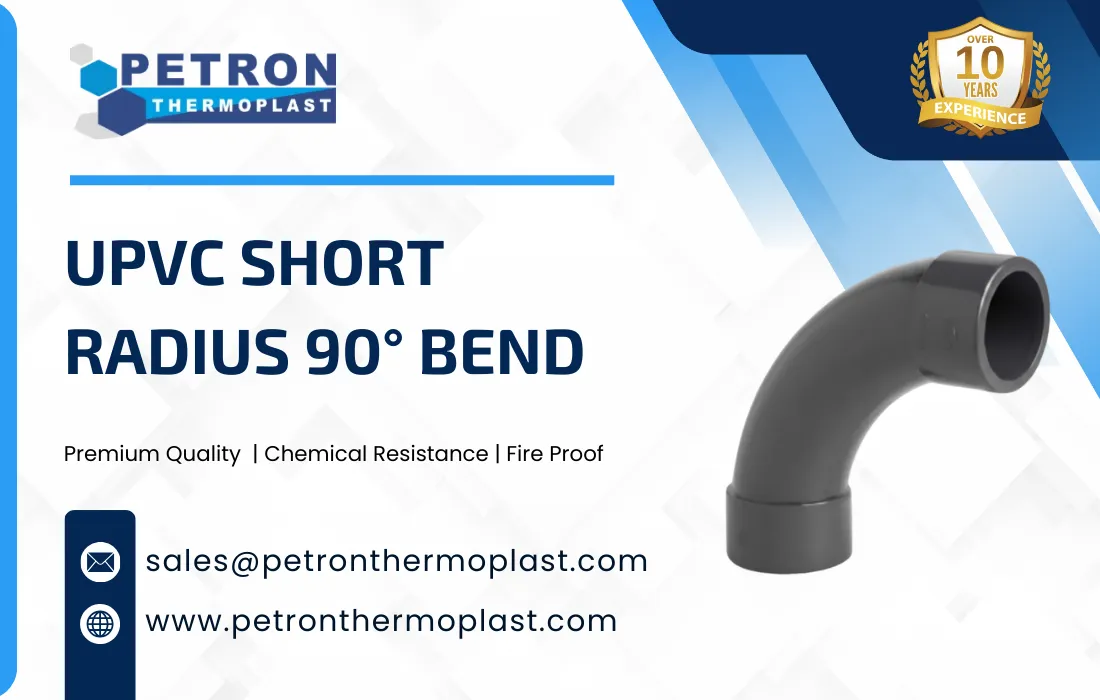
UPVC Short Radius 45° Bend
The UPVC Short Radius 45° Bend is a precision-molded pipe fitting designed to change the direction of flow by 45 degrees in piping systems where space is limited. Manufactured from Unplasticized Polyvinyl Chloride (UPVC), this bend is ideal for applications requiring corrosion resistance, chemical compatibility, and compact flow routing. It is commonly used in water supply, irrigation, chemical transport, and industrial fluid systems.
- Chemical Resistance
- Low Maintenance Requirement
- Low Thermal Conductivity
- Long Service Life
- Easy Installation
- Corrosion Resistance
UPVC Short Radius 45° Bend Details
ID / OD: Inside and Outside Diameter.
WT: Wall Thickness.
SL: Socket Length (depth the pipe enters the fitting).
L: Overall length of the component.
H: Total height or vertical clearance of the fitting.
| Size (Inch) | ID (mm) | OD (mm) | WT (mm) | SL (mm) | L (mm) | H (mm) |
| ½ | 21.64 | 29.10 | 3.73 | 22.23 | 45 | 59 |
| ¾ | 26.97 | 34.79 | 3.91 | 25.40 | 58 | 68 |
| 1 | 33.78 | 42.88 | 4.55 | 28.58 | 60 | 74 |
| 1¼ | 42.55 | 52.25 | 4.85 | 31.75 | 77 | 85 |
| 1½ | 48.72 | 58.88 | 5.08 | 34.93 | 83 | 88 |
| 2 | 60.78 | 71.86 | 5.54 | 38.10 | 98 | 115 |
| 2½ | 73.56 | 87.58 | 7.01 | 44.45 | 130 | 168 |
| 3 | 89.50 | 104.74 | 7.62 | 47.63 | 126 | 188 |
| 4 | 114.99 | 132.11 | 8.56 | 57.15 | 145 | 235 |
| Parameter | Specification |
| Material | UPVC (Unplasticized Polyvinyl Chloride) |
| Angle | 45° |
| Bend Radius | Short Radius |
| Size Range | ½” to 12” (15 mm to 315 mm) |
| Connection Type | Solvent Weld Socket Ends |
| Operating Pressure | Up to 10 bar (150 psi) |
| Temperature Range | 0°C to 60°C (32°F to 140°F) |
| Standards Compliance | ASTM D2466 / D1785, ISO, DIN |
| Color | Typically Grey |
1. Radius Geometry
- Centerline radius = 1 × Nominal Pipe Size (NPS)
- More compact than long-radius bends
2. Bend Angle
- 45° change in flow direction
- Often used in pairs to achieve smoother directional changes.
3. Compact Design
- Requires minimum installation space
- Ideal for congested piping layouts
4. Manufacturing Options
- Seamless, welded, hot-induction bent, or cold-formed
- Uniform wall thickness per applicable standards
5. End Connections
- Butt weld (BW) – most common
- Socket weld (SW) and threaded (THD) for small bore piping
6. Standards Compliance
- Manufactured as per ASME B16.9 (BW)
- ASME B16.11 (SW / THD)
- EN, DIN, and JIS equivalents available
7. Material Availability
- Carbon steel, stainless steel, alloy steel
- Duplex, super duplex, and non-ferrous alloys
8. Wall Thickness
- Available in all pipe schedules (Sch 10 to XXS)
- Schedule matches connecting pipe.
9. Pressure & Temperature Rating
- Designed to handle system pressure and temperature as per piping code
- Suitable for moderate to high-pressure applications
10. Flow Characteristics
- Higher turbulence and pressure drop compared to long-radius bends
- Acceptable for utilities and non-erosive services
A. ASTM Standard (Schedule System)
| Pipe Schedule | Pressure Rating (psi) | Pressure Rating (bar) |
| Sch 40 | ~450 psi | ~31 bar |
| Sch 80 | ~630 psi | ~43 bar |
B. ISO / EN Standard (PN System)
| PN Class | Pressure Rating (bar) | Typical Application |
| PN 6 | 6 bar | Drainage / low pressure |
| PN 10 | 10 bar | Water supply |
| PN 16 | 16 bar | Industrial fluids |
C. Temperature Derating (Applicable to All Ratings)
| Operating Temperature | Allowable Pressure |
| 20–25 °C | 100% |
| 30 °C | 88% |
| 40 °C | 70% |
| 50 °C | 50% |
| >60 °C | Not recommended |
| Property | Typical Value | Unit | Remarks |
| Density | 1.38 – 1.45 | g/cm³ | Lightweight compared to metals |
| Color | Grey / White | — | As per the standard or application |
| Surface Finish | Smooth, glossy | — | Low friction, low fouling |
| Tensile Strength | 45 – 55 | MPa | ASTM D638 |
| Compressive Strength | ~70 | MPa | Good load-bearing capacity |
| Flexural Strength | 80 – 90 | MPa | ASTM D790 |
| Modulus of Elasticity | 2.5 – 3.2 | GPa | Rigid material |
| Hardness | Rockwell R 110–120 | — | High surface hardness |
| Impact Strength (Izod) | 2 – 5 | kJ/m² | ASTM D256 |
| Vicat Softening Temperature | 75 – 85 | °C | Upper temperature limit |
| Maximum Working Temperature | 60 | °C | Continuous service |
| Thermal Conductivity | 0.14 – 0.16 | W/m·K | Good thermal insulation |
| Coefficient of Thermal Expansion | 5–7 ×10⁻⁵ | /°C | Higher than metals |
| Water Absorption (24 h) | ≤ 0.1 | % | Excellent moisture resistance |
| Electrical Resistivity | >10¹⁴ | Ω·cm | Excellent insulator |
| Corrosion Resistance | Excellent | — | Resistant to most acids & alkalis |

Custom Product Manufacturing Available
If you are searching for customized product designs that meet your requirements, don’t worry. Petron Thermoplast also offers custom product manufacturing services to meet the unique needs of various industries. Work with our expert engineers to create custom designs suited for your application.
Benefits of Using UPVC Short Radius Bend 45°
1. Space Saving
- SR bends have a radius = 1 × pipe diameter, so they take up much less space than long-radius bends.
- Ideal for tight layouts, pipe racks, skids, and compact equipment rooms.
2. Better Directional Control
- A 45° bend changes flow direction gradually compared to a 90° bend.
- Using two 45° SR bends can replace one 90°, giving more flexibility in routing.
3. Cost-Effective
- A shorter centerline radius means less material than long-radius bends.
- Often cheaper in fabrication and installation, especially in congested areas.
4. Easier Installation
- Lightweight and compact → easier handling and alignment.
- Useful where welding access is limited.
5. Good for Small Bore & High-Density Piping
- Commonly used in small-diameter piping systems where long-radius bends are impractical.
- Works well in instrument air, utilities, and secondary process lines.
6. Reduces Layout Complexity
- Helps avoid extra offsets, fittings, or pipe spools.
- Simplifies piping design in tight geometries.
7. Acceptable Pressure Performance
- Designed per standards like ASME B16.9, ensuring adequate strength for design pressure and temperature.
Types of UPVC Short Radius Bend 45°
1. By Manufacturing Method
- Seamless SR 45° Bend
Made from seamless pipe; used for high-pressure or critical services. - Welded SR 45° Bend
Fabricated from welded pipe; common for general industrial use. - Hot Induction Bent SR 45°
Formed by heating and bending straight pipe; good for thick walls and large sizes. - Cold Formed SR 45°
Bent without heating, usually for smaller diameters and thinner walls.
2. By End Connection
- Butt Weld (BW) SR 45° Bend
most common in process piping - Socket Weld (SW) SR 45° Bend
small bore, high pressure - Threaded (THD) SR 45° Bend
low pressure, small sizes
3. By Material
- Carbon Steel (ASTM A234 WPB, WPC)
- Stainless Steel (304, 316, 321, etc.)
- Alloy Steel (P11, P22, P91)
- Duplex / Super Duplex
- Non-ferrous (Copper, Nickel alloys)
4. By Standard
- ASME B16.9 – Factory-made wrought SR 45° bends
- ASME B16.11 – Forged socket-weld and threaded types
- EN / DIN / JIS standards – European and Asian equivalents
5. By Wall Thickness
- Available in all pipe schedules (Sch 10, 20, 40, 80, 160, XXS, etc.)
Why Choose Petron Thermoplast?
Petron Thermoplast is a seasoned name in the manufacturing and supply of high-quality UPVC Short Radius 45° Bend
Our Specialties:
Premium Quality Materials
Long-Lasting Design
Customized Solutions to Suit Every Industry
Timely Delivery and Reliable Service
UPVC Pipe Fittings
We offer UPVC Pipe Fittings products in all standard sizes and provide complete customization options to meet your specific project requirements across our entire product range.