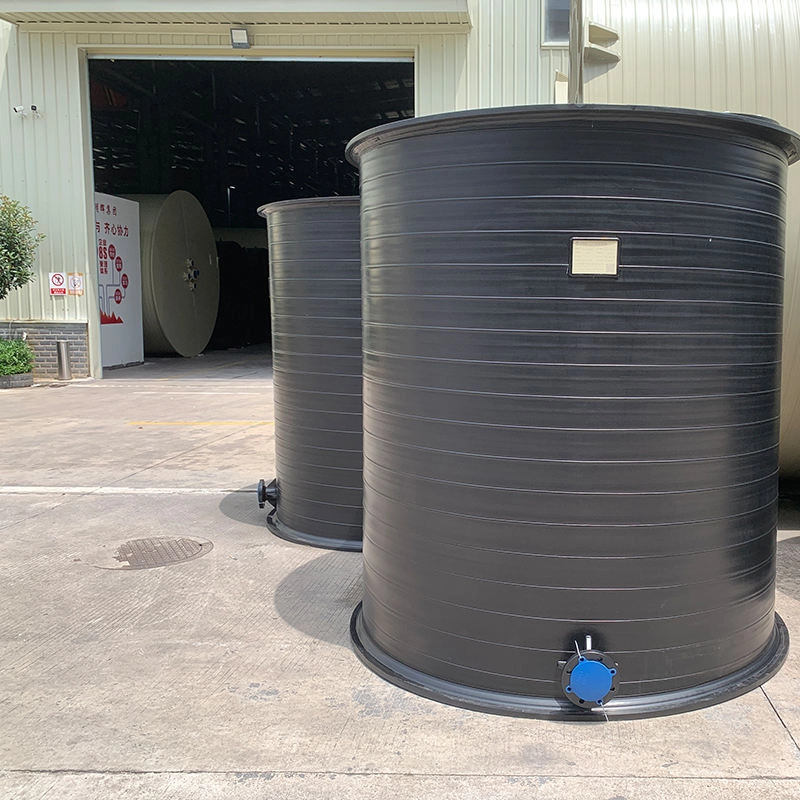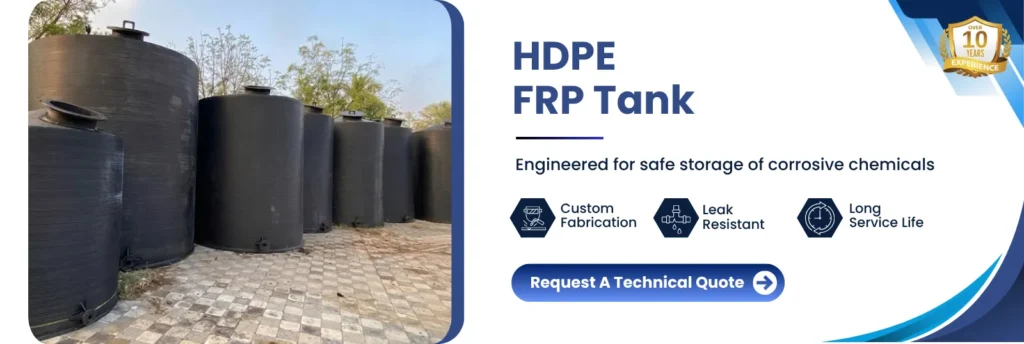







Excellent Chemical Resistance
HDPE FRP tanks provide an outstanding resistance against Acids, Alkalis, Corrosive chemicals & Industrial solvents

Temperature Resistance
Operating Temperature - Approx. -5°C to 70°C Pressure Condition - Atmospheric / Low Pressure

Advantages
Lightweight, Durable, Chemical Resistant, Low Maintenance

Safety Features
Corrosion Resistant, Impact Resistant, Leak Resistant

Chemical Processing Industry
HDPE FRP tanks are widely used for storing and handling:
Acids
Alkalis
Corrosive chemicals
Industrial solvents
Process liquids

Water Treatment Plants
These tanks are commonly used in water treatment systems for storing:
Sodium hypochlorite
Alum
Caustic soda
Hydrochloric acid
Chlorine solutions

Effluent Treatment Plants (ETP)
HDPE FRP tanks are extensively used in ETP systems for:
Neutralization chemical storage
Wastewater treatment chemicals
Sludge treatment solutions
Chemical dosing applications
Pharmaceutical Industry
In pharmaceutical plants, HDPE FRP tanks are used for:
Process chemical storage
Purified water systems
Intermediate liquid storage
Chemical mixing applications

Electroplating Industry
HDPE FRP tanks are widely used in electroplating operations for:
Acid dipping solutions
Metal treatment chemicals
Surface finishing chemicals

Pickling & Surface Treatment Plants
The tanks are used for:
Acid pickling baths
Chemical cleaning solutions
Surface preparation chemicals

Power Plants
Power generation industries use HDPE FRP tanks for:
Boiler treatment chemicals
Cooling tower chemicals
DM water treatment chemicals
Acid and alkali storage

Mining Industry
Mining operations use HDPE FRP tanks for:
Chemical reagent storage
Corrosive slurry handling
Process liquid containment
Their strong composite structure supports harsh industrial environments.

Petrochemical Industry
These tanks are used in petrochemical plants for:
Additive storage
Chemical transfer systems
Corrosive fluid handling

Chemical Dosing Systems
HDPE FRP tanks are integrated into:
Dosing skids
Metering systems
Chemical injection systems
for controlled chemical handling operations.

Marine & Coastal Applications
The corrosion-resistant design makes these tanks suitable for:
Coastal industrial plants
Saltwater environments
Marine chemical storage systems

Hazardous Chemical Storage
HDPE FRP tanks are ideal for safely storing:
Hazardous liquids
Reactive chemicals
Toxic industrial fluids
with reliable leak-proof protection.
Bulk Industrial Liquid Storage
These tanks are also used for:
Bulk liquid storage
Process water handling
Industrial chemical distribution systems
Dual-Layer Composite Construction
HDPE FRP tanks are manufactured with:
Inner HDPE liner for chemical resistance
Outer FRP layer for the structural strength
Excellent Chemical Resistance
Acids
Alkalis
Corrosive chemicals
Industrial solvents
Structural stability
Load-bearing capacity
Impact resistance
Pressure handling capability

Corrosion-Free Performance
Unlike metal tanks, HDPE FRP tanks do not rust or corrode, even in highly corrosive industrial environments.

Leak-Proof Construction
Advanced thermoplastic welding and FRP lamination to create the strong, leak-resistant joints for safe liquid containment.

Lightweight Design
Easy transportation
Faster installation
Reduced handling cost
Lower structural load

Long Service Life
High durability
Resistance to environmental damage
Extended operational life with minimal maintenance

UV & Weather Resistance
Sunlight exposure
Weather damage
Outdoor environmental conditions

Low Maintenance Requirement
Maintenance frequency
Repair costs
Surface treatment requirements
Excellent Structural Stability
Tank shape
Dimensional stability
Mechanical reliability

Customizable Design
Storage capacity
Shape and dimensions
Chemical application
Nozzle arrangement
Thickness requirements
Smooth Internal Surface
Reduces chemical deposits
Improves cleaning efficiency
Supports hygienic storage
Prevents contamination
Temperature Resistance
These tanks can safely to handle the moderate industrial operating temperatures in chemical storage systems.

Suitable for Hazardous Chemical Storage
HDPE FRP tanks are designed for safe storage of:
Hazardous chemicals
Reactive liquids
Corrosive process fluids
Cost-Effective Storage Solution
Their long life, low maintenance, and corrosion resistance make HDPE FRP tanks an economical industrial storage option.