CPVC Materials
CPVC (Chlorinated Polyvinyl Chloride) material is a thermoplastic polymer produced by chlorinating polyvinyl chloride (PVC) resin, which increases its chlorine content and improves its heat resistance, chemical resistance, and mechanical strength.CPVC material is widely used in industrial piping systems, hot and cold water distribution, chemical processing equipment, and the manufacturing of fittings and valves because it can withstand higher temperatures and corrosive environments compared to standard PVC.
The defining feature of CPVC is its chlorine content. Through a free radical chlorination reaction, the chlorine content of the base PVC is increased from approximately 57% to nearly 67-74%. This change in molecular structure provides heat resistance unlike standard PVC, which begins to soften around 60°C (140°F). CPVC can withstand temperatures up to 93°C (200°F). It is highly resistant to many acids, bases, and salts, preventing corrosion over decades of use. CPVC has a high, meaning it does not support combustion in normal atmospheric conditions and is self-extinguishing.
- Chemical Resistance
- Low Maintenance Requirement
- Low Thermal Conductivity
- Long Service Life
- Easy Installation
- Corrosion Resistance
CPVC Materials Details
| Property | Typical Value / Specification | Definition / Importance |
| Material Type | Chlorinated Polyvinyl Chloride (Thermoplastic) | A high-heat resistant version of PVC created by chlorination. |
| Chemical Formula | (C₂H₃Cl)n | The repeating molecular structure of the polymer. |
| Density | 1.50 – 1.60 g/cm³ | Mass per unit volume of the material. |
| Max Service Temp | 90°C – 95°C | The highest temperature the material can handle continuously. |
| Glass Transition Temp | 110°C – 115°C | The point where the material softens from a rigid state. |
| Tensile Strength | 50 – 60 MPa | Maximum stress the material can withstand when stretched. |
| Flexural Strength | 80 – 100 MPa | The material’s resistance to bending forces. |
| Impact Strength | High resistance | The ability to resist sudden shock or mechanical impact. |
| Hardness | Rockwell R110 – R120 | Surface hardness and resistance to indentation. |
| Thermal Conductivity | 0.14 – 0.17 W/m·K | The material’s ability to conduct heat. |
| Thermal Expansion | 6.0 – 7.0 × 10⁻⁵ /°C | Rate of expansion with temperature changes. |
| Water Absorption | ≤ 0.1% | Indicates very low moisture absorption. |
| Flammability | Self-extinguishing | Inherently resistant to burning; stops when heat source is removed. |
| Chemical Resistance | Excellent | Resistance to acids, alkalis, and salts (corrosion-proof). |
| Rod Diameter (Thickness) | Diameter (mm) | Standard Length |
| 1/4 inch | 6 mm | 1 m / 2 m / 3 m |
| 3/8 inch | 10 mm | 1 m / 2 m / 3 m |
| 1/2 inch | 12 mm | 1 m / 2 m / 3 m |
| 3/4 inch | 20 mm | 1 m / 2 m / 3 m |
| 1 inch | 25 mm | 1 m / 2 m / 3 m |
| 1 1/4 inch | 32 mm | 1 m / 2 m / 3 m |
| 1 1/2 inch | 40 mm | 1 m / 2 m / 3 m |
| 2 inch | 50 mm | 1 m / 2 m / 3 m |
| 2 1/2 inch | 63 mm | 1 m / 2 m / 3 m |
| 3 inch | 75 mm | 1 m / 2 m / 3 m |
| 4 inch | 100 mm | 1 m / 2 m / 3 m |
- High Temperature Resistance
CPVC materials can withstand temperatures up to 90–95°C, making them suitable for hot water systems. - Excellent Chemical Resistance
They are resistant to acids, alkalis, salts, and many corrosive chemicals. - Corrosion and Rust Resistance
CPVC materials do not rust, corrode, or scale, ensuring long service life. - High Mechanical Strength
They provide good strength, rigidity, and durability for industrial applications. - Lightweight Material
CPVC is lighter than many metal materials, which makes handling and installation easier. - Smooth Surface Finish
The smooth surface helps in better fluid flow and reduces friction loss in piping systems. - Low Water Absorption
CPVC materials absorb very little moisture, maintaining dimensional stability. - Good Electrical Insulation
Being a non-conductive material, CPVC provides good electrical insulation properties. - Easy Fabrication and Installation
CPVC materials can be easily cut, joined, and fabricated for different industrial uses.
| Temperature | Typical Pressure Rating |
| 23°C (73°F) | Up to 400 psi (27.6 bar) |
| 40°C (104°F) | Up to 300 psi (20.7 bar) |
| 60°C (140°F) | Up to 200 psi (13.8 bar) |
| 82°C (180°F) | Up to 100 psi (6.9 bar) |
| 93°C (200°F) | Up to 80 psi (5.5 bar) |
| Property | Typical Value / Specification |
| Maximum Continuous Service Temp | 90°C – 95°C |
| Short-Term Maximum Temperature | Up to 100°C |
| Minimum Service Temperature | 0°C to -10°C |
| Glass Transition Temperature | 110°C – 115°C |
| Recommended Operating Temp | 0°C – 90°C |
| Density (g/cm³) | 1.50 – 1.60 |
| Density (kg/m³) | 1500 – 1600 |
| Specific Gravity | 1.50 – 1.60 |

Custom Product Manufacturing Available
If you are searching for customized product designs that meet your requirements, don’t worry. Petron Thermoplast also offers custom product manufacturing services to meet the unique needs of various industries. Work with our expert engineers to create custom designs suited for your application.
User Manual for CPVC Materials
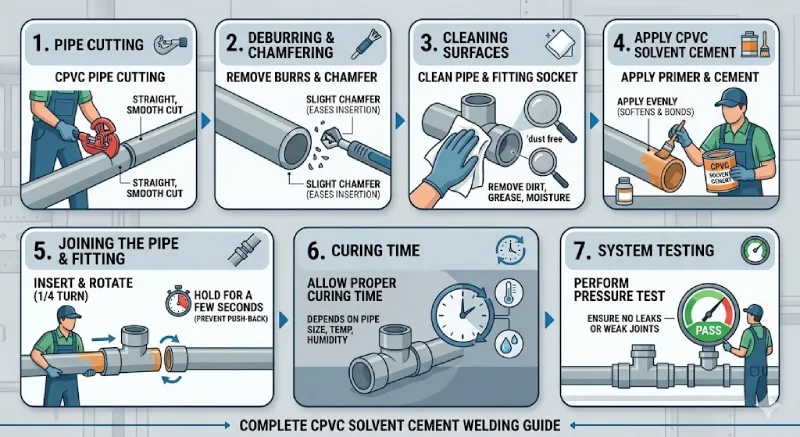
1. Installation of CPVC Materials
Proper installation of Chlorinated Polyvinyl Chloride (CPVC) materials is essential to ensure long-term performance, leak-free connections, and durability in piping systems used for water supply, chemical handling, and industrial applications.
Steps for Installing CPVC Materials
- Pipe Cutting
- Use a pipe cutter, fine-tooth saw, or wheel cutter.
- Ensure the cut is straight and smooth to allow a proper fitting connection.
- Deburring and Chamfering
- Remove burrs and rough edges from the pipe end.
- Chamfer the pipe edge slightly to make insertion into the fitting easier.
- Cleaning the Surfaces
- Clean the pipe and fitting socket using a dry cloth.
- Remove dirt, grease, and moisture before applying solvent cement.
- Application of CPVC Solvent Cement
- Apply CPVC primer (if required) and solvent cement evenly on the pipe end and inside the fitting.
- This softens the surfaces and creates a strong chemical bond.
- Joining the Pipe and Fitting
- Immediately insert the pipe into the fitting socket while rotating slightly (about ¼ turn).
- Hold the joint for a few seconds to prevent push-back.
- Curing Time
- Allow proper curing time before applying pressure to the system.
- Curing time depends on pipe size, temperature, and humidity.
- System Testing
- After installation, perform pressure testing to ensure there are no leaks or weak joints.
2. Maintenance of CPVC Materials
CPVC materials require minimal maintenance compared to metal piping systems, but regular inspection helps maintain efficiency and safety.
Maintenance Practices
- Regular Inspection
- Check pipes and fittings for cracks, leaks, or deformation.
- Inspect joints and connections periodically.
- Cleaning
- Remove dust, dirt, or chemical deposits from the surface of pipes and fittings.
- Temperature Monitoring
- Ensure operating temperature remains within the recommended limits of CPVC materials.
- Avoid Mechanical Stress
- Prevent excessive bending, heavy loads, or impacts on CPVC pipes and fittings.
- Chemical Compatibility Check
- Ensure the chemicals flowing through the system are compatible with CPVC material.
- Leak Repair
- If leakage occurs, replace damaged fittings or reapply solvent cement to the joint if necessary.
Customization of Chlorinated Polyvinyl Chloride (CPVC) materials allows manufacturers to modify products according to specific industrial requirements such as size, pressure rating, temperature resistance, and application environment. CPVC products can be tailored to improve performance, durability, and compatibility with different piping systems.
Common Customization Options:
- Size Customization
- Pipes, rods, and fittings can be manufactured in different diameters and lengths.
- Custom sizes are available based on project requirements.
- Size Customization
- Wall Thickness Adjustment
- Thickness can be modified to increase pressure resistance and mechanical strength
- Thickness can be modified to increase pressure resistance and mechanical strength
- Pressure Rating Customization
- CPVC components can be designed for different pressure classes depending on the system requirements.
- CPVC components can be designed for different pressure classes depending on the system requirements.
- Temperature Resistance
- Formulations can be adjusted to handle higher temperatures in industrial applications.
- Formulations can be adjusted to handle higher temperatures in industrial applications.
- Color Customization
- CPVC materials are available in various colors, such as grey, orange, cream, and custom shades for identification.
- CPVC materials are available in various colors, such as grey, orange, cream, and custom shades for identification.
- Surface Finish
- Smooth, polished, or textured finishes can be applied depending on usage.
- Smooth, polished, or textured finishes can be applied depending on usage.
- Special Chemical Resistance
- CPVC formulations can be modified for improved resistance against acids, alkalis, and corrosive chemicals.
Processing
Processing of CPVC involves several manufacturing techniques used to convert raw CPVC resin into pipes, rods, sheets, and fittings.
- Extrusion
- The most common process for producing CPVC pipes, rods, and sheets.
- Molten CPVC material is pushed through a die to form continuous shapes.
- Injection Molding
- Used to manufacture CPVC fittings such as elbows, tees, couplers, and adapters.
- Molten CPVC is injected into molds to create precise shapes.
- Compression Molding
- Used for producing thicker CPVC components and industrial parts.
- Used for producing thicker CPVC components and industrial parts.
- Machining
- CPVC rods and sheets can be cut, drilled, milled, or turned using machining tools.
- CPVC rods and sheets can be cut, drilled, milled, or turned using machining tools.
- Thermoforming
- Heated CPVC sheets are shaped into specific forms using molds.
- Heated CPVC sheets are shaped into specific forms using molds.
- Solvent Cement Joining
- CPVC pipes and fittings are joined using special solvent cement that chemically bonds the materials.
| Quality Check Stage | Process & Inspection Details |
| Raw Material Inspection | CPVC resin and additives are checked for purity and consistency before production begins. This ensures the chemical base meets industry standards. |
| Dimensional Accuracy | Pipes, rods, and fittings are measured using precision calipers and gauges to ensure correct diameter, wall thickness, and length. |
| Surface Finish Inspection | Products are checked for smooth internal and external surfaces, uniform color (cream/light grey), and the absence of cracks, pits, or visual defects. |
| Process Monitoring | Critical factors such as temperature, pressure, and extrusion or molding speeds are continuously controlled during the manufacturing cycle. |
| Final Product Inspection | Finished products undergo comprehensive visual and mechanical checks (including stress and impact tests) before packaging and dispatch. |
| Test Name | Purpose |
| Hydrostatic Pressure Test | Determines the ability of CPVC pipes and fittings to withstand internal pressure over time. |
| Impact Strength Test | Measures resistance to sudden mechanical shocks or impacts. |
| Tensile Strength Test | Evaluates the maximum stress the material can withstand when stretched. |
| Heat Deflection Temp Test | Determines the temperature at which the material begins to deform under load. |
| Chemical Resistance Test | Ensures compatibility with various chemicals and corrosive fluids. |
| Density Test | Confirms the material composition and structural consistency. |
| Dimensional Stability Test | Checks whether the material maintains its shape and size under temperature changes. |
| Burst Pressure Test | Determines the maximum pressure the pipe can withstand before failure. |
- High Temperature Resistance
CPVC materials can handle temperatures up to 90–95°C, making them ideal for hot water systems. - Excellent Chemical Resistance
They resist acids, alkalis, salts, and corrosive chemicals, making them suitable for chemical industries. - Corrosion and Rust Free
CPVC does not rust, corrode, or scale, unlike metal pipes. - Lightweight Material
CPVC is much lighter than metal materials, making transportation and installation easier. - Long Service Life
CPVC materials have high durability and long-lasting performance under normal operating conditions. - Low Maintenance
Due to their corrosion resistance, CPVC systems require very little maintenance. - Smooth Internal Surface
The smooth inner wall helps reduce friction and improve fluid flow efficiency. - Easy Installation
CPVC pipes and fittings can be easily cut, joined, and installed, saving time and labor. - Good Electrical Insulation
CPVC is a non-conductive material that provides good electrical insulation properties.
- Material Systems
CPVC materials are commonly used in hot and cold water distribution systems in commercial and industrial buildings. - Industrial Piping Systems
They are used for transporting corrosive chemicals, acids, and liquids in chemical processing plants. - Fire Sprinkler Systems
CPVC pipes are widely used in automatic fire sprinkler systems due to their heat resistance and reliability. - Water Treatment Plants
Used in water purification, filtration, and wastewater treatment systems. - Chemical Processing Industry
CPVC materials are suitable for chemical storage tanks, reactors, and processing equipment because of their chemical resistance. - Electrical Insulation Applications
CPVC is used as an insulating material in electrical and electronic components. - Industrial Equipment Fabrication
CPVC sheets and rods are used for manufacturing machine parts, valves, and custom industrial components. - Irrigation Systems
CPVC pipes and fittings are used in irrigation and water supply systems for farms and agricultural fields.
Benefits of UPVC Materials
High Temperature Resistance
CPVC materials can withstand temperatures up to 90–95°C, making them suitable for hot water and industrial applications.
Excellent Chemical Resistance
They resist acids, alkalis, salts, and many corrosive chemicals, which makes them ideal for chemical processing environments.
Corrosion and Rust Resistance
CPVC does not rust, corrode, or scale, ensuring a longer service life compared to metal materials.
Lightweight Material
CPVC materials are lighter than metal pipes and components, which makes handling and installation easier.
High Strength and Durability
They provide good mechanical strength and long-term durability in demanding environments.
Low Maintenance
Due to their resistance to corrosion and chemicals, CPVC materials require minimal maintenance.
Smooth Inner Surface
The smooth surface helps in better fluid flow and reduces friction loss in piping systems.
Good Electrical Insulation
CPVC is a non-conductive material, making it suitable for electrical insulation applications.
Easy Installation and Fabrication
CPVC materials can be easily cut, joined, and fabricated, which reduces installation time and cost.
Types of CPVC Materials
CPVC Pipe Fittings
We supply a wide range of CPVC Pipe Fittings including elbows, tees, reducers, couplings, and end caps. These fittings are ideal for corrosive fluid transfer systems in industries such as chemical processing, semiconductor manufacturing, and water treatment plants.
CPVC Valves
Our CPVC Valves ensure reliable flow control in critical applications where standard materials fail. Available in ball valves, diaphragm valves, check valves, and butterfly valves, these are built to handle aggressive media with ease.
CPVC Sheets
CPVC Sheets are used in applications requiring chemical resistance, durability, and thermal stability. They are commonly applied in linings, fabrication, protective covers, and cleanroom components.
CPVC Rods
CPVC Rods are perfect for machining custom parts and industrial components. They provide dimensional stability, wear resistance, and high strength for demanding engineering applications.
CPVC Pipes
Used in hot and cold water systems, industrial piping, and chemical transport systems.
CPVC Granules / Resin
Raw material used by manufacturers to produce CPVC pipes, fittings, and other plastic products.
CPVC Coatings and Linings
Used for protective coatings in chemical plants and industrial equipment to prevent corrosion.
Why Buy CPVC Material from Petron Thermoplast?
- Leading manufacturer & supplier of engineering plastics in India.
- Wide range of CPVC sheets, rods, pipes, and custom parts.
- Cut-to-size supply for easy fabrication.
- ISO-certified products meeting international standards
- Competitive pricing with global export capability.
Conclusion
In conclusion, Chlorinated Polyvinyl Chloride (CPVC) materials are widely used in industrial piping and chemical processing systems due to their excellent performance and reliability. CPVC offers high temperature resistance, strong chemical resistance, and superior durability compared to many traditional piping materials.T he material is lightweight, easy to install, and requires very little maintenance, making it a cost-effective solution for industrial applications. Its resistance to corrosion, scaling, and rust ensures a longer service life and improved system efficiency.
Because of these advantages, CPVC materials have become an ideal choice for hot and cold water distribution, chemical handling, water treatment plants, and various industrial piping systems. Overall, CPVC provides a safe, durable, and efficient solution for modern piping and fluid handling applications
Frequently Asked Questions
CPVC (Chlorinated Polyvinyl Chloride) materials are thermoplastic polymers produced by chlorinating PVC resin. They are widely used in piping systems because of their high temperature resistance, durability, and chemical stability.
CPVC materials are commonly used in:
- Hot and cold water systems
- Industrial piping systems
- Chemical processing plants
- Water treatment facilities
Agricultural irrigation systems
CPVC materials can generally withstand temperatures up to 90°C to 95°C, making them suitable for hot water applications.
Yes, CPVC materials have excellent resistance to many acids, alkalis, salts, and corrosive chemicals, making them suitable for industrial and chemical applications.
Some key advantages include:
- High temperature resistance
- Corrosion and rust resistance
- Long service life
- Lightweight and easy installation
- Low maintenance
CPVC pipes and fittings are usually joined using solvent cement, which chemically bonds the materials to form a strong and leak-proof joint.
Under proper installation and operating conditions, CPVC materials can last 40–50 years or more.
Yes, CPVC materials used for potable water systems are tested and certified according to international standards to ensure they are safe for the drinking water supply.
CPVC piping systems require very little maintenance because they resist corrosion, scaling, and chemical damage.
CPVC materials are used in several industries, including:
- Construction
- Chemical processing
- Water treatment
- Power generation