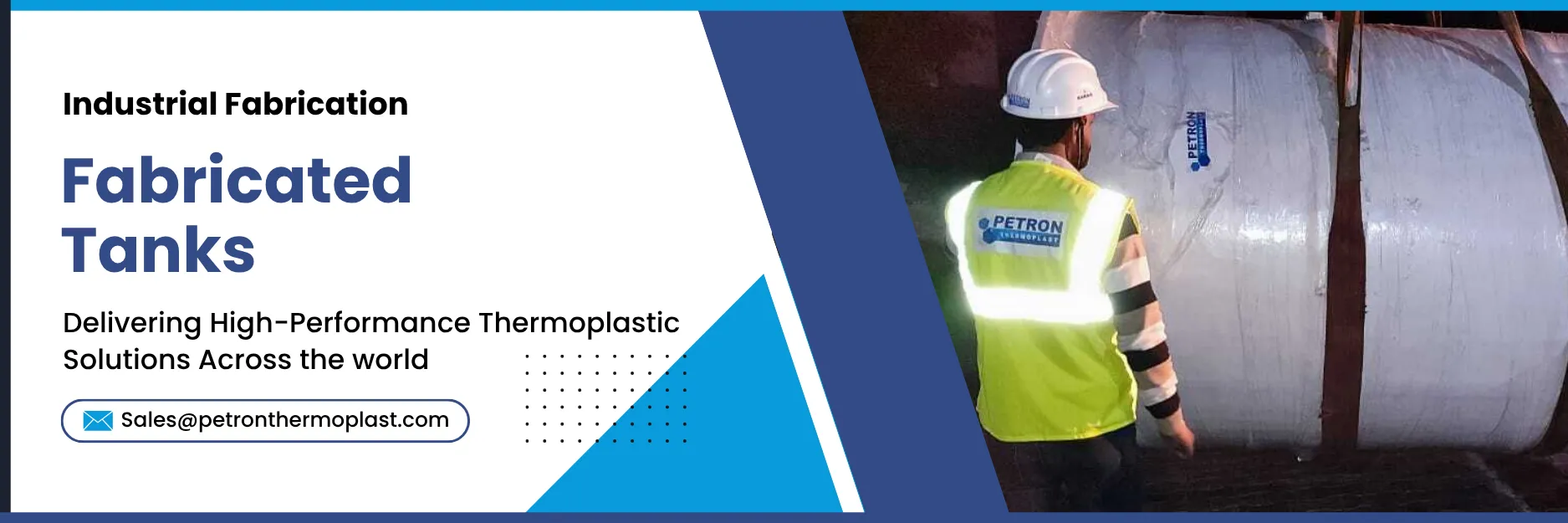
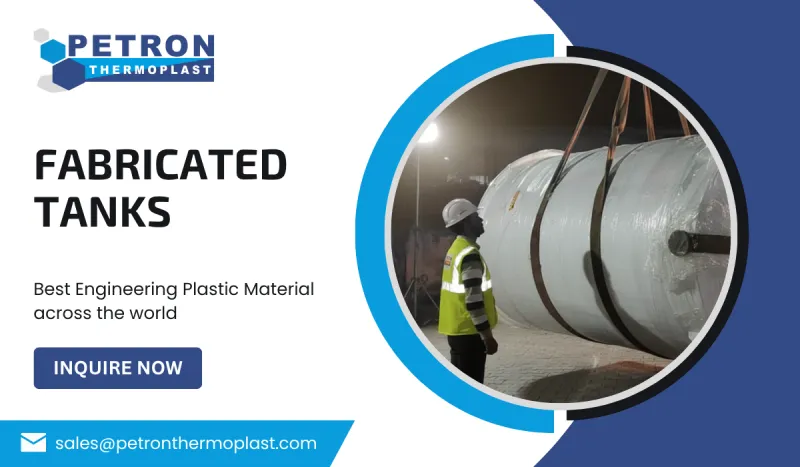
Fabricated Tanks Manufacturer for Industrial Storage Solutions
A fabricated tank is a custom-engineered storage container built by assembling raw materials—typically plates or plastic sheets using cutting, rolling, and welding techniques. These tanks are designed to meet specific industrial requirements for storing liquids, gases, or dry materials, often adhering to standards like API 650 or ASME. Fabricated tanks are designed in various shapes, sizes, and capacities to meet the operational needs of different industries.
A Fabricated Tank is a specially manufactured storage or processing tank made by assembling and welding different sections of material such as HDPE, carbon, FRP, or PVC according to specific design requirements. These tanks are custom-built to store, process, or transport liquids, chemicals, water, or industrial fluids safely and efficiently.

Fabricated Tanks Details
| Parameter | Details / Specification |
| Product Name | Fabricated Tank |
| Tank Type | Vertical / Horizontal / Cylindrical / Rectangular |
| Material Options | HDPE, PP, FRP, PVC, CPVC, Stainless Steel, Carbon Steel |
| Manufacturing Process | Fabrication & Welding |
| Capacity Range | 100 Liters to 100,000 Liters or customized |
| Diameter Range | As per design requirement |
| Height / Length | Customized according to application |
| Wall Thickness | 5 mm to 50 mm or as required |
| Pressure Rating | Atmospheric / Low Pressure / Pressurized |
| Operating Temperature | -40°C to +120°C (depends on material) |
| Density (HDPE Tank) | 0.94 – 0.96 g/cm³ |
| Jointing Method | Butt Weld / Extrusion Weld / Flanged |
| Surface Finish | Smooth / Polished / UV Stabilized |
| Chemical Resistance | Excellent against acids, alkalis, and chemicals |
| Corrosion Resistance | High (depends on material type) |
| UV Resistance | Available with UV stabilized material |
| Reinforcement Options | FRP Reinforcement / MS Structure Support |
| Shape Options | Round, Square, Rectangular, Cone Bottom |
| Nozzle & Fittings | Inlet, Outlet, Vent, Drain, Level Gauge |
| Standard Compliance | ISO, ASTM, DIN, ASME |
| Testing Methods | Hydro Test, Leak Test, Visual Inspection |
| Installation Type | Indoor / Outdoor |
| Service Life | 20–50 years depending on application |
| Applications | Chemical Storage, Water Treatment, Industrial Processing |
1. Customizable Design
- Available in different shapes, sizes, and capacities
- Designed according to specific industrial requirements
- Can be fabricated as vertical, horizontal, rectangular, or cylindrical tanks
2. Strong & Durable Construction
- Manufactured using high-quality materials
- Capable of handling pressure, temperature, and heavy-duty operations
- Long-lasting structural strength
3. Excellent Chemical Resistance
Depending on the material used, fabricated tanks offer resistance to:
- Acids
- Alkalis
- Corrosive chemicals
- Industrial fluids
4. Corrosion Resistance
- Materials like HDPE, FRP, PVC, resist rust and corrosion
- Suitable for harsh industrial environments
5. Leak-Proof Performance
- Precision welding and fabrication ensure secure joints
- Prevents leakage and contamination
6. Wide Material Options
Fabricated tanks can be manufactured using:
- HDPE
- PP
- FRP
- PVC / CPVC
- Stainless Steel
- Carbon Steel
7. Temperature Resistance
- Suitable for low and high-temperature applications depending on material type
- Maintains performance under varying operating conditions
8. UV & Weather Resistance
- UV stabilized materials available for outdoor installations
- Resistant to sunlight and environmental exposure
9. Lightweight & Easy Installation
- Plastic fabricated tanks are lightweight and easy to transport
- Simplifies handling and installation processes
10. Low Maintenance
- Corrosion-resistant materials reduce maintenance requirements
- Easy cleaning and inspection
11. High Storage Capacity
- Available from small storage units to large industrial tanks
- Suitable for bulk liquid storage applications
12. Safety & Reliability
- Designed according to industrial standards
- Provides safe storage and handling of chemicals and liquids
| Nominal Pipe Size (NPS) | Outer Diameter (OD) | Typical Wall Thickness | Pressure Class / SDR |
| 20 mm (¾”) | 20 mm | 2.0 – 3.0 mm | SDR 11 / PN16 |
| 25 mm (1”) | 25 mm | 2.3 – 3.5 mm | SDR 11 / PN16 |
| 32 mm (1¼”) | 32 mm | 2.4 – 4.0 mm | SDR 11 / PN16 |
| 40 mm (1½”) | 40 mm | 2.5 – 4.5 mm | SDR 11 / PN16 |
| 50 mm (2”) | 50 mm | 3.0 – 5.0 mm | SDR 11 / PN16 |
| 63 mm | 63 mm | 3.8 – 5.8 mm | SDR 11 / PN16 |
| 75 mm | 75 mm | 4.5 – 6.8 mm | SDR 11 / PN16 |
| 90 mm | 90 mm | 5.4 – 8.2 mm | SDR 11 / PN16 |
| 110 mm | 110 mm | 6.6 – 10.0 mm | SDR 11 / PN16 |
| 160 mm | 160 mm | 9.5 – 14.6 mm | SDR 11 / PN16 |
| 200 mm | 200 mm | 11.9 – 18.2 mm | SDR 11 / PN16 |
| 250 mm | 250 mm | 14.8 – 22.7 mm | SDR 11 / PN16 |
| 315 mm | 315 mm | 18.7 – 28.6 mm | SDR 11 / PN16 |
| 400 mm | 400 mm | 23.7 – 36.3 mm | SDR 11 / PN16 |
| 500 mm | 500 mm | 29.7 – 45.4 mm | SDR 11 / PN16 |
| Tank Type / Pressure Class | Pressure Rating | Typical Application |
| Atmospheric Tank | 0 – 0.5 bar | Water and chemical storage |
| Low Pressure Tank | 0.5 – 2 bar | Industrial fluid handling |
| Medium Pressure Tank | 2 – 10 bar | Chemical processing systems |
| High Pressure Tank | 10 – 25 bar | Industrial process applications |
| HDPE Fabricated Tank | PN6 to PN10 | Chemical and water storage |
| PP / PVC Fabricated Tank | PN6 to PN10 | Corrosive chemical handling |
| FRP Fabricated Tank | PN6 to PN16 | Chemical and wastewater systems |
| Stainless Steel Tank | PN10 to PN25 | High-pressure industrial use |
| Carbon Steel Tank | PN10 to PN25 or higher | Oil, gas, and process industries |
| Material Type | Operating Temperature Range | Density |
| HDPE Fabricated Tank | -40°C to +60°C | 0.94 – 0.96 g/cm³ |
| PP Fabricated Tank | 0°C to +100°C | 0.90 – 0.92 g/cm³ |
| PVC Fabricated Tank | 0°C to +60°C | 1.30 – 1.45 g/cm³ |
| CPVC Fabricated Tank | 0°C to +90°C | 1.50 – 1.60 g/cm³ |
| FRP Fabricated Tank | -20°C to +120°C | 1.50 – 2.00 g/cm³ |
| Stainless Steel Tank | -200°C to +800°C | 7.75 – 8.10 g/cm³ |
| Carbon Steel Tank | -29°C to +425°C | 7.80 – 7.90 g/cm³ |
User Manual for Fabricated Tanks
1. Customization of Fabricated Tank
a) Material Customization
Fabricated tanks can be manufactured using different materials depending on the application:
- HDPE
- PP (Polypropylene)
- FRP (Fiber Reinforced Plastic)
- PVC / CPVC
- Stainless Steel
- Carbon Steel
Material selection depends on:
- Chemical compatibility
- Operating temperature
- Pressure conditions
- Corrosion resistance requirements
b) Size & Capacity Customization
Tanks can be customized based on:
- Storage capacity (100 L to 100,000 L or more)
- Diameter and height
- Wall thickness
- Space availability and project specifications
c) Shape Customization
Available tank designs include:
- Vertical tanks
- Horizontal tanks
- Cylindrical tanks
- Rectangular tanks
- Cone bottom tanks
d) Nozzle & Fitting Customization
Additional accessories can be integrated:
- Inlet and outlet nozzles
- Drain connections
- Vent pipes
- Level indicators
- Flanges and valves
e) Reinforcement & Support
Customization options include:
- FRP external reinforcement
- MS structural support
- Stiffeners and bracing for large tanks
f) Surface Finish & Coating
Surface treatment options:
- Smooth internal finish
- UV stabilization
- Anti-corrosion coating
- Polishing and protective lining
g) Pressure & Temperature Design
Fabricated tanks can be designed for:
- Atmospheric storage
- Low-pressure applications
- High-temperature chemical storage
Processing of Fabricated Tank
a) Design & Engineering
- Tank designs are prepared using CAD software
- Engineering calculations ensure structural strength and safety
b) Material Cutting
Materials are cut using:
- CNC cutting machines
- Saw cutting
- Laser cutting
- Plasma cutting
- c) Forming & Shaping
- Sheets are rolled or molded into the required tank shape
- Bending and forming processes maintain dimensional accuracy
d) Welding & Fabrication
Common joining methods:
- Butt welding
- Extrusion welding
- TIG / MIG welding
- Fusion welding
e) Assembly & Fit-Up
- Tank sections, nozzles, and fittings are assembled accurately
- Alignment checks are performed before final welding
f) Surface Finishing
Processing includes:
- Grinding and polishing
- Surface cleaning
- Coating or painting
- UV protective treatment
g) Testing & Quality Inspection
Fabricated tanks undergo:
- Hydrostatic testing
- Leak testing
- Dimensional inspection
- Weld quality inspection
- Visual inspection
h) Packaging & Transportation
- Proper packing and support structures are provided
- Tanks are protected from damage during transportation
- Chemical Processing: Safely stores industrial chemicals, acids, solvents, and hazardous materials, frequently using corrosion-resistant materials.
- Water Treatment & Storage: Holds potable water, treated wastewater, and process water for industrial or municipal use.
- Pharmaceuticals: Specialized tanks for storing active ingredients, liquid formulations, and for processing.
- Industrial & Specialized Uses: Includes pressure vessels, fermentation vessels (fermenters), and distillation columns used in chemical reactions or brewing.
a) Site Preparation
- Ensure the installation area is clean, level, and structurally strong
- Prepare a proper foundation or support platform
- Verify installation space according to tank dimensions
b) Inspection Before Installation
Before installation, inspect the tank for:
- Transportation damage
- Surface cracks or dents
- Weld quality and fittings
- Correct dimensions and specifications
c) Proper Handling & Lifting
- Use suitable lifting equipment such as cranes or slings
- Avoid dragging or dropping the tank
- Protect nozzles, fittings, and surfaces during handling
d) Positioning & Alignment
- Place the tank in the correct position according to engineering drawings
- Ensure proper alignment of inlet, outlet, and drain connections
- Maintain adequate clearance for maintenance access
e) Connection of Piping & Accessories
Install:
- Inlet and outlet pipelines
- Vent pipes
- Valves and fittings
- Level indicators and gauges
f) Support & Anchoring
- Provide proper supports and anchoring systems
- Prevent movement, vibration, or tilting during operation
g) Electrical & Safety Accessories
- Earthing system
- Level sensors
- Safety valves
- Overflow protection systems
h) Testing After Installation:
- Hydrostatic testing
- Leak testing
- Visual inspection
- Joint and weld inspection
Maintenance of Fabricated Tank
a) Routine Inspection
Regularly inspect for:
- Leakage
- Cracks or deformation
- Corrosion or chemical damage
- Loose fittings and supports
b) Cleaning
- Clean the tank periodically to remove sludge, deposits, or contaminants
- Use cleaning methods compatible with tank material
c) Weld & Joint Inspection
- Check welded joints and flange connections
- Repair or replace damaged gaskets and fittings immediately
d) Corrosion Protection
- Inspect protective coatings and linings
- Reapply anti-corrosion coatings if necessary
e) Pressure & Temperature Monitoring
- Ensure operating conditions remain within design limits
- Avoid excessive pressure and overheating
f) Preventive Maintenance
- Schedule periodic maintenance checks
- Replace worn-out accessories and damaged components on time
g) Safety Precautions
- Depressurize and empty the tank before maintenance work
- Follow industrial safety standards and use PPE
h) Documentation & Record Keeping
Maintain records of:
- Inspection reports
- Testing results
- Maintenance schedules
- Repair history
1. High-Density Polyethylene (HDPE):
- Excellent chemical resistance
- Lightweight and durable
- Corrosion-free and leak-proof
- UV and weather resistant:
- Chemical storage
- Water treatment plants
- Effluent systems
2. Polypropylene (PP):
- High chemical resistance
- Good temperature resistance
- Strong and lightweight:
- Acid storage tanks
- Chemical processing industries
- Laboratory applications
3. Fiber Reinforced Plastic (FRP):
- High strength-to-weight ratio
- Excellent corrosion resistance
- Suitable for aggressive chemical environments:
- Chemical industries
- Wastewater treatment plants
- Marine applications
4. Polyvinyl Chloride (PVC):
- Economical and lightweight
- Corrosion resistant
- Easy fabrication and installation:
- Water storage
- Low-pressure chemical systems
- Drainage applications
5. Chlorinated Polyvinyl Chloride (CPVC):
- Better temperature resistance than PVC
- Good chemical resistance
- Smooth internal surface:
- Hot chemical storage
- Industrial process systems
6. Mild Steel (MS):
- Strong and economical
- Easy fabrication and welding:
- Water tanks
- Industrial utility tanks
- Structural support tanks
1. Raw Material Inspection
Before fabrication, all raw materials are checked for:
- Material grade verification
- Surface defects
- Thickness accuracy
- Compliance with specifications and standards
2. Dimensional Inspection
Fabricated tanks are inspected for:
- Diameter and height accuracy
- Wall thickness
- Nozzle position and alignment
- Overall dimensional tolerance
3. Visual Inspection
Visual checks are conducted to identify:
- Surface cracks
- Welding defects
- Scratches or dents
- Improper finishing
- Misalignment of components
4. Weld Quality Inspection
Weld joints are tested to ensure strength and leak-proof performance.
Common Weld Testing Methods:
- Visual Weld Inspection
- Ultrasonic Testing (UT)
- Radiographic Testing (RT)
- Dye Penetrant Testing (DPT)
- Spark Testing (for plastic tanks)
5. Hydrostatic Testing
- The tank is filled with water and pressurized
- Checks for leakage, deformation, and structural integrity
- Ensures the tank can safely withstand operating conditions
6. Leak Testing
Leak testing is performed to verify:
- Joint sealing quality
- Nozzle tightness
- Weld integrity
7. Pressure Testing
For pressure-rated tanks:
- Internal pressure testing is conducted
- Confirms the tank’s pressure handling capability
8. Surface Finish & Coating Inspection
Inspection includes:
- Coating thickness measurement
- Surface smoothness verification
- Adhesion testing for coatings and linings
- Corrosion protection quality checks
9. Non-Destructive Testing (NDT)
NDT methods help detect hidden defects without damaging the tank:
- Ultrasonic Testing
- Radiography
- Magnetic Particle Testing
- Dye Penetrant Testing
10. Material Identification & Traceability
- Tanks are marked with identification numbers
- Material batches, welders, and inspection records are maintained for traceability
11. Compliance with Standards
Fabricated tanks are manufactured and tested according to:
- ISO Standards
- ASTM Standards
- ASME Standards
- DIN Standards
- ANSI Specifications
12. Final Quality Documentation
Quality records generally include:
- Inspection reports
- Hydro test certificates
- Material certificates
- Welding qualification records
- NDT reports

Custom Product Manufacturing Available
If you are searching for customized product designs that meet your requirements, don’t worry. Petron Thermoplast also offers custom product manufacturing services to meet the unique needs of various industries. Work with our expert engineers to create custom designs suited for your application.
Types of Fabricated Tanks
1. Based on Shape/Orientation:
- Vertical Tanks: Commonly used for liquid storage, often featuring cone or flat roofs.
- Horizontal Tanks (Bullet Tanks): Usually shop-fabricated with cylindrical bodies and dished/hemispherical heads, ideal for storing pressurized products like LPG.
- Rectangular/Square Tanks: Used when space optimization is necessary.
2. Based on Roof Type (Storage Tanks):
- Fixed Roof Tanks: Includes cone, dome, or umbrella roofs; generally for lower volatility liquids.
- Floating Roof Tanks: Designed to reduce vapor loss by having the roof rise and lower with the liquid level.
3. Welded Pipe Spool
- Steel Tanks (Carbon/Stainless): Durable, high-pressure, used for chemicals and fuels.
- Plastic/Plastic Fabricated Tanks: Fabricated from HDPE, polypropylene (PP), or PVC for corrosion resistance, specifically for storing aggressive chemicals.
- Fiberglass (FRP) Tanks: Used in chemical applications, though they are susceptible to certain materials.
4. Based on Function:
- Pressure Vessels: Designed for high-pressure storage, such as bullets and Horton spheres.
- Mixing/Process Tanks: Fabricated with integrated agitators for blending ingredients in food, beverage, and chemical industries.
- Low-Temperature/Cryogenic Tanks: Specialized for storing liquefied gases (e.g., propane, methane) at very low temperatures.
- Underground/Aboveground Tanks: Classified based on installation location.
Why Choose Petron Thermoplast?
At Petron Thermoplast, quality and innovation serve as the core foundation of all operations. As the exclusive distributor of Petron Thermoplast Fittings in India, the company offers a specialized range of products, including brass transitional couplers and hydrogen-ready certified solutions. Every product is rigorously tested and carries prestigious certifications, such as DVGW for gas and IIP for water and sewerage applications. Beyond supplying hardware, their team of experts provides comprehensive technical guidance—from initial product selection to final installation—to ensure safe and efficient tank performance. When reliability is a priority, partnering with Petron Thermoplast guarantees more than just high-quality components; it provides complete, end-to-end industrial solutions.
Conclusion
Fabricated tanks are highly reliable and versatile storage solutions widely used in industrial applications for storing water, chemicals, and process fluids. Their customizable design, strong construction, and compatibility with various materials make them suitable for a broad range of operating conditions.
Manufactured using materials such as HDPE, PP, FRP, PVC, CPVC, stainless steel, and carbon steel, fabricated tanks offer excellent corrosion resistance, durability, and long service life. They are designed to withstand different pressure and temperature conditions while ensuring safe and leak-proof performance.
With advanced fabrication techniques, precise engineering, and strict quality testing, fabricated tanks provide efficient storage, easy maintenance, and dependable operation in industries such as chemical processing, water treatment, pharmaceuticals, food processing, and oil & gas. Their flexibility, cost-effectiveness, and durability make them an ideal choice for modern industrial storage systems.
Frequently Asked Questions
A fabricated tank is a custom-manufactured storage or processing tank made by assembling and welding materials such as HDPE, FRP, PVC, or carbon according to specific industrial requirements.
Common materials include:
- HDPE
- PP (Polypropylene)
- FRP
- PVC / CPVC
- Stainless Steel
- Carbon Steel
Fabricated tanks are used for:
- Chemical storage
- Water storage
- Industrial processing
- Effluent treatment
- Pharmaceutical and food processing applications
- Customizable design
- Corrosion resistance
- Leak-proof construction
- High durability
- Easy maintenance
- Long service life
Fabricated tanks are available in:
- Vertical tanks
- Horizontal tanks
- Cylindrical tanks
- Rectangular tanks
- Cone bottom tanks
Pressure ratings vary depending on material and design:
- Atmospheric tanks
- Low-pressure tanks
- PN6 to PN25 pressure-rated tanks
The operating temperature depends on the material used:
- HDPE: -40°C to +60°C
- PP: Up to +100°C
- Stainless Steel: Up to +800°C
- FRP: Up to +120°C
Yes, fabricated tanks made from HDPE, PP, FRP, PVC, and stainless steel provide excellent resistance to chemicals, acids, and alkalis.
Yes, tanks can be customized based on:
- Capacity
- Shape and size
- Wall thickness
- Nozzle positions
- Pressure and temperature requirements