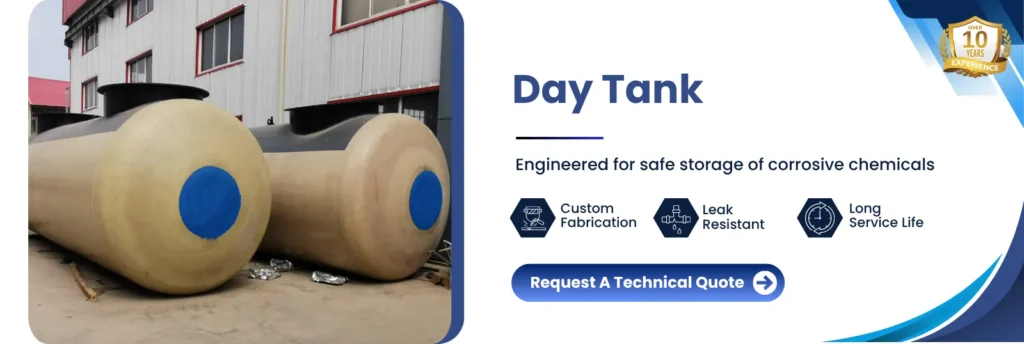






Day Tank banner Final

Day Tank

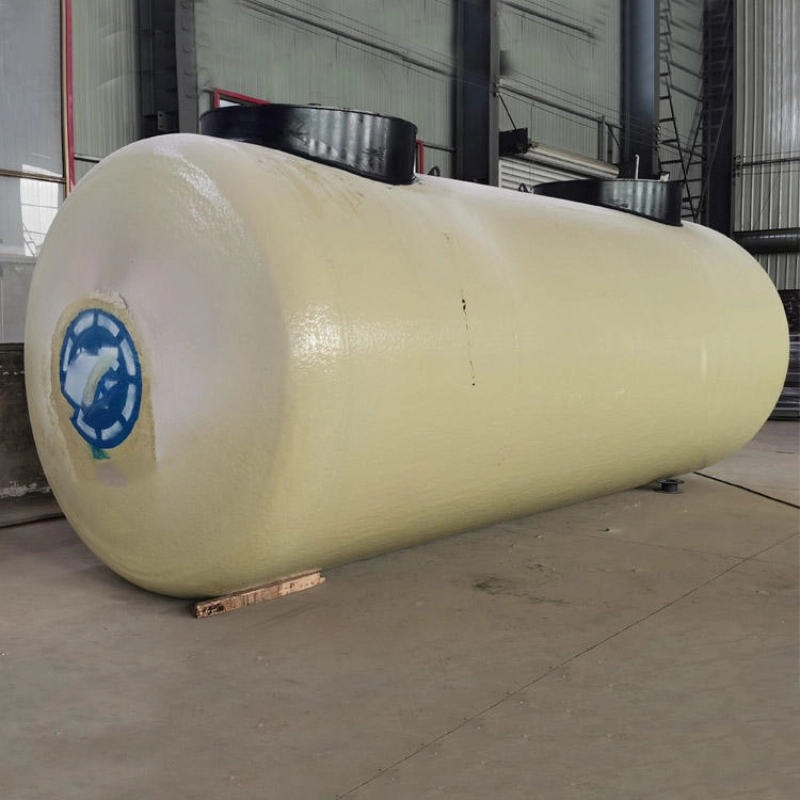
A Day Tank is a small-capacity storage tank designed to hold and supply a limited quantity of fuel, chemicals, water, or process liquids for short-term operational use. The end use of the product is usually a generator. The purpose of the day tank is to provide immediate product to the end user, where the supply otherwise would be influenced by product temperature, viscosity, and inadequate supply pressure. A day tank is used to hold and supply a limited quantity of liquid (such as fuel or chemicals) for short-term, daily consumption. A day tank is a small intermediate storage tank used for short-term storage and continuous supply of liquids to the industrial equipment for process systems. 

A day tank is typically installed near the equipment, such as generators, boilers, or process systems.  To ensure a continuous and reliable supply of fluid without needing direct connection to the main storage tank at all times. It sits between bulk storage (large tanks, tank farms, or delivery trucks) and the point-of-use equipment to provide a reliable, steady feed, conditioning, and safety buffer. It is commonly used to maintain a steady supply of fuel, chemicals, oils, and the process liquids for daily operational requirements. Petron Thermoplast to ensures the quality is 100%. Day Tanks that deliver to consistent performance in demanding environments.

defence

Fuel / Liquid Type

Diesel, Oil, Chemicals, Water

weather (1)

Temperature Resistance

-10°C to 80°C (depends on material used)

layer

Corrosion-Free Construction

No rusting when exposed to chemicals & moisture.

grade

Long Service Life

Excellent durability and can operate for many years

guarantee

ISO / ASTM / DVS Certified

Manufactured to international quality standards

-10°C to 80°C

Operating Temperature

50 L to 5K L

Capacity (Customizable)

ISO / ASTM / API

Certified quality standards

3 mm to 10 mm

Wall Thickness

Technical Details

ParameterDetails
Material of ConstructionMild Steel (MS), Stainless Steel (SS), HDPE, FRP
Capacity Range50 Liters to 5,000 Liters (custom sizes available)
ShapeCylindrical (Vertical/Horizontal), Rectangular
Wall Thickness3 mm to 10 mm (depends on material and capacity)
Design TypeOpen top / Closed top
Fuel / Liquid TypeDiesel, Oil, Chemicals, Water
Operating Temperature-10°C to 80°C (depends on material used)
Pressure RatingAtmospheric (generally not designed for high pressure)
Level Control SystemFloat switch, level sensor, level gauge
Inlet ConnectionFlanged or threaded connection
Outlet ConnectionBottom outlet with valve
Overflow ConnectionProvided to prevent overfilling
Vent PipeIncluded for pressure balance
Pump IntegrationTransfer pump or dosing pump (optional)
Filtration SystemOptional fuel filter or strainer
Coating / LiningAnti-corrosion coating or internal lining (for MS tanks)
Mounting TypeSkid-mounted / Floor-mounted
Stand / SupportMS frame or base support
Standards ComplianceAs per ISO / ASTM / API standards
Safety FeaturesLevel alarms, overflow protection, leak-proof design
AccessoriesLevel indicator, control panel, valves, piping, alarm system

Chemical compatibility of a day tank refers to the ability of the tank material to safely store fuels, chemicals, oils, or process liquids without corrosion, leakage, deformation, or material failure. Proper compatibility is essential for safe operation, long service life, and reliable industrial performance.

The compatibility depends on:

  • Type of liquid
  • Chemical concentration
  • Operating temperature
  • Tank material
  • Pressure conditions

Common Materials Used for Day Tanks

Tank MaterialMain Characteristics
HDPEExcellent corrosion resistance, lightweight
Polypropylene (PP)Good chemical and temperature resistance
FRPHigh structural strength and corrosion resistance
Stainless Steel (SS)Hygienic and durable
Mild Steel (MS)Strong and suitable for fuel storage

Common Liquids Compatible with Day Tanks

Liquid TypeCompatible Tank MaterialsTypical Applications
Diesel FuelMS, SS, FRPGenerator systems
Fuel OilMS, SSBoiler systems
Lubricating OilMS, SS, HDPEMachinery lubrication
Hydraulic OilMS, SSHydraulic systems
Sodium HypochloriteHDPE, PP, FRPWater treatment
Caustic SodaHDPE, PP, PVDFChemical dosing
Hydrochloric AcidPP, PVDF, FRPChemical processing
Alum SolutionHDPE, PPWater treatment plants
Ferric ChlorideHDPE, PP, FRPETP systems
Process WaterHDPE, SSIndustrial applications
Detergent ChemicalsHDPE, PPCleaning systems

1. Raw Material Inspection

  • Verification of material grade (MS, SS, HDPE, FRP)
  • Checking mechanical properties and chemical compatibility
  • Ensures compliance with relevant standards (ISO/ASTM/API)

2. Visual Inspection

  • Examination for surface defects, dents, cracks, or corrosion
  • Inspection of weld joints, edges, and overall finishing quality

3. Dimensional Accuracy Test

  • Measurement of thickness, diameter, height, and fittings placement
  • Ensures the tank meets design specifications

4. Hydrostatic (Leak) Testing

  • The tank is filled with water to check for leaks
  • Confirms leak-proof construction and joint integrity

5. Pressure Testing (If Applicable)

  • Conducted for tanks designed for slight internal pressure
  • Ensures structural strength under operating conditions

6. Weld Quality Testing (For Metal Tanks)

  • Non-Destructive Testing (NDT) methods like:
    • Dye Penetrant Test (DPT)
    • Ultrasonic Testing (UT)
  • Ensures strong and defect-free welds

7. Coating & Lining Inspection

  • Thickness and adhesion testing of internal/external coatings
  • Ensures corrosion resistance, especially for MS tanks

8. Load & Structural Testing

  • Evaluates the tank’s ability to withstand operational loads
  • Includes support structure and skid strength checks

9. Functional Testing of Components

  • Testing of level sensors, float switches, pumps, and alarms
  • Ensures proper functioning of control systems

10. Overflow & Safety System Check

  • Verification of overflow line, vent pipe, and emergency features
  • Prevents overfilling and pressure build-up

Industries We Serve

A day tank is used for short-term storage and continuous supply of fuel, chemicals, oils, and process of liquids in industrial systems. These tanks to help the maintain uninterrupted operations by providing a controlled of daily supply of liquids to equipment and process systems.

determination

Diesel Generator (DG) Systems

Day tanks are widely used in generator applications for:
Daily diesel fuel storage
Continuous fuel supply to DG sets
Emergency power backup systems
Automatic fuel feeding systems

wafer-probing-test

Boiler Fuel Supply Systems

In boiler plants, day tanks are used for:
Fuel oil storage
Diesel supply to burners
Controlled fuel feeding systems
Continuous boiler operation
water-filter

Water Treatment Plants

Day tanks are commonly used for storing and dosing:
Sodium hypochlorite
Caustic soda
Alum solution
Chlorine chemicals
pH correction chemicals
water-tank (1)

Effluent Treatment Plants (ETP)

In ETP systems, day tanks are used for:
Chemical dosing operations
Neutralization chemical storage
Coagulant preparation
Flocculant solution storage

sewage-plant

Sewage Treatment Plants (STP)

The corrosion-resistant nature of HDPE makes these tanks suitable for:
Saltwater environments
Coastal industrial plants
Marine chemical storage systems

chemical

Chemical Processing Industry

Chemical industries use day tanks for:
Intermediate chemical storage
Process liquid feeding
Additive dosing systems
Continuous chemical supply

molecular

Lubrication Systems

Day tanks are used for:
Lubricating oil storage
Hydraulic oil supply
Continuous lubrication systems
Industrial machinery operation
electrophoresis

Power Plants

Power generation facilities use day tanks for:
Diesel fuel systems
Turbine lubrication oil
Boiler chemical dosing
Fuel oil storage

power

Marine Industry

Marine applications include:
Engine fuel supply systems
Lubrication oil storage
Auxiliary machinery fuel systems
Emergency fuel storage

pharmaceutical

Pharmaceutical Industry

Day tanks are used in pharmaceutical plants for:
Process liquid storage
Purified water systems
Chemical preparation systems
Controlled dosing operations

purity

Oil & Gas Industry

In oil & gas operations, day tanks are used for: Fuel storage systems
Chemical injection systems
Hydraulic oil storage
Process fluid handling

mining

Mining Industry

Mining operations use day tanks for:
Fuel storage
Chemical reagent handling
Hydraulic systems
Process liquid supply
Features of Day Tanks

tube

Short-Term Liquid Storage

Day tanks are specially designed for:
Daily operational liquid storage
Intermediate storage applications
Continuous process supply systems
They provide a steady and controlled liquid supply to industrial equipment.

sintering

Continuous Supply Capability

Day tanks ensure uninterrupted supply of:
Diesel fuel
Fuel oil
Chemicals
Lubricants
Process liquid
This improves operational efficiency and reduces downtime.

determination

Compact Design

The compact structure allows:
Easy installation
Space-saving arrangement
Convenient equipment integration
especially in limited industrial spaces.

lock

Strong Structural Construction

Day tanks are manufactured using durable materials such as:
HDPE
Mild Steel (MS)
Stainless Steel (SS)
FRP
Polypropylene (PP)
High mechanical strength
Structural stability
Long service life

chemical

Excellent Chemical Resistance

Chemical-grade day tanks offer strong resistance against:
Corrosive chemicals
Acids
Alkalis
Water treatment chemicals
ensuring safe chemical handling.

leak

Leak-Proof Construction

Precision welding and fabrication provide:
Leak-resistant joints
Safe liquid containment
Reliable storage performance

corrosion

Corrosion Resistance

Depending on material selection, day tanks offer protection against:
Rust formation
Chemical corrosion
Environmental degradation
This reduces maintenance requirements.

weather (1)

Easy Level Monitoring

Day tanks can be equipped with:
Level indicators
Float switches
Sight glass system
Electronic monitoring systems
for accurate liquid level control.

l-scale

Customizable Design

Day tanks can be customized according to:
Storage capacity
Process requirement
Installation space
Nozzle arrangement
Operating conditions

layer

Multiple Shape Options

Available configurations include:
Vertical tanks
Horizontal tanks
Cylindrical tanks
Rectangular tanks
Depending on application requirements.

purity

Safe Fuel & Chemical Handling

Day tanks provide:
Controlled liquid storage
Safe transfer systems
Reduced spill risk
Improved operational safety

defence

Agitator & Mixer Provision

Chemical dosing day tanks may include:
Agitator mounting
Mixing systems
Chemical blending arrangement for process applications.

guarantee

Easy Maintenance

The tanks are designed for:
Simple cleaning
Easy inspection
Low maintenance operation
which reduces operational costs.

weather

UV & Weather Resistance

Outdoor day tanks may include:
UV-resistant coating
Weatherproof construction
Environmental protection
for long-term outdoor operation.

recycle-symbol

High Operational Reliability

Day tanks provide:
Stable liquid supply
Consistent process operation
Reliable industrial performance

construction

Flexible Installation Options

These tanks can be installed:
Indoor
Outdoor
Above ground
On skids or support frames
According to plant layout requirements.

eye

Compatibility with Pumping Systems

Day tanks are compatible with:
Fuel transfer pumps
Dosing pumps
Metering systems
Automation systems
for efficient liquid handling.

deadline

Long Service Life

Properly manufactured day tanks offer:
Durable operation
Reduced replacement frequency
Long-term reliability
Manufacturing Process of Day Tank

The manufacturing process of a day tank to involve the careful engineering, material selection, fabrication, welding, assembly, and quality testing to ensure safe and reliable storage of fuels, chemicals, oils, and process liquids. Day tanks are commonly manufactured using to Mild Steel (MS), Stainless Steel (SS), HDPE, PPH, and  FRP depending on the application.

Stage 1
Design & Engineering

The manufacturing process begins with detailed engineering calculations based on:

  • Storage capacit y(50 Liters to 5,000 Liters (custom sizes available))
  • Type of liquid
  • Chemical compatibility
  • Operating temperature
  • Installation conditions
  • Pressure and load requirements
  • Tank dimensions
  • Wall thickness
  • Structural reinforcement
  • Nozzle arrangement
1
Stage 2
Material Selection

The tank material is selected according to the application.

Common materials include:

  • Mild Steel (MS)
  • Stainless Steel (SS)
  • HDPE
  • Polypropylene (PP)
  • FRP (Fiber Reinforced Plastic)
  • Corrosion resistance
  • Fuel compatibility
  • Chemical resistance
  • Mechanical strength
2
Stage 3
Sheet Cutting & Preparation

Raw material sheets are cut into required sizes using:

  • CNC cutting machines
  • Plasma cutting
  • Laser cutting
  • Circular saws
  • Tank shell
  • Bottom plate
  • Top cover
  • Reinforcement components
3
Stage 4
Shell Rolling & Forming

The cut sheets are rolled into cylindrical or custom shapes using rolling machines.

Common tank configurations:

  • Vertical tanks
  • Horizontal tanks
  • Rectangular tanks
  • Accurate dimensions
  • Structural alignment
  • Uniform shape
4
Stage 5
Welding & Joint Fabrication

Tank sections are joined using suitable welding methods.

Metal Tanks

Common welding methods:

  • TIG welding
  • MIG welding
  • Arc welding

Thermoplastic Tanks

Common welding methods:

  • Butt fusion welding
  • Extrusion welding
  • Hot gas welding

These welding techniques provide:

  • Strong joints
  • Leak-proof construction
  • Structural integrity
5
Stage 6
Bottom & Top Assembly

The tank bottom and roof sections are attached to the shell body.

Top designs may include:

  • Flat top
  • Dome top
  • Open top

Bottom designs may include:

  • Flat bottom
  • Sloped bottom
  • Conical bottom

Depending on operational requirements.

6
Stage 7
Nozzle & Accessory Installation

Various fittings are installed including:

  • Inlet nozzles
  • Outlet nozzles
  • Vent pipes
  • Overflow connections
  • Drain valves
  • Level indicators
  • Manholes

These accessories improve tank functionality and safety.

7
Stage 8
Reinforcement & Structural Support

Additional strengthening components may include:

  • Reinforcement rings
  • Support legs
  • Saddle supports
  • Structural frames
  • FRP lamination (if required)

These supports improve:

  • Mechanical strength
  • Stability
  • Load-bearing capacity
8
Stage 9
Surface Treatment & Coating

Depending on the application, tanks may receive:

  • Anti-corrosion coating
  • Epoxy coating
  • Chemical-resistant lining
  • UV protection coating
  • Surface polishing

This improves durability and corrosion resistance.

9
Stage 10
Leak Testing & Inspection

The completed tank undergoes strict quality testing such as:

  • Hydrostatic testing
  • Leak testing
  • Weld inspection
  • Vacuum testing
  • Dimensional inspection

These tests ensure safe and reliable performance.

10
Stage 11
Calibration & Functional Checks

Functional checks may include:

  • Level indication testing
  • Pump connection verification
  • Overflow system testing
  • Accessory inspection
11
Stage 12
Finishing Operations

Final finishing includes:

  • Surface cleaning
  • Edge trimming
  • Painting or polishing
  • Labeling and marking
12

How to Select the Right Day Tank

1. Identify the Chemical to be Stored

The first step is to determine:

  • Type of liquid
  • Chemical properties
  • Corrosive nature
  • Viscosity
  • Flammability

Common liquids stored in day tanks include:

  • Diesel fuel
  • Fuel oil
  • Lubricating oil
  • Hydraulic oil
  • Water treatment chemicals
  • Process chemicals
2. Check Chemical Compatibility

The tank material must be compatible with the stored liquid.

Common tank materials include:

  • HDPE
  • Polypropylene (PP)
  • FRP
  • Stainless Steel (SS)
  • Mild Steel (MS)
  • Corrosion
  • Leakage
  • Material damage
  • Operational failure
3. Determine Required Storage Capacity

Tank capacity should be selected based on:

  • Daily liquid consumption
  • Backup storage requirement
  • Equipment operating hours
  • Process demand
  • Small tanks: 50–500 liters
  • Medium tanks: 1 KL–5 KL
  • Large systems: 10 KL and above
4. Evaluate Operating Temperature
  • Ambient temperature
  • Liquid temperature
  • Process operating conditions
  • Special lining
  • Reinforced construction
  • Heat-resistant materials
5. Choose the Right Tank Shape

Common tank designs include:

  • Vertical tanks
  • Horizontal tanks
  • Cylindrical tanks
  • Rectangular tanks
  • Available installation space
  • Process requirement
  • Ease of maintenance
7. Consider Installation Location

Indoor Installation

  • Reduced UV exposure
  • Lower environmental impact

Outdoor Installation

  • UV-resistant construction
  • Weatherproof design
  • Corrosion protection
8. Verify Pressure & Venting Requirements

Most day tanks operate under atmospheric pressure.

  • Venting systems
  • Overflow protection
  • Pressure balancing
  • Reinforced tank design
  • Vacuum protection
9. Select Required Accessories

Choose accessories according to operational needs.

Common accessories include:

  • Level indicators
  • Float switches
  • Drain valves
  • Vent pipes
  • Manholes
  • Pump connections
  • Overflow nozzles
10. Check Pump Compatibility

Ensure the tank is compatible with:

  • Fuel transfer pumps
  • Dosing pumps
  • Metering systems
  • Automation controls

Proper nozzle arrangement improves efficiency.

11. Evaluate Structural Support

Large day tanks may require:

  • Support frames
  • Reinforcement rings
  • Skid-mounted structures
  • External stiffeners

to improve structural stability.

12. Review Wall Thickness

Tank wall thickness depends on:

  • Liquid density
  • Tank size
  • Operating conditions
  • Material selection

Proper thickness ensures:

  • Mechanical strength
  • Safe operation
  • Long service life
13. Verify Safety Features

Important safety features may include:

  • Leak-proof construction
  • Emergency overflow system
  • Flame arrestor (for fuel systems)
  • Secondary containment
  • Level alarms
14. Confirm Quality Standards

Choose tanks manufactured according to:

  • ASTM standards
  • Industrial fabrication standards
  • Welding quality standards
  • Hydro testing
  • Leak testing
  • Weld inspection
13. Verify Safety Features

Important safety features may include:

  • Leak-proof construction
  • Emergency overflow system
  • Flame arrestor (for fuel systems)
  • Secondary containment
  • Level alarms
Day Tank Product Image
Repairing Service

Custom Product Manufacturing Available

If you are searching for customized product designs that meet your requirements, don’t worry. Petron Thermoplast also offers custom product manufacturing services to meet the unique needs of various industries. Work with our expert engineers to create custom designs suited for your application.

Why Choose Petron Thermoplast?

Petron Thermoplast is known for precise manufacturing, quality materials, and adherence to standards. Working with a trusted manufacturer like Petron Thermoplast to ensures the quality is 100%. Day Tanks that deliver to consistent performance in demanding environments. With the experience in producing standard and custom designs, Petron Thermoplast provides solutions tailored to the needs of diverse industries worldwide.

Frequently Asked Questions

1. What is a day tank?

A day tank is a small storage tank used to hold and supply fuel or liquid for short-term (daily) use, typically connected to equipment like generators or boilers.

2. What is the purpose of a day tank?

Its main purpose is to ensure a continuous and reliable supply of fuel or liquid to equipment without directly relying on the main storage tank.

3. What liquids are stored in a day tank?

Day tanks are commonly used for:

  • Diesel fuel
  • Furnace oil
  • Lubricating oil
  • Water or certain chemicals
4. What is the typical capacity of a day tank?

Capacity usually ranges from 50 liters to 5,000 liters, depending on the application and consumption requirements.

5. Where are day tanks used?

They are widely used in:

  • Diesel generator systems
  • Boiler fuel systems
  • Industrial processing units
  • Commercial buildings
6. How does a day tank work?

Fuel or liquid is transferred from the main storage tank to the day tank. From there, it is supplied directly to the equipment, often using pumps and level control systems.

7. What materials are used to manufacture day tanks?

Common materials include:

  • Mild Steel (MS)
  • Stainless Steel (SS)
  • HDPE
  • FRP
8. What safety features are included in a day tank?

Typical safety features include:

  • Overflow protection
  • Level indicators and alarms
  • Vent pipes
  • Leak-proof construction
9. Can a day tank be used outdoors?

Yes, day tanks can be designed for outdoor use with proper coating, lining, or UV-resistant materials.

10. What maintenance is required for a day tank?
  • Regular cleaning
  • Checking for leaks or corrosion
  • Inspection of pumps, valves, and level systems
  • Monitoring fuel quality