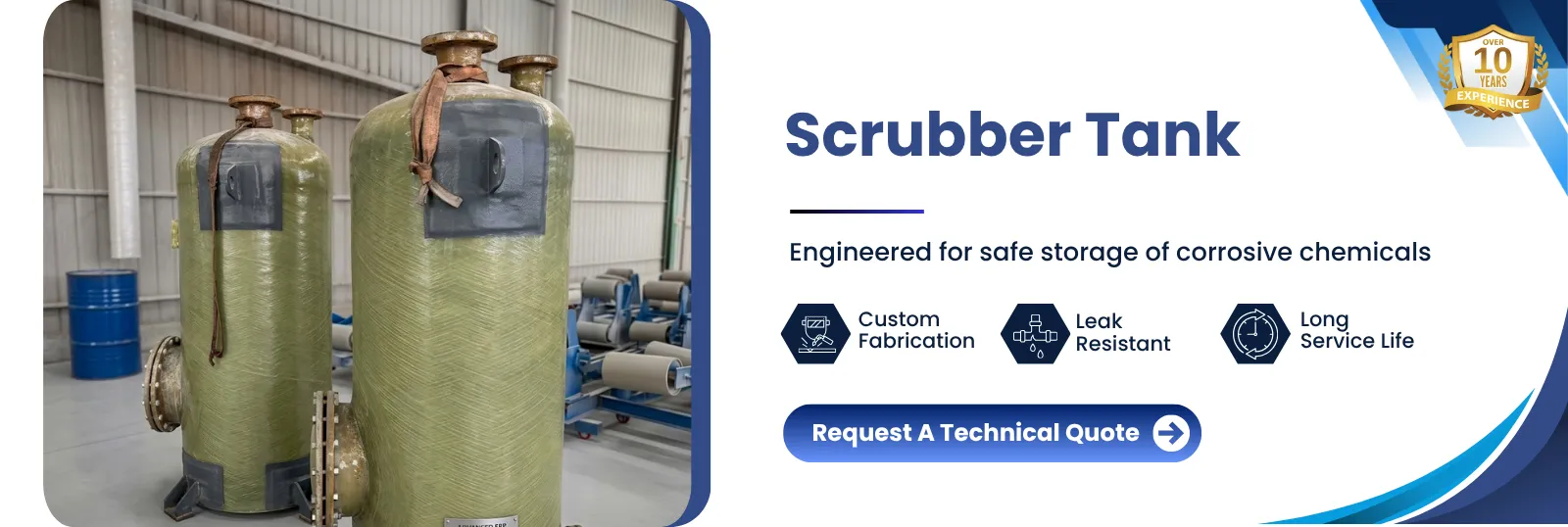






Scrubber Tank
A Scrubber Tank is a well-designed industrial tank used in scrubber systems. Scrubber storage tank used to collect the circulation, store, and treat chemical solutions. Scrubber tanks are used to remove the harmful gases, fumes, dust particles, and airborne contaminants from the exhausting industrial systems. Scrubber tanks are the tanks to be manufactured for using the corrosion-resistant materials such as HDPE, PPH, FRP, PVC, PVDF to withstand the aggressive chemicals and harsh operating conditions.
Scrubber tanks are an important part of air pollution control systems. Scrubber tanks are widely used in industries to neutralize the acidic, alkaline fumes, toxic gases, and chemical vapors. The particulate matter is generated during the industrial processes. Scrubber tanks are widely used in chemical plants, pharmaceutical industries, and wastewater treatment plants. Manufacturing facilities where air pollution control and environmental safety are essential. Petron Thermoplast provides a Scrubber Tank as a practical choice for controlling the chemical flow in environments that require chemical resistance and high purity
Excellent Chemical Resistance
materials such as HDPE, PP, FRP, PVDF, PVC, and stainless steel
Temperature Resistance
Safely handle moderate operating temperatures.
Corrosion-Free Construction
No rusting when exposed to chemicals & moisture.
Long Service Life
Durable materials and anti-corrosive construction
ASTM, ASME, ISO, DIN Certified
Manufactured to international quality standards
-10°C to 120°C
Operating Temperature
100 L – 100K L
Capacity (Customizable)
ASTM, ASME, ISO, DIN
Certified quality standards
5 mm – 50 mm
Wall Thickness

Excellent Chemical Resistance
Scrubber Tanks are manufactured using highly chemical-resistant materials such as HDPE, PP, FRP, PVDF, PVC, and stainless steel to safely handle corrosive gases, acidic fumes, and alkaline solutions.

Temperature Resistance
Designed to handle varying operating temperatures depending on the chemical process and material used.

Long Service Life
Durable materials and anti-corrosive construction provide extended operational life with minimal maintenance.

Safe Chemical Handling
Designed for safe handling and circulation of corrosive chemicals, acidic vapors, alkaline solutions, and toxic fumes.

Technical Details
| Parameter | Technical & Physical Details |
| Product Name | Scrubber Tank |
| Material Options | HDPE, PP, FRP, PVC, PVDF, Stainless Steel, Rubber-Lined Steel |
| Tank Type | Vertical, Horizontal, Cylindrical, Rectangular |
| Capacity Range | 100 Liters to 100,000+ Liters |
| Wall Thickness | 5 mm to 50 mm (depending on application & capacity) |
| Shape | Cylindrical / Rectangular / Square |
| Design Standard | ASTM, ASME, ISO, DIN Standards |
| Operating Temperature | -10°C to 120°C (depends on the material and chemical used) |
| Pressure Rating | Atmospheric to customized pressure rating |
| Chemical Compatibility | Suitable for acidic, alkaline, and corrosive scrubber chemicals |
| Corrosion Resistance | Excellent resistance to corrosive fumes and chemicals |
| Density of Material | HDPE: 0.94–0.97 g/cm³, PP: 0.90–0.91 g/cm³, FRP: 1.5–2.0 g/cm³ |
| UV Resistance | UV-stabilized materials available for outdoor installation |
| Color Options | Natural, Black, White, Grey, Customized |
| Mounting Type | Ground Mounted / Skid Mounted |
| Inlet Connection | Top inlet / Side inlet |
| Outlet Connection | Flanged, Threaded, Socket Weld |
| Lining Options | PTFE, Rubber, FRP, HDPE, PVDF |
| Reinforcement | FRP reinforcement / Steel support structure |
| Fabrication Method | Extrusion welding, Butt welding, Rotational molding, Fabrication |
| Surface Finish | Smooth internal finish / Anti-corrosive finish |
| Leak Protection | Leak-proof welded construction |
| Ventilation Provision | Integrated vent and pressure release arrangement |
| Level Indicator | Optional level gauge installation |
| Agitator Provision | Available on request |
| Manhole Provision | Customized manhole sizes available |
| Drainage System | Bottom drain outlet available |
| Impact Resistance | High impact and abrasion resistance |
| Thermal Stability | Suitable for moderate to high temperature operations |
| Mechanical Strength | High structural and load-bearing strength |
| Safety Features | Anti-corrosion, UV protection, chemical resistance |
| Maintenance Requirement | Low maintenance |
| Service Life | Long operational life |
| Applications | Air pollution control systems, chemical industries, electroplating, wastewater treatment |
| Installation Type | Indoor & Outdoor installation |
| Customization | Available as per customer requirements |
Scrubber Tank compatibility refers to the ability of the tank material to safely withstand the chemical, temperature, pressure, and environmental conditions involved in scrubber operations without corrosion, deformation, leakage, or failure.
Proper compatibility is essential because the scrubber systems to handle the highly corrosive gases, acidic fumes, alkali solutions, and chemical vapors.
Important Factors Affecting Scrubber Tank Compatibility
1. Chemical Compatibility
The tank material must resist the chemical stored or circulated inside the scrubber system.
Common Chemicals Used in Scrubber Systems
- Hydrochloric Acid (HCl)
- Sulfuric Acid (H₂SO₄)
- Nitric Acid
- Caustic Soda (NaOH)
- Sodium Hypochlorite
- Chlorine compounds
- Acidic fumes and vapors
Different chemicals react differently with tank materials, making compatibility evaluation critical.
2. Temperature Compatibility
Chemical resistance changes with temperature.
Temperature Considerations
- Higher temperatures increase chemical aggressiveness
- Some plastics soften under elevated temperatures
- Thermal expansion affects tank stability
Common Material Temperature Range
| Material | Approximate Temperature Resistance |
| HDPE | Moderate temperature applications |
| PPH | Higher temperature resistance |
| FRP | Suitable for elevated temperatures |
| PVC/CPVC | Moderate to high chemical resistance |
3. Corrosion Resistance
Scrubber tanks must resist:
- Chemical corrosion
- Fume attack
- Oxidation
- Moisture exposure
Corrosion-resistant materials extend tank life and reduce maintenance costs.
4. Structural Compatibility
The tank must withstand:
- Chemical load
- Internal pressure
- Pump circulation forces
- Vacuum conditions
- External environmental stress
Proper reinforcement and wall thickness are important for structural safety.
Testing and quality assurance of a Scrubber Tank are essential to ensure the safe operation, chemical resistance, structural strength, and long service life. Since scrubber tanks to handle the corrosive chemicals, acidic fumes, and industrial gases, strict inspection and testing procedures are required during and after manufacturing.
Importance of Testing & Quality in Scrubber Tanks
Proper testing helps to:
- Prevent chemical leakage
- Ensure structural stability
- Verify weld integrity
- Improve operational safety
- Increase tank lifespan
- Reduce maintenance costs
- Maintain environmental safety
Quality Control Process of Scrubber Tank
1. Raw Material Inspection
Quality control begins with inspection of raw materials.
Parameters Checked
- Material grade verification
- Sheet thickness
- Surface finish
- Chemical resistance properties
- Manufacturer certification
- Physical defects or damage
Only approved materials are used for fabrication.
2. Dimensional Inspection
Tank dimensions are checked according to approved drawings and specifications.
Inspection Includes
- Tank diameter
- Height and length
- Wall thickness
- Nozzle position
- Reinforcement alignment
- Flatness and roundness
Accurate dimensions ensure proper installation and system compatibility.
3. Welding Quality Inspection
Weld joints are critical areas in scrubber tanks.
Welding Checks
- Uniform weld appearance
- Proper fusion
- Crack inspection
- Porosity detection
- Joint strength verification
Common welding methods inspected:
- Butt welding
- Extrusion welding
- Hot gas welding
Proper welding ensures leak-proof construction.
Common Testing Methods for Scrubber Tanks
4. Hydrostatic Testing
Hydro testing is performed by filling the tank with water to check:
- Leakage
- Structural strength
- Joint performance
- Pressure resistance
This is one of the most important quality tests.
5. Spark Testing
Spark testing identifies invisible weld defects or pinholes.
Purpose
- Detect micro-cracks
- Verify weld sealing
- Ensure leak-proof joints
This test is commonly used in plastic and lined tanks.
6. Leak Testing
Leak testing confirms that:
- Nozzles are sealed properly
- Weld joints are leak-proof
- Connections are secure
Air pressure or water methods may be used.
7. Vacuum and Pressure Testing
For specialized scrubber systems, tanks may be tested under:
- Internal pressure conditions
- Vacuum conditions
This ensures the tank can withstand operating stress.
8. Load and Structural Testing
Structural testing evaluates the tank’s ability to handle:
- Chemical weight
- External loads
- Pump vibration
- Operational stress
Reinforcement performance is also verified.
9. Visual Inspection
Final visual inspection checks:
- Surface finish
- Welding appearance
- Alignment accuracy
- Accessories installation
- Overall fabrication quality
Any visible defects are corrected before dispatch.
10. Chemical Resistance Verification
Material compatibility with the intended chemical is verified based on:
- Chemical concentration
- Operating temperature
- Corrosion resistance data
This ensures long-term durability.
Quality Standards Followed in Scrubber Tank Manufacturing
Manufacturers may follow:
- Industrial fabrication standards
- Plastic welding standards
- Chemical storage safety norms
- Client technical specifications
- Internal quality assurance procedures
Industries We Serve

Air Pollution Control Systems
Scrubber tanks are an essential part of wet scrubber systems used to remove: Toxic gases Chemical fumes Dust particles Smoke Airborne contaminants
Chemical Processing Industries
Used for handling and circulating chemical solutions required for neutralizing corrosive gases and vapors generated during chemical manufacturing.
Acid Fume Scrubbing Systems
Scrubber tanks are used for controlling acidic fumes such as: Hydrochloric acid fumes Sulfuric acid vapors Nitric acid fumes Chemical mist emissions

Alkali Fume Treatment Systems
Used in systems designed to neutralize alkaline vapors and caustic chemical emissions

Electroplating Industries
Widely used in electroplating plants for removing hazardous fumes generated during: Metal coating Surface treatment Acid dipping Chemical cleaning processes
Metal Processing Industries
Used in metal treatment and pickling operations where corrosive gases and fumes are generated during processing.

Wastewater Treatment Plants
Used in odor control and chemical gas treatment systems to reduce harmful emissions from wastewater treatment processes.

Power Plants
Used for flue gas treatment and emission control applications in industrial power generation facilities.
Features of Scrubber Tanks

Excellent Chemical Resistance
Scrubber Tanks are manufactured using highly chemical-resistant materials such as HDPE, PP, FRP, PVDF, PVC, and stainless steel to safely handle corrosive gases, acidic fumes, and alkaline solutions.

Corrosion-Resistant Construction
The tank structure is specially designed to resist corrosion caused by aggressive chemicals and industrial fumes, ensuring long-term durability.

Leak-Proof Design
High-quality welded joints and secure fittings provide leak-proof operation for safe chemical circulation and storage

High Mechanical Strength
These tanks are built with strong structural integrity to withstand industrial operating conditions, pressure loads, and environmental stress.

Long Service Life
Durable materials and anti-corrosive construction provide extended operational life with minimal maintenance.

UV & Weather Resistance
UV-stabilized materials protect the tank from sunlight and harsh outdoor weather conditions.

High Temperature Resistance
Designed to handle varying operating temperatures depending on the chemical process and material used.

Smooth Internal Surface
The smooth internal finish reduces chemical buildup, scaling, and contamination while improving cleaning efficiency.

Low Maintenance Requirement
Corrosion-resistant materials and smooth surfaces reduce maintenance and cleaning costs.

Customizable Design
Available in customized: Sizes Capacities Thicknesses Shapes Connection types Lining options

Multiple Material Options
Manufactured using materials such as: HDPE PP FRP PVDF PVC Stainless Steel Rubber-lined steel

Reinforced Structure
Optional FRP reinforcement or steel support structures improve tank strength and operational stability.

Safe Chemical Handling
Designed for safe handling and circulation of corrosive chemicals, acidic vapors, alkaline solutions, and toxic fumes.
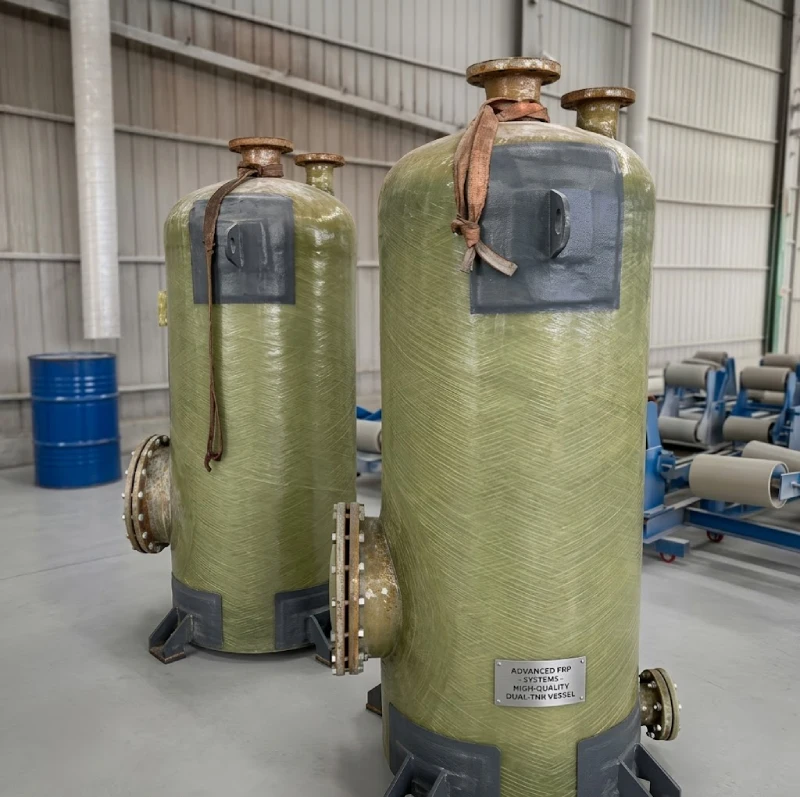
Manufacturing Process of Scrubber Tank
The manufacturing process of a Scrubber Tank involves a series of engineering, fabrication, welding, and testing procedures to ensure the safe handling of corrosive chemicals, fumes, and industrial gases. Scrubber tanks are commonly manufactured to using the materials such as HDPE, PPH, FRP, PVC, or PP depending on the chemical compatibility and operating conditions.
The manufacturing process begins with detailed engineering and design calculations based on:
- Chemical type and concentration
- Operating temperature (-10°C to 120°C (depends on the material and chemical used))
- Tank capacity (100 Liters to 100,000+ Liters)
- Pressure and vacuum conditions
- Flow rate requirements
- Installation location
- Structural load conditions
Design Considerations
- Tank thickness
- Reinforcement structure
- Nozzle positioning
- Vent arrangement
- Drainage system
- Support structure
CAD drawings and fabrication layouts are prepared before production.
Suitable material is selected according to chemical compatibility and process requirements.
Common Materials Used
Material | Application |
HDPE | Moderate chemical applications |
PPH | High-temperature corrosive chemicals |
FRP | Heavy-duty industrial scrubber systems |
PVC/PP | Specialized chemical handling |
Proper material selection ensures corrosion resistance and long service life.
Before fabrication, raw materials are inspected for:
- Thickness accuracy
- Surface quality
- Material grade
- Manufacturing defects
- Chemical resistance certification
Only approved materials are used for fabrication
Plastic or FRP sheets are cut according to the approved design dimensions using:
- CNC cutting machines
- Panel saws
- Hot cutting systems
- Router cutting equipment
Edges are prepared for welding and joining operations.
The tank body is formed by:
- Rolling sheets into cylindrical shapes
- Panel assembly for rectangular tanks
- Bottom and top section fabrication
- Butt welding
- Extrusion welding
- Hot gas welding
- Shell joints
- Bottom-to-shell joints
- Nozzle connections
- Reinforcement supports
Different welding methods are used depending on material type. Common Welding Techniques Butt welding Extrusion welding Hot gas welding Fusion welding For FRP tanks: Resin lamination Fiber reinforcement layering Hand lay-up or filament winding methods Proper welding ensures leak-proof construction and structural strength.
Various accessories and process connections are installed, such as:
- Inlet and outlet nozzles
- Vent nozzles
- Drain connections
- Level indicators
- Flanges
- Manholes
Reinforcements are added to improve structural stability.
Reinforcement Components
- Stiffener rings
- Support ribs
- Cross bracing
- External support frames
This helps the tank withstand:
- Chemical load
- Pressure variations
- External stress
- Thermal expansion
Required accessories and process fittings are installed, including:
- Inlet nozzles
- Outlet nozzles
- Drain connections
- Vent nozzles
- Overflow systems
- Level indicators
- Manholes
All fittings are welded and sealed properly.
The tank surface is cleaned and finished for:
- Smooth appearance
- Better corrosion resistance
- Easy maintenance
- Improved durability
FRP tanks may receive protective gel coating or UV-resistant finishing.
Strict quality control procedures are performed to ensure tank reliability.
Common Tests Conducted
| Test | Purpose |
| Hydrostatic Test | Leakage and strength testing |
| Spark Test | Weld defect detection |
| Visual Inspection | Surface and joint quality |
| Dimensional Inspection | Size verification |
| Load Testing | Structural performance |
| Leak Testing | Leak-proof verification |
Only approved tanks proceed for dispatch.
How to Select the Right Scrubber Tank
Selecting the right Scrubber Tank is essential for safe chemical handling, efficient fume treatment, and long-term plant performance. A properly designed scrubber tank to ensure the effective storage, circulation, and neutralization of corrosive gases and chemical solutions used in wet scrubber systems.
The first step is to determine:
- Type of chemical or scrubbing media
- Acidic or alkaline nature
- Chemical concentration
- Corrosive properties
Common scrubber chemicals include:
- Hydrochloric Acid (HCl)
- Sulfuric Acid (H₂SO₄)
- Caustic Soda (NaOH)
- Sodium Hypochlorite
Correct chemical identification helps in selecting compatible tank material.
The tank material must resist corrosion from the stored chemical. Common material options include:
- HDPE
- PPH
- FRP
- PVC/PPH lined systems
For highly corrosive and high-temperature applications, PPH and FRP are often preferred.
Temperature significantly affects tank performance and life.
- Low to moderate temperatures: HDPE tanks
- Higher temperature applications: PPH or FRP tanks
Always verify the maximum operating temperature of the chemical process.
Select the tank size based on:
- Process flow rate
- Chemical consumption
- Retention time
- System circulation requirements
- Future expansion needs
Proper capacity prevents overflow and ensures stable scrubber operation.
Choose the tank configuration according to available space and process requirements:
- Vertical tanks
- Horizontal tanks
- Rectangular scrubber tanks
- Cone-bottom tanks
The design should allow easy drainage and maintenance.
A scrubber tank should withstand:
- Chemical load
- Pump vibration
- External environmental conditions
- Internal pressure and vacuum conditions
Proper reinforcement and thickness are critical for long service life.
Ensure the tank includes necessary fittings and accessories such as:
- Level indicators
- Nozzles
- Drain connections
- Overflow arrangements
- Vent systems
- Agitator mounting provision
- Access manholes
These improve operational safety and maintenance efficiency.
Installation environment affects material selection:
- Indoor installation
- Outdoor UV exposure
- High-humidity environments
- Corrosive industrial atmosphere
Outdoor tanks should have UV stabilization and weather-resistant construction.
A good scrubber tank should include:
- Leak-proof welded joints
- Secondary containment
- Emergency overflow systems
- Chemical-resistant seals and gaskets
- Proper venting arrangements
Safety features help prevent accidents and chemical leakage.

Custom Product Manufacturing Available
If you are searching for customized product designs that meet your requirements, don’t worry. Petron Thermoplast also offers custom product manufacturing services to meet the unique needs of various industries. Work with our expert engineers to create custom designs suited for your application.
Why Choose Petron Thermoplast?
Petron Thermoplast provides a Scrubber Tank as a practical choice for controlling the chemical flow in environments that require chemical resistance and high purity. It combines the simplicity of Scrubber Tank operation with the added durability of Scrubber lining. Petron Thermoplast makes it ideal for industries dealing with aggressive media. From clean design to its protective features, Scrubber Tank offers a smart and long-lasting solution for many industrial applications. If you’re looking for durable and chemical resistant Scrubber Tank, you can connect with Petron Thermoplast to explore the reliable Tank solutions built for long-term industrial use.
Frequently Asked Questions
A Scrubber Tank is a chemical-resistant tank used in scrubber systems to store, circulate, or neutralize chemicals and contaminated liquids generated during industrial fume and gas treatment processes
The main purpose of a scrubber tank is to:
- Collect chemical solution
- Neutralize harmful gases and fumes
- Support recirculation in wet scrubber systems
- Reduce air pollution and chemical emissions
Scrubber tanks are widely used in:
- Chemical processing plants
- Electroplating industries
- Pharmaceutical industries
- Metal finishing plants
- Steel and galvanizing industries
- Wastewater treatment plants
Common materials include:
- HDPE (High-Density Polyethylene)
- PPH (Polypropylene Homopolymer)
- FRP (Fiber Reinforced Plastic)
- PVC/PP
- FRP-lined systems
Material selection depends on chemical compatibility and operating temperature.
Chemical compatibility ensures:
- Corrosion resistance
- Leak prevention
- Longer tank life
- Safe chemical handling
- Reduced maintenance costs
Improper material selection may cause tank failure.
Typical scrubber chemicals include:
- Hydrochloric Acid (HCl)
- Sulfuric Acid (H₂SO₄)
- Caustic Soda (NaOH)
- Sodium Hypochlorite
- Nitric Acid
- Neutralizing solutions
Yes, but the temperature capacity depends on the tank material:
- HDPE: Moderate temperatures
- PPH: Higher temperature applications
- FRP: Suitable for elevated temperatures
Operating temperature should always be verified before selection.
Scrubber tanks are available in:
- Vertical cylindrical tanks
- Horizontal tanks
- Rectangular tanks
- Cone-bottom tanks
- Customized designs
Important factors include:
- Chemical type
- Chemical concentration
- Temperature
- Tank capacity
- Pressure conditions
- Installation environment
- Required accessories
Common accessories include:
- Level indicators
- Vent nozzles
- Overflow connections
- Drain valves
- Agitators
- Pumps
- Manholes
- Ladders and platforms