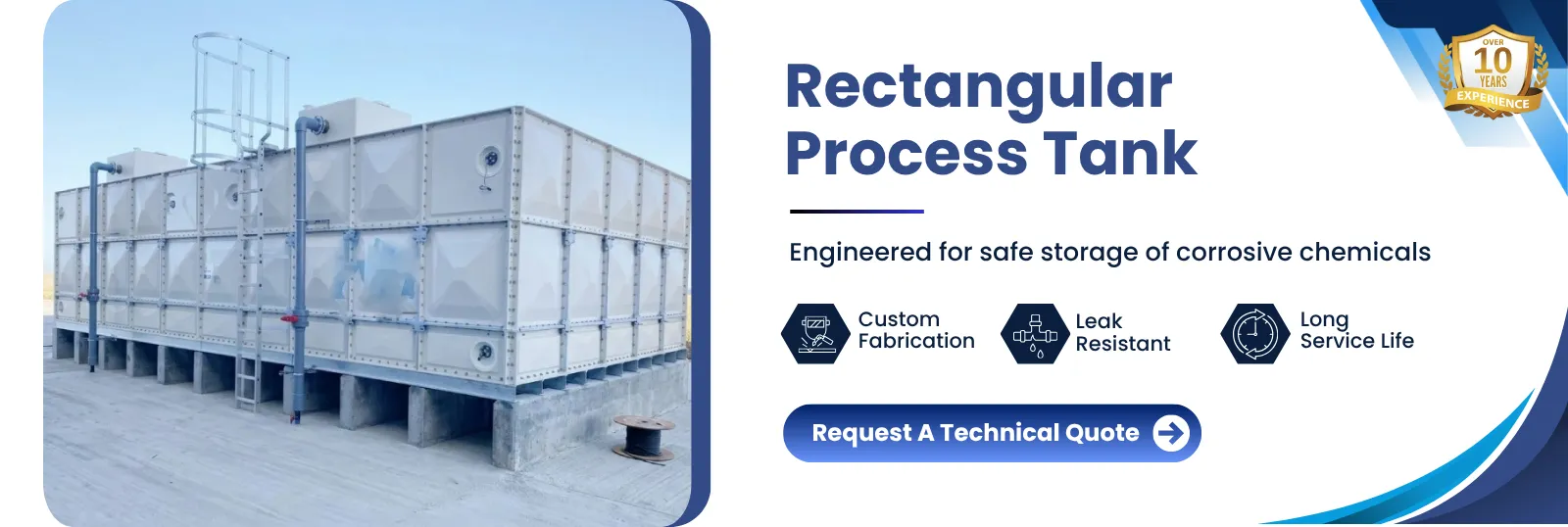






Rectangular Process Tank
A Rectangular Process Tank is a specially fabricated industrial tank with a rectangular shape. Rectangular Process Tanks are designed for storing, mixing, processing, and handling liquids, chemicals, water, and industrial solutions. In the various manufacturing and processing operations. Rectangular process tanks are widely used in industries where space optimization, efficient liquid handling, and customization to process the systems are required. The rectangular design allows maximum utilization of available floor space and easy integration into industrial processing lines.
A Rectangular Process Tank is a four-sided and flat walled container. Rectangular Process Tanks are used for storing, mixing, treating liquids, chemicals, or slurries across industrial applications. Rectangular Process Tanks are commonly constructed from thermoplastics (PPH, HDPE) for corrosion resistance. Petron Thermoplast has a strong technical team and maintains close communication and cooperation with international advanced counterparts, so that our products and technologies have always been at the forefront of the world.
Excellent Chemical Resistance
Suitable for chemicals, acids, alkalis, water, and industrial liquids
Temperature Resistance
-10°C to 120°C (depends on material and application)
UV Resistance
UV-stabilized materials available for outdoor applications
Long Service Life
Excellent durability and can operate for many years
ASTM, ASME, ISO, DIN Certified
Manufactured to international quality standards
-10°C to 120°C
Operating Temperature
100 L – 100K L
Capacity (Customizable)
ASTM, ASME, ISO, DIN
Certified quality standards
5 mm – 50 mm
Wall Thickness

Excellent Chemical Resistance
Manufactured using corrosion-resistant materials such as HDPE, PP, FRP, PVDF, PVC, and stainless steel for safe handling of chemicals, acids, alkalis, and industrial liquids.

Corrosion-Resistant Structure
Suitable for handling corrosive chemicals and aggressive industrial solutions in demanding environments.

Long Service Life
Durable materials and anti-corrosive construction ensure long operational life with minimal maintenance requirements.

Leak-Proof Welded Joints
Precision fabrication and high-quality welding provide leak-proof performance for secure storage and processing operations.

Technical Details
| Parameter | Technical & Physical Details |
| Product Name | Rectangular Process Tank |
| Material Options | HDPE, PPH, FRP, PVC, PVDF, Stainless Steel, Rubber-Lined Steel |
| Tank Shape | Rectangular / Square |
| Tank Type | Open Top / Closed Top |
| Storage Capacity | 100 Liters to 100,000+ Liters |
| Wall Thickness | 5 mm to 50 mm (depending on capacity & application) |
| Design Standard | ASTM, ASME, ISO, DIN Standards |
| Operating Temperature | -10°C to 120°C (depends on material and application) |
| Pressure Rating | Atmospheric to customized pressure rating |
| Chemical Compatibility | Suitable for chemicals, acids, alkalis, water, and industrial liquids |
| Corrosion Resistance | Excellent resistance to corrosive chemicals |
| Density of Material | HDPE: 0.94–0.97 g/cm³, PP: 0.90–0.91 g/cm³, FRP: 1.5–2.0 g/cm³ |
| UV Resistance | UV-stabilized materials available for outdoor applications |
| Color Options | Natural, Black, White, Grey, Customized |
| Mounting Type | Ground Mounted / Skid Mounted |
| Inlet Connection | Top inlet / Side inlet |
| Outlet Connection | Flanged, Threaded, Socket Weld |
| Lining Options | PTFE, Rubber, FRP, HDPE, PVDF |
| Reinforcement | FRP reinforcement / Steel support structure |
| Fabrication Method | Extrusion welding, Butt welding, Fabrication |
| Surface Finish | Smooth internal finish / Anti-corrosive finish |
| Leak Protection | Leak-proof welded construction |
| Ventilation Provision | Optional vent and pressure release system |
| Level Indicator | Optional level gauge installation |
| Agitator Provision | Available on request |
| Manhole Provision | Customized manhole options available |
| Drainage System | Bottom drain outlet available |
| Impact Resistance | High impact and abrasion resistance |
| Thermal Stability | Suitable for moderate to high temperature operations |
| Mechanical Strength | High structural and load-bearing strength |
| Safety Features | Anti-corrosion, UV protection, chemical resistance |
| Maintenance Requirement | Low maintenance |
| Service Life | Long operational life |
| Applications | Chemical processing, water treatment, electroplating, pickling, and industrial processing |
| Installation Type | Indoor & Outdoor installation |
| Customization | Available as per customer requirements |
Chemical compatibility is one of the most important factors when selecting a rectangular process tank. It refers to the ability of the tank material to safely store, process, or handle the chemicals without corrosion, swelling, cracking, leakage, or structural damage.
Proper chemical compatibility ensures:
- Safe operation
- Long service life
- Reduced maintenance
- Leak-free performance
- Reliable process efficiency
Common Materials Used for Rectangular Process Tanks
| Material | Chemical Resistance |
| Polypropylene (PP) | Excellent resistance to acids and alkalis |
| HDPE | Good resistance to many chemicals |
| FRP | Excellent structural and corrosion resistance |
| PVDF | Superior resistance to highly aggressive chemicals |
| Stainless Steel | Suitable for selected chemicals and hygienic applications |
Compatibility with Common Chemicals
| Chemical | PPH | HDPE | FRP | PVDF | Stainless Steel |
| Hydrochloric Acid (HCl) | Excellent | Good | Excellent | Excellent | Poor to Moderate |
| Sulfuric Acid (H₂SO₄) | Excellent | Good* | Excellent | Excellent | Good* |
| Nitric Acid (HNO₃) | Good | Moderate | Good | Excellent | Good |
| Phosphoric Acid | Excellent | Excellent | Excellent | Excellent | Good |
| Sodium Hydroxide (NaOH) | Excellent | Excellent | Good | Excellent | Moderate |
| Potassium Hydroxide (KOH) | Excellent | Excellent | Good | Excellent | Moderate |
| Sodium Hypochlorite | Good | Excellent | Good | Excellent | Poor |
| Ferric Chloride | Excellent | Good | Excellent | Excellent | Poor |
| Alum Solution | Excellent | Excellent | Excellent | Excellent | Good |
| Process Water | Excellent | Excellent | Excellent | Excellent | Excellent |
Quality inspection and testing of a rectangular process tank are essential to ensure structural integrity, leak-proof performance, chemical resistance, and long-term reliability. Since these tanks are often used for chemical processing, water treatment, pickling, electroplating, and industrial applications, stringent quality control measures are required throughout the manufacturing process.
1. Raw Material Inspection
Before fabrication, all raw materials are inspected to verify:
- Material grade and specification
- Sheet thickness
- Surface quality
- Chemical resistance properties
- Manufacturer certifications
Materials commonly inspected include:
- Polypropylene (PP)
- HDPE
- FRP components
- PVDF lining materials
- Stainless Steel sheets
2. Dimensional Inspection
Dimensions are checked against approved drawings to ensure manufacturing accuracy.
Parameters inspected include:
| Inspection Item | Purpose |
| Length | Verify design dimensions |
| Width | Ensure process compatibility |
| Height | Confirm storage capacity |
| Wall Thickness | Verify structural strength |
| Nozzle Position | Ensure proper piping alignment |
3. Welding Inspection
Weld quality is critical for tank performance.
Thermoplastic Tanks
Inspection includes:
- Butt fusion weld examination
- Extrusion weld inspection
- Hot gas weld quality checks
Stainless Steel Tanks
Inspection includes:
- TIG/MIG weld evaluation
- Weld penetration verification
- Surface finish inspection
Quality welds ensure:
- Leak-proof joints
- Structural integrity
- Long service life
4. Visual Inspection
A thorough visual inspection is conducted to identify:
- Surface defects
- Cracks
- Weld imperfections
- Material damage
- Fabrication irregularities
This is one of the first and most important quality checks.
5. Hydrostatic Leak Testing
Hydrostatic testing is performed by filling the tank with water and holding it for a specified period.
The test verifies:
- Leak-proof construction
- Weld integrity
- Structural stability
- Resistance to deformation
Any leakage or abnormal deformation results in corrective action.
6. Spark Testing (Holiday Testing)
For lined or laminated tanks, spark testing is used to detect:
- Pinholes
- Lining defects
- Surface discontinuities
- Imperfections in protective layers
Commonly applied to:
- PVDF-lined tanks
- FRP-lined tanks
- Protective coating systems
7. Thickness Measurement
Thickness is measured using calibrated instruments to verify:
- Wall thickness
- Lining thickness
- Reinforcement thickness
This ensures compliance with design requirements and safety factors.
8. Structural Strength Inspection
Rectangular tanks experience significant wall stress due to flat surfaces.
Structural inspection evaluates:
- Reinforcement ribs
- Support frames
- Stiffeners
- Welded supports
- Tank rigidity
This confirms the tank can safely withstand operational loads.
9. Nozzle & Fitting Inspection
All installed accessories are checked for:
- Proper positioning
- Welding quality
- Leak-proof connections
- Dimensional accuracy
Common fittings inspected include:
- Inlet nozzles
- Outlet nozzles
- Drain connections
- Overflow nozzles
- Vent pipes
10. Agitator Support Inspection
For tanks with mixers or agitators, inspections verify:
- Mounting strength
- Alignment accuracy
- Structural reinforcement
- Mechanical stability
This prevents vibration-related failures.
Industries We Serve

Chemical Processing Industries
Used for storing and processing: Acids Alkalis Solvents Chemical solutions Process liquids

Water Treatment Plants
Rectangular process tanks are widely used in: Water storage Chemical dosing systems Neutralization processes Sedimentation systems Wastewater treatment operations

Electroplating Industries
Used in electroplating plants for: Chemical dipping Metal cleaning Rinsing operations Surface treatment processes

Pickling & Metal Treatment Industries
Suitable for: Acid pickling Descaling operations Metal surface treatment Chemical cleaning processes

Pharmaceutical Industries
Used in pharmaceutical manufacturing for: Chemical preparation Liquid storage Process mixing Cleaning and washing systems

Wastewater Treatment Systems
Used in industrial wastewater plants for: Effluent collection Neutralization systems Chemical treatment operations

Semiconductor & Electronics Industries
Used for handling purified water, process chemicals, and cleaning solutions in precision manufacturing operations.
Features of Rectangular Process Tanks

1. Space-Efficient Design
The rectangular shape allows maximum utilization of floor space, making the tank ideal for compact industrial installations and process layouts.

2. Excellent Chemical Resistance
3. Leak-Proof Construction Manufactured using corrosion-resistant materials such as HDPE, PP, FRP, PVDF, PVC, and stainless steel for safe handling of chemicals, acids, alkalis, and industrial liquids.

3. Leak-Proof Construction
Precision fabrication and high-quality welding provide leak-proof performance for secure storage and processing operations.

4. High Mechanical Strength
Designed with strong structural integrity to withstand industrial loads, liquid pressure, and operational stress.

5. Long Service Life
Durable materials and anti-corrosive construction ensure long operational life with minimal maintenance requirements.

6. Corrosion-Resistant Structure
Suitable for handling corrosive chemicals and aggressive industrial solutions in demanding environments.

7. Smooth Internal Surface
The smooth internal finish reduces scaling, chemical deposits, and contamination while improving cleaning efficiency.

8. Lightweight Construction
Plastic and hybrid rectangular process tanks are lightweight, allowing easier transportation, handling, and installation.

9. Low Maintenance Requirement
Corrosion-resistant materials and smooth surfaces reduce maintenance, cleaning, and operational costs.

10. Customizable Design
Available in customized Sizes, Capacities, Thicknesses, Shapes, Connection types, Lining options

11. Multiple Material Options
Manufactured using materials such as:
HDPE PPH FRP PVDF PVC Stainless Steel Rubber-lined steel

12. Reinforced Structure
Optional FRP reinforcement or steel support structures provide additional strength and stability.
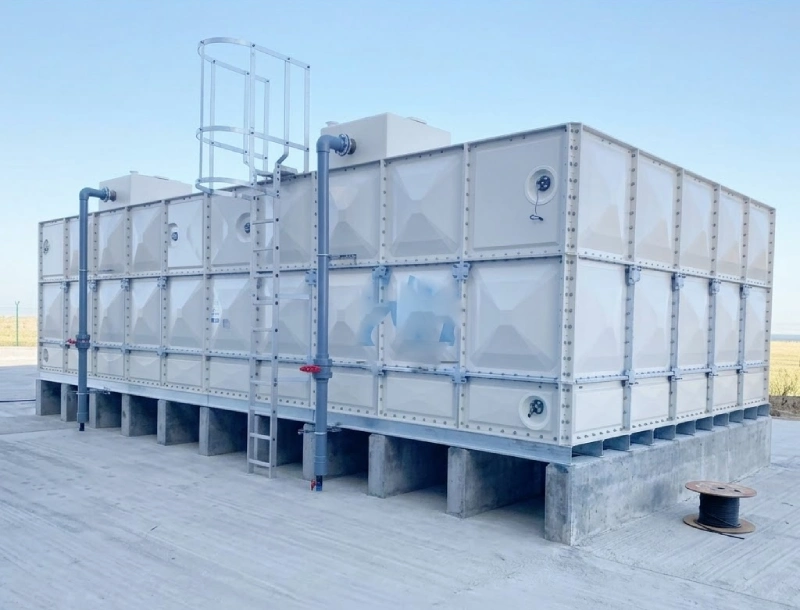
Manufacturing Process of Rectangular Process Tank
The manufacturing process of a rectangular process tank involves detailed engineering, precision fabrication, welding, reinforcement, assembly, and quality testing to ensure the safe and reliable operation in industrial applications. These tanks are commonly used for chemical processing, water treatment, electroplating, pickling, dosing, and various industrial processes.
The manufacturing process begins with detailed design calculations based on:
- Process application
- Chemical compatibility
- Tank capacity (100 Liters to 100,000+ Liters)
- Operating temperature (-10°C to 120°C (depends on material and application))
- Liquid density
- Structural load requirements
- Tank dimensions
- Wall thickness
- Reinforcement requirements
- Nozzle locations
- Support structure design
The tank material is selected according to:
- Chemical resistance requirements
- Operating temperature
- Mechanical strength
- Process conditions
Common Materials Used
- PPH sheets
- HDPE sheets
- FRP materials
- PVDF lining sheets
- Stainless Steel plates
Proper material selection ensures durability and corrosion resistance.
Raw material sheets are cut to required dimensions using:
- CNC cutting machines
- Circular saws
- Laser cutting systems
- Thermoplastic fabrication equipment
- Side walls
- Bottom panel
- Top cover
- Reinforcement strips
- Support sections
Individual panels are prepared and machined according to design specifications.
This includes:
- Edge preparation
- Alignment marking
- Hole cutting for nozzles
- Reinforcement positioning
Accurate fabrication ensures proper assembly.
The bottom panel and side walls are assembled into the rectangular configuration.
The assembly process ensures:
- Accurate dimensions
- Proper alignment
- Structural stability
Temporary supports may be used during fabrication.
The panels are joined using suitable welding techniques.
Thermoplastic Tanks
Common methods:
- Butt fusion welding
- Extrusion welding
- Hot gas welding
Stainless Steel Tanks
Common methods:
- TIG welding
- MIG welding
- Arc welding
These methods provide:
- Strong joints
- Leak-proof seams
- Long-term durability
Rectangular tanks require reinforcement because flat walls experience higher stress.
Common reinforcement methods include:
- External ribs
- PP stiffeners
- Steel support frames
- FRP reinforcement
- Cross braces
- Structural strength
- Wall stability
- Load-bearing capacity
Required fittings are installed, including:
- Inlet nozzles
- Outlet nozzles
- Overflow connections
- Drain nozzles
- Vent pipes
- Level indicators
- Sampling ports
The fittings are welded and sealed carefully.
For mixing applications, the tank may be equipped with:
- Agitator mounting plates
- Motor support structures
- Mixer reinforcements
This ensures safe operation under dynamic loads.
For highly corrosive applications:
- PVDF lining may be installed
- FRP lamination may be applied
- Protective coatings may be added
- Chemical resistance
- Corrosion protection
- Service life
Required fittings are installed, including:
- Inlet nozzles
- Outlet nozzles
- Overflow connections
- Drain nozzles
- Vent pipes
- Level indicators
- Sampling ports
The fittings are welded and sealed carefully.
How to Select the Right Rectangular Process Tank
The first step is to determine the intended use of the tank, such as:
- Chemical storage
- Process mixing
- Pickling operations
- Electroplating
- Water treatment
- Rinsing or washing processes
Understanding the application helps to define the tank design and material requirements.
The tank material must be compatible with the liquid to being stored or processed.
Common tank materials include:
- Polypropylene (PP)
- HDPE
- FRP
- PVDF
- Stainless Steel
- Corrosion
- Leakage
- Material degradation
- Product contamination
Tank size should be selected based on:
- Process volume
- Batch size
- Production capacity
- Retention time
Ensure adequate capacity for both current and future operational needs.
The operating temperature affects material selection and tank design.
Check:
- Process temperature
- Chemical temperature
- Ambient conditions
- PVDF lining
- Reinforced PPH construction
- Additional structural support
Material | Suitable Applications |
PP | Chemical processing, pickling |
HDPE | Water treatment, mild chemicals |
FRP | Large industrial tanks |
PVDF | High-temperature corrosive chemicals |
Stainless Steel | Food, pharmaceutical, and hygienic processes |
Rectangular tanks are ideal where:
- Floor space is limited
- Large process areas are required
- Equipment layout demands a rectangular shape
- Length
- Width
- Height
- Available installation space
Rectangular tanks experience higher wall stress than cylindrical tanks.
Additional reinforcement may include:
- External ribs
- Steel frames
- FRP strengthening
- Support beams
Proper reinforcement ensures structural stability.
- Easy cleaning
- Inspection access
- Drainage
- Component replacement

Custom Product Manufacturing Available
If you are searching for customized product designs that meet your requirements, don’t worry. Petron Thermoplast also offers custom product manufacturing services to meet the unique needs of various industries. Work with our expert engineers to create custom designs suited for your application.
Why Choose Petron Thermoplast?
Petron Thermoplast has a strong technical team and maintains close communication and cooperation with international advanced counterparts, so that our products and technologies have always been at the forefront of the world. At the same time, the company is equipped with a complete after-sales team. Whether it is a product choice of materials or the deep processing of parts, we are equipped with professional one-to-one service. Choosing our Rectangular Process Tanks will truly make you worry-free!
Frequently Asked Questions
A rectangular process tank is an industrial tank designed for storing, processing, mixing, rinsing, or treating liquids and chemicals. Its rectangular shape makes it ideal for applications where space utilization and process accessibility are important.
Common materials include:
- Polypropylene (PP)
- HDPE
- FRP (Fiber Reinforced Plastic)
- PVDF-lined materials
- Stainless Steel
The material selection depends on the chemical, temperature, and process requirements.
Rectangular process tanks are widely used in:
- Chemical processing
- Water treatment
- Electroplating
- Pickling plants
- Pharmaceutical manufacturing
- Surface treatment industries
Rectangular tanks offer:
- Better space utilization
- Easy installation in confined areas
- Convenient access for processing operations
- Efficient arrangement in production lines
Depending on the tank material, they can store:
- Acids
- Alkalis
- Water treatment chemicals
- Process solutions
- Electroplating chemicals
- Cleaning solutions
Material selection depends on:
- Chemical compatibility
- Operating temperature
- Concentration of chemicals
- Process requirements
- Mechanical loading conditions
Rectangular process tanks can be manufactured in customized capacities ranging from small laboratory tanks to large industrial process tanks holding several thousand liters.
Yes, tanks can be customized for:
- Dimensions
- Capacity
- Nozzle arrangements
- Reinforcement design
- Agitator mounting
- Heating systems
Yes, when manufactured from compatible materials such as PP, FRP, HDPE, or PVDF, they can safely handle highly corrosive chemicals.
Unlike cylindrical tanks, flat walls experience greater outward pressure. Reinforcements help:
- Prevent bulging
- Improve structural strength
- Increase tank life
- Ensure operational safety