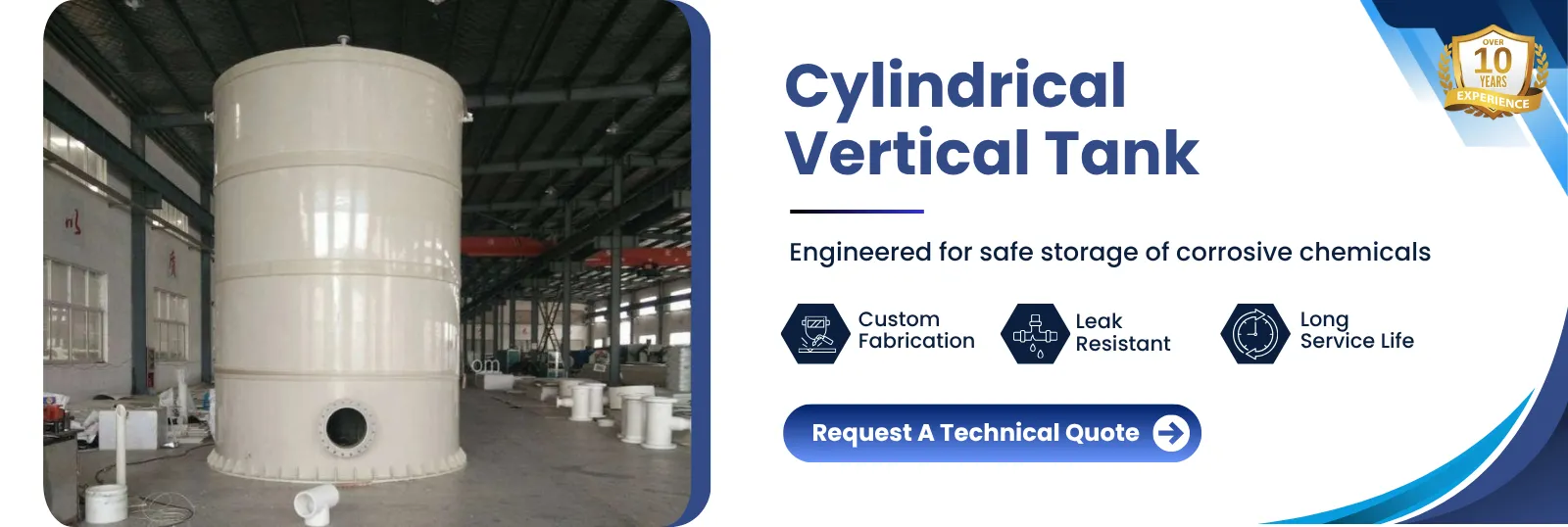






Cylindrical Vertical Tank banner Final

Cylindrical Vertical Tank

A Cylindrical Vertical Tank is a storage vessel with a circular base and vertical sidewalls. A top is a position to upright the store of liquids (water, chemicals, oil) or gases. Cylindrical Vertical Tanks are to minimize the footprint while offering the large capacities. They typically feature flat, conical, or dished ends and are constructed from materials like titanium or plastic. 

A Cylindrical Vertical Tank is a vertically mounted industrial storage tank with a cylindrical shape. Cylindrical Vertical Tanks are designed for storing, processing, and handling liquids, chemicals, water, and industrial solutions. The vertical cylindrical designed to allow efficient storage with minimal usage of making the floor space. Cylindrical Vertical tanks are ideal for industries where high-capacity and liquid storage to optimize the space of utilization are important. There are strong structural designs to provide excellent pressure distribution and mechanical stability during industrial operations. Petron Thermoplast provides cylindrical vertical tanks that are easy to install. Cylindrical Vertical Tanks are extremely lightweight compared to industrial connectors

defence

Material Options

HDPE, PPH, FRP, PVC, PVDF, Stainless Steel, Rubber-Lined Steel

weather (1)

Operating Temperature

-10°C to 120°C (depends on material and application)

layer

Corrosion-Free Construction

No rusting when exposed to chemicals & moisture.

grade

Long Service Life

Excellent durability and can operate for many years

guarantee

ASTM, ASME, ISO, DIN Certified

Manufactured to international quality standards

-10°C to 120°C

Operating Temperature

100 L – 500K L

Capacity (Customizable)

ASTM D1998 & ISO

Certified quality standards

5 mm – 60 mm

Wall Thickness

corrosion

Excellent Chemical Resistance

Manufactured using corrosion-resistant materials such as HDPE, PPH, FRP, PVDF, PVC, and stainless steel for safe handling of chemicals, acids, alkalis, and industrial liquids.

fire

Temperature Resistance

Designed to handle moderate to high operating temperatures, depending on material selection and application.

accuracy

Long Service Life

Durable construction and anti-corrosive materials provide extended operational life with minimal maintenance requirements.

shield

Leak-Proof Welded Joints

Precision fabrication and high-quality welded joints ensure leak-proof performance for safe liquid storage and transfer.

Technical Details

ParameterTechnical & Physical Details
Product NameCylindrical Vertical Tank
Material OptionsHDPE, PPH, FRP, PVC, PVDF, Stainless Steel, Rubber-Lined Steel
Tank ShapeCylindrical Vertical
Tank TypeOpen Top / Closed Top
Storage Capacity100 Liters to 500,000+ Liters
Wall Thickness5 mm to 60 mm (depending on capacity & application)
Design StandardASTM, ASME, ISO, DIN Standards
Operating Temperature-10°C to 120°C (depends on material and application)
Pressure RatingAtmospheric to customized pressure rating
Chemical CompatibilitySuitable for chemicals, acids, alkalis, water, and industrial liquids
Corrosion ResistanceExcellent resistance to corrosive chemicals and environments
Density of MaterialHDPE: 0.94–0.97 g/cm³, PPH: 0.90–0.91 g/cm³, FRP: 1.5–2.0 g/cm³
UV ResistanceUV-stabilized materials available for outdoor installation
Color OptionsNatural, Black, White, Grey, Customized
Mounting TypeVertical Ground Mounted
Inlet ConnectionTop inlet / Side inlet
Outlet ConnectionFlanged, Threaded, Socket Weld
Lining OptionsPTFE, Rubber, FRP, HDPE, PVDF
ReinforcementFRP reinforcement / Steel support structure
Fabrication MethodExtrusion welding, Butt welding, Rotational molding, Fabrication
Surface FinishSmooth internal finish / Anti-corrosive finish
Leak ProtectionLeak-proof welded construction
Ventilation ProvisionOptional vent and pressure release system
Level IndicatorOptional level gauge installation
Agitator ProvisionAvailable on request
Manhole ProvisionCustomized manhole sizes available
Drainage SystemBottom drain outlet available
Impact ResistanceHigh impact and abrasion resistance
Thermal StabilitySuitable for moderate to high temperature applications
Mechanical StrengthHigh structural and load-bearing strength
Safety FeaturesAnti-corrosion, UV protection, chemical resistance
Maintenance RequirementLow maintenance
Service LifeLong operational life
ApplicationsChemical storage, water treatment, pharmaceuticals, food processing, wastewater treatment
Installation TypeIndoor & Outdoor installation
CustomizationAvailable as per customer requirements

Chemical compatibility is the ability of a cylindrical vertical tank to safely store the chemicals without experiencing corrosion, degradation, swelling, cracking, leakage, or loss of structural integrity. Selecting the correct tank material based on the stored chemical is critical for ensuring safety, durability, and long-term performance.

Why Chemical Compatibility is Important

Proper chemical compatibility helps to:

  • Prevent tank corrosion and damage
  • Avoid chemical contamination
  • Reduce maintenance costs
  • Improve operational safety
  • Extend tank service life
  • Ensure reliable storage performance

Common Materials Used for Cylindrical Vertical Tanks

MaterialCharacteristics
HDPEExcellent resistance to many acids and alkalis
Polypropylene (PP)High chemical and temperature resistance
FRPStrong structural and corrosion resistance
PVDFSuperior resistance to aggressive chemicals
Stainless SteelSuitable for selected chemicals and hygienic applications

Compatibility with Common Chemicals

ChemicalHDPEPPFRPPVDFStainless Steel
Hydrochloric Acid (HCl)GoodExcellentExcellentExcellentPoor
Sulfuric Acid (H₂SO₄)Good*ExcellentExcellentExcellentGood*
Nitric Acid (HNO₃)ModerateGoodGoodExcellentGood
Phosphoric AcidExcellentExcellentExcellentExcellentGood
Sodium Hydroxide (NaOH)ExcellentExcellentGoodExcellentModerate
Potassium Hydroxide (KOH)ExcellentExcellentGoodExcellentModerate
Sodium HypochloriteExcellentGoodGoodExcellentPoor
Ferric ChlorideGoodExcellentExcellentExcellentPoor
Alum SolutionExcellentExcellentExcellentExcellentGood
WaterExcellentExcellentExcellentExcellentExcellent

Quality inspection and testing of a cylindrical vertical tank are critical to ensuring structural integrity, leak-proof performance, chemical resistance, and long-term operational reliability. These inspections are carried out throughout the manufacturing process and before the tank is delivered for installation.

1. Raw Material Inspection

The quality process begins with the inspection of raw materials to verify:

  • Material grade and specifications
  • Sheet thickness
  • Surface condition
  • Chemical resistance properties
  • Manufacturer certificates
  • HDPE sheets
  • Polypropylene (PP) sheets
  • FRP materials
  • PVDF lining sheets
  • Stainless Steel plates

2. Dimensional Inspection

Tank dimensions are checked against approved engineering drawings.

Parameters Verified

Inspection ItemPurpose
Tank DiameterConfirms design accuracy
Tank HeightVerifies storage capacity
Wall ThicknessEnsures structural strength
Nozzle PositionConfirms piping alignment
Reinforcement PlacementEnsures proper support

3. Visual Inspection

A detailed visual inspection is performed to identify:

  • Surface defects
  • Scratches
  • Cracks
  • Material damage
  • Fabrication irregularities
  • Welding imperfections

This helps detect defects before further testing.

4. Welding Quality Inspection

Weld quality is one of the most important factors in tank performance.

Thermoplastic Tanks

Inspection includes:

  • Butt fusion weld examination
  • Extrusion weld inspection
  • Hot gas weld verification

Stainless Steel Tanks

Inspection includes:

  • TIG/MIG weld inspection
  • Weld penetration checks
  • Surface finish evaluation

Benefits:

  • Leak-proof joints
  • High structural strength
  • Long service life

5. Hydrostatic Testing

Hydrostatic testing is conducted by filling the tank with water and holding it for a specified period.

Purpose

  • Detect leakage
  • Verify weld integrity
  • Confirm structural stability
  • Check resistance to deformation

This is one of the most important acceptance tests.

6. Spark Testing (Holiday Testing)

Spark testing is commonly performed on:

  • PVDF-lined tanks
  • FRP-lined tanks
  • Coated tanks
  • Pinholes
  • Lining defects
  • Surface discontinuities
  • Coating imperfections

This ensures complete protection against chemical attack.

7. Thickness Measurement

Wall and lining thickness are measured using calibrated instruments.

Areas Checked

  • Tank shell
  • Bottom section
  • Roof section
  • Lining material
  • Reinforcement zones

Proper thickness ensures:

  • Structural safety
  • Chemical resistance
  • Long service life

8. Nozzle & Fitting Inspection

All fittings are inspected for:

  • Correct positioning
  • Proper welding
  • Leak-proof sealing
  • Dimensional accuracy
  • Inlet nozzles
  • Outlet nozzles
  • Overflow connections
  • Drain nozzles
  • Vent pipes


Industries We Serve

chemical

Chemical Processing Industries

Used for storing and handling:
Acids
Alkalis
Solvents
Chemical solutions
Industrial process liquids
water-filter

Water Treatment Plants

Widely used in:
Raw water storage
Chemical dosing systems
Treated water storage
Neutralization processes
Wastewater treatment operations

tank (1)

Acid & Alkali Storage

Suitable for safe storage of corrosive chemicals such as:
Hydrochloric Acid (HCl)
Sulfuric Acid (H₂SO₄)
Caustic soda solutions
Industrial alkalis

pharmaceutical

Pharmaceutical Industries

Used in pharmaceutical manufacturing for:
Process liquid storage
Purified water storage
Chemical preparation
Mixing and dosing systems

power

Marine & Coastal Applications

The corrosion-resistant nature of HDPE makes these tanks suitable for:
Saltwater environments
Coastal industrial plants
Marine chemical storage systems

sewage-plant

Wastewater Treatment Plants

Used for:
Effluent collection
Neutralization tanks
Chemical treatment systems
Sludge processing applications

electrophoresis

Power Plants

Used in:
Cooling water systems
Chemical dosing units
Boiler feed water treatment systems

power

Oil & Gas Industries

Suitable for storing industrial chemicals, treatment fluids, and process liquids used in refinery and processing operations.

Features of Cylindrical Vertical Tank

shield

1. Space-Saving Vertical Design

The vertical cylindrical shape allows maximum storage capacity while occupying minimal floor space, making it ideal for industrial installations with limited area.

chemical

2. Excellent Chemical Resistance

Manufactured using corrosion-resistant materials such as HDPE, PPH, FRP, PVDF, PVC, and stainless steel for safe handling of chemicals, acids, alkalis, and industrial liquids.

leak

3. Leak-Proof Construction

Precision fabrication and high-quality welded joints ensure leak-proof performance for safe liquid storage and transfer.

determination

4. High Mechanical Strength

Designed with strong structural integrity to withstand industrial loads, liquid pressure, and harsh operating conditions.

deadline

5. Long Service Life

Durable construction and anti-corrosive materials provide extended operational life with minimal maintenance requirements.

corrosion

6. Corrosion-Resistant Structure

Suitable for storing corrosive chemicals and aggressive industrial solutions in demanding environments.

layer

7. Smooth Internal Surface

The smooth inner finish minimizes scaling, chemical deposits, and contamination while improving cleaning efficiency.

purity

8. Lightweight Construction

Plastic and hybrid cylindrical vertical tanks are lightweight, making transportation, handling, and installation easier.

construction

9. Low Maintenance Requirement

Corrosion-resistant materials and smooth surfaces reduce maintenance, cleaning, and operational costs.

construction

10. Customizable Design

Available in customized: Sizes Capacities Thicknesses Connection types Lining options Top and bottom configurations According to industrial requirements.

wafer-probing-test

11. Multiple Material Options

Manufactured using materials such as: HDPE PPH FRP PVDF PVC Stainless Steel Rubber-lined steel

molecular

12. Reinforced Structure

Optional FRP reinforcement or steel support structures improve tank strength and stability.

high-temperature

13. High Temperature Resistance

Designed to handle moderate to high operating temperatures, depending on material selection and application.

weather

14. UV & Weather Resistance

UV-stabilized materials protect the tank from sunlight and harsh outdoor environmental conditions.
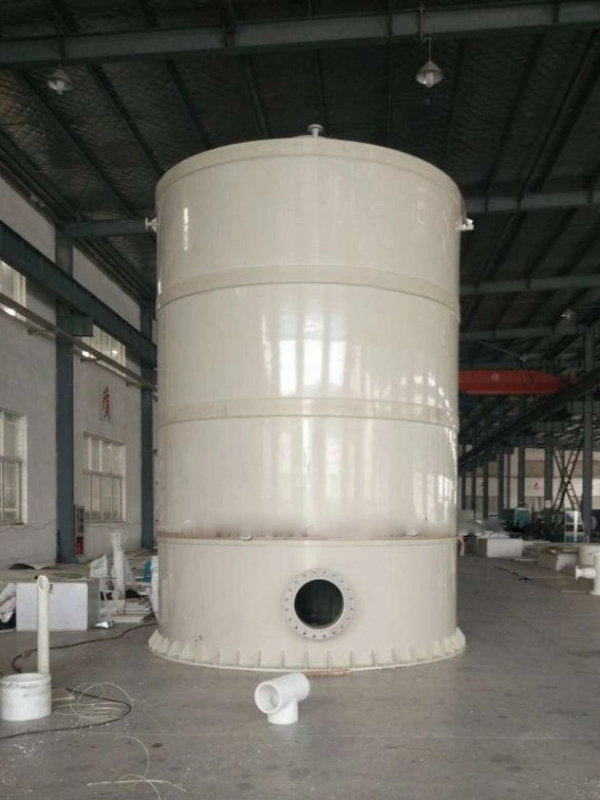
Manufacturing Process of Cylindrical Vertical Tank

The manufacturing process of a cylindrical vertical tank involves careful engineering, material selection, fabrication, welding, assembly, reinforcement, and quality testing to ensure the safe storage and reliable performance. These tanks are widely used for chemical storage, water treatment, process applications, acid and alkali handling, and industrial liquid storage.

Material Used For Manufacture
Cylindrical vertical tanks are commonly manufactured using
  • HDPE
  • Polypropylene (PP)
  • FRP
  • PVDF-lined materials
  • Stainless Steel

Depending on the application and chemical compatibility requirements.

0
Stage 1
Design & Engineering

The manufacturing process begins with detailed engineering calculations based on:

  • Storage capacity(100 Liters to 500,000+ Liters)
    • Chemical compatibility
    • Liquid density
  • Operating temperature(-10°C to 120°C (depends on material and application))
  • Installation conditions
  • Structural load requirements
  • Tank diameter
  • Tank height
  • Wall thickness
  • Reinforcement requirements
  • Nozzle locations
1
Stage 2
Material Selection

The appropriate material is selected according to:

  • Chemical resistance
  • Temperature resistance
  • Mechanical strength
  • Process requirements

Common Materials 

Material

Typical Applications

HDPE

Water treatment and chemical storage

PP

Acids, alkalis, and process chemicals

FRP

Large-capacity outdoor storage

PVDF

High-temperature corrosive chemicals

Stainless Steel

Hygienic and pharmaceutical applications

2
Stage 3
Sheet Cutting & Preparation

Raw material sheets are cut to the required dimensions using:

  • CNC cutting machines
  • Laser cutting systems
  • Circular saws
  • Thermoplastic cutting tools
  • Shell sections
  • Bottom plates
  • Roof sections
  • Reinforcement elements
3
Stage 4
Shell Rolling & Forming

The cut sheets are rolled into cylindrical sections using specialized rolling machines.

This process ensures:

  • Accurate tank diameter
  • Uniform curvature
  • Proper dimensional accuracy

The shell sections are then aligned for assembly.

4
Stage 5
Shell Welding & Assembly

The rolled shell sections are joined together using suitable welding techniques.

Thermoplastic Tanks

Common methods include:

  • Butt fusion welding
  • Extrusion welding
  • Hot gas welding

Stainless Steel Tanks

Common methods include:

  • TIG welding
  • MIG welding
  • Arc welding

These welding processes create:

  • Strong joints
  • Leak-proof seams
  • Long-term durability
5
Stage 6
Bottom Plate Fabrication

The tank bottom is fabricated and attached to the cylindrical shell.

Common bottom configurations:

  • Flat bottom
  • Cone bottom
  • Dish bottom
  • Sloped bottom

Selection depends on the application and drainage requirements.

6
Stage 7
Top Roof Fabrication

The roof section is manufactured according to process requirements.

Common roof designs include:

  • Flat roof
  • Dome roof
  • Conical roof
  • Open-top design

The roof is then attached to the shell structure.

7
Stage 8
Reinforcement Installation

Large tanks require additional structural reinforcement.

Typical reinforcement includes:

  • Stiffening rings
  • Reinforcement bands
  • External ribs
  • Structural frames
  • Mechanical strength
  • Shape retention
  • Load-bearing capacity
8
Stage 9
Nozzle & Accessory Installation

Various process connections and accessories are installed, including:

  • Inlet nozzles
  • Outlet nozzles
  • Overflow nozzles
  • Vent pipes
  • Drain connections
  • Manholes
  • Level indicators

The fittings are aligned and welded according to approved drawings.

9
Stage 10
Agitator & Equipment Supports (If Required)

For process applications involving mixing:

  • Agitator supports are installed
  • Motor mounting plates are added
  • Structural reinforcements are provided

This ensures safe operation under dynamic loads.

10

How to Select the Right Cylindrical Vertical Tank

1. Identify the Application

The first step is to determine the tank’s intended use:

  • Chemical storage
  • Water storage
  • Acid storage
  • Alkali storage
  • Process tank applications
  • Dosing systems
  • Wastewater treatment

The application will influence the tank material, design, and accessories.

2. Determine Chemical Compatibility

The tank material must be compatible with the liquid being stored.

Common tank materials include:

  • HDPE
  • Polypropylene (PP)
  • FRP
  • PVDF-lined systems
  • Stainless Steel
  • Corrosion
  • Leakage
  • Product contamination
  • Material degradation
3. Calculate Required Capacity

Tank capacity should be selected based on:

  • Daily consumption
  • Process requirements
  • Storage duration
  • Future expansion plans
  • Small tanks (100–1,000 liters)
  • Medium tanks (1,000–10,000 liters)
  • Large tanks (10 KL and above)
4. Consider Operating Temperature

Temperature affects material performance and tank design.

Evaluate:

  • Storage temperature
  • Process temperature
  • Ambient temperature
  • PPH or PVDF construction
  • Additional reinforcement
  • Specialized linings
5. Select the Appropriate Material

Material

Suitable Applications

HDPE

Water treatment and mild chemicals

PPH

Acids, alkalis, and process chemicals

FRP

Large outdoor storage systems

PVDF

High-temperature corrosive chemicals

Stainless Steel

Hygienic and pharmaceutical applications

6. Evaluate Tank Dimensions

The available installation area should be assessed for:

  • Tank diameter
  • Tank height
  • Access space
  • Maintenance clearance
  • Floor space is limited
  • High storage capacity is required
7. Verify Structural Strength

The tank should be designed to withstand:

  • Hydrostatic pressure
  • Chemical load
  • Wind load (for outdoor tanks)
  • Seismic conditions (if applicable)
  • Reinforcement rings
  • Stiffeners
  • Support structures
8. Determine Wall Thickness

Wall thickness depends on:

  • Tank height
  • Liquid density
  • Chemical type
  • Operating temperature
  • Structural stability
  • Long service life
  • Safe operation
Repairing Service

Custom Product Manufacturing Available

If you are searching for customized product designs that meet your requirements, don’t worry. Petron Thermoplast also offers custom product manufacturing services to meet the unique needs of various industries. Work with our expert engineers to create custom designs suited for your application.

Why Choose Petron Thermoplast?

Petron Thermoplast provides cylindrical vertical tanks that are easy to install. Cylindrical Vertical Tanks are extremely lightweight compared to industrial connectors. Cylindrical Vertical Tanks mean no concern regarding Corrosion. The flow will be smoother and consistently more cost-effective in comparison to other components.

At Petron Thermoplast, we are committed to delivering high-quality Cylindrical Vertical Tanks that meet industry standards and exceed customer expectations. Our products have been rigorously tested and certified through various tests to ensure their durability and performance.

Petron thermoplast provides a wide range of cylindrical vertical tanks that can be used to extend the performance and versatility of our storage tanks. Different sizes and types are available to suit various applications.

Frequently Asked Questions

1. What is a Cylindrical Vertical Tank?

A cylindrical vertical tank is a vertically mounted storage or process tank with a circular cross-section, designed for storing liquids, chemicals, water, acids, alkalis, and industrial process fluids.

2. What are cylindrical vertical tanks used for?

These tanks are commonly used for:

  • Chemical storage
  • Water storage
  • Acid and alkali storage
  • Process applications
  • Water treatment systems
  • Dosing systems
  • Wastewater treatment
3. What materials are used to manufacture cylindrical vertical tanks?

Common materials include:

  • HDPE (High-Density Polyethylene)
  • Polypropylene (PP)
  • FRP (Fiber Reinforced Plastic)
  • PVDF-lined materials
  • Stainless Steel

Material selection depends on the chemical, temperature, and process requirements.

4. Why choose a cylindrical vertical tank?

Advantages include:

  • Excellent structural strength
  • Efficient use of floor space
  • Uniform pressure distribution
  • Easy installation and maintenance
  • Suitable for large storage capacities
5. What capacities are available?

Cylindrical vertical tanks can be manufactured in capacities ranging from:

  • 100 liters
  • 500 liters
  • 1,000 liters
  • Several thousand liters
  • Large industrial tanks exceeding 100 KL
6. Can cylindrical vertical tanks store corrosive chemicals?

Yes. When manufactured using compatible materials such as PP, FRP, HDPE, or PVDF, they can safely store highly corrosive acids and alkalis.

7. How is the correct tank material selected?

Material selection depends on:

  • Chemical compatibility
  • Chemical concentration
  • Operating temperature
  • Process requirements
  • Environmental conditions
8. Are cylindrical vertical tanks suitable for outdoor installation?

Yes. Tanks can be designed for outdoor use with:

  • UV-resistant materials
  • Weather-resistant coatings
  • Structural reinforcement for wind loads
9. Can the tank be customized?

Yes. Tanks can be customized for:

  • Capacity
  • Diameter and height
  • Nozzle locations
  • Agitator mounting
  • Reinforcement design
  • Special accessories
10. Can agitators be installed in cylindrical vertical tanks?

Yes. Tanks can be equipped with:

  • Top-mounted agitators
  • Side-mounted mixers
  • Motor support structures
  • Reinforced mounting systems