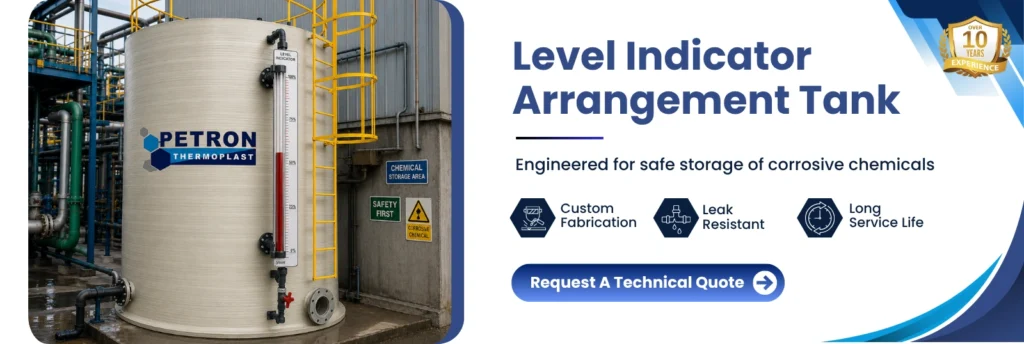
Level Indicator Arrangement Tank
A Level Indicator Arrangement Tank is specially designed for storage and process, equipped with integrated level and monitoring systems such as sight glasses, level gauges, float indicators, or electronic sensors. It is used to monitor and display the continuous liquid level inside the tank to ensure safe and efficient operation of industrial processes.
Level Indicator Arrangement Tanks help to operators and maintain accurate control over the fluid storage to prevent overflow and dry running conditions, and improve the overall safety and efficiency of the process. They are commonly manufactured using the materials such as HDPE, PP, FRP, PVDF, Stainless Steel, or hybrid materials to depends on the application and chemical compatibility requirements. Petron Thermoplast is a customizable level indicator, gauge, and sensor arrangement to allow the easy integration with manual or automated monitoring systems.


Excellent Chemical Resistance
HDPE, PP, FRP, PVDF, SS 304, SS 316, Mild Steel

Temperature Resistance
-10°C to 120°C (Depends on Material)

Corrosion-Free Construction
Excellent Chemical & Corrosion Resistance

Long Service Life
Long Operational Life with High Durability

ISO / ASTM / DVS Certified
Manufactured to international quality standards
-10°C to 120°C
Operating Temperature
100 L – 100K L
Capacity (Customizable)
ASTM D1998 & ISO
Certified quality standards
5 mm to 50 mm
Wall Thickness

Corrosion-Resistant Construction
Manufactured using the HDPE, PP, FRP, PVDF, Stainless Steel, or Mild Steel for excellent chemical resistance.

Temperature Resistance
Suitable for handling aggressive chemicals and varying operating temperatures.

Long Service Life
Built to withstand the harsh industrial environments and continuous operation.

Leak-Proof Welded Joints
Strong fabrication and secure fittings ensure safe and leak-free operation.
Technical Details
| Parameter | Details |
| Product Name | Level Indicator Arrangement Tank |
| Tank Type | Storage Tank / Process Tank / Chemical Handling Tank |
| Material of Construction | HDPE, PP, FRP, PVDF, SS 304, SS 316, Mild Steel |
| Tank Shape | Vertical, Horizontal, Cylindrical, Rectangular |
| Capacity Range | 100 Liters to 50,000 Liters or Customized |
| Thickness Range | 5 mm to 50 mm (Depending on Application) |
| Level Indicator Type | Sight Glass, Float Type, Magnetic, Digital, Ultrasonic |
| Level Monitoring | Manual or Automatic |
| Operating Temperature | -10°C to 120°C (Depends on Material) |
| Pressure Rating | Atmospheric to Low Pressure |
| Corrosion Resistance | Excellent Chemical & Corrosion Resistance |
| Surface Finish | Smooth / Matte / Mirror Finish (for SS Tanks) |
| Fabrication Method | Butt Welding, Extrusion Welding, FRP Lamination |
| Level Accuracy | High Precision Liquid Level Monitoring |
| Mounting Arrangement | Side Mounted / Top Mounted |
| Connection Type | Flanged, Threaded, Socket Weld |
| Accessories Available | Agitator, Ladder, Manhole, Drain Valve, Sensor, Pump |
| Safety Features | Overflow Protection & Leak-Proof Design |
| Applications | Chemical Storage, Dosing, Water Treatment, Process Monitoring |
| Industry Usage | Chemical, Pharma, Food, Textile, Oil & Gas, Electroplating |
| Maintenance | Low Maintenance & Easy Cleaning |
| Customization | Available as per Client Requirement |
| Service Life | Long Operational Life with High Durability |
Chemical compatibility is a critical factor when selecting a Level Indicator Arrangement Tank. Since level indicators are continuously exposed to the stored liquid, all wetted components—including gauges, sensors, floats, chambers, seals, and fittings—must be resistant to chemical attack. Proper compatibility to ensure the accurate level measurement, safe operation, and long service life.
Why Chemical Compatibility Matters
Proper chemical compatibility helps to:
- Prevent corrosion and material degradation
- Maintain level measurement accuracy
- Reduce maintenance and replacement costs
- Prevent leaks and chemical spills
- Improve equipment reliability and safety
- Extend service life of the tank and level indicator system
Components That Require Compatibility Assessment
When evaluating a level indicator arrangement, the following components should be checked:
- Tank body
- Sight tube or sight glass
- Magnetic float
- Float switches
- Level transmitters
- Sensor housings
- Chamber assemblies
- Flanges and nozzles
- Gaskets and seals
- Fasteners and mounting hardware
All wetted parts must be compatible with the stored chemical.
Common Materials Used in Level Indicator Arrangements
HDPE (High-Density Polyethylene)
HDPE is widely used for chemical storage tanks and external level columns.
Compatible with:
- Sulfuric Acid
- Hydrochloric Acid
- Phosphoric Acid
- Sodium Hydroxide
- Ferric Chloride
- Sodium Hypochlorite
- Excellent corrosion resistance
- Lightweight construction
- Cost-effective solution
PPH (Polypropylene Homopolymer)
PPH offers excellent chemical resistance and higher temperature capability.
Compatible with:
- Strong acids
- Strong alkalis
- Salt solutions
- Industrial process chemicals
- Superior temperature resistance
- High chemical durability
- Excellent mechanical strength
PVDF (Polyvinylidene Fluoride)
PVDF is preferred for highly aggressive and high-purity chemical applications.
Compatible with:
- Nitric Acid
- Oxidizing chemicals
- Chlorinated chemicals
- High-purity process fluids
- Exceptional chemical resistance
- Excellent long-term stability
- High-temperature performance
PTFE (Polytetrafluoroethylene)
PTFE is commonly used for seals, gaskets, and sensor protection components.
- Near-universal chemical resistance
- Excellent sealing performance
- High-temperature capability
Chemical Compatibility Guide
| Chemical | HDPE | PPH | PVDF | PTFE |
| Sulfuric Acid | Excellent | Excellent | Excellent | Excellent |
| Hydrochloric Acid | Excellent | Excellent | Excellent | Excellent |
| Phosphoric Acid | Excellent | Excellent | Excellent | Excellent |
| Sodium Hydroxide | Excellent | Excellent | Excellent | Excellent |
| Sodium Hypochlorite | Excellent | Excellent | Excellent | Excellent |
| Ferric Chloride | Excellent | Excellent | Excellent | Excellent |
| Nitric Acid | Good* | Good* | Excellent | Excellent |
| Acetic Acid | Good | Excellent | Excellent | Excellent |
| Ammonia Solution | Excellent | Excellent | Excellent | Excellent |
The Testing and Quality Assurance of a Level Indicator Arrangement Tank are critical to ensuring accurate level measurement, leak-free operation, structural integrity, and long-term reliability. Since the level indicator is an essential monitoring component, both the tank and the level indication system must undergo comprehensive inspections and testing before commissioning.
Importance of Testing and Quality Control
Proper testing helps to:
- Ensure accurate level measurement
- Verify leak-proof construction
- Confirm structural integrity
- Improve operational safety
- Prevent product loss and overfilling
- Extend equipment service life
- Ensure compliance with industry standards
1. Raw Material Inspection
Quality assurance begins with the verification of all incoming materials.
Material Verification
Inspection includes:
- Material grade confirmation
- Manufacturer certification review
- Chemical resistance verification
- Visual inspection for defects
Thickness Verification
The thickness of thermoplastic sheets and indicator chamber materials is checked to ensure compliance with design specifications.
2. Dimensional Inspection
Critical dimensions are verified during fabrication.
Inspection Parameters
- Tank diameter, height, and capacity
- Nozzle sizes and locations
- Indicator chamber dimensions
- Sight tube length
- Mounting arrangement dimensions
- Support structure measurements
Accurate dimensions ensure proper installation and operation.
3. Weld Quality Inspection
All welded joints are inspected throughout manufacturing.
Visual Weld Inspection
Checks include:
- Weld uniformity
- Surface finish
- Cracks
- Porosity
- Incomplete fusion
- Excessive deformation
Critical Weld Areas
Special attention is given to:
- Tank shell welds
- Bottom welds
- Nozzle connections
- Indicator chamber welds
- Reinforcement welds
4. Hydrostatic Testing
Hydrostatic testing verifies the integrity of the tank structure.
- The tank is filled with water to the designated test level.
- The tank is maintained under observation for a specified period.
- Welds and joints are inspected for leakage and deformation.
- Confirm leak-proof construction
- Verify structural strength
- Validate fabrication quality
5. Level Indicator Leak Testing
The level indicator arrangement is tested independently.
Inspection Areas
- Sight tube connections
- Float chamber joints
- Sensor mounting points
- Isolation valves
- Instrument nozzles
This testing ensures the level monitoring system remains leak-free during operation.
Industries We Serve

Chemical Storage Industries
They are used for the accurate monitoring and storage of chemicals, acids, alkalis, and industrial liquids.

Water Treatment Plants
They are Ideal for monitoring the water levels in dosing tanks, treatment tanks, and wastewater processing systems.

Oil & Gas Industries
Applied in the fuel storage and process, the tanks for the safe and continuous level indication

Electroplating Industry
Suitable for monitoring chemical solution levels in plating and surface treatment tanks.

Industrial Water Storage
Integrated with an automated system for real-time liquid to level monitoring and process control.

Liquid Transfer Systems
They support the safe liquid handling by preventing overflow and dry-run conditions.
Features of Level Indicator Arrangement Tank

Accurate Liquid Level Monitoring
The designed to provide the precise and continuous monitoring of liquid levels inside the tank.
Multiple Level Indicator Options
Compatible with the sight glass, float type, magnetic, digital, and ultrasonic level indicators.
Corrosion-Resistant Construction
Manufactured using the HDPE, PP, FRP, PVDF, Stainless Steel, or Mild Steel for excellent chemical resistance.

Leak-Proof Design
Strong fabrication and secure fittings ensure safe and leak-free operation.

Real-Time Level Visibility
Allows operators to easily monitor of liquid levels for improved process of control and safety.
Overflow Protection
Helps prevent overflow, dry running, and liquid wastage during industrial operations.

Customizable Configuration
Available in various capacities, shapes, thicknesses, and indicator arrangements as per the requirement.

Easy Integration with Automation Systems
Can be connected with the sensors, alarms, pumps, and PLC-based control systems.

High Durability & Strength
Built to withstand the harsh industrial environments and continuous operation.

Low Maintenance Requirement
The smooth surface finish and durable materials to reduce the cleaning and maintenance efforts.
Safe & Reliable Operation
Enhances to workplace safety through controlled liquid monitoring and process management.
Temperature & Chemical Resistance
Suitable for handling aggressive chemicals and varying operating temperatures.
Manufacturing Process of Level Indicator Arrangement Tank
A Level Indicator Arrangement Tank is a storage or process tank equipped with a level monitoring system that allows operators to accurately measure and monitor liquid levels. The manufacturing process involves precision tank fabrication, installation of level indication components, quality inspections, and performance testing to ensure safe and reliable operation.
The manufacturing process begins with detailed engineering and design based on:
- Tank capacity requirements (100 Liters to 50,000 Liters or Customized)
- Chemical compatibility
- Operating temperature and pressure (-10°C to 120°C (Depends on Material))
- Type of level indicator arrangement
- Installation location
- Process and instrumentation requirements
- Applicable industry standards
Engineering drawings are prepared showing tank dimensions, nozzle locations, level indicator connections, and support structures.
The tank and level indicator components are manufactured from materials compatible with the stored liquid.
Common materials include:
- HDPE (High-Density Polyethylene)
- PPH (Polypropylene Homopolymer)
- PP (Polypropylene)
- PVDF
- PTFE (for seals and gaskets)
Material certifications are verified before fabrication begins.
Thermoplastic sheets are cut according to approved fabrication drawings.
This includes:
- Tank shell panels
- Bottom plates
- Roof sections
- Reinforcement components
- Level indicator chamber sections
- Nozzle connection pieces
Precision cutting ensures accurate assembly and dimensional consistency.
Shell Formation
The tank shell is fabricated by:
- Rolling sheets into cylindrical shapes, or
- Fabricating rectangular panels for custom tanks
The panels are aligned and prepared for welding.
Bottom Assembly
The tank bottom is welded to the shell using approved thermoplastic welding techniques to create a strong and leak-proof structure.
Top Assembly
Depending on the application, the top section may include:
- Flat covers
- Dome roofs
- Inspection openings
- Access manways
The level indicator system is fabricated according to the selected design.
Common Arrangements Include
Sight Tube Arrangement
- Transparent level tube
- Upper and lower connecting nozzles
- Isolation valves
- Protective guards
Magnetic Level Indicator
- Float chamber
- Magnetic float assembly
- External indicator scale
- Process connection nozzles
Sensor-Based Arrangement
- Mounting nozzles
- Sensor supports
- Instrument flanges
- Cable entry provisions
Nozzles are installed at designated locations for:
- Level indicator connections
- Filling lines
- Discharge lines
- Overflow systems
- Vent connections
- Instrumentation ports
Precise positioning ensures proper operation of the level indication system.
How to Select the Right HDPE Chemical Storage Tank
Selecting the right Level Indicator Arrangement Tank is essential for accurate liquid level monitoring, process control, inventory management, and operational safety. The proper level indication system helps to prevent overfilling, dry running of pumps, product loss, and process interruptions.
Begin by identifying the tank’s purpose and operating conditions:
- Chemical storage
- Water storage
- Process tanks
- Dosing tanks
- Mixing tanks
- Wastewater treatment tanks
The application determines the type of level indicator and arrangement required.
The characteristics of the liquid significantly influence level indicator selection.
Chemical composition
- Corrosiveness
- Viscosity
- Density
- Transparency
- Presence of solids or slurry
Highly corrosive chemicals may require non-contact level measurement systems and chemically resistant materials.
Visual Level Indication
Suitable for operators who need direct level observation.
Common options include:
- Sight Tube Indicators
- Transparent Level Gauges
- External Level Columns
Continuous Level Monitoring
Provides real-time level measurement.
Common options include:
- Ultrasonic Level Sensors
- Radar Level Sensors
- Hydrostatic Level Transmitters
- Magnetic Level Indicators
Point Level Detection
Used for high-level and low-level alarms.
Common options include:
- Float Switches
- Conductivity Sensors
- Capacitive Sensors
Sight Glass / Sight Tube Arrangement
- Simple design
- Cost-effective
- Easy visual monitoring
- Water tanks
- Chemical dosing tanks
- Small process tanks
Float-Type Level Indicator
- Mechanical operation
- Reliable performance
- Easy installation
- Storage tanks
- Water treatment systems
Magnetic Level Indicator
- External indication
- No direct liquid exposure
- High safety
- Hazardous and corrosive chemicals
Radar or Ultrasonic Level Indicator
- Non-contact measurement
- High accuracy
- Low maintenance
- Large chemical storage tanks
- Aggressive chemicals
- Automated facilities
The level indicator arrangement should match the tank dimensions.
Small Tanks
- Sight tubes
- Float indicators
Medium Tanks
- Magnetic indicators
- Level transmitters
Large Tanks
- Radar systems
- Ultrasonic transmitters
- Remote monitoring systems
Larger tanks typically require more sophisticated level monitoring solutions.
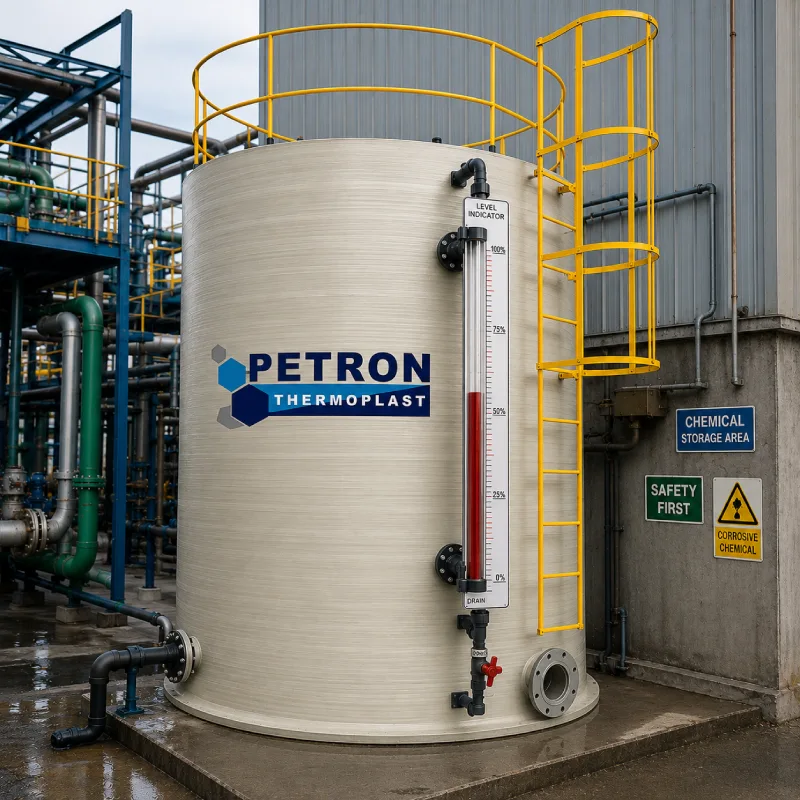

Custom Product Manufacturing Available
If you are searching for customized product designs that meet your requirements, don’t worry. Petron Thermoplast also offers custom product manufacturing services to meet the unique needs of various industries. Work with our expert engineers to create custom designs suited for your application.
Why Choose Petron Thermoplast?
Petron Thermoplast provides the Level Indicator Arrangement Tanks that are preferred in industrial applications because they provide accurate and continuous monitoring of liquid levels inside the storage of process tanks. The integrated level indication system helps to operators and maintain the proper chemical levels, prevent overflow, and improve the overall process efficiency and safety.
At Petron Thermoplast, the Level Indicator Arrangement Tanks are manufactured using durable and corrosion-resistant materials such as HDPE, PP, FRP, PVDF, and Stainless Steel, to make them suitable for handling chemicals, water, and industrial liquids. Petron Thermoplast is a customizable level indicator, gauge, and sensor arrangement to allow the easy integration with manual or automated monitoring systems.
Frequently Asked Questions
A Level Indicator Arrangement Tank is a storage or process tank equipped with a level monitoring system that allows operators to visually or electronically monitor the liquid level inside the tank. The arrangement may include sight tubes, magnetic level indicators, float systems, or electronic level sensors.
A level indicator helps:
- Monitor liquid levels accurately
- Prevent tank overfilling
- Avoid dry running of pumps
- Improve inventory management
- Enhance process control
- Increase operational safety
Common level indication systems include:
- Sight Tube Level Indicators
- Magnetic Level Indicators
- Float-Type Level Indicators
- Ultrasonic Level Sensors
- Radar Level Transmitters
- Hydrostatic Level Transmitters
- Float Switches
The choice depends on the application and process requirements.
A sight tube is connected to the tank through upper and lower nozzles. The liquid level inside the tube matches the level inside the tank, allowing operators to visually monitor the contents.
A magnetic level indicator uses a float containing a magnet that moves with the liquid level. The float’s movement is transferred to an external indicator, providing safe and accurate level measurement without direct exposure to the liquid.
For highly corrosive chemicals, common options include:
- Magnetic Level Indicators
- Radar Level Transmitters
- Ultrasonic Level Sensors
These systems minimize direct contact with the chemical and provide reliable performance.
Yes. Many level indication systems can be retrofitted to existing tanks, provided suitable nozzle connections and installation space are available.
Common materials include:
- HDPE
- PPH
- PP
- PVDF
- PTFE
- Stainless Steel (for suitable applications)
Material selection depends on chemical compatibility and operating conditions.
Accuracy depends on the technology used:
- Sight Tubes: Basic visual indication
- Magnetic Indicators: Moderate to high accuracy
- Radar Sensors: High accuracy
- Ultrasonic Sensors: High accuracy
- Hydrostatic Transmitters: High accuracy
The required accuracy should be determined during system design.
Yes. Electronic level indicators can be integrated with:
- PLC Systems
- SCADA Systems
- DCS Systems
- Remote Monitoring Systems
This allows real-time monitoring and automated process control.