Selecting the right pipe fittings is an important part of planning an industrial piping system. Fittings connect pipes, change flow direction, create branch lines and help connect pipelines with valves, tanks and process equipment. A wrong selection can lead to installation difficulties, compatibility problems or unexpected maintenance requirements. CPVC pipe fittings are used in suitable industrial piping applications where material compatibility, operating conditions and reliable connections are important.
Before purchasing CPVC fittings, buyers should review the product specifications, pipeline requirements and intended application. Petron Thermoplast manufactures industrial CPVC pipe fittings for process piping requirements. This buyer’s checklist explains the important factors to consider when selecting CPVC pipe fittings for industrial projects.
What Are CPVC Pipe Fittings?
CPVC stands for Chlorinated Polyvinyl Chloride. It is a thermoplastic material used in selected piping applications.
CPVC pipe fittings connect compatible CPVC pipes and help create the required pipeline arrangement. They are available in different shapes and configurations to support various piping layouts.
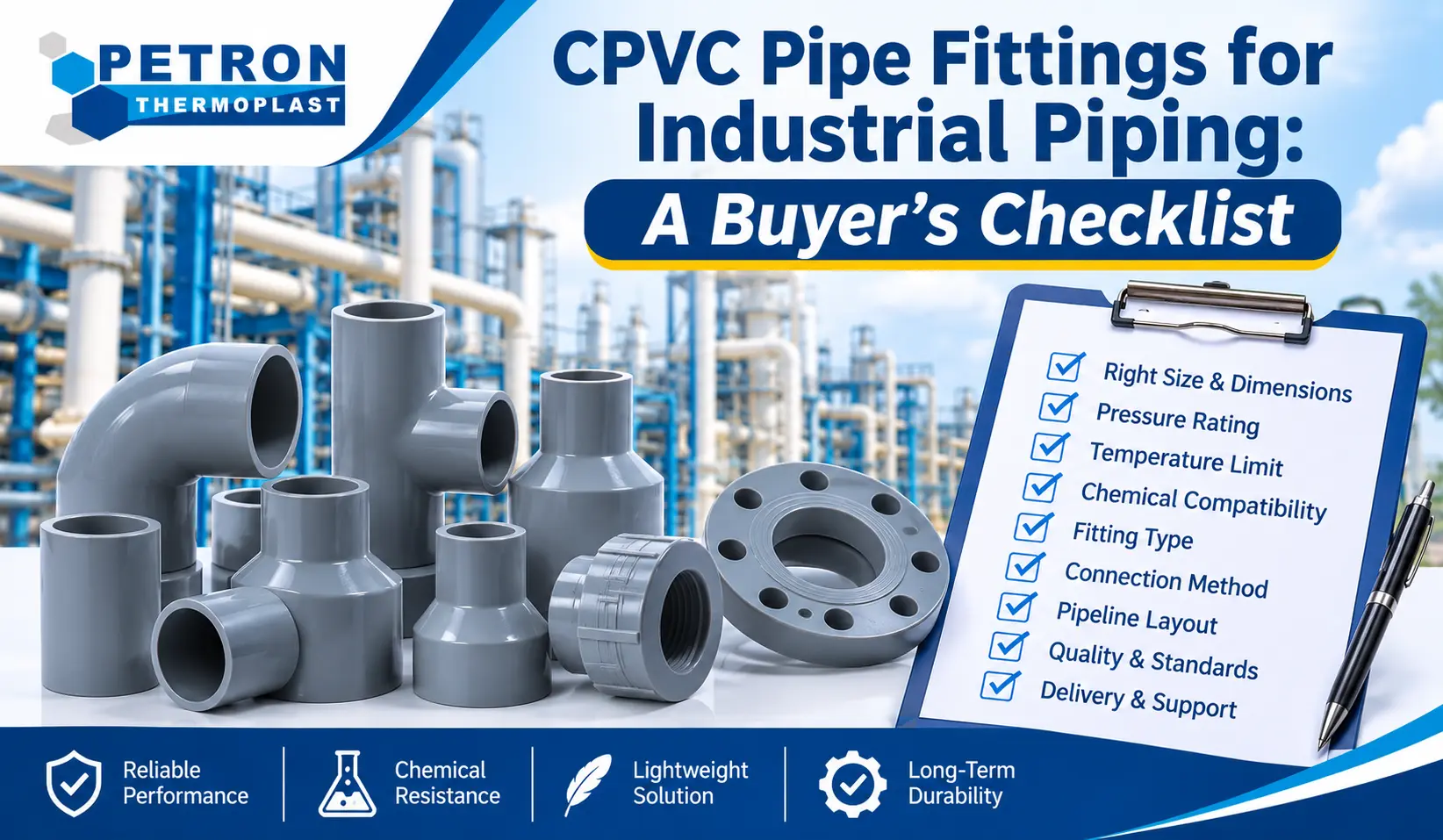
Common CPVC pipe fittings include:
- CPVC Elbows
- CPVC Tees
- CPVC Reducers
- CPVC Couplings
- CPVC Flanges
- CPVC Unions
- CPVC Adapters
- CPVC End Caps
Each fitting has a specific function. Elbows change the direction of a pipeline, tees create branch connections, and reducers connect different pipe sizes.
Choosing the correct fitting depends on the piping design, operating conditions and product specifications.
1. Check the Required Pipe Size and Fitting Dimensions
The first step when purchasing CPVC pipe fittings is to confirm the required size.
Industrial piping systems may use different pipe diameters depending on the flow requirement, equipment connection and pipeline design.
Before ordering, check:
- Required pipe diameter
- Fitting size
- Connection dimensions
- Pipe and fitting compatibility
- Applicable dimensional standards
Do not select a fitting based only on its nominal size. Confirm the actual dimensions and connection requirements with the product datasheet or approved technical drawing.
For large industrial projects, preparing a fitting list with the required sizes can help reduce ordering errors.
2. Select the Correct Fitting Type
Different fitting types perform different functions in a pipeline.
CPVC Elbows
Elbows are used to change the direction of a pipeline. Common configurations include 45-degree and 90-degree elbows, subject to product availability.
CPVC Tees
Tees create branch connections from a main pipeline. Equal and reducing configurations may be used according to the required pipe sizes.
CPVC Reducers
Reducers connect pipes with different diameters. They help create size transitions within the piping system.
CPVC Couplings
Couplings connect compatible pipe sections in a straight pipeline arrangement.
CPVC Flanges
Flanged connections are used where the piping design requires a removable or equipment connection.
Selecting the correct fitting type helps maintain the intended pipeline layout and makes installation planning easier.
3. Verify Pressure Rating
Operating pressure is an important factor when selecting industrial CPVC pipe fittings.
The pressure rating depends on the fitting design, size, material specifications and operating temperature. Buyers should not assume that every CPVC fitting has the same pressure capacity.
Before purchasing, confirm:
- Required operating pressure
- Product pressure rating
- Pressure limitations at the operating temperature
- System design requirements
- Applicable safety factors
Always refer to the approved product datasheet and engineering specifications.
Avoid using a general pressure value for all fitting sizes unless the manufacturer confirms that it applies to the complete product range.
4. Check the Operating Temperature
Temperature can affect the performance and pressure capacity of thermoplastic piping systems.
Before selecting CPVC fittings, identify the normal operating temperature and the maximum temperature expected during the process.
Check the following details:
- Continuous operating temperature
- Maximum process temperature
- Temperature variations
- Fluid temperature during cleaning or maintenance
- Pressure capacity at the operating temperature
The fitting must be suitable for the actual operating conditions of the pipeline.
A product’s maximum temperature limit should not automatically be treated as its maximum pressure operating condition. Pressure and temperature must be evaluated together.
5. Confirm Chemical Compatibility
Industrial piping systems may transport acids, alkalis, chemical solutions and other process fluids.
CPVC can be suitable for selected industrial chemical applications, but compatibility depends on the chemical composition and operating conditions.
Before ordering CPVC pipe fittings, confirm:
- Chemical name
- Concentration
- Fluid temperature
- Operating pressure
- Exposure conditions
- Compatibility of seals and connected components
Chemical resistance should be checked using reliable technical compatibility information.
Do not assume that CPVC is suitable for every chemical or concentration. Material selection should be reviewed by the responsible engineering team.
6. Check the Joining and Connection Method
The connection method is another important consideration when purchasing CPVC fittings.
Different fittings may use different connection arrangements depending on the product design and piping system.
For compatible CPVC socket systems, solvent cement joining may be used according to the manufacturer’s instructions. Other connection types may be required for specific equipment or pipeline arrangements.
Before ordering, confirm:
- Required connection type
- Pipe and fitting compatibility
- Joining procedure
- Installation equipment
- Required accessories
- Manufacturer’s installation instructions
Using the correct joining method helps create a suitable connection and supports the intended performance of the piping system.
7. Review the Pipeline Layout
A fitting should be selected according to the actual pipeline arrangement.
Industrial piping systems may include straight sections, directional changes, branch lines and connections to tanks or equipment.
Before finalizing the order, review the piping drawing and check:
- Pipeline direction
- Elbow positions
- Branch connection locations
- Reducer positions
- Valve and equipment connections
- Maintenance access
- Pipe support requirements
A well-planned layout can make installation more organized and help reduce unnecessary fitting changes during the project.
8. Confirm Product Quality and Technical Documentation
Industrial buyers should review the product information before placing an order.
Useful documents may include:
- Product datasheet
- Technical dimensions
- Material information
- Pressure and temperature details
- Installation instructions
- Applicable test or inspection records
- Relevant manufacturing standards, where confirmed
Ask the manufacturer for the documentation required by your project.
Do not rely only on general product descriptions. Technical information should match the actual fitting being supplied.
9. Consider Quantity and Project Requirements
For industrial projects, purchasing the correct quantity of fittings is important.
A detailed fitting schedule can help buyers organize the order and reduce the possibility of missing components.
Your purchase list should include:
- Fitting name
- Size
- Quantity
- Connection type
- Material requirement
- Technical specification
- Project delivery location
For customized or large-volume requirements, provide drawings or a bill of materials wherever available.
This information helps the manufacturer understand the project and prepare a more accurate quotation.
10. Check Delivery and Packaging Requirements
Industrial piping projects often follow installation schedules. Buyers should discuss delivery requirements before confirming an order.
Check:
- Required quantity
- Product availability
- Packaging requirements
- Delivery location
- Dispatch schedule
- Export or project documentation, if applicable
Fittings should be packed and handled in a way that protects them from damage during transportation and storage.
Confirm the delivery details with the manufacturer rather than assuming a standard delivery timeline.
Common Mistakes to Avoid When Buying CPVC Pipe Fittings
Avoid these common purchasing mistakes:
- Ordering fittings without confirming dimensions
- Selecting pressure ratings without checking operating temperature
- Ignoring chemical compatibility
- Choosing an incorrect connection type
- Using outdated or incomplete technical drawings
- Ordering quantities without a fitting schedule
- Assuming all CPVC fittings have identical specifications
- Failing to request product documentation
A careful review of these points before ordering can help prevent avoidable project delays and installation issues.
CPVC Pipe Fittings Buyer’s Checklist
Use this checklist before submitting your purchase enquiry.
| Checklist Item | What to Confirm |
| Pipe size | Required diameter and fitting dimensions |
| Fitting type | Elbow, tee, reducer, coupling, flange or other |
| Pressure | Required operating pressure and product rating |
| Temperature | Normal and maximum operating conditions |
| Chemical | Fluid type, concentration and compatibility |
| Connection | Joining method and connection arrangement |
| Layout | Pipeline drawing and fitting positions |
| Quantity | Required number of fittings |
| Documentation | Datasheet and technical details |
| Delivery | Location, packaging and project schedule |
Why Choose Petron Thermoplast for CPVC Pipe Fittings?
Petron Thermoplast manufactures industrial CPVC pipe fittings for suitable process piping applications. Our product range supports industrial buyers looking for fitting components for pipeline connections, directional changes and branch arrangements.
For project enquiries, buyers can share their required fitting types, sizes, quantities and technical specifications. This information helps the team understand the application and discuss suitable product requirements.
Conclusion
Buying CPVC pipe fittings for industrial piping requires careful consideration of size, fitting type, pressure, temperature, chemical compatibility and connection method. A clear buyer’s checklist helps engineers, contractors and purchasing teams review the important specifications before placing an order.
By confirming the product details and following the approved pipeline design, industrial buyers can select suitable CPVC fittings for their project requirements. Petron Thermoplast supports industrial enquiries for CPVC pipe fittings. Share your fitting list and technical requirements to discuss products for your piping application.
Frequently Asked Questions
1. What should I check before buying CPVC pipe fittings?
Check the fitting size, type, pressure rating, operating temperature, chemical compatibility, connection method and technical documentation.
2. Are CPVC pipe fittings suitable for industrial applications?
CPVC fittings are used in selected industrial piping applications. Suitability depends on the fluid, operating pressure, temperature and product specifications.
3. How do I select the correct CPVC fitting size?
Confirm the pipe diameter, fitting dimensions and connection requirements using the approved technical drawing or product datasheet.
4. Can CPVC pipe fittings be used for chemical handling?
They may be suitable for selected chemicals. Always verify compatibility with the chemical, concentration and operating conditions before use.
5. Which documents should I request from a CPVC fittings manufacturer?
Request the relevant product datasheet, dimensional information, material details, pressure and temperature specifications, and installation instructions.
6. How can I request a quotation for CPVC pipe fittings from Petron Thermoplast?
Share the required fitting types, sizes, quantities, connection details and project requirements by emailing sales@petronthermoplast.com.