Selecting the right CPVC pipe fittings is an important step in developing a reliable industrial piping system. The fittings used in a pipeline directly affect its performance, durability, and ability to handle different operating conditions. In industrial facilities, piping systems often carry chemicals, process fluids, and other materials that require careful selection of compatible components.
CPVC pipe fittings are widely considered for industrial applications because of their chemical resistance, corrosion protection, and suitability for various process environments. However, choosing the correct fittings requires more than checking the material name or pipe size. Factors such as chemical compatibility, operating temperature, pressure requirements, fitting design, and installation conditions must also be evaluated.
For industrial buyers, engineers, and project contractors, understanding these factors can help reduce installation problems and support long-term pipeline performance. This guide explains how to choose CPVC pipe fittings for industrial projects and what to consider before placing a bulk order.
What Are CPVC Pipe Fittings?
CPVC stands for Chlorinated Polyvinyl Chloride. It is a thermoplastic material produced by adding chlorine to PVC, which changes its material properties and improves its performance at elevated temperatures compared with standard PVC.
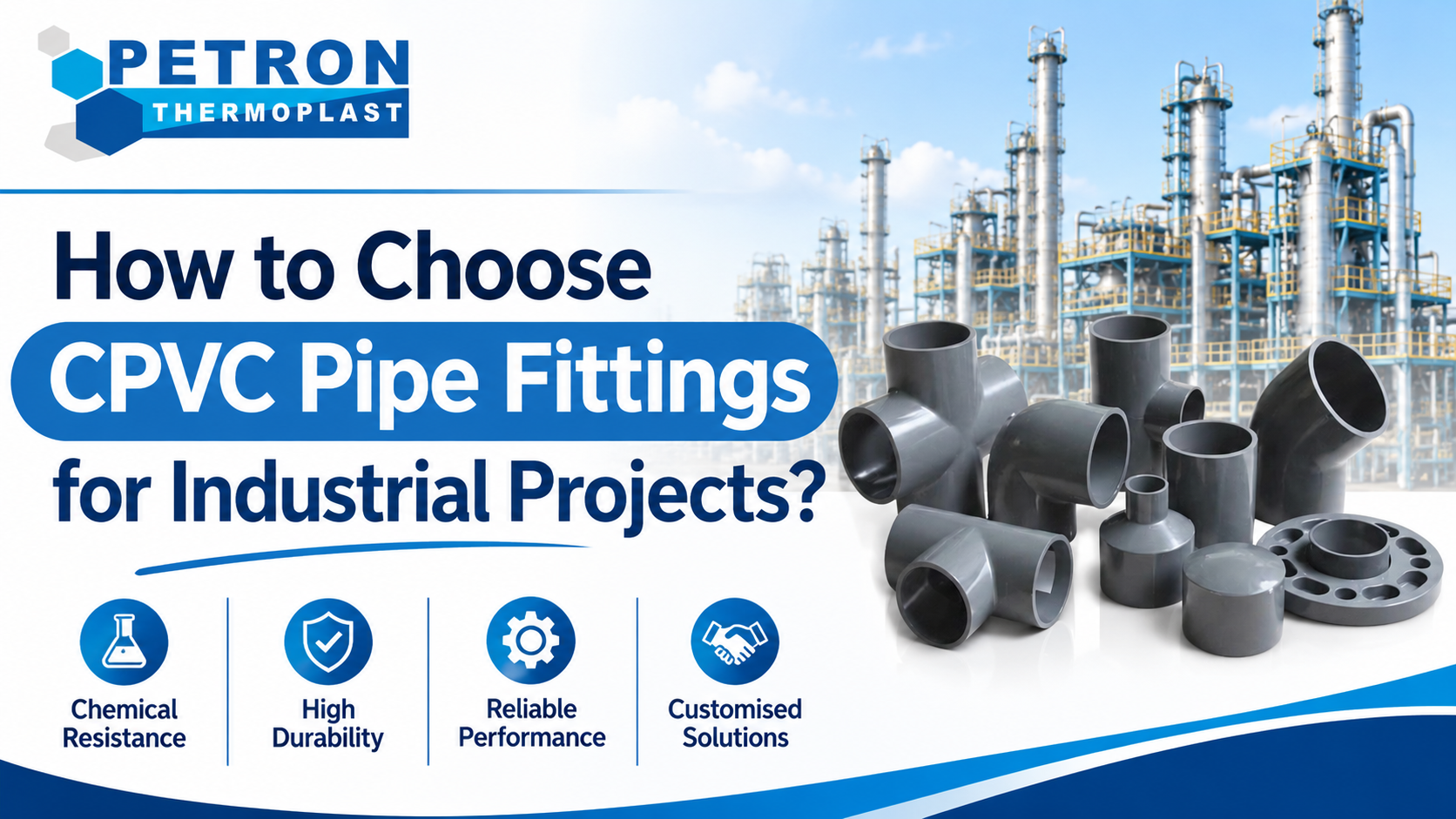
CPVC pipe fittings are used to connect, redirect, branch, or control the flow of fluids in a piping system. They are available in different designs and dimensions to suit various industrial pipeline arrangements.
Common CPVC pipe fittings include:
- CPVC Elbow
- CPVC Tee
- CPVC Reducer
- CPVC Coupling
- CPVC Union
- CPVC Flange
- CPVC Socket Fittings
- CPVC Threaded Fittings
- CPVC End Cap
1. Understand the Application Requirements
The first step in choosing CPVC pipe fittings is to understand the purpose of the piping system. Every industrial project has different operating conditions, and the fitting selection should be based on the actual application.
Before selecting fittings, identify:
- The type of fluid passing through the pipeline
- The operating temperature
- The working pressure
- The required pipe diameter
- The pipeline layout
- The installation environment
- The expected operating conditions
2. Check Chemical Compatibility
Chemical compatibility is one of the most important factors when selecting CPVC pipe fittings for industrial projects.
Industrial pipelines may carry acids, alkalis, salts, and other process chemicals. Although CPVC offers resistance to many chemicals, its suitability depends on the specific chemical, concentration, temperature, and exposure conditions.
Before finalizing the fittings, check the following:
- Chemical name and concentration
- Operating temperature of the fluid
- Chemical exposure duration
- Compatibility of the fitting material
- Compatibility of the joining method and sealing components
3. Select the Correct Size and Dimensions
The size of CPVC pipe fittings should match the pipeline design and required flow conditions.
Industrial projects may require fittings in different nominal diameters, depending on the pipeline capacity and equipment connections. Choosing the wrong size can create installation difficulties and may affect system performance.
Consider these dimensional requirements:
| Parameter | Selection Requirement |
| Nominal Pipe Size | Match the approved pipeline design |
| Outside Diameter | Confirm compatibility with the pipe system |
| Wall Thickness | Check the applicable pipe schedule or standard |
| Socket Dimensions | Verify proper joining compatibility |
| Thread Size | Match the connected equipment or component |
| Flange Dimensions | Confirm bolt pattern and connection standard |
4. Evaluate Pressure and Temperature Conditions
Pressure and temperature are closely related to the performance of CPVC pipe fittings.
CPVC systems are designed for specific operating conditions. However, the allowable pressure may decrease as the operating temperature increases. Therefore, a pressure rating should never be considered independently of temperature.
When selecting fittings, review:
- Maximum operating pressure
- Normal operating temperature
- Temperature variations
- Pressure fluctuations
- Possible surge or transient conditions
- Manufacturer’s pressure-temperature rating
5. Choose the Right Type of CPVC Pipe Fitting
Different fitting designs serve different purposes in industrial pipeline networks. Selecting the correct type helps simplify installation and maintain the required flow direction.
CPVC Elbow
CPVC elbows are used to change the direction of a pipeline. They are available in different angles, including 45-degree and 90-degree designs, depending on the piping layout.
CPVC Tee
CPVC tees are used to create branch connections from the main pipeline. They are suitable for pipeline arrangements where fluid needs to be distributed to multiple sections.
CPVC Reducer
Reducers connect pipes of different diameters. They are used when the pipeline size changes according to the system design.
CPVC Coupling
Couplings connect two compatible pipe sections in a straight pipeline arrangement.
CPVC Flange
Flanged fittings provide detachable connections between pipeline sections, equipment, or other components. They can be useful where inspection, maintenance, or equipment removal is required.
The fitting type should be selected according to the approved piping layout and connection requirements.
6. Consider the Connection Method
CPVC pipe fittings are available with different connection arrangements. The correct connection method depends on the pipeline design, installation conditions, and maintenance requirements.
Common connection methods include:
- Socket or solvent-cement joints
- Threaded connections
- Flanged connections
7. Check Applicable Standards and Quality Requirements
Industrial projects often require piping components to meet specific standards, drawings, or procurement specifications.
Before purchasing CPVC pipe fittings, check whether the project requires:
- A particular dimensional standard
- Material specifications
- Pressure-rating documentation
- Inspection or quality records
- Traceability requirements
- Approved product drawings
- Testing documentation, where applicable
8. Review Installation and Maintenance Requirements
A suitable CPVC fitting should not only meet the design requirements but also be practical to install and maintain.
Consider the available installation space, pipeline alignment, accessibility, and the need for future maintenance.
For example, a flanged connection may be preferred near equipment that requires periodic removal. A properly selected elbow or tee can also help simplify the pipeline arrangement.
During installation, ensure that:
- Pipes and fittings are properly aligned
- Joining surfaces are clean and prepared
- Compatible joining materials are used
- The recommended curing time is followed
- The system is inspected before operation
- Testing is performed according to the approved procedure
9. Select a Reliable CPVC Pipe Fittings Manufacturer
Choosing the right manufacturer is an important part of industrial procurement. A reliable manufacturer can help buyers obtain fittings according to project specifications and provide technical information during the selection process.
When evaluating a CPVC pipe fittings manufacturer, consider:
- Product range and availability
- Manufacturing and fabrication capabilities
- Customized fitting options
- Dimensional consistency
- Technical documentation
- Quality inspection procedures
- Bulk order handling
- Delivery planning
- Export and packaging support
Industrial Applications of CPVC Pipe Fittings
CPVC pipe fittings are used in different industrial environments where the material is compatible with the process conditions.
Common applications include:
- Chemical processing plants
- Industrial water treatment systems
- Manufacturing facilities
- Chemical transfer pipelines
- Industrial utility piping
- Process fluid distribution systems
- Equipment connection pipelines
Benefits of Choosing the Right CPVC Pipe Fittings
Selecting suitable fittings can provide several practical benefits for industrial piping projects.
Improved Pipeline Reliability
Correctly selected fittings help maintain proper connections and support reliable pipeline operation.
Corrosion Resistance
CPVC offers resistance to many corrosive environments, depending on the chemical and operating conditions.
Easy System Planning
A suitable range of elbows, tees, reducers, and other fittings helps engineers develop organized pipeline layouts.
Reduced Installation Issues
Matching fitting dimensions and connection types with the approved design can reduce fitting errors during installation.
Maintenance Convenience
Appropriate connection arrangements can make certain pipeline sections easier to inspect or dismantle when required.
Why Choose Petron Thermoplast for CPVC Pipe Fittings?
Petron Thermoplast focuses on industrial thermoplastic piping products and customized solutions for project-based requirements.
For industrial buyers, the selection of CPVC pipe fittings should be based on technical specifications, application requirements, and the approved pipeline design. Petron Thermoplast supports industrial project requirements with CPVC piping components and fitting options for different pipeline configurations.
Whether the requirement involves standard fittings or customized components, buyers should share the required sizes, connection details, operating conditions, and project drawings to help identify suitable products. For bulk procurement and industrial pipeline projects, clear technical communication helps improve product selection and order coordination.
Conclusion
Choosing the right CPVC pipe fittings for industrial projects requires careful evaluation of application requirements, chemical compatibility, size, pressure, temperature, connection method, and quality specifications.
A well-planned fitting selection helps engineers develop a piping system that meets the intended operating conditions and installation requirements. It also supports better procurement planning and reduces the possibility of avoidable fitting mismatches.
Before finalizing an order, review the technical specifications and confirm that the selected CPVC pipe fittings are suitable for the complete industrial piping system. For customized industrial requirements, Petron Thermoplast can be contacted with the project specifications, fitting sizes, and connection details to discuss suitable CPVC piping solutions.