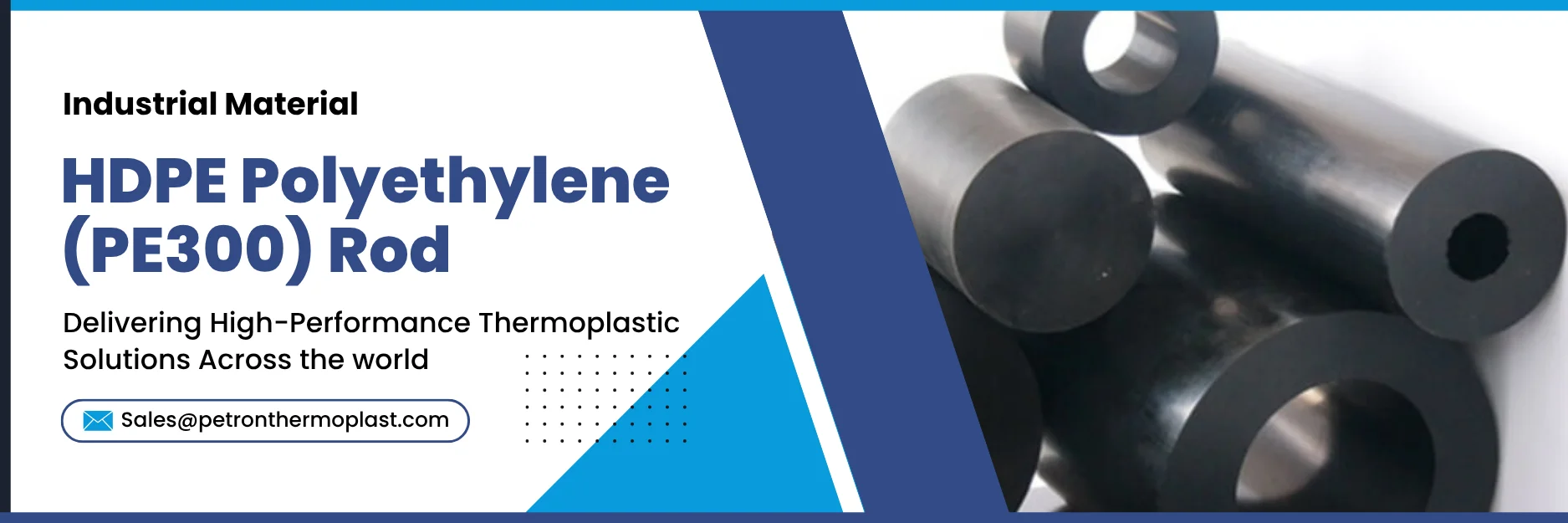
HDPE Polyethylene (PE300) Rod
An HDPE Polyethylene (PE300) rod is a solid, cylindrical engineering plastic product made from High-Density Polyethylene resin, specifically classified under the PE300 grade, which represents a standard-density and general-purpose polyethylene material.HDPE Polyethylene (PE300) rod is a general-purpose, solid plastic rod made from standard-grade high-density polyethylene, used for machining and industrial applications due to its durability and chemical resistance.
An HDPE PE300 rod is a thermoplastic polymer rod produced through extrusion, offering Moderate strength and stiffness, Excellent chemical resistance,Good impact resistance and Low moisture absorption.

Polyethylene PE300 Rod – HDPE Details
| Property | Value (Typical) |
| Material Type | High-Density Polyethylene (HDPE – PE300) |
| Density | 0.94 – 0.96 g/cm³ |
| Color | Natural (White), Black, Custom colors |
| Water Absorption | < 0.01% |
| Surface Finish | Smooth / Machined |
| Tensile Strength | 20 – 30 MPa |
| Elongation at Break | 500 – 700% |
| Flexural Modulus | 800 – 1200 MPa |
| Impact Strength | High (Excellent toughness) |
| Hardness | Shore D 60 – 70 |
| Working Temperature | -50°C to +80°C |
| Melting Point | 120 – 130°C |
| Vicat Softening Point | ~ 75 – 85°C |
| Thermal Conductivity | ~ 0.4 W/m·K |
| Dielectric Strength | 20 – 30 kV/mm |
| Volume Resistivity | > 10¹⁵ Ω·cm |
| Insulation Properties | Excellent |
| Chemical Resistance | Excellent against acids, alkalis, salts |
| Solvent Resistance | Good (limited resistance to strong oxidizers) |
| Corrosion Resistance | उत्कृष्ट (Highly resistant) |
| Manufacturing Method | Extrusion |
| Machinability | Easy (turning, drilling, milling) |
| Weldability | Excellent (butt fusion, extrusion welding) |
| Formability | Good |
1. High Impact Strength
- Excellent resistance to shocks and sudden loads
- Does not crack easily under stress
2. Lightweight Material
- Density around 0.95 g/cm³
- Much lighter than metals, easy to handle and install
3. Excellent Chemical Resistance
- Consistent to acids, alkalis, and many chemicals
- Ideal for corrosive environments
4. Low Moisture Absorption
- Near-zero water absorption
- Suitable for wet and humid conditions
5. Good Machinability
- Easy to cut, drill, mill, and turn
- Compatible with CNC machining
6. Low Friction Surface
- Smooth surface reduces wear and friction
- Ideal for sliding and moving parts
7. Corrosion Resistant
- Does not rust or degrade like metals
- Long-lasting in harsh environments
8. Non-Toxic & Food Safe
- Virgin grades are safe for food contact
- Widely used in food processing industries
9. Good Electrical Insulation
- High dielectric strength
- Suitable for electrical applications
| Small Sizes (mm) | Medium Sizes (mm) | Large Sizes (mm) |
| 10 | 60 | 160 |
| 12 | 65 | 180 |
| 15 | 70 | 200 |
| 16 | 75 | 225 |
| 20 | 80 | 250 |
| 25 | 90 | 280 |
| 30 | 100 | 300 |
| 32 | 110 | 350 |
| 35 | 120 | 400 |
| 40 | 125 | 500 |
| 45 | 130 | 600 |
| 50 | 140 | 700 |
| Property | Value (Typical) |
| Compressive Strength @ 23°C | 20 – 30 MPa |
| Allowable Working Stress | 8 – 12 MPa (recommended) |
| Rod Diameter | Load Capacity (Approx.)* |
| 20 mm | 6 – 10 kN |
| 50 mm | 40 – 70 kN |
| 100 mm | 150 – 300 kN |
| 200 mm | 600 – 1200 kN |
1. Industrial & Engineering Applications
- Bushings and bearings
- Gears and rollers
- Wear strips and guide rails
- Spacer blocks and supports
2. Chemical Industry
- Tank components and linings
- Valve seats and seals
- Pump parts
3. Water Treatment
- Pipe fittings and connectors
- Pump housings
- Filtration system parts
4. Food Processing Industry
- Cutting boards
- Food handling equipment
- Rollers and conveyor parts
5. Marine Industry
- Dock fenders
- Boat components
- Wear pads
6. Automotive Industry
- Bushings and washers
- Interior mechanical parts
- Protective components
7. Construction Industry
- Ground protection mats (machined parts)
- Shims and spacers
- Structural support components
User Manual for Polyethylene PE300 Rod – HDPE
| Property | Value (Typical) |
| Working Temperature Range | -50°C to +80°C |
| Short-Term Maximum Temperature | Up to 90–100°C |
| Melting Point | 120°C to 130°C |
| Vicat Softening Temperature | 75°C to 85°C |
| Brittle Temperature | Below -70°C (approx.) |
1. Pre-Installation Preparation
- Check rod for defects, cracks, or deformation
- Verify dimensions and tolerances as per design
- Clean the surface to remove dust, oil, or contaminants
2. Cutting & Machining
- Use standard tools for:
- Cutting (band saw, circular saw)
- Turning and drilling
- Maintain sharp tools to avoid surface damage
- Avoid excessive heat buildup during machining
3. Fitting & Assembly
- Ensure proper alignment during installation
- Use bolts, clamps, or press-fit methods depending on application
- Allow slight clearance for thermal expansion
4. Welding
Methods:
- Butt fusion
- Hot plate welding
- Extrusion welding
- Maintain correct temperature and pressure for strong joints
5. Handling & Storage During Installation
- Avoid dropping or dragging rods
- Store on flat surfaces to prevent bending
- Protect from direct sunlight (if not UV stabilized)
Maintenance of HDPE (PE300) Rod
1. Regular Inspection
- Check for:
- Wear and tear
- Cracks or deformation
- Surface damage
- Inspect periodically based on usage conditions
2. Cleaning
- Clean with:
- Mild detergent
- Water or soft cloth
- Avoid harsh chemicals that may degrade the surface
3. Lubrication (If Used in Moving Parts)
- Usually not required due to low friction
- Light lubrication may be used in high-load applications
4. Wear Monitoring
- Replace components if:
- Excessive wear is observed
- Dimensional accuracy is lost
5. Temperature Control
- Ensure operation within -50°C to +80°C
- Avoid prolonged exposure to high temperatures
6. UV Protection
- Use UV-stabilized rods for outdoor use
- Apply protective covers if necessary
7. Storage Maintenance
- Store in a cool, dry place
- Keep away from direct sunlight and heat sources
- Stack properly to avoid deformation
1. Size & Dimension Customization
- Diameter: 10 mm to 500 mm+
- Length: Standard (1–3 m) or custom cut sizes
- Tight tolerances achievable for precision parts
2. Shape & Component Customization
- Converted into:
- Bushings
- Bearings
- Rollers
- Gears
- Sleeves and spacers
- Custom profiles based on drawings or CAD designs
3. Material Grade Customization
- Virgin PE300 → High quality, food-grade applications
- Reprocessed PE300 → Economical option
- Modified grades:
- UV stabilized
- Anti-static
- Glass-filled (enhanced strength and stiffness)
4. Color Customization
- Standard: Natural (white), Black
- Custom colors: Blue, Green, Red, Yellow
- Used for identification, branding, or safety coding
5. Surface Finish Customization
- Smooth finish for low friction
- Matte/textured finish for grip
- Polished surfaces for precision components
6. Additive Customization
- UV stabilizers for outdoor use
- Anti-oxidants for thermal stability
- Flame retardants for safety applications
Processing of HDPE (PE300) Rod
1. Extrusion Process
- Primary manufacturing method
- HDPE granules are melted and extruded through a die
- Produces rods with uniform diameter and smooth surface
2. Machining Operations
HDPE PE300 rods are easy to machine:
- Turning (lathe work)
- Milling
- Drilling
- Cutting and sawing
- Threading
3. CNC Processing
- High-precision machining for complex shapes
- Ideal for engineering parts with tight tolerances
4. Welding & Fabrication
- Methods:
- Butt fusion
- Hot plate welding
- Extrusion welding
- Used for joining with other plastic components
5. Thermal Forming (Limited)
- Heating and bending into required shapes
- Less common than machining but possible
6. Surface Treatment
- Polishing for smooth finish
- Flame treatment for improved bonding (if adhesive is used)
1. Testing of HDPE (PE300) Rod
Density Test
- Confirms material consistency and grade
- Typical range: 0.94 – 0.96 g/cm³
- Method: Water displacement / density column
Melt Flow Index (MFI) Test
- Measures flow behavior of molten HDPE
- Indicates molecular weight and processing quality
- Ensures uniform extrusion performance
Tensile Strength Test
- Evaluates resistance to pulling forces
- Ensures mechanical strength for load-bearing applications
- Standard: ASTM D638 / ISO 527
Impact Strength Test
- Determines resistance to sudden shocks
- Methods: Izod or Charpy impact test
Hardness Test
- Measured on Shore D scale (60–70 typical)
- Indicates surface durability and wear resistance
Thermal Testing
- Includes:
- Vicat Softening Temperature (VST)
- Heat Deflection Temperature (HDT)
- Ensures performance at elevated temperatures
2. Quality Control Process
Raw Material Inspection
- Verification of HDPE resin grade (PE300)
- Checking for contamination and impurities
In-Process Quality Control
- Monitoring extrusion parameters:
- Temperature
- Pressure
- Cooling rate
- Ensures uniform diameter and smooth surface
Final Product Inspection
- Visual inspection:
- Cracks
- Voids
- Surface defects
- Mechanical and dimensional testing before dispatch
1. Engineering & Manufacturing Industry
- Used for:
- Bushings and bearings
- Rollers and gears
- Wear strips and guide rails
- Low friction and high impact strength
2. Chemical & Process Industry
- Applications:
- Chemical tank components
- Pump and valve parts
- Scrubber systems
- Excellent resistance to corrosive chemicals
3. Water Treatment Industry
- Used in:
- Pipe fittings
- Filtration components
- Pump housings
- Non-toxic and corrosion-resistant
4. Food Processing Industry
- Applications:
- Cutting boards
- Food conveyor parts
- Machine components
- Food-grade safe and hygienic (virgin PE300)
5. Automotive Industry
- Applications:
- Bushings and spacers
- Interior mechanical parts
- Protective components
- Lightweight and wear-resistant
6. Construction Industry
- Used in:
- Spacer blocks
- Shims and supports
- Ground protection components
- High strength and weather resistance
1. Base Raw Material
High-Density Polyethylene (HDPE – PE300) Resin
- Primary material used for manufacturing
- Produced by polymerization of ethylene (C₂H₄)
- Supplied in the form of granules/pellets
- Density: 0.94 – 0.96 g/cm³
- High strength-to-weight ratio
- Excellent chemical resistance
- Low moisture absorption
2. Additives Used
UV Stabilizers
- Protect against sunlight degradation
- Essential for outdoor applications
Antioxidants
- Prevent thermal degradation during processing
- Increase product lifespan
Carbon Black / Color Masterbatch
- Provides color (especially black)
- Enhances UV resistance
Processing Aids
- Improve melt flow during extrusion
- Ensure smooth surface finish
Anti-static Agents
- Reduce static charge buildup
- Used in electronic or dust-sensitive environments
Flame Retardants
- Improve fire resistance
- Used in safety-critical applications
Glass Fiber Reinforcement (Optional)
- Increases stiffness and strength
- Used for heavy-duty industrial parts
3. Types of Raw Material Grades
Virgin HDPE (PE300)
- Pure, high-quality material
- Suitable for food-grade and medical use
Reprocessed (Recycled) HDPE
- Made from recycled plastic
- Cost-effective but slightly lower performance
Modified HDPE Compounds
- Tailored formulations with additives for specific applications:
- UV-resistant HDPE
- Anti-static HDPE
- Flame-retardant HDPE
4. Input Form for Manufacturing
- Raw material is fed into machines as:
- Pellets / Granules
- Processed through extrusion to form solid rods

Custom Product Manufacturing Available
If you are searching for customized product designs that meet your requirements, don’t worry. Petron Thermoplast also offers custom product manufacturing services to meet the unique needs of various industries. Work with our expert engineers to create custom designs suited for your application.
Benefits of HDPE Polyethylene (PE300) Rod
Durability
HDPE rods demonstrate impressive impact strength, making them suitable for demanding applications requiring durability.
Chemical Resistance
They resist degradation from acids, bases, and solvents, allowing for prolonged use in harsh environments.
Low Friction
The low coefficient of friction makes them ideal for sliding applications or as bearing materials.
Recyclability
As a recyclable material, HDPE contributes to sustainability efforts, reducing the carbon footprint.
Cost-Effectiveness
HDPE is generally affordable, especially considering its durability and longevity.
Types of HDPE Polyethylene (PE300) Rod
1. Based on Material Composition
Virgin HDPE (PE300) Rod
- Made from 100% pure raw material
- High strength and consistent quality
- Suitable for food-grade and medical applications
Reprocessed (Recycled) HDPE Rod
- Made from recycled HDPE material
- Cost-effective
- Slightly lower mechanical properties
- Used in non-critical applications
2. Based on Functional Modifications
UV Stabilized HDPE Rod
- Contains UV additives
- Resistant to sunlight degradation
- Ideal for outdoor applications
Anti-Static HDPE Rod
- Reduces static electricity buildup
- Used in electronics and dust-sensitive areas
Flame-Retardant HDPE Rod
- Modified to resist fire spread
- Used in electrical and industrial safety applications
Glass-Filled HDPE Rod
- Reinforced with glass fibers
- Increased stiffness and strength
- Used in heavy-duty engineering parts
3. Based on Color
Natural (White) HDPE Rod
- Standard, uncolored form
- Common in food and pharmaceutical industries
Black HDPE Rod
- Contains carbon black
- Improved UV resistance
- Widely used in outdoor and industrial applications
Colored HDPE Rods
- Blue, Green, Red, Yellow, etc.
- Used for identification and aesthetic purposes
4. Based on Manufacturing Method
Extruded HDPE Rod
- Most common type
- Cost-effective
- Available in a wide range of sizes
Molded HDPE Rod
- Produced by compression molding
- Better internal structure for large diameters
- Higher cost but improved performance
Why Choose Petron Thermoplast?
At Petron Thermoplast, HDPE Materials are critical components in piping systems, ensuring smooth flow transitions and efficient use of space. Understanding the dimensions and applications of short radius bends is essential for designing reliable and efficient piping systems. By adhering to standards such as ASME B16.9, engineers can ensure compatibility and performance across various industries.
Conclusion
HDPE Polyethylene (PE300) rods are versatile, durable, and cost-effective engineering materials widely used in general industrial and commercial applications. They offer a balanced combination of mechanical strength, chemical resistance, low friction, and lightweight properties, making them suitable for machining into a variety of components.
With features like easy machinability, corrosion resistance, and low moisture absorption, PE300 rods perform reliably in environments involving chemicals, water exposure, and moderate mechanical loads. Their ability to be customized and processed into different shapes and sizes further enhances their usability across industries such as chemical processing, food handling, construction, and manufacturing.
Although they have moderate temperature and load-bearing limits compared to higher grades (like PE500 or UHMW/PE1000), PE300 rods remain an economical and practical choice for non-critical and general-purpose applications.
Frequently Asked Questions
An HDPE Polyethylene (PE300) rod is a solid plastic rod made from high-density polyethylene, designed for general engineering and industrial applications.
PE300 refers to a standard-grade polyethylene with moderate molecular weight, suitable for general-purpose use.
- Bushings and bearings
- Rollers and gears
- Chemical tank parts
- Food processing equipment
- Water treatment components
- Diameter: 10 mm to 500 mm+
- Length: 1 m, 2 m, 3 m (custom available)
Typically 0.94 – 0.96 g/cm³, making it lightweight yet strong.
- Working range: -50°C to +80°C
- Melting point: 120–130°C
Yes, they have excellent resistance to acids, alkalis, and many chemicals.
Yes, they are easy to machine using:
- Turning
- Milling
- Drilling
- CNC machining
Yes, virgin-grade PE300 is food-safe and suitable for food processing applications.
No, they have very low moisture absorption, making them ideal for wet environments.
- Standard PE300: Limited UV resistance
- UV-stabilized PE300: Suitable for outdoor use
Yes, using:
- Butt fusion
- Extrusion welding
- Hot plate welding
- Lightweight
- Corrosion resistant
- Low friction
- Easy to fabricate
- Cost-effective
- PE300: General-purpose, economical
- PE500: Higher strength and better wear resistance
Yes, they are 100% recyclable, making them environmentally friendly.