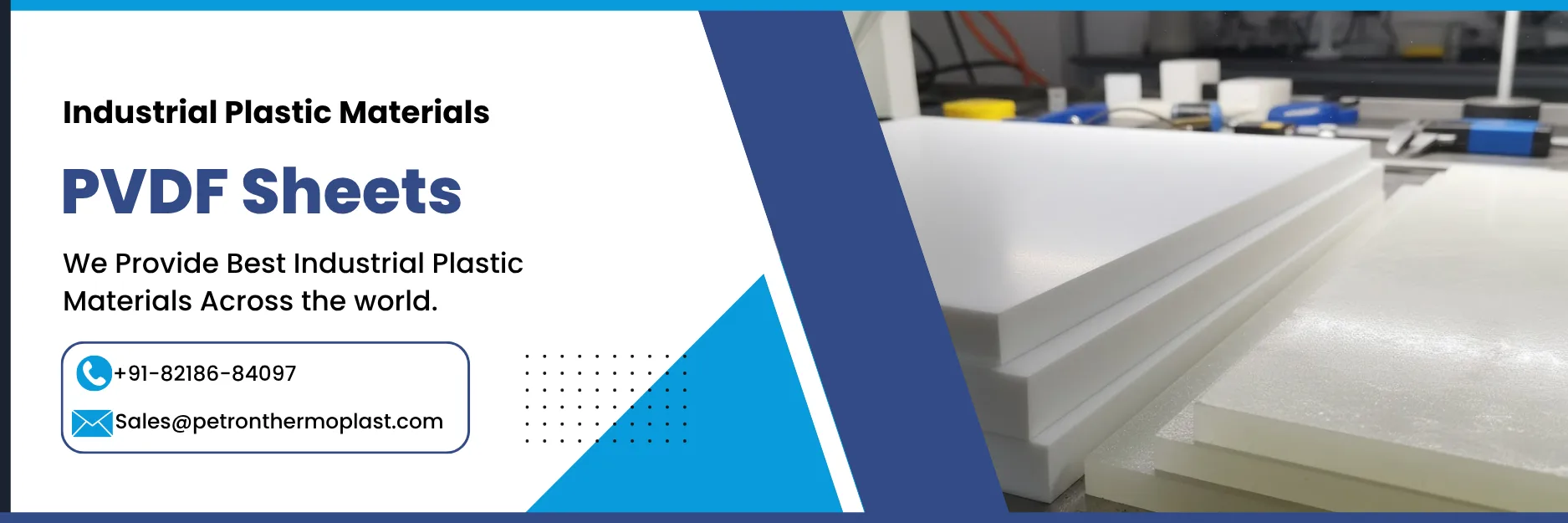
PVDF Sheets
A PVDF sheet is a flat, solid sheet made from Polyvinylidene Fluoride (PVDF), a high-performance thermoplastic fluoropolymer. PVDF sheets are known for their excellent chemical resistance, thermal stability, mechanical strength, and electrical insulation properties. They are widely used in chemical, pharmaceutical, electrical, food processing, and industrial applications where durability and resistance to harsh environments are required.
PVDF sheet has strong chemical resistance as well as good mechanical, thermal, and electrical qualities. It offers strong UV, corrosion, and radiation resistance and may be utilised in chemical applications. It is also a versatile engineering material due to its high wear resistance and sliding qualities. Electrical wire and cable insulation, anti-corrosion linings, corrosion resistant diaphragms, pipe-lining for corrosive liquids and gases, sliding components, and agitators are some of the main applications.

- Chemical Resistance
- Low Maintenance Requirement
- Low Thermal Conductivity
- Long Service Life
- Easy Installation
- Corrosion Resistance
PVDF Sheet Details
| Property | Typical Value / Description |
| Material | PVDF (Polyvinylidene Fluoride) |
| Form | Sheet / Plate |
| Standard Thickness Range | 1 mm – 50 mm (custom thicknesses available) |
| Standard Sheet Size | 1000 mm × 2000 mm, 1220 mm × 2440 mm |
| Color | Natural White / Translucent |
| Density | 1.75 – 1.78 g/cm³ |
| Melting Point | 165 – 175 °C |
| Glass Transition Temperature (Tg) | ~ –35 °C |
| Max Continuous Service Temp | ~140 °C (depending on grade and seal compatibility) |
| Min Service Temperature | ~ –40 °C |
| Tensile Strength | 40 – 55 MPa |
| Elongation at Break | 30 – 50% |
| Flexural Strength | 50 – 80 MPa |
| Hardness (Shore D) | 70 – 80 |
| Impact Strength (Notched Izod) | 5 – 8 kJ/m² |
| Thermal Conductivity | 0.17 – 0.19 W/m·K |
| Coefficient of Thermal Expansion | 100 – 150 ×10⁻⁶ /°C |
| Water Absorption (24 h) | < 0.04% |
| Chemical Resistance | Excellent: strong acids, bases, halogens, and oxidizers |
| UV Resistance | Moderate; UV-stabilized grades available |
| Flammability | UL 94 V-0 (self-extinguishing) |
| Surface Finish | Smooth, glossy or matte |
| Machinability | Easily cut, milled, drilled, or shaped (CNC ready) |
| Applications | Liners, chemical tanks, corrosion-resistant panels, insulation |
| Thickness | Standard Sheet Size (mm) | Remarks / Typical Use |
| 1 mm | 1000 × 2000 / 1200 × 2400 | Thin sheets for lining, insulation, or protective covers |
| 2 mm | 1000 × 2000 / 1200 × 2400 | General-purpose applications, chemical tanks |
| 3 mm | 1000 × 2000 / 1200 × 2400 | Medium-strength industrial use |
| 4 mm | 1000 × 2000 / 1200 × 2400 | Chemical and corrosion-resistant panels |
| 5 mm | 1000 × 2000 / 1200 × 2400 | Heavy-duty lining and fabrication |
| 6 mm | 1000 × 2000 / 1200 × 2400 | Structural parts, machine guards |
| 8 mm | 1000 × 2000 / 1200 × 2400 | High-strength mechanical and chemical applications |
| 10 mm | 1000 × 2000 / 1200 × 2400 | Thick panels for tanks, wear-resistant surfaces |
| 12 mm | 1000 × 2000 / 1200 × 2400 | Large-scale industrial and structural use |
| 15 mm | 1000 × 2000 / 1200 × 2400 | Heavy-duty corrosion protection and fabrication |
| 20 mm | 1000 × 2000 / 1200 × 2400 | Specialty applications requiring high chemical and mechanical resistance |
| Temperature (°C) | Approx. Density (g/cm³) | Notes |
| −50 | 1.79 | Below $T_g$, rigid |
| 0 | 1.79 | Slight contraction |
| 7 | 1.78–1.79 | Typical low temp |
| 25 (room temp) | 1.78 | Standard reference |
| 50 | 1.77 | Slight thermal expansion |
| 100 | 1.76 | Polymer softens slightly |
| 150 | 1.75 | Approaching melt, density decreases |
| 170–175 | 1.74–1.75 | Melting point range, crystalline regions break down |
| >175 | – | PVDF melts, sheet loses solid structure |
| PVDF Sheet Thickness (mm) | Maximum Working Pressure (MPa / bar) | Notes |
| 1 mm | 2 MPa / 20 bar | Small sheets, low load |
| 2 mm | 4 MPa / 40 bar | Standard thin sheets |
| 3 mm | 6 MPa / 60 bar | Medium thickness |
| 5 mm | 10 MPa / 100 bar | Common industrial sheet |
| 10 mm | 15 MPa / 150 bar | Heavy-duty applications |
| 20 mm | 20 MPa / 200 bar | Thick sheets, structural use |
1. High Chemical Resistance
- Resistant to strong acids, bases, and most organic solvents.
- Suitable for chemical tanks, piping, and equipment.
2. Excellent Mechanical Strength
- Strong, durable, and impact-resistant.
- Maintains integrity under pressure and moderate loads.
3. Thermal Stability
- Can withstand continuous temperatures up to 150–170 °C.
- Stable for hot fluid handling and industrial processes.
4. Abrasion and Wear Resistance
- Smooth surface reduces friction.
- Resistant to wear and erosion, ideal for chutes and slides.
5. UV and Weather Resistance
- Resistant to sunlight, weathering, and outdoor conditions.
- Does not easily crack, yellow, or degrade over time.
6. Electrical Insulation
- High dielectric strength, suitable for electrical and electronic applications.
7. Non-Toxic and Food Safe
- Safe for use in food processing, pharmaceuticals, and potable water applications.
8. Lightweight and Easy to Fabricate
- Easier to handle than metals.
- Can be cut, welded, thermoformed, or machined into custom shapes.
9. Long Service Life
- Resistant to chemical attack, UV, thermal stress, and wear.
- Provides durable, reliable performance in harsh environments.
More About PVDF Sheet
1. Chemical Processing Industry
- PVDF sheets are resistant to strong acids, bases, and solvents, making them ideal for:
- Lining tanks, vessels, and pipes
- Fabrication of chemical storage containers
- Corrosion-resistant components in reactors
- Lining tanks, vessels, and pipes
2. Pharmaceutical and Food Industry
- PVDF is non-toxic, hygienic, and resistant to bacterial growth, used for:
- Food processing equipment
- Pharmaceutical reactors and hoppers
- Filters and membranes in production lines
3. Electrical and Electronics Industry
- PVDF sheets have excellent electrical insulation properties:
- Insulation layers in transformers, motors, and cables
- Protective housings for electronic devices
- Components in capacitors
4. Water Treatment and Membrane Technology
- PVDF is used in ultrafiltration and microfiltration membranes:
- Water and wastewater treatment plants
- Filtration units in industrial processes
- Membranes in desalination plants
5. Aerospace and Automotive Industries
- PVDF’s lightweight and heat-resistant nature makes it suitable for:
- Fuel system components
- Protective linings and gaskets
- Coatings and laminates for interior panels
6. Architectural and Construction Industry
- PVDF sheets are used as coatings and panels:
- Facade laminates and cladding
- Roofing and window frames
- Decorative panels resistant to UV and weathering
7. Battery and Energy Storage Industry
- PVDF is used as a binder in lithium-ion batteries:
- Coating for electrodes in batteries
- Ensures chemical stability and enhances performance
1. Preparation
- Surface Cleaning
- Ensure the surface is smooth, clean, dry, and free from dust, oil, or chemicals.
- For industrial applications, remove rust or rough edges if lining tanks or pipes
- Cutting
- PVDF sheets can be cut using fine-toothed saws, CNC routers, or shears.
- Avoid excessive force to prevent cracking.
- Allow for thermal expansion by leaving small gaps between sheets if used as cladding.
- Checking Sheet Condition
- Inspect for scratches, cracks, or defects before installation.
- Keep sheets flat; avoid bending sharply.
2. Mounting / Fixing
For Industrial Lining (Tanks, Vessels, Pipes)
- Use adhesives suitable for PVDF (like PTFE-based adhesives) or mechanical fasteners with insulation pads.
- Ensure expansion joints: PVDF expands with heat; allow 2–3 mm per meter.
- Welded or heat-bonded seams may be used in specialized applications (requires skilled labor).
For Roofing and Cladding
- Install with screws, rivets, or clips designed for PVDF sheets.
- Maintain a uniform gap (typically 5–10 mm) for thermal expansion.
- Overlap edges slightly if used outdoors to prevent water ingress.
For Electrical / Battery Applications
- PVDF sheets as insulators or separators are cut to size and placed without stress; mechanical fasteners are usually not required.
3. Thermal Considerations
- PVDF expands with temperature: coefficient of linear expansion ≈ 1.3 × 10⁻⁴ mm/mm/°C.
- Always allow movement in fixing points to prevent buckling.
- Avoid installation in extreme cold without warming the sheets.
4. Post-Installation
- Check alignment and flatness of sheets.
- Inspect for gaps, loose fasteners, or scratches.
- For chemical applications, allow adhesives to cure fully before exposure.
Maintenance
1️. Routine Cleaning
- Use lukewarm water and mild detergent
- Clean with a soft cloth or sponge
- Rinse thoroughly with clean water
- Dry with a microfiber cloth to avoid water spots
- Abrasive scrubbers
- Strong solvents (unless PVDF chemical compatibility is confirmed)
- High-pressure water directly at sheet joints
2️. Inspection and Preventive Checks
Every 3–6 months:
- Check for:
- Loose fasteners
- Cracks or warping
- Joint separation
- Surface scratches
For industrial lining:
- Inspect welded seams
- Look for chemical attack signs
- Check expansion gaps
3️. Chemical Exposure Maintenance
PVDF has strong resistance to:
- Acids
- Alkalis
- Solvents
- After heavy chemical exposure, rinse immediately.
- Confirm chemical compatibility if new chemicals are introduced.
- Neutralize spills before cleaning if required.
4️. Scratch & Surface Damage Repair
Minor scratches:
- Light polishing with approved plastic polish.
- Section replacement is recommended.
- For welded sheets, professional re-welding may be needed.
5️.Outdoor / UV Exposure Care
- Remove dirt buildup to maintain appearance.
- Check expansion joints yearly.
- Inspect fasteners for corrosion.
6️. Storage
- Store flat on a clean surface.
- Keep away from direct sunlight.
- Avoid heavy loads on top.
- Maintain room temperature storage.
A. Mechanical Testing
- Tensile Strength Test: Measures rod’s resistance to pulling forces.
- Flexural Strength Test: Determines resistance to bending.
- Impact Test (Notched Izod or Charpy): Evaluates resistance to sudden shocks.
- Hardness Test (Rockwell R): Assesses surface hardness and wear resistance.
B. Thermal Testing
- Heat Deflection Temperature (HDT): Determines the temperature at which the rod deforms under load.
- Melting Point Analysis: Ensures correct crystallinity and thermal stability (~170–175 °C).
- Thermal Expansion Test: Measures linear expansion to allow proper installation and tolerances.
C. Chemical Resistance Testing
- Immersion in acids, bases, and solvents to ensure no swelling, cracking, or degradation.
- Ensures suitability for chemical processing and water treatment applications.
D. Electrical Testing
- Dielectric Strength Test: Confirms insulating ability.
- Volume & Surface Resistivity Tests: Measures electrical resistivity for electronic applications.
E. Physical & Dimensional Testing
- Density Measurement: Confirms consistency of material composition.
- Dimensional Accuracy: Verifies diameter, length, and straightness.
- Water Absorption Test: Ensures low moisture uptake.
F. Visual & Surface Inspection
- Check for surface defects, scratches, cracks, or inclusions.
- Ensures a smooth surface for sliding parts or aesthetic applications.
Quality Standards
- Conformance to ASTM standards (e.g., ASTM D3299 for PVDF resin).
- ISO certification may apply to manufacturing and testing processes.
- Material certificates (Mill Test Certificates) are usually provided for chemical, mechanical, and thermal properties.
- Batch testing ensures uniformity and reliability across production.
1️. Cutting & Machining
Cutting Methods
- Circular saw (fine-tooth blade)
- CNC routing
- Laser cutting (controlled settings)
- Waterjet cutting (high precision)
Machining Operations
- Drilling
- Milling
- Turning
- Slotting and grooving
2️. Thermoforming & Bending
PVDF can be heat-formed but requires controlled temperature.
Process:
- Heating range: 150°C – 170°C
- Use strip heaters or industrial ovens
- Bend gradually to avoid stress cracks
- Allow slow cooling to maintain shape
- Curved linings
- Protective covers
- Custom enclosures
3️. Welding & Joining
Welding Methods:
- Hot air welding
- Extrusion welding
- Butt welding
- Socket fusion (for pipes)
- Use compatible PVDF welding rods
- Clean surfaces before welding
- Skilled operator required for chemical tank fabrication
4️. Surface Customization
Surface Finishes:
- Smooth
- Matte
- Textured
- Embossed
Color Customization:
- Natural (off-white)
- Black
- Custom industrial colors (upon request)
Printing & Labeling:
- UV printing
- Laser marking
- Engraving
- Used for branding, identification panels, and architectural facades.
5️.Thickness & Size Customization
- Thickness: 1 mm – 50 mm
- Custom sheet sizes available
- CNC-cut custom shapes
- Chemical tank linings
- Electrical insulation panels
- Battery component sheets
- Architectural cladding
6️. Laminating & Composite Fabrication
PVDF sheets can be:
- Bonded to metal panels
- Used as corrosion-resistant liners
- Combined with FRP structures
- Integrated into multilayer composite systems
- Chemical plants
- Water treatment facilities
- Roofing and facade systems
7️. Special Industrial Processing
Perforation
For filtration and airflow systems.
CNC Precision Components
Used in semiconductor and electronics industries.
Membrane Production
PVDF is processed into filtration membranes for water treatment.
- Primary Material:
- Polyvinylidene Fluoride (PVDF)
- Semi-crystalline fluoropolymer made from the polymerization of vinylidene fluoride monomer (CH₂=CF₂).
- Grades:
- Homopolymer PVDF: Offers higher mechanical strength and chemical resistance.
- Copolymer PVDF: Slightly lower mechanical properties but better impact resistance and processability.
- Additives (Optional):
- UV stabilizers – for outdoor durability
- Lubricants – for easier machining
- Colorants – for aesthetic or identification purposes
Benefits of PVDF Sheets
1. Excellent Chemical Resistance
- Resistant to most acids, bases, and solvents.
- Can handle harsh chemicals like hydrochloric acid, sulfuric acid, and chlorine solutions without degradation.
- Ideal for lining tanks, pipes, and reactors in chemical industries.
2. High Mechanical Strength
- Strong and durable, with good tensile and impact strength.
- Maintains structural integrity under moderate loads and pressures, even at elevated temperatures.
3. Thermal Stability
- Can withstand temperatures up to ~150–170 °C continuously.
- Maintains performance in hot fluid handling and industrial processes.
4. Low Friction & Wear Resistance
- Smooth surface reduces friction, making it ideal for lining chutes, slides, or wear plates.
- Resistant to abrasion compared to many other plastics.
5. UV & Weather Resistance
- Excellent resistance to UV radiation, sunlight, and outdoor weather.
- Doesn’t yellow, crack, or degrade easily, making it suitable for outdoor applications.
6. Non-Toxic & Food Safe
- Can be used in food processing, pharmaceutical, and medical applications.
- Meets regulatory standards for contact with potable water and food.
7. Electrical Insulation Properties
- Good dielectric strength, useful in electrical and electronic components.
8. Lightweight & Easy to Fabricate
- Easier to handle and install than metals.
- Can be cut, welded, or thermoformed for custom shapes and assemblies.
9. Long Service Life
- Resistant to corrosion, chemical attack, UV, and wear, giving it a long operational lifespan.
Applications of PVDF Sheets
1. Chemical Industry
- Tank and pipe linings – Resistant to acids, alkalis, and corrosive chemicals.
- Chemical reactors – Used as a protective lining to prevent corrosion.
- Valves, fittings, and gaskets – Ensure long-term chemical resistance.
2. Food & Pharmaceutical Industry
- Food processing equipment – Non-toxic and compliant with food safety standards.
- Pharmaceutical manufacturing – Used in cleanroom environments for chemical-resistant surfaces.
- Storage tanks and hoppers – For handling sensitive chemicals or liquids safely.
3. Water Treatment
- Membrane modules and filter housings – PVDF is hydrophobic yet chemically resistant, ideal for ultrafiltration systems.
- Piping for aggressive fluids – Handles acids, bases, and disinfectants.
4. Electrical & Electronics
- Insulation materials – High dielectric strength for cables and electronic components.
- Protective coatings – For wires and sensors in harsh environments.
5. Industrial & Mechanical Applications
- Wear plates and liners – Low friction and abrasion-resistant surfaces for chutes, hoppers, and slides.
- Structural components – Sheets can be cut, welded, or thermoformed into machine parts.
- Pump and valve components – Corrosion-resistant parts in industrial machinery.
6. Architectural & Outdoor Applications
- Facade cladding and roofing – UV-resistant and weatherproof.
- Protective coatings – For metal surfaces exposed to sunlight and corrosive environments.
7. Renewable Energy
- Solar panels and energy storage systems – Used as protective sheets and insulators due to chemical and UV resistance.
Advantages of PVDF Sheet
1. Excellent Chemical Resistance
- Resistant to strong acids, bases, and most solvents.
- Ideal for chemical tanks, pipes, and reactors without corrosion risk
2. High Mechanical Strength
- Durable and impact-resistant.
- Maintains structural integrity under moderate loads and pressure.
3. Thermal Stability
- Can operate continuously at temperatures up to 150–170 °C.
- Performs well in hot fluid handling and industrial processes.
4. Abrasion and Wear Resistance
- Low friction surface reduces wear.
- Suitable for wear plates, chutes, and slides.
5. UV and Weather Resistance
- Excellent resistance to sunlight and outdoor conditions.
- Does not crack, yellow, or degrade easily over time.
6. Non-Toxic and Food Safe
- Safe for food processing and pharmaceutical applications.
- Complies with standards for contact with potable water.
7. Electrical Insulation
- Good dielectric strength, useful for electrical and electronic applications.
8. Lightweight and Easy to Fabricate
- Easier to handle than metals.
- Can be cut, welded, or thermoformed for custom shapes.
9. Long Service Life
- Resistant to chemical attack, UV, abrasion, and thermal degradation.
- Provides a durable and reliable solution in harsh environments.
Why Choose Petron Thermoplast?
Petron Thermoplast supply PVDF plastic sheets and customized parts with excellent quality, export-grade standards, and professional processing to meet diverse needs. The use of advanced technology ensures that the PVDF sheet surface is smooth and flawless, without pores, and has a delicate touch, perfectly presenting the unique charm of high-quality PVDF plastic sheets and parts. PVDF sheets undergo rigorous performance tests to ensure that strength, weather resistance and other indicators meet standards, providing customers with reliable and durable plastic sheets and parts.
With a wide variety of products and sufficient inventory, we can quickly respond to customer needs and meet purchasing needs in one stop.
We are committed to providing high-quality services throughout the entire process. From consultation to after-sales, our professional team is on standby at all times to ensure customer satisfaction and create a worry-free purchasing experience.
Conclusion
PVDF sheets are a premium-grade thermoplastic solution suitable for demanding industrial and structural applications. Their durability, versatility, and resistance properties make them one of the most reliable materials for environments where standard plastics fail. PVDF (Polyvinylidene Fluoride) sheets are high-performance engineering thermoplastic materials known for their exceptional chemical resistance, thermal stability, UV resistance, mechanical strength, and electrical insulation properties. Overall assessment of PVDF sheets offers a strong combination of: excellent resistance to acids, alkalis, and solvents, Superior UV and weather resistance, good mechanical and impact strength, low maintenance requirements and Long service life in harsh environments
Industrial Significance
Because of these properties, PVDF sheets are widely used in:
- Chemical processing equipment
- Water treatment systems
- Pharmaceutical and food industries
- Electrical insulation and battery applications
- Architectural cladding and roofing
- Aerospace and automotive components
Cost vs. Performance
Although PVDF sheets may have a higher initial cost compared to standard plastics, they provide:
- Reduced maintenance costs
- Longer operational lifespan
- Improved safety and reliability
- Lower replacement frequency
Frequently Asked Questions
A PVDF sheet is a high-performance thermoplastic sheet made from Polyvinylidene Fluoride, known for excellent chemical resistance, UV stability, and mechanical strength.
They are used in:
- Chemical tank linings
- Water treatment systems
- Electrical insulation
- Battery components
- Architectural cladding
- Pharmaceutical equipment
Yes. PVDF has outstanding resistance to:
- Strong acids
- Alkalis
Most solvents
It is ideal for corrosive environments.
- Continuous service temperature: up to 40–140°C
- Melting point: 170–175°C
Yes. PVDF has excellent UV and weather resistance, making it suitable for roofing, facades, and exterior panels.
Yes. They can be joined using:
- Hot air welding
- Extrusion welding
- Butt fusion welding
Certain grades are compliant with food and pharmaceutical standards. Always confirm FDA or relevant certification before use.
- Use mild detergent and water
- Clean with a soft cloth
- Avoid abrasive cleaners and harsh chemicals
Typically available from 1 mm to 50 mm, depending on manufacturer and application.
PVDF offers:
- Higher temperature resistance
- Better chemical resistance
- Superior UV stability
Yes. Like all thermoplastics, it expands with temperature changes. Installation should allow for thermal expansion.
In proper conditions, PVDF sheets can last 15–25 years or more, especially in outdoor and chemical environments.