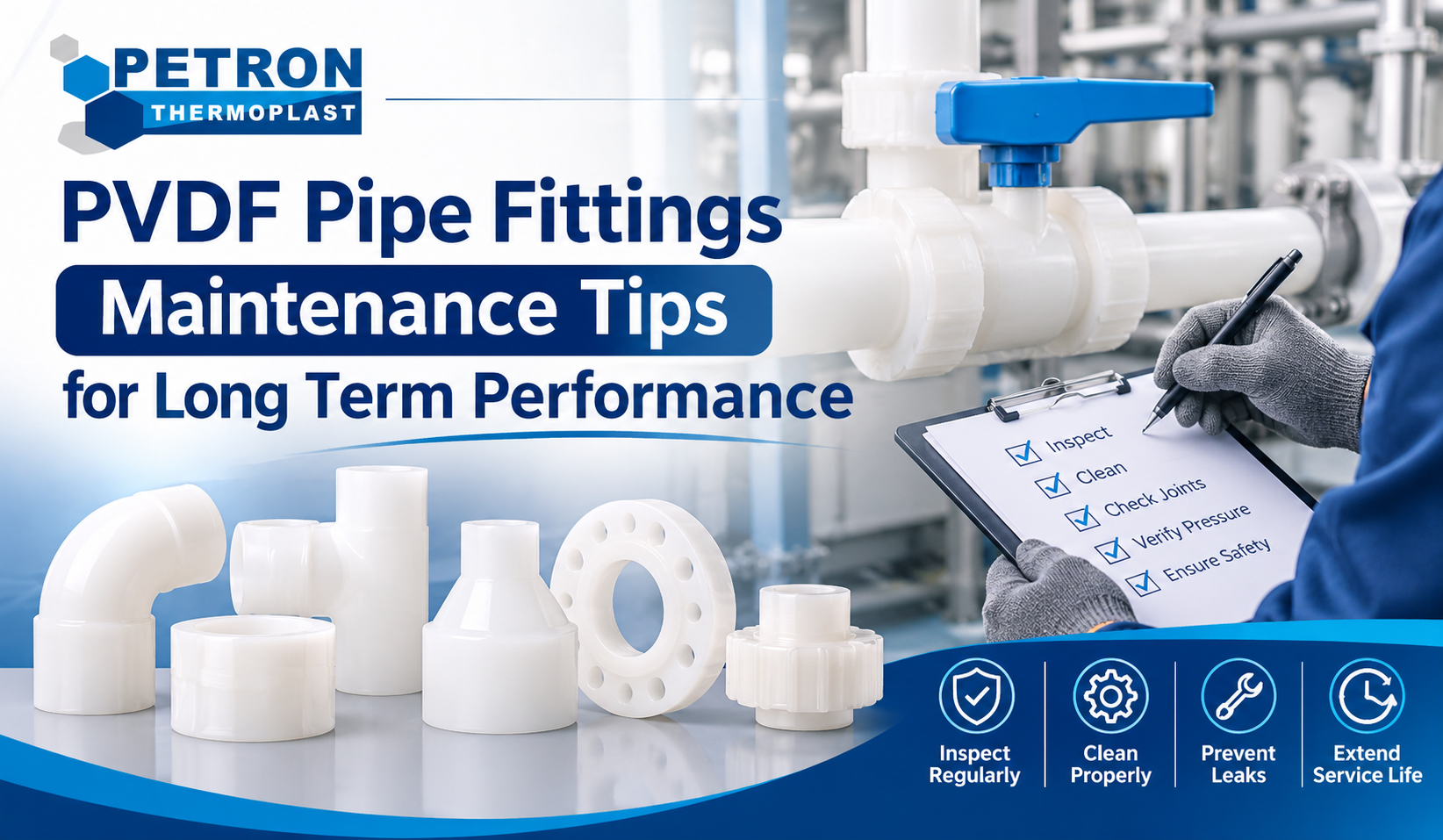
PVDF pipe fittings are widely used in industrial piping systems where chemical resistance, durability, and reliable fluid handling are important. These fittings are commonly selected for chemical processing plants, water treatment facilities, pharmaceutical applications, and other industries that require corrosion-resistant pipeline components. However, even high-quality PVDF pipe fittings need proper maintenance to support long-term performance.
Regular inspection, correct installation practices, and suitable operating conditions help reduce leakage, premature wear, and unexpected pipeline shutdowns. Maintenance also allows engineers to identify potential problems before they affect the complete piping system.
Petron Thermoplast manufactures industrial thermoplastic products, including PVDF pipe fittings for demanding piping applications. This guide explains practical PVDF pipe fittings maintenance tips that can help industrial users maintain their pipeline systems efficiently.
Why Is PVDF Pipe Fittings Maintenance Important?
PVDF, or Polyvinylidene Fluoride, is a high-performance thermoplastic material known for its chemical resistance and mechanical properties. It is used in industrial applications where conventional materials may not provide the required corrosion resistance.
Although PVDF pipe fittings are suitable for many demanding environments, their performance depends on proper handling, installation, and maintenance.
A regular maintenance program helps industrial facilities:
- Identify leakage and connection problems at an early stage
- Maintain reliable pipeline operation
- Reduce the risk of unexpected equipment shutdowns
- Detect mechanical damage or stress
- Improve the service life of piping components
- Maintain safe and efficient chemical transfer operations
1. Conduct Regular Visual Inspections
Visual inspection is one of the simplest and most effective maintenance practices for PVDF pipe fittings.
Industrial maintenance teams should inspect fittings, joints, and nearby pipeline sections at scheduled intervals. The inspection frequency should depend on the application, operating conditions, and risk level of the process.
During inspection, check for:
- Visible leakage around joints and connections
- Cracks, scratches, or surface damage
- Discolouration or unusual surface changes
- Loose supports or damaged mounting arrangements
- Signs of vibration or mechanical stress
- Deformation around fitting connections
Pay particular attention to elbows, tees, reducers, flanges, and other connection points where mechanical stress may develop.
If any damage is identified, the affected component should be evaluated before the system continues operating. Do not ignore small leaks or visible cracks, as they may indicate a developing problem.
2. Check PVDF Pipe Fittings for Chemical Compatibility
PVDF offers resistance to many industrial chemicals, but compatibility should never be assumed for every chemical or operating condition.
Chemical compatibility depends on several factors, including:
- Chemical type
- Concentration
- Operating temperature
- Exposure duration
- Pressure and flow conditions
- Presence of mixed chemicals
Before using PVDF pipe fittings in a chemical processing system, confirm that the selected material is suitable for the actual process conditions.
During maintenance, investigate any unexpected swelling, surface changes, cracking, or deterioration. Such signs may indicate chemical exposure outside the recommended operating conditions or another material-related issue.
Always consult the manufacturer’s technical documentation and chemical compatibility information before approving a fitting for a specific application.
3. Maintain Correct Operating Pressure and Temperature
Pressure and temperature have a direct effect on the performance of thermoplastic piping systems.
PVDF pipe fittings should operate within the limits specified for the particular fitting, size, design, and material grade. The allowable pressure may decrease as operating temperature increases.
Maintenance teams should regularly review:
- Actual operating pressure
- Temperature variations
- Pressure fluctuations
- Sudden pressure surges
- Process changes
- Abnormal operating conditions
Avoid operating the pipeline beyond its approved pressure and temperature limits.
If the process requires a change in chemical concentration, temperature, or pressure, the piping system should be reviewed by a qualified engineer before the change is implemented.
4. Inspect Pipe Joints and Connections
The condition of joints is an important factor in the performance of PVDF pipe fittings.
Depending on the system design, PVDF fittings may use suitable fusion joining methods, threaded connections, flanged connections, or other approved arrangements.
During maintenance, inspect joints for:
- Leakage
- Misalignment
- Improper tightening
- Visible gaps
- Damage to sealing surfaces
- Signs of excessive mechanical loading
For flanged connections, inspect the gasket and sealing surfaces. Replace damaged or unsuitable sealing components according to the system manufacturer’s recommendations.
Do not apply excessive tightening force to plastic fittings or flange connections. Over-tightening may damage the fitting, gasket, or connection arrangement.
For fused joints, any suspected defect should be assessed by a trained technician. Repair or replacement should follow the approved joining and maintenance procedure.
5. Prevent Excessive Vibration and Mechanical Stress
Excessive vibration can affect the reliability of PVDF piping systems, especially around pumps, compressors, valves, and other connected equipment.
Continuous vibration may place additional stress on fittings and joints. Over time, this can contribute to connection failure or damage.
To reduce vibration-related problems:
- Check pipe supports and brackets regularly
- Inspect nearby rotating equipment
- Maintain proper pipeline alignment
- Avoid unsupported pipe sections
- Use suitable support arrangements for valves and heavy components
- Review the system if vibration increases unexpectedly
PVDF pipe fittings should not carry unnecessary loads from connected equipment or improperly supported piping.
If vibration is detected, identify and correct its source rather than relying only on replacing the affected fitting.
6. Clean PVDF Pipe Fittings Using Suitable Methods
Cleaning is important in industrial piping systems, particularly where chemical deposits, suspended particles, or process residues may accumulate.
However, the cleaning method must be compatible with the PVDF material and the process requirements.
Before cleaning, confirm:
- The cleaning chemical is compatible with PVDF
- The cleaning temperature is within approved limits
- The cleaning pressure is suitable for the piping system
- The cleaning procedure is safe for the process
- The system has been isolated and depressurised where required
Avoid using abrasive tools that may scratch or damage the fitting surface.
Do not use an unapproved chemical cleaning agent simply because it is commonly used for other piping materials. Always verify compatibility with the fitting manufacturer.
7. Check for Blockages and Flow Restrictions
Deposits, suspended solids, or process residues can sometimes restrict flow through industrial piping systems.
A blockage may increase pressure loss, affect process efficiency, or place additional stress on connected equipment.
Maintenance teams should monitor:
- Flow rate
- Pressure difference across relevant pipeline sections
- Unusual noise
- Changes in pump performance
- Visible deposits where inspection is possible
If a restriction is suspected, follow the approved cleaning or flushing procedure.
Do not attempt to remove a blockage by applying excessive pressure or using sharp tools that could damage the fitting.
8. Protect PVDF Pipe Fittings During Handling and Storage
Proper handling is important before installation and during maintenance activities.
Although PVDF is a durable engineering thermoplastic, fittings can still be damaged by impact, improper storage, or rough handling.
For safe handling:
- Avoid dropping fittings onto hard surfaces
- Do not drag fittings across rough floors
- Keep fittings away from sharp objects
- Store components in a clean and protected area
- Prevent unnecessary exposure to damaging environmental conditions
- Use suitable packaging during transportation
Before installing a stored fitting, inspect it for cracks, deformation, contamination, or other visible damage.
Damaged fittings should not be installed without technical evaluation.
9. Follow the Correct Replacement Procedure
When a PVDF pipe fitting becomes damaged or reaches the end of its approved service life, replacement may be necessary.
Before replacing a component, identify the reason for its failure. Replacing a fitting without correcting the underlying problem may lead to repeated maintenance issues.
Check the following before replacement:
- Correct fitting type and dimensions
- Material compatibility with the process
- Pressure and temperature requirements
- Connection or joining method
- Pipeline alignment
- Support and load conditions
Use a replacement component that matches the approved system specification.
After replacement, inspect the connection and conduct the required testing according to the plant’s safety procedures and applicable engineering requirements.
10. Maintain a Planned Inspection and Maintenance Schedule
A planned maintenance schedule helps industrial facilities manage piping systems more effectively.
The schedule should be based on operating conditions, process risk, manufacturer recommendations, and plant maintenance procedures.
A basic inspection checklist may include:
| Inspection Item | What to Check | Recommended Action |
| Fitting body | Cracks, scratches, or damage | Evaluate and replace if required |
| Pipe joints | Leakage or misalignment | Inspect and correct connection |
| Flanged connections | Gasket and sealing condition | Replace damaged sealing parts |
| Pipe supports | Loose or damaged supports | Repair support arrangement |
| Operating pressure | Pressure fluctuations | Investigate abnormal conditions |
| Operating temperature | Temperature variation | Verify approved operating limits |
| Chemical compatibility | Signs of material deterioration | Review chemical and process conditions |
| Flow performance | Restriction or unusual pressure loss | Inspect and clean as approved |
Common PVDF Pipe Fittings Maintenance Mistakes to Avoid
Incorrect maintenance practices can reduce the reliability of industrial piping systems.
Avoid these common mistakes:
- Ignoring minor leakage
- Using incompatible cleaning chemicals
- Over-tightening plastic connections
- Operating beyond approved pressure or temperature limits
- Installing damaged fittings
- Leaving pipes unsupported
- Using incorrect replacement components
- Performing repairs without checking the cause of failure
- Skipping inspection after maintenance work
Why Choose Petron Thermoplast for Industrial PVDF Pipe Fittings?
Petron Thermoplast manufactures industrial thermoplastic products for applications where material selection and piping requirements are important. PVDF pipe fittings are used in suitable industrial systems requiring corrosion resistance and reliable fluid handling. The selection of the correct fitting depends on the chemical, operating conditions, connection type, and project specifications.
Industrial buyers can discuss their requirements for PVDF pipe fittings with Petron Thermoplast, including fitting type, dimensions, quantity, and application details. For project enquiries, provide the chemical name, concentration, operating temperature, pressure, and required connection method. This information helps support a more accurate product selection and quotation process.
Conclusion
PVDF pipe fittings can provide reliable performance in demanding industrial piping systems when they are selected, installed, and maintained correctly. Regular visual inspections, chemical compatibility checks, pressure and temperature monitoring, joint inspection and proper handling are important parts of an effective maintenance program.
Industrial users should follow manufacturer recommendations and approved plant procedures for inspection, cleaning, repair, and replacement. A planned maintenance approach helps identify potential issues early and supports the safe, efficient operation of chemical and process piping systems. Petron Thermoplast manufactures industrial PVDF pipe fittings for suitable piping applications. Contact the team with your project specifications to discuss your industrial fitting requirements.
Frequently Asked Questions
1. How often should PVDF pipe fittings be inspected?
Inspection frequency depends on the application, chemical exposure, operating pressure, temperature, and plant maintenance policy. High-risk systems may require more frequent inspections.
2. Can PVDF pipe fittings be cleaned with chemical solutions?
Yes, suitable cleaning solutions may be used when their compatibility with PVDF has been verified. Always check the chemical concentration, temperature, and cleaning procedure before use.
3. What causes leakage in PVDF pipe fittings?
Leakage may result from improper joining, damaged sealing components, misalignment, excessive mechanical stress, vibration, or operation outside approved conditions.
4. Can damaged PVDF pipe fittings be repaired?
Repair depends on the fitting design, damage type, and approved maintenance procedure. In many cases, replacement with a suitable component may be the safer option.
5. Are PVDF pipe fittings suitable for corrosive chemicals?
PVDF offers resistance to many chemicals, but suitability depends on the chemical type, concentration, temperature, and exposure conditions. Compatibility should be confirmed before installation.
6. How can the service life of PVDF pipe fittings be improved?
Correct material selection, proper installation, regular inspection, suitable operating conditions, and planned maintenance can help support long-term performance.
7. What information is required when ordering PVDF pipe fittings?
Industrial buyers should provide the fitting type, size, quantity, connection method, chemical details, operating temperature, pressure, and project specifications.