HDPE pipe fittings are widely used in industrial pipeline systems because of their strength, flexibility, and suitability for various water, chemical, and process applications. When selecting HDPE fittings for an industrial project, choosing the correct joining method is just as important as selecting the fitting size and material.
Two commonly used joining methods are HDPE Electrofusion Fittings and HDPE Butt Fusion Fittings. Both methods use heat to join polyethylene components, but they differ in equipment, installation procedure, fitting design, and application requirements. Understanding the difference between electrofusion and butt fusion helps engineers, contractors, and industrial buyers select the right connection method for their pipeline projects.
What Are HDPE Electrofusion Fittings?
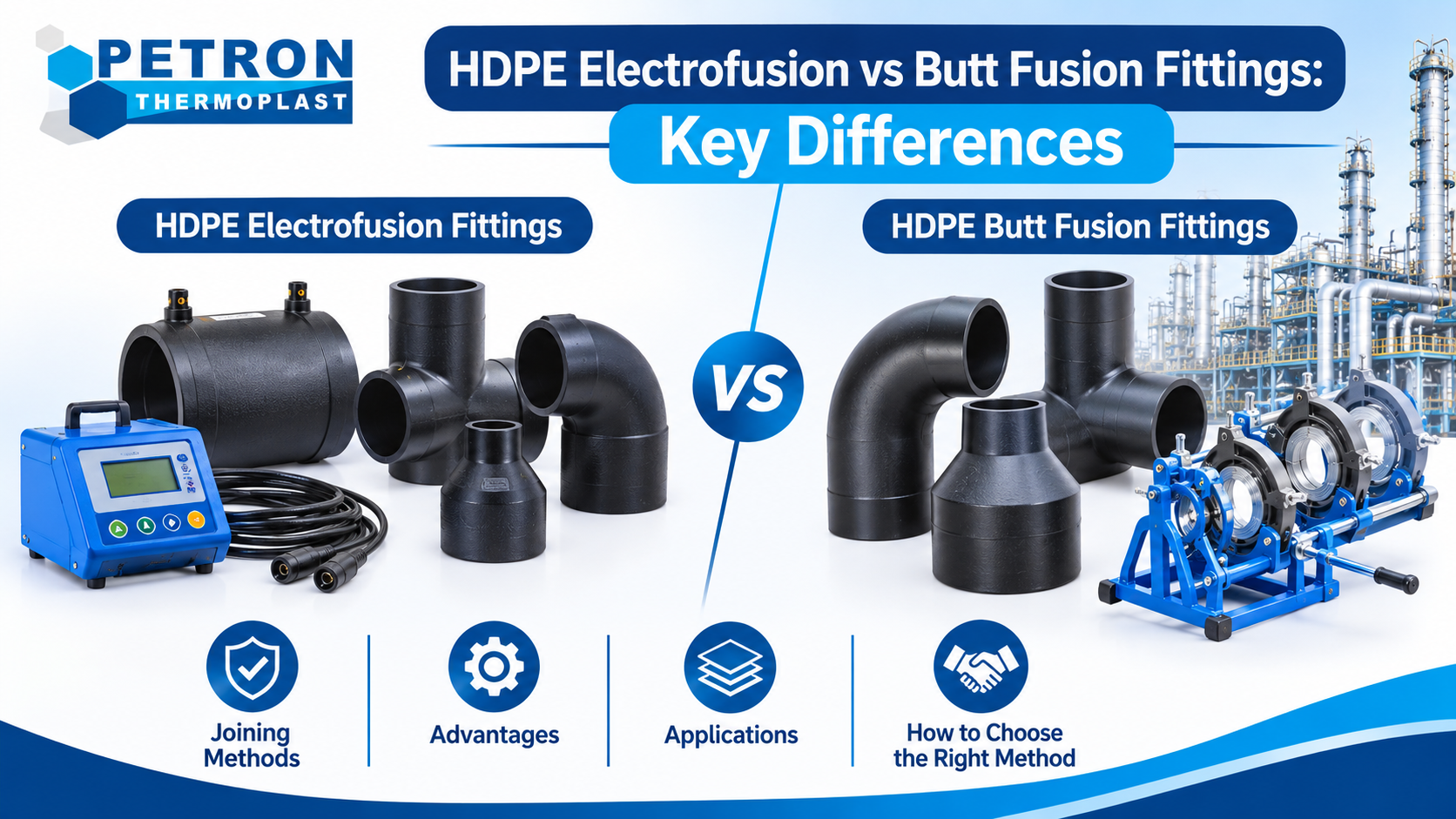
HDPE Electrofusion Fittings are polyethylene fittings designed with integrated electrical heating elements. These heating elements are located inside the fitting’s joining surface.
During installation, the pipe is inserted into the fitting socket. A compatible electrofusion control unit supplies electrical energy to the heating elements. The heat generated melts the contact surfaces of the fitting and pipe, allowing them to fuse together. After the prescribed fusion and cooling cycles, the joint forms a permanent connection.
Common types of HDPE electrofusion fittings include:
- HDPE Electrofusion Coupling
- HDPE Electrofusion Elbow
- HDPE Electrofusion Tee
- HDPE Electrofusion Reducer
- HDPE Electrofusion Saddle
- HDPE Electrofusion Tapping Tee
What Are HDPE Butt Fusion Fittings?
HDPE Butt Fusion Fittings are polyethylene components joined to compatible pipe ends through a controlled heat-fusion process.
In butt fusion, the ends of the pipe or fitting are prepared and aligned in a fusion machine. A heated plate is used to bring the joining surfaces to the required molten condition. The plate is then removed, and the prepared ends are pressed together under controlled conditions.
The joint is held during the specified cooling period to allow the material to fuse properly.
Common HDPE components joined using butt fusion include:
- HDPE Butt Fusion Elbow
- HDPE Butt Fusion Tee
- HDPE Butt Fusion Reducer
- HDPE Stub End
- HDPE Fabricated Fittings
- HDPE Pipe-to-Pipe Connections
HDPE Electrofusion vs Butt Fusion: Key Differences
The main difference between these two methods is how heat is applied to the joining surfaces.
| Comparison Factor | HDPE Electrofusion | HDPE Butt Fusion |
| Joining Method | Electrical heating element inside the fitting | External heated plate |
| Fitting Design | Fitting contains integrated heating wires | Compatible pipe ends or spigot fitting ends are fused |
| Equipment | Electrofusion control unit | Butt fusion welding machine |
| Pipe Preparation | Surface scraping, cleaning, and insertion | Facing, cleaning, and alignment |
| Installation Space | Often suitable for restricted access | Requires space for machine positioning and pipe movement |
| Pipe Movement | Useful for fixed pipe sections and tie-ins | Pipe ends must be positioned and aligned in the machine |
| Jointing Process | Machine-controlled electrical fusion cycle | Controlled heating, pressure, and cooling process |
| Consumables | Electrofusion fitting required for the joint | No separate coupling is needed for a direct pipe-to-pipe joint |
| Common Applications | Repairs, branches, service connections, and tie-ins | Long straight pipeline runs and suitable fabricated connections |
| Cooling | Fitting must remain restrained during prescribed cooling | Joint must remain under specified conditions during cooling |
How Does HDPE Electrofusion Joining Work?
Electrofusion joining involves several important installation steps.
1. Pipe Cutting and Preparation
The pipe ends are cut square and checked for proper dimensions. The joining area must be prepared according to the fitting manufacturer’s instructions.
2. Surface Scraping
The oxidized outer layer of the pipe is removed from the fusion area using an appropriate scraping tool. This step is essential for achieving a reliable fusion joint.
3. Cleaning and Assembly
The prepared surfaces are cleaned using the approved method. The pipe is then inserted into the fitting to the specified depth.
4. Clamping and Fusion
The pipe and fitting are secured using suitable clamps. The electrofusion control unit is connected and operated according to the fitting’s fusion instructions.
5. Cooling
The joint must remain undisturbed for the required cooling period. Removing clamps too early or moving the assembly during cooling can affect joint quality.
How Does HDPE Butt Fusion Joining Work?
Butt fusion is performed using a dedicated welding machine.
1. Pipe Alignment
The pipe ends or fitting spigots are placed in the machine clamps and aligned properly.
2. Facing
A facing tool removes material from the ends to create clean, flat, and parallel joining surfaces.
3. Heating
The prepared surfaces are brought into contact with a heated plate under the specified conditions.
4. Joining
After the heating stage, the plate is removed and the molten ends are brought together under controlled joining pressure.
5. Cooling and Inspection
The joint is held according to the prescribed cooling procedure. The completed weld is then inspected as required by the project quality plan. Butt fusion requires suitable alignment, equipment settings, and operator control to achieve consistent results.
Advantages of HDPE Electrofusion Fittings
Electrofusion fittings offer several practical advantages for industrial pipeline installation.
Suitable for Restricted Areas: Their joining arrangement can be useful in confined trenches, repair locations, and areas where large fusion machines cannot be positioned easily.
Useful for Pipeline Repairs: Electrofusion couplings and other fittings can help connect compatible pipe sections during maintenance or repair work.
Convenient for Branch Connections: Electrofusion tees and tapping tees provide options for creating pipeline branches according to the system design.
Controlled Fusion Cycle: The electrofusion control unit manages the prescribed electrical fusion cycle when operated correctly.
Flexible Installation Planning: Electrofusion can be useful for fixed pipe sections and certain tie-in arrangements.
Advantages of HDPE Butt Fusion Fittings
Butt fusion is also widely used in industrial HDPE pipeline systems.
Direct Pipe Joining: Compatible pipe ends can be joined without installing a separate coupling for a straight connection.
Suitable for Long Pipeline Runs: Butt fusion is practical for projects involving repeated straight joints and accessible working areas.
Efficient for Repeated Connections: Reusable fusion equipment can be used across multiple joints, subject to the project requirements.
Strong Permanent Joints: Correctly performed butt fusion produces a continuous polyethylene joint.
Suitable for Fabricated Fittings: Many HDPE fabricated fittings are produced or assembled using butt fusion techniques.
Which HDPE Joining Method Should You Choose?
The choice between electrofusion and butt fusion depends on the pipeline design, site conditions, fitting type, and installation requirements.
Choose electrofusion when:
- The pipeline connection is in a restricted area.
- A repair or tie-in is required.
- The existing pipe cannot be moved easily.
- A branch connection or tapping arrangement is needed.
- The approved design specifies electrofusion fittings.
Choose butt fusion when:
- The project involves long, accessible pipeline runs.
- Compatible pipe ends can be aligned in a fusion machine.
- Repeated straight connections are required.
- Suitable butt fusion equipment and trained operators are available.
- The project specification allows butt fusion.
Industrial Applications of HDPE Electrofusion and Butt Fusion Fittings
Both joining methods are used in suitable HDPE pipeline applications across different industries.
Common applications include:
- Industrial water supply systems
- Water treatment plants
- Wastewater treatment pipelines
- Chemical processing facilities
- Industrial utility networks
- Infrastructure and underground pipelines
- Manufacturing plant piping systems
Why Choose Petron Thermoplast for HDPE Pipe Fittings?
Petron Thermoplast focuses on industrial thermoplastic piping products and customized fitting requirements for pipeline projects. The selection of HDPE electrofusion and butt fusion fittings should be based on the approved piping design, connection type, pipe dimensions, and operating conditions.
Petron Thermoplast supports industrial requirements for HDPE pipe fittings and customized pipeline components. Buyers can share their required fitting type, size, SDR, connection method, quantity, and project drawings to help identify suitable products.
For bulk industrial procurement, clear technical specifications help improve product selection and order coordination.
Conclusion
HDPE Electrofusion and Butt Fusion Fittings are two important joining solutions used in industrial polyethylene pipeline systems. Electrofusion uses integrated heating elements within the fitting, while butt fusion joins compatible pipe or fitting ends using an external heated plate.
Electrofusion is often useful for repairs, tie-ins, branches, and restricted installation areas. Butt fusion is commonly selected for accessible straight pipeline runs and suitable fabricated connections.
The best joining method depends on the project requirements, pipe compatibility, installation conditions, and approved technical specifications. Proper surface preparation, trained operators, suitable equipment, and controlled cooling are essential for reliable fusion joints. For industrial HDPE pipeline projects, Petron Thermoplast can help buyers explore suitable HDPE pipe fittings and customized components according to their technical requirements.