Bulk purchasing of CPVC pipe fittings is an important decision for industrial projects, pipeline contractors, engineering companies, and procurement teams. Buying the right fittings in the required quantity can help maintain project schedules, control procurement costs, and ensure consistent piping system performance.
CPVC (Chlorinated Polyvinyl Chloride) pipe fittings are used in suitable industrial piping applications where chemical resistance, temperature performance, and reliable connections are required. These fittings are available in different sizes, shapes, and connection types to meet specific pipeline requirements.
However, before placing a bulk order, buyers should carefully evaluate the material, dimensions, pressure rating, operating conditions, product quality, and manufacturer capabilities.
Petron Thermoplast manufactures industrial thermoplastic piping products and supports CPVC pipe fitting requirements for customized projects, bulk orders, and international customers. This guide explains the important factors to consider before purchasing CPVC pipe fittings in bulk.
1. Understand Your Industrial Application
The first step before buying CPVC pipe fittings in bulk is to understand the application in which they will be installed.
Different industrial projects have different piping requirements. A fitting suitable for one process may not be appropriate for another because of variations in fluid composition, temperature, pressure, and installation conditions.
Before preparing your purchase order, identify:
- The type of fluid or chemical being transported
- Operating temperature and pressure
- Required pipe diameter
- Piping system layout
- Installation environment
- Expected service conditions
For chemical processing applications, material compatibility should be checked carefully. CPVC is resistant to many chemicals, but its suitability depends on the chemical type, concentration, temperature, and exposure conditions.
Selecting fittings according to the actual application helps avoid unnecessary replacement and installation problems.
2. Check the CPVC Material Quality
Material quality is one of the most important factors when purchasing CPVC pipe fittings in bulk.
CPVC fittings should be manufactured using suitable CPVC material that meets the technical requirements of the intended piping system. Material consistency is especially important when ordering large quantities for a single industrial project.
Before purchasing, ask the manufacturer about:
- Material grade and product specifications
- Manufacturing quality controls
- Dimensional consistency
- Surface finish
- Product identification and traceability, where applicable
3. Select the Correct Fitting Types
Industrial piping systems require different fitting configurations to connect pipes, change flow direction, create branches, and reduce pipe diameter.
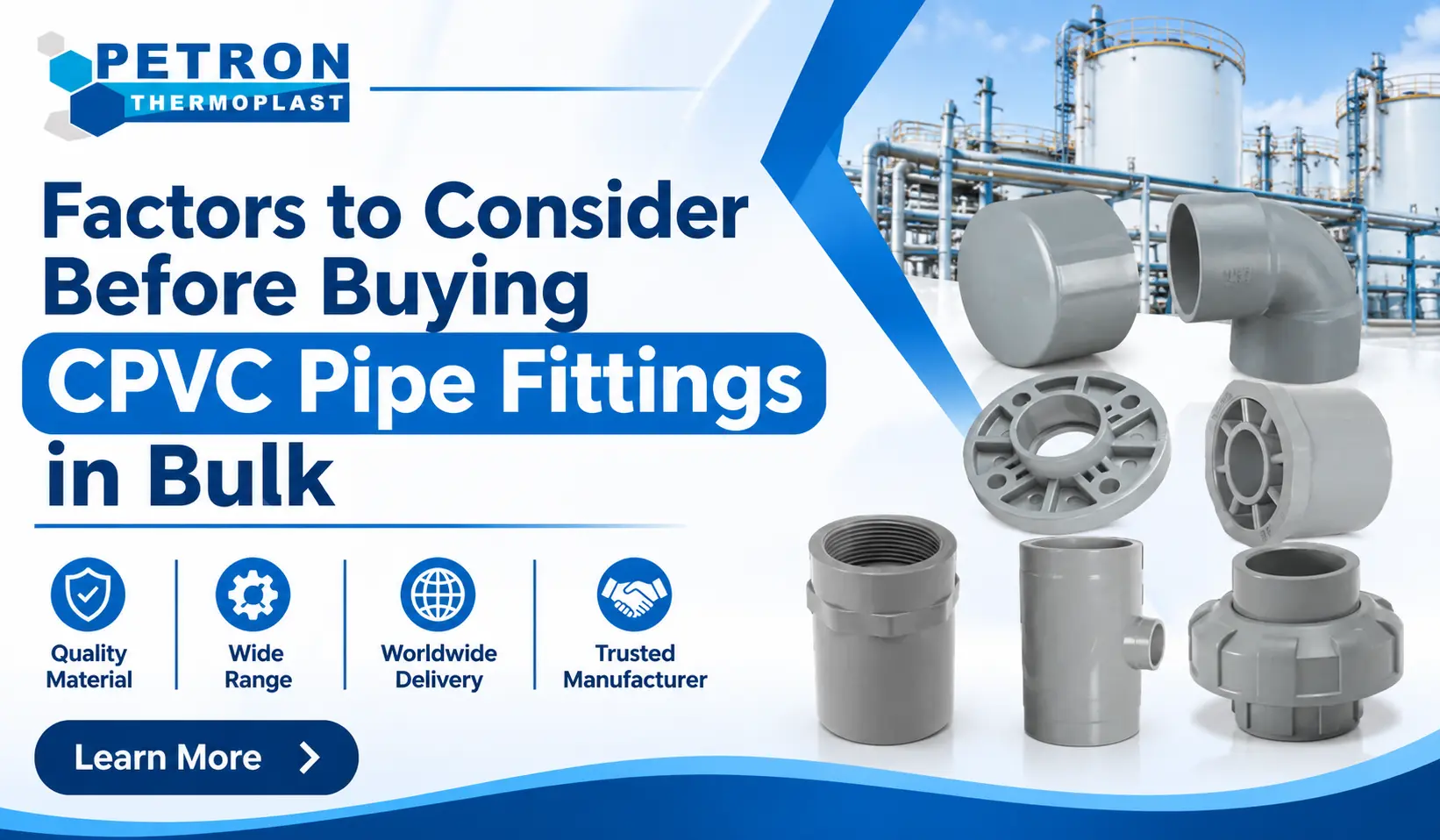
Common CPVC pipe fittings include:
CPVC Elbow
Used to change the direction of a pipeline. Elbows are available in different angles according to the piping layout.
CPVC Tee
Used to create a branch connection from the main pipeline. Equal and reducing configurations may be required.
CPVC Reducer
Connects pipes of different diameters and supports transitions within a piping system.
CPVC Coupling
Used to connect compatible pipe sections during installation or pipeline extension.
CPVC Flange
Provides a flanged connection between piping components, equipment, or other compatible assemblies.
CPVC End Cap
Used to close the end of a compatible pipe section.
For bulk procurement, prepare a complete list of fitting types and quantities based on the approved engineering drawing or bill of materials.
4. Confirm the Required Size and Dimensions
Incorrect dimensions can cause delays during installation and may result in additional procurement costs.
Before placing a bulk order, confirm the required fitting dimensions with the manufacturer.
Important dimensional details include:
- Nominal pipe size
- Outside diameter compatibility
- Socket dimensions, where applicable
- Fitting angle
- Overall length
- Wall thickness or applicable dimensional series
- Connection configuration
5. Verify Pressure and Temperature Ratings
Pressure and temperature ratings are essential when selecting CPVC pipe fittings for industrial applications.
The pressure capacity of a fitting can vary according to its size, design, material, and operating temperature. Temperature can also affect the pressure capability of a thermoplastic piping system.
Before purchasing in bulk, verify:
- Required operating pressure
- Maximum and minimum operating temperature
- Pressure rating at the actual operating temperature
- Applicable design standards
- Compatibility with the connected pipes and valves
Do not rely on a single pressure value for every fitting size or operating condition. Always request the manufacturer’s technical data for the specific product.
Proper technical verification helps ensure that the selected fittings are suitable for the intended piping system.
6. Check Connection Type and Installation Method
CPVC pipe fittings are available with different connection arrangements depending on the product design and application.
Common connection types may include:
- Socket connections
- Threaded connections
- Flanged connections
- Other project-specific configurations
The connection type should match the pipe, valve, equipment, or accessory being connected.
For solvent-cement socket joints, use the compatible joining materials and follow the manufacturer’s installation instructions. Threaded connections should also be assembled according to the recommended procedure to avoid excessive tightening or damage.
For bulk orders, maintaining consistency in connection type across the purchase order can simplify installation and inventory management.
7. Evaluate Manufacturer Quality and Reliability
Choosing a reliable CPVC pipe fittings manufacturer is important for bulk procurement.
A manufacturer should be able to understand your technical requirements, provide accurate product information, and coordinate the order according to the agreed specifications.
Before finalizing the purchase, review:
- Product range and manufacturing capability
- Technical documentation
- Quality inspection procedures
- Communication and order coordination
- Customization capability
- Packaging and dispatch arrangements
A clear technical discussion before ordering can help prevent misunderstandings during production, supply, and installation.
8. Compare Bulk Pricing Carefully
Bulk purchasing can provide commercial advantages, but the lowest quotation is not always the best option.
When comparing quotations from different manufacturers, check whether the prices are based on the same specifications.
Compare:
- Material and product grade
- Fitting size and configuration
- Quantity
- Technical requirements
- Packaging
- Freight and delivery terms
- Applicable taxes
- Payment terms
A quotation with a lower unit price may exclude important requirements such as special packaging, documentation, or customized dimensions.
Request a detailed quotation that clearly identifies the product specifications and commercial terms. This makes it easier to compare offers accurately.
9. Confirm Stock Availability and Delivery Schedule
Bulk orders often involve multiple fitting types and sizes. If some products are unavailable, the entire project schedule may be affected.
Before placing the order, confirm:
- Availability of required products
- Estimated manufacturing or preparation time
- Order processing schedule
- Dispatch timeline
- Delivery location
- Packaging requirements
For urgent industrial projects, discuss the delivery schedule before confirming the purchase order.
Petron Thermoplast supports industrial CPVC pipe fitting requirements and coordinates bulk orders according to product specifications and order details. Customers can share their fitting list and project schedule to help review the requirement.
10. Consider Packaging and Transportation
Proper packaging is important when transporting CPVC pipe fittings, particularly for large or international orders.
Fittings should be packed in a way that protects them from damage, contamination, and unnecessary handling during transportation.
For bulk shipments, discuss:
- Product-wise packing
- Quantity identification
- Protection during handling
- Packaging suitable for the shipping route
- Export packing requirements, where applicable
Clear packaging labels can also help the receiving team identify fitting types, sizes, and quantities more efficiently.
11. Review Quality Inspection and Documentation
Quality inspection helps confirm that the supplied fittings match the purchase order and technical requirements.
Before ordering, ask the manufacturer what inspection and documentation are available for the products.
Depending on the project, documentation may include:
- Product technical datasheets
- Dimensional inspection details
- Material information
- Applicable conformity or test documents
- Batch or traceability information, where available
For critical industrial projects, define the inspection requirements before placing the order. This helps both the buyer and manufacturer understand the expected quality checks.
12. Plan Your Bulk Quantity and Inventory
Ordering the correct quantity is important for cost control and project continuity.
An insufficient quantity may cause installation delays, while excessive stock can increase storage and handling costs.
Before purchasing, prepare a bill of materials that includes:
| Fitting Type | Required Size | Quantity | Connection Type |
| CPVC Elbow | As per project | As required | As specified |
| CPVC Tee | As per project | As required | As specified |
| CPVC Reducer | As per project | As required | As specified |
| CPVC Coupling | As per project | As required | As specified |
| CPVC Flange | As per project | As required | As specified |
13. Check Customization Requirements
Some industrial projects require fittings with specific dimensions, configurations, or connection arrangements.
Before requesting customized CPVC pipe fittings, provide the manufacturer with clear technical information.
Useful details include:
- Product drawing
- Required dimensions
- Material specifications
- Connection details
- Operating conditions
- Required quantity
- Project delivery schedule
Customization should be confirmed based on the manufacturer’s actual design and manufacturing capabilities.
Why Choose Petron Thermoplast for CPVC Pipe Fittings?
Petron Thermoplast focuses on industrial thermoplastic piping products for engineering, process, and infrastructure requirements.
For CPVC pipe fitting procurement, customers can discuss:
- Industrial CPVC pipe fittings
- Multiple fitting configurations
- Project-based product requirements
- Bulk quantity enquiries
- Customized specifications, subject to feasibility
- Domestic and worldwide delivery coordination
Providing complete technical and commercial details helps Petron Thermoplast review your requirements and respond more effectively.
Conclusion
Buying CPVC pipe fittings in bulk requires careful planning and technical evaluation. Material quality, fitting dimensions, pressure and temperature ratings, connection types, manufacturer reliability, pricing, and delivery schedules all influence the success of an industrial procurement decision.
Before finalizing your bulk order, verify the product specifications against your project requirements and prepare a detailed fitting list. This approach can help improve purchasing accuracy, reduce installation delays, and support reliable industrial piping performance.
Petron Thermoplast manufactures industrial thermoplastic piping products and supports CPVC pipe fitting requirements for bulk and customized projects. Contact Petron Thermoplast with your required fitting sizes, quantities, and technical specifications to discuss your industrial procurement needs.
Frequently Asked Questions
1. What should I check before buying CPVC pipe fittings in bulk?
Check material quality, fitting dimensions, pressure and temperature ratings, connection type, chemical compatibility, manufacturer reliability, pricing, and delivery schedule.
2. Which CPVC pipe fittings are commonly used in industrial projects?
Common types include CPVC elbows, tees, reducers, couplings, flanges, and end caps. The required type depends on the pipeline layout and application.
3. Can CPVC pipe fittings be customized for industrial projects?
Customization may be possible depending on the fitting design and manufacturing capability. Buyers should provide technical drawings, dimensions, and project specifications for review.
4. How can I verify CPVC pipe fitting quality?
Review the manufacturer’s technical datasheets, dimensional specifications, inspection procedures, and available product documentation before placing a bulk order.
5. Does Petron Thermoplast provide CPVC pipe fittings for bulk orders?
Petron Thermoplast supports industrial CPVC pipe fitting enquiries for project and bulk requirements. Share your product specifications, quantities, and delivery location to discuss your requirements.