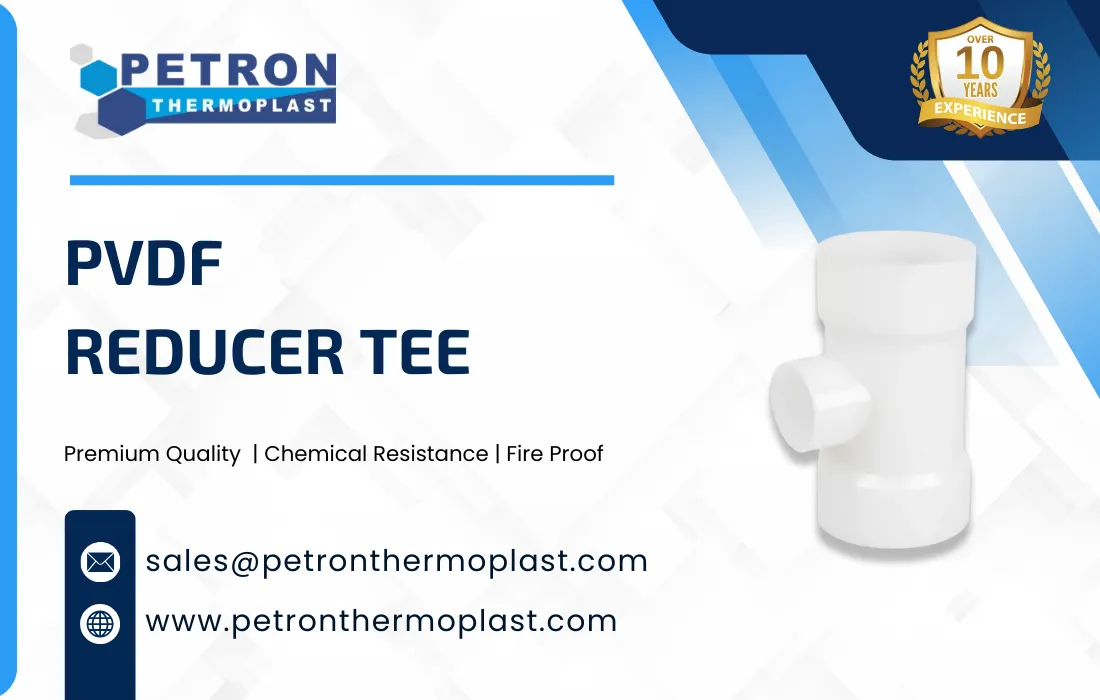
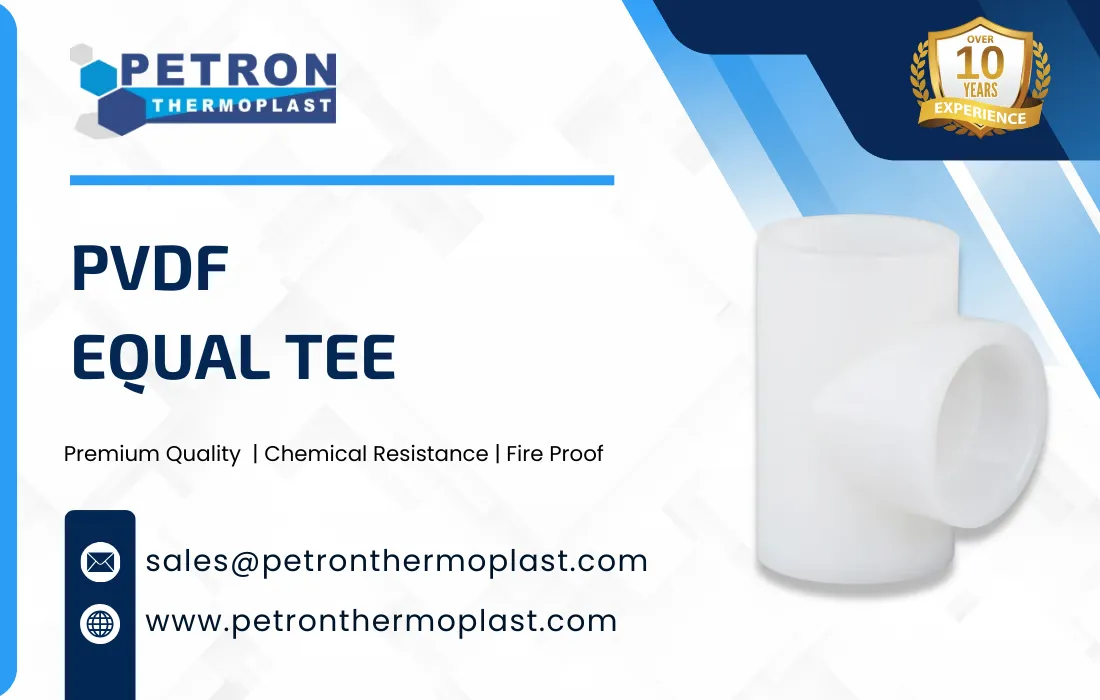
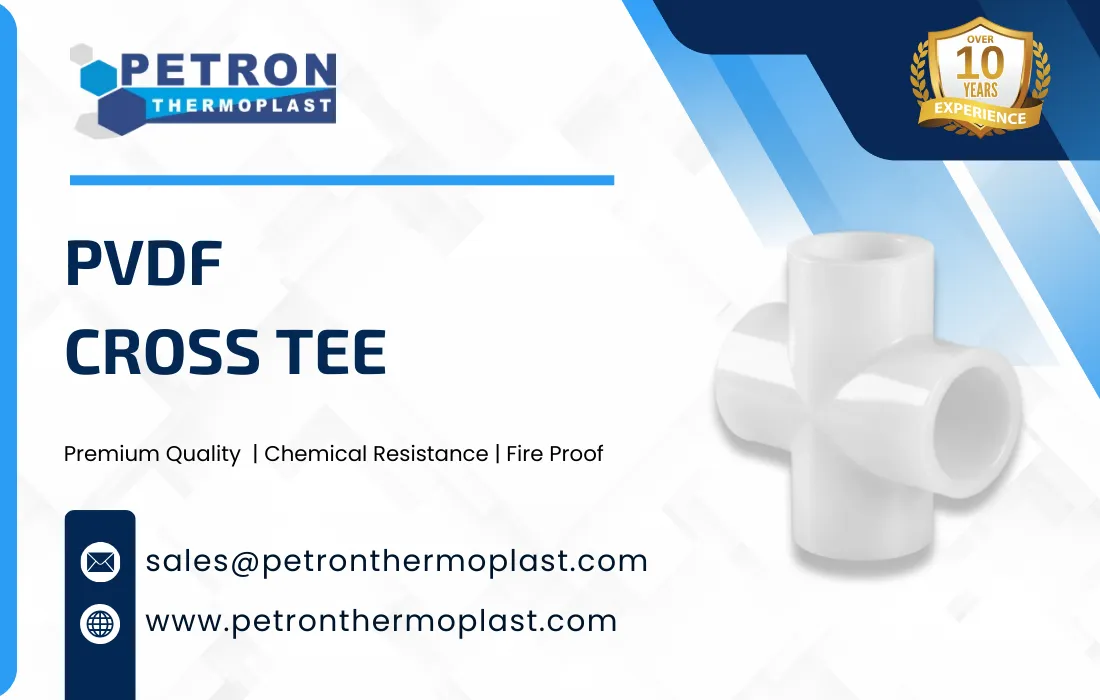
PVDF Cross Tee
PVDF Cross Tee is a type of pipe fitting that allows for the connection of four pipes in a cross-shaped configuration. It essentially combines the functionality of a “Tee” fitting but with two intersecting branches, forming a “+” shape. This is made from Polyvinylidene Fluoride (PVDF). A PVDF Cross Tee is a four-way fitting used in PVDF piping systems to join and split fluid flow in two directions simultaneously, while maintaining the chemical resistance, durability, and leak-proof performance.
A PVDF Cross Tee is a distribution of fluid flow from a central inlet to three outlets (or vice versa) at 90-degree angles. This PVDF Cross Tee fitting offers superior chemical resistance, mechanical strength, and thermal stability, making it ideal for use in highly corrosive environments such as chemical processing, pharmaceuticals, oil, gas treatment, and semiconductor industries.

- Chemical Resistance
- Low Maintenance Requirement
- Low Thermal Conductivity
- Long Service Life
- Easy Installation
- Corrosion Resistance
PVDF Cross Tee Details
*Technical Diagram
*Technical Data
| Parameter | Specification / Details |
| Material | Polyvinylidene Fluoride (PVDF) |
| Type | Cross Tee (Four-way fitting) |
| Design | 4 outlets at 90° (cross shape) |
| Size Range | 20 mm to 110 mm (custom sizes available) |
| Density | ~1.75 – 1.80 g/cm³ |
| Color | Natural translucent / white |
| Temperature Range | -20°C to +140°C |
| Pressure Rating | PN10 / PN16 (10–16 bar approx.) |
| Tensile Strength | ~38 – 50 MPa |
| Elongation at Break | ~12% – 50% |
| Hardness | ~79 Shore D |
| Water Absorption | < 0.04% (very low) |
| Thermal Conductivity | Low (good insulation property) |
| Surface Finish | Smooth internal bore for low friction |
| Permeability | Very low (excellent barrier properties) |
| Connection Types | Socket fusion, butt fusion, threaded |
| Standards | ASTM D3222, DIN 8077/8078, ISO 10931 |
Exceptional Chemical Resistance: Withstands a wide range of acids, bases, and organic solvents.
High Temperature Tolerance: Performs reliably in environments up to 140°C.
Strong Mechanical Properties: Offers excellent impact resistance and long-term durability.
Smooth Internal Bore: Reduces pressure drop and prevents material buildup.
Low Permeability: Suitable for high-purity and aggressive chemical transport.
UV and Weather Resistant: Can be used in both indoor and outdoor installations.
| Property | Typical Value / Range | Notes / Significance |
| Density | 1.78–1.80 g/cm³ | Lightweight yet strong |
| Melting Point | 170–175°C | Can handle moderate to high temperatures |
| Glass Transition Temp (Tg) | 110°C | Temperature where material starts softening |
| Tensile Strength | 48–55 MPa | Good mechanical strength |
| Elongation at Break | 20–50% | Shows flexibility before failure |
| Flexural Strength | 70–75 MPa | Resistance to bending stress |
| Impact Strength (Izod) | 10–12 kJ/m² | Resistance to shock/impact |
| Hardness (Shore D) | 80–85 | Hard and durable surface |
| Thermal Conductivity | 0.19–0.22 W/m·K | Low thermal conductivity, good insulation |
| Coeff. of Thermal Expansion | $1.2–1.5 \times 10^{-4} \text{ /°C}$ | Moderate expansion with temperature |
| Water Absorption | < 0.05% | Maintains dimensional stability |
| Dielectric Constant | 8.4 (1 kHz) | Excellent electrical insulation |
| Dielectric Strength | 50–70 kV/mm | High resistance to electrical breakdown |
| Chemical Resistance | Excellent | Resists acids, bases, and solvents |
| UV Resistance | Excellent | Suitable for outdoor/sunlight exposure |
| Surface Finish | Smooth, low friction | Reduces fouling, easier to clean |

Custom Product Manufacturing Available
If you are searching for customized product designs that meet your requirements, don’t worry. Petron Thermoplast also offers custom product manufacturing services to meet the unique needs of various industries. Work with our expert engineers to create custom designs suited for your application.
Benefits of Using PVDF Cross Tee
Excellent Chemical Resistance
- Withstands strong acids, alkalis, solvents, and corrosive chemicals.
- Ideal for chemical processing, water treatment, and pharmaceutical industries.
- Prevents contamination and material degradation.
Four-Way Flow Distribution
- Allows splitting or combining fluid flow in four directions.
- Reduces the need for multiple fittings, simplifying piping layouts.
- Improves system efficiency and compactness.
High Pressure & Temperature Capability
- Suitable for moderate to high-pressure applications (as per PN rating).
- Maintains performance across a wide temperature range.
- Reliable for both hot and cold fluid systems.
Lightweight Compared to Metal
- Much lighter than stainless steel or metal cross tees.
- Easier handling, transportation, and installation.
- Reduces stress on pipelines and support structures.
Corrosion-Free & Long Service Life
- Does not rust, pit, or corrode like metal fittings.
- Ideal for long-term use in harsh environments.
- Lower replacement and downtime costs.
Leak-Proof Connections
- Available in socket weld, threaded, and flanged types.
- Provides secure, tight, and reliable joints.
- Minimizes risk of leakage in complex piping systems.
Low Maintenance
- Smooth internal surface reduces scaling and fouling.
- Requires minimal cleaning and maintenance.
- Suitable for high-purity and clean-fluid applications.
UV & Weather Resistance
- Performs well in outdoor installations.
- Resists UV radiation and environmental aging.
- Maintains mechanical strength over time.
Electrical Insulation
- Non-conductive material.
- Safe for applications where electrical isolation is required.
Cost-Effective Over Time
- Lower maintenance and longer lifespan reduce total lifecycle cost.
- Eliminates corrosion-related failures common with metal fittings.
Types of PVDF Cross Tee
1. Equal PVDF Cross Tee
- All four outlets are the same diameter.
- Used where uniform flow distribution is required.
- Most commonly used type.
2. Reducing PVDF Cross Tee
- One or more outlets have a different (smaller) diameter.
- Helps transition between pipe sizes while branching flow.
- Applications: Pump discharge lines, process control systems.
3. Socket Weld PVDF Cross Tee
- Pipes are joined by heat fusion welding.
- Provides a strong, permanent, leak-proof joint.
- Best for high-purity and high-pressure systems.
4. Threaded PVDF Cross Tee
- Internal or external threads.
- Easy installation and removal.
- Suitable for low-to-medium pressure systems.
5. Flanged PVDF Cross Tee
- Equipped with flanges on all four ends.
- Allows easy dismantling for maintenance.
- Suitable for larger pipe sizes and higher pressures.
6. Injection-Moulded PVDF Cross Tee
- Precision-moulded for consistent dimensions.
- Cost-effective for standard sizes.
7. Machined PVDF Cross Tee
- Manufactured from solid PVDF rods.
- Higher dimensional accuracy and strength.
- Ideal for custom sizes or demanding conditions.
Why Choose Petron Thermoplast?
Petron Thermoplast is your go-to solution for PVDF Cross Tees when you need precise flow control in industrial applications. They create higher pressure drops than some alternatives, but that tortuous flow path is exactly what gives them their incredible throttling capability.
Use Petron Thermoplast when: