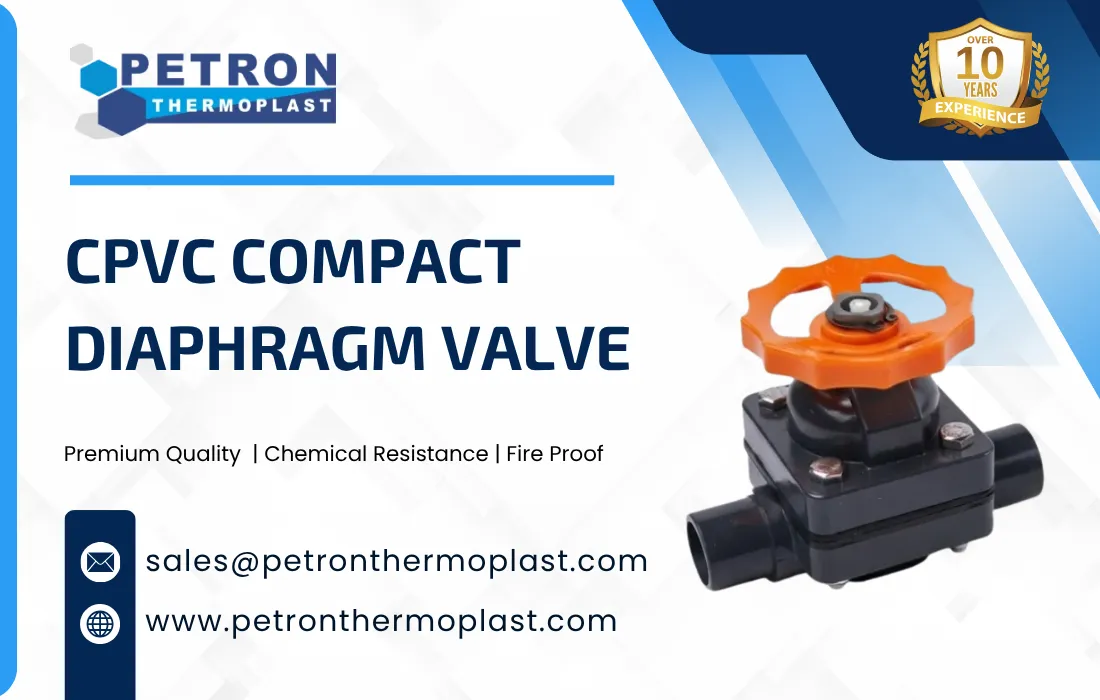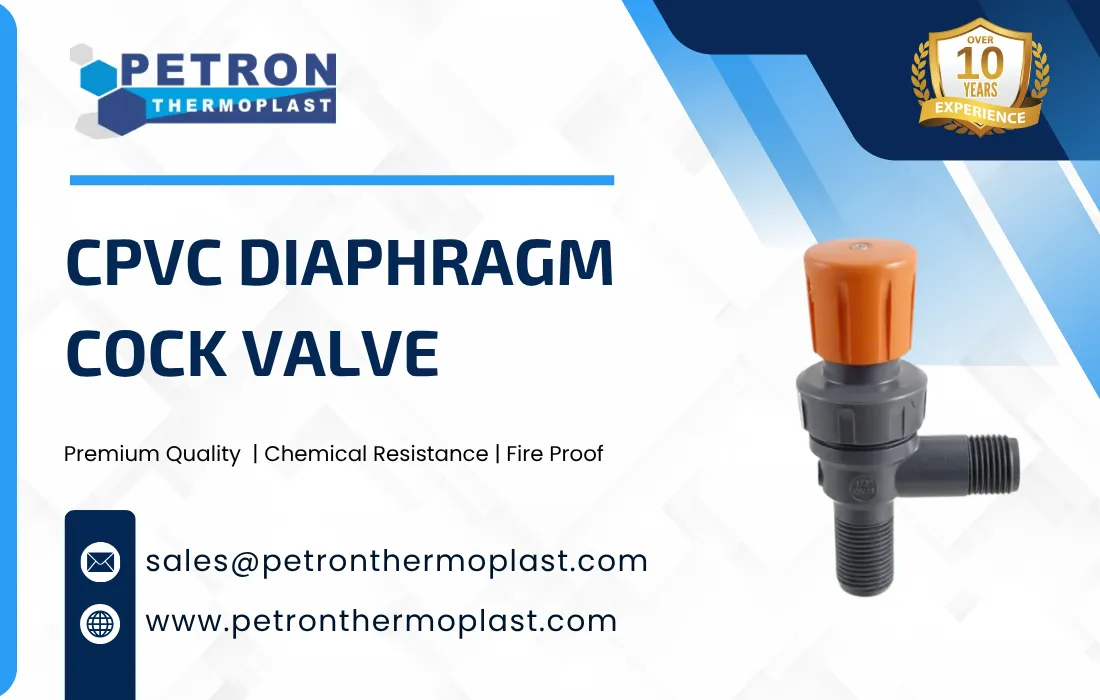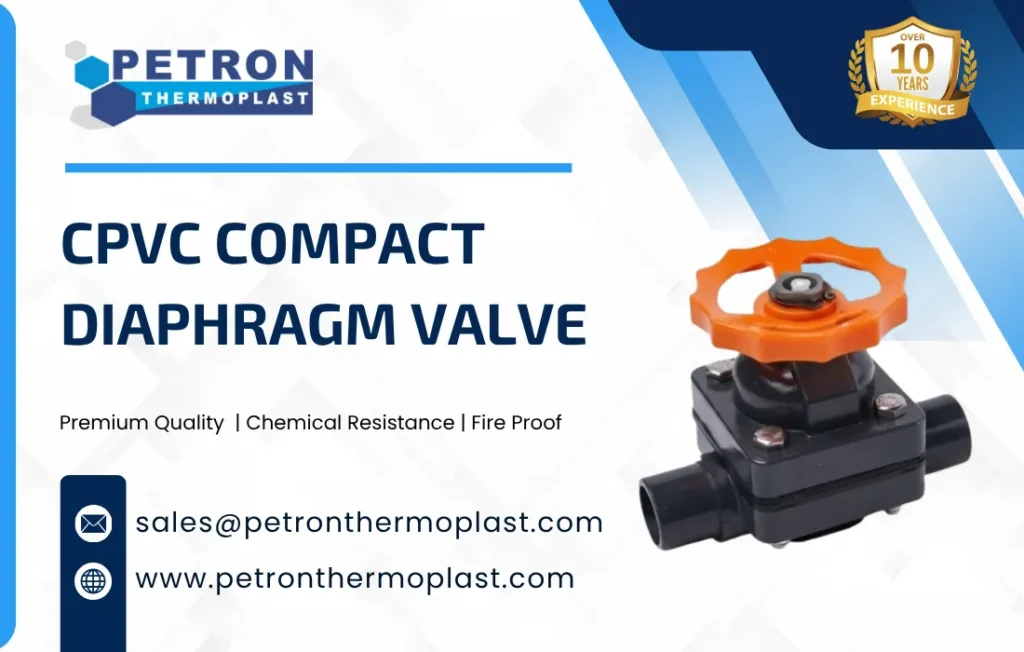
CPVC Compact Diaphragm Valve
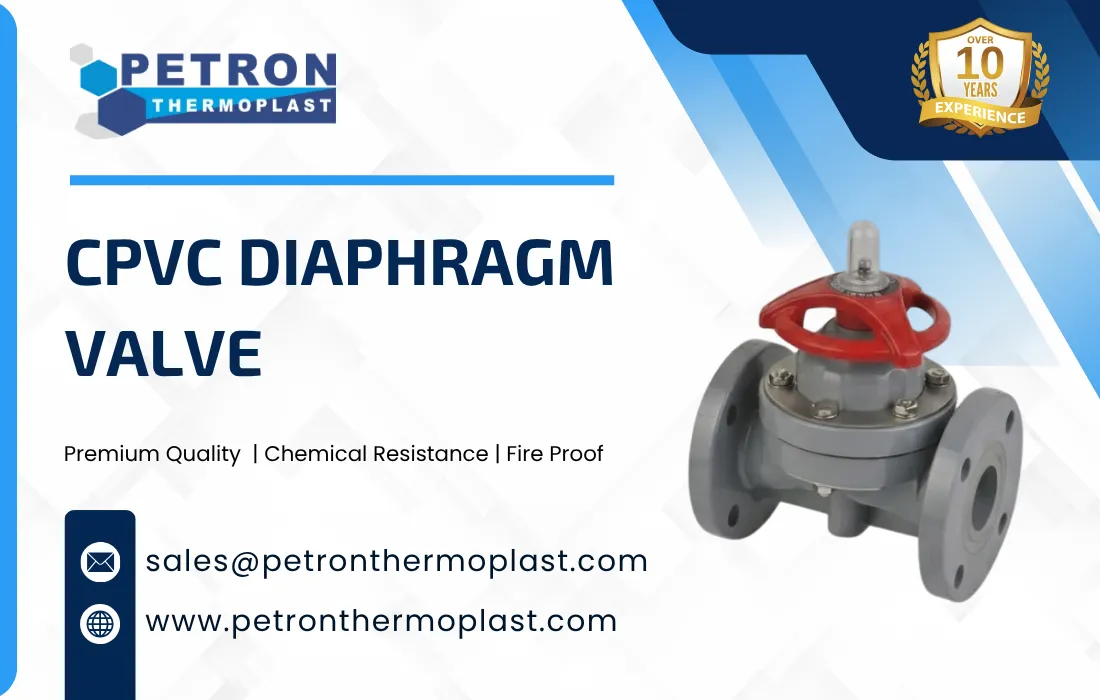
A CPVC Compact Diaphragm Valve is a type of flow-control valve made from Chlorinated Polyvinyl Chloride (CPVC) that uses a flexible diaphragm to regulate, start, or stop the flow of liquids in a piping system. The valve has a compact design, making it suitable for installations where space is limited while still providing reliable sealing and precise flow control. A CPVC Compact Diaphragm Valve is a space-saving plastic valve that controls liquid flow using a flexible diaphragm and is designed for corrosion-resistant piping systems.
The valve works by moving a flexible diaphragm up or down using a handwheel or actuator. When the diaphragm presses against the valve seat, the flow stops; when it lifts away, the fluid flows through the valve. CPVC Compact Diaphragm Valves are widely used in chemical processing, water treatment, and industrial piping systems because CPVC offers excellent resistance to corrosion, chemicals, and high temperatures. The CPVC Compact Diaphragm Valve, which consists of a flexible disc that is sealed with a seat at the top of the valve body. It is excellent for use in restricted spaces.

- Chemical Resistance
- Low Maintenance Requirement
- Low Thermal Conductivity
- Long Service Life
- Easy Installation
- Corrosion Resistance
CPVC Compact Diaphragm Valve Details
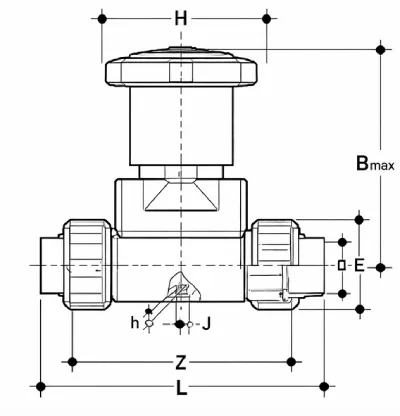
d: Outside diameter
DN: Nominal diameter
R1: Thread size (inches)
PN: Nominal pressure (bar)
E: Body diameter
H: Overall height
H1: Center-to-bottom height
Z: Face-to-face length
I: Mounting hole distance
J: Mounting bolt thread (Metric)
FPM/PTFE: Material types (Fluorinated Rubber / Teflon)
| Diaphragm Type | d | DN | R1 | PN | E | H | H1 | Z | I | J |
| EPDM | 20 | 15 | 1″ | 6 | 41 | 129.5 | 58.5 | 97.5 | 35 | M5 |
| FPM | 20 | 15 | 1″ | 6 | 41 | 129.5 | 58.5 | 97.5 | 35 | M5 |
| PTFE | 20 | 15 | 1″ | 6 | 41 | 129.5 | 58.5 | 97.5 | 35 | M5 |
| Parameter | Details |
| Valve Type | Compact Diaphragm Valve (Weir / Straight-through) |
| Construction | Single-piece compact body with diaphragm sealing |
| Size Range | DN 12 – DN 15 (≈ ½”) |
| Pressure Rating | PN 6 (≈ 6 bar) at 20°C |
| Max Pressure (General) | Up to 90–150 psi (Design dependent) |
| Temperature Range | 0°C to 60°C (Standard CPVC) |
| End Connections | Socket (Solvent weld), Threaded, Flanged, True Union |
| Standards | EN ISO 1452, ASTM D1785, DIN, JIS |
| Operation | Manual (Handwheel) / Pneumatic Actuator |
| Flow Control | Suitable for Throttling and On-off service |
| Body Material | CPVC (Chlorinated Polyvinyl Chloride) |
| Bonnet / Cover | CPVC / Glass-filled Polyamide |
| Diaphragm | EPDM / FKM (Viton) / PTFE |
| Stem / Compressor | Stainless Steel / Engineering Plastic |
| Seals & O-rings | EPDM, PTFE, or FKM |
| Design Type | Compact, lightweight, space-saving |
| Structure | Weir-type diaphragm (prevents fluid entrapment) |
| Surface Finish | Smooth internal surface for low contamination |
| Weight | Lightweight compared to metal valves |
| Leakage | Bubble-tight sealing |
| Flow Characteristics | Linear throttling control |
| Maintenance | Low maintenance, easy diaphragm replacement |
- Corrosion Resistance
Made from CPVC material, the valve offers excellent resistance to corrosion, chemicals, and aggressive fluids. - Compact Design
The compact body design saves installation space and makes it suitable for tight piping systems. - Excellent Chemical Compatibility
Suitable for handling acids, alkalis, and other chemical solutions commonly used in industrial processes. - Leak-Proof Sealing
The flexible diaphragm provides a tight shut-off and prevents leakage in the system. - Smooth Flow Control
Provides precise flow regulation and throttling capability. - Low Maintenance
Simple construction with fewer moving parts reduces maintenance requirements. - Lightweight Construction
CPVC material makes the valve lightweight and easy to install and handle. - High Temperature Resistance
Capable of handling higher temperatures compared to standard PVC valves. - Long Service Life
Durable materials and corrosion resistance ensure long operational life. - Easy Installation and Replacement
Designed for easy integration with CPVC piping systems using threaded or solvent cement connections.
| Temperature (°C) | Pressure Rating (Bar) | Pressure Rating (PSI) |
| 20°C | 6 bar | 87 psi |
| 30°C | 5.4 bar | 78 psi |
| 40°C | 4.8 bar | 70 psi |
| 50°C | 3.6 bar | 52 psi |
| 60°C | 2.4 bar | 35 psi |

Custom Product Manufacturing Available
If you are searching for customized product designs that meet your requirements, don’t worry. Petron Thermoplast also offers custom product manufacturing services to meet the unique needs of various industries. Work with our expert engineers to create custom designs suited for your application.
Benefits of Using CPVC Compact Diaphragm Valve
Excellent Chemical Resistance
CPVC material resists many corrosive chemicals, acids, and alkalis, making the valve suitable for chemical processing and water treatment applications.
Corrosion-Free Operation
Unlike metal valves, CPVC valves do not rust or corrode, ensuring long service life in aggressive environments.
Compact and Lightweight Design
The compact structure makes installation easier and saves space in piping systems.
Leak-Proof Sealing
The flexible diaphragm provides a tight seal, preventing leakage and ensuring reliable shut-off.
Low Maintenance Requirement
Simple internal construction reduces wear and tear, resulting in lower maintenance and replacement costs.
Good Flow Control
The diaphragm design allows smooth throttling and accurate flow regulation.
High Durability
CPVC offers strong mechanical strength and can withstand high temperatures compared to standard PVC valves.
Smooth Internal Surface
The smooth bore reduces friction, minimizes scaling, and improves flow efficiency.
Easy Installation
Compatible with solvent cement joints, threaded connections, or union ends for quick installation and removal.
Cost-Effective Solution
Provides reliable performance at a lower cost compared to many metal or specialty alloy valves.
Types of CPVC Compact Diaphragm Valve
Manual CPVC Compact Diaphragm Valve
- Operated manually using a handwheel or knob.
- Commonly used in small piping systems and laboratory applications.
Pneumatic Actuated CPVC Compact Diaphragm Valve
- Operated by a pneumatic actuator using compressed air.
- Suitable for automated industrial processes.
Electric Actuated CPVC Compact Diaphragm Valve
- Controlled by an electric actuator.
- Used in automated systems where remote operation is required.
Weir Type CPVC Compact Diaphragm Valve
- Has a raised weir (saddle) inside the valve body.
- Provides good sealing and is ideal for throttling applications.
Straight Through CPVC Compact Diaphragm Valve
- Designed with a straight flow path.
- Suitable for slurry, viscous fluids, and applications requiring minimal flow restriction.
Threaded End CPVC Compact Diaphragm Valve
- Comes with threaded connections for easy installation in smaller pipelines.
Socket / Solvent Cement End CPVC Compact Diaphragm Valve
- Connected using solvent cement joints.
- Commonly used in CPVC piping systems for strong leak-proof joints.
Applications of CPVC Compact Diaphragm Valve
Process Industry
High Purity Applications
Electronic Industry
Electrical Industry
Semi-conductors Industry
Pharmaceutical Industry
Solar power panels
Sugar Industry
Paper & Pulp Industry
Nuclear Power Industry
Automotive Industry
DI water plants
Why Choose Petron Thermoplast?
In the field of water, fluid, and chemical technology, Petron Thermoplast Company played a leading role, known for innovation and reliability. Petron Thermoplast has engineered a high-performance CPVC Compact Diaphragm Valve that maximizes mixing efficiency and durability. Their design is patented to ensure consistent performance across a wide range of flow rates and pressures.
Petron Thermoplast CPVC Compact Diaphragm Valves are particularly favored in chemical treatment applications due to their precision, long service life, and compatibility with corrosive water. By harnessing the valve effect, these devices offer a reliable, energy-efficient method for fluid injection without the need for pumps or electricity. With companies like Petron Thermoplast pushing the technology forward, the future of fluid injection remains efficient, sustainable, and powerful