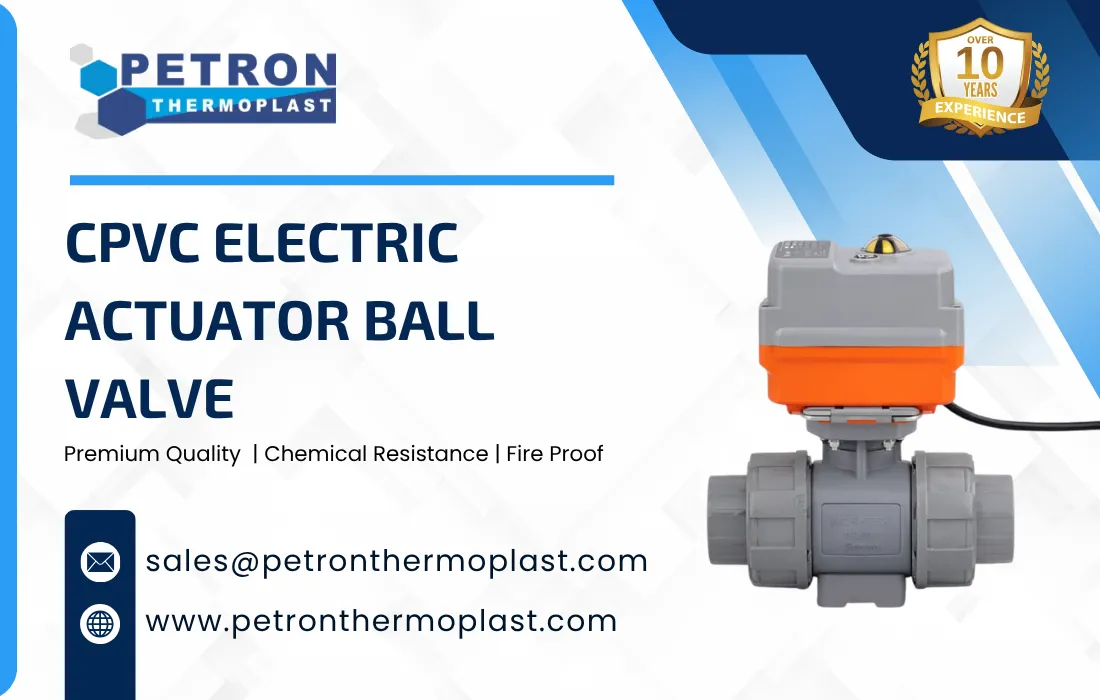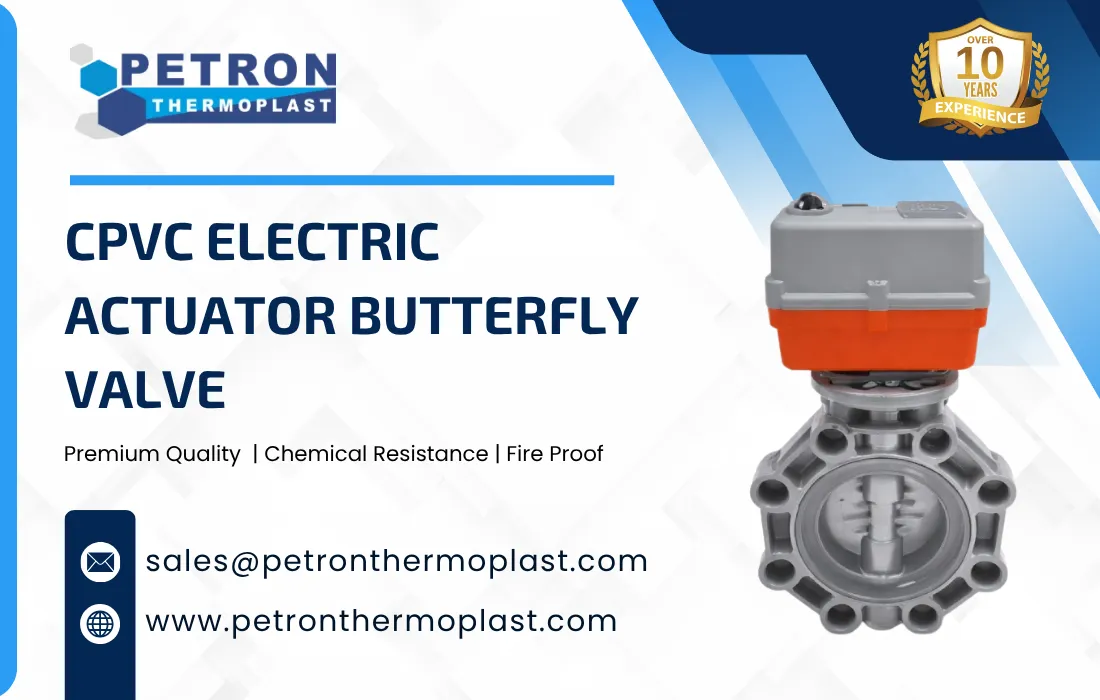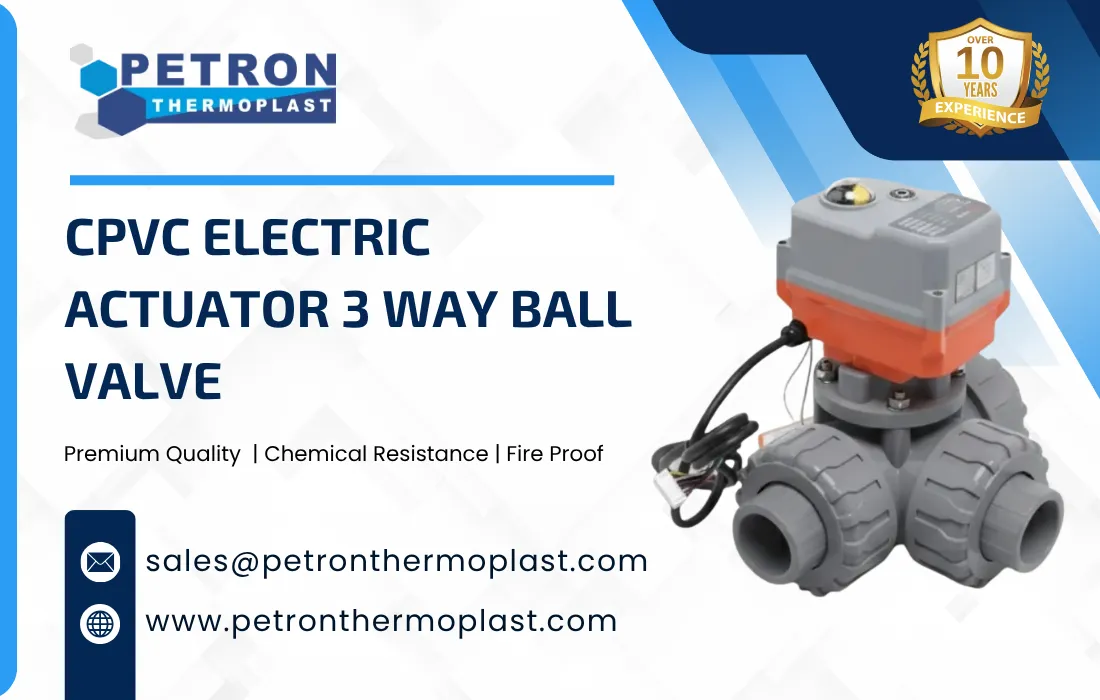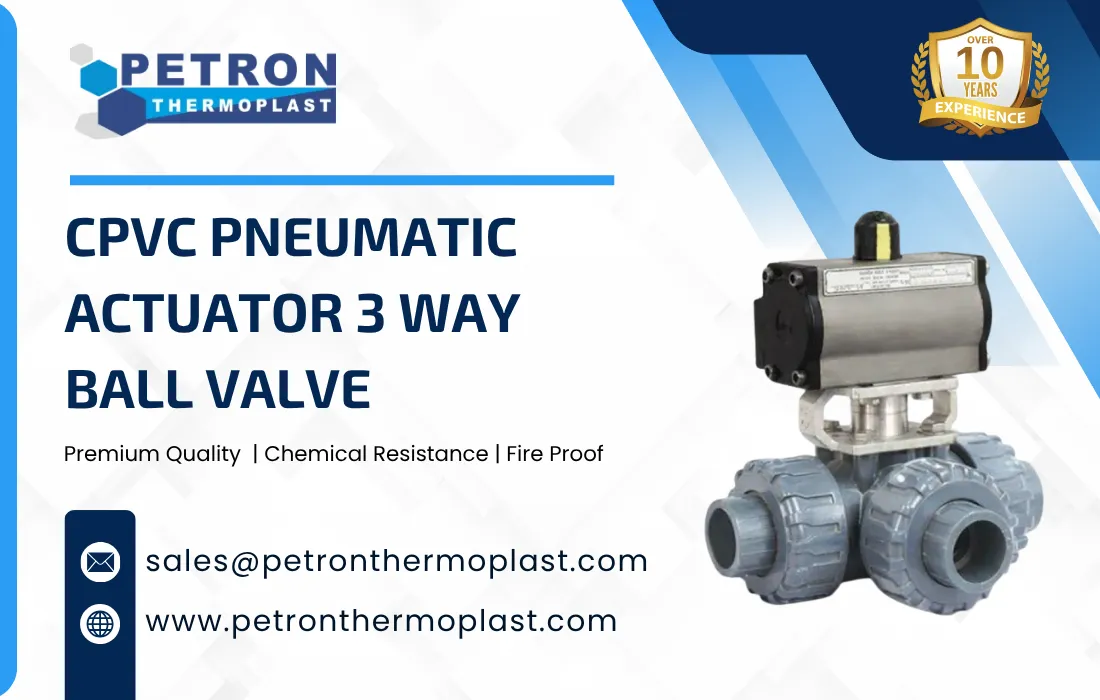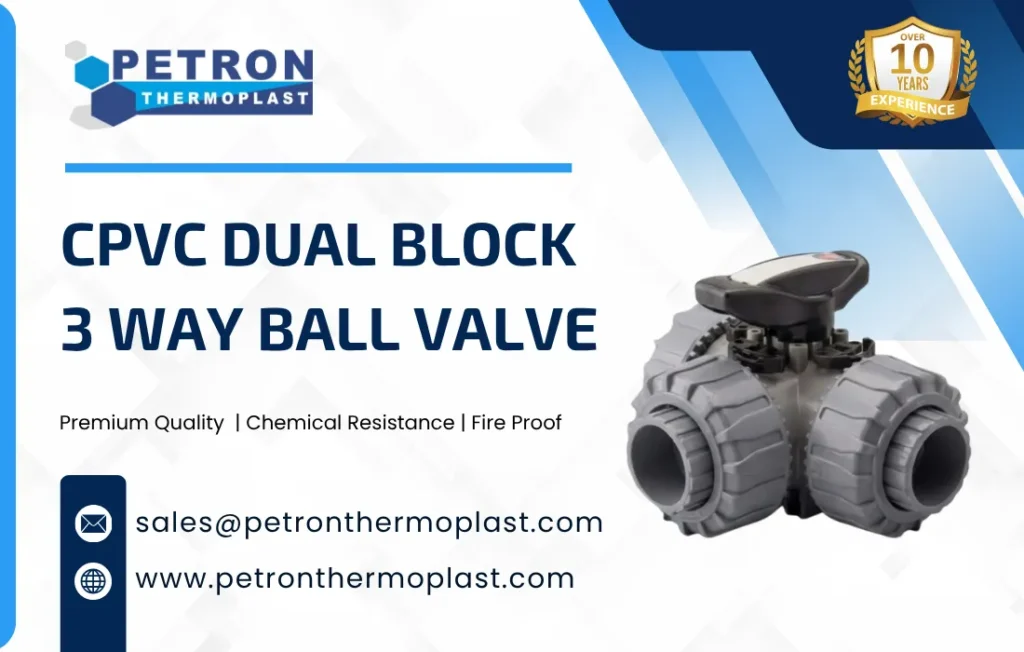
CPVC Dual Block 3-Way Ball Valve
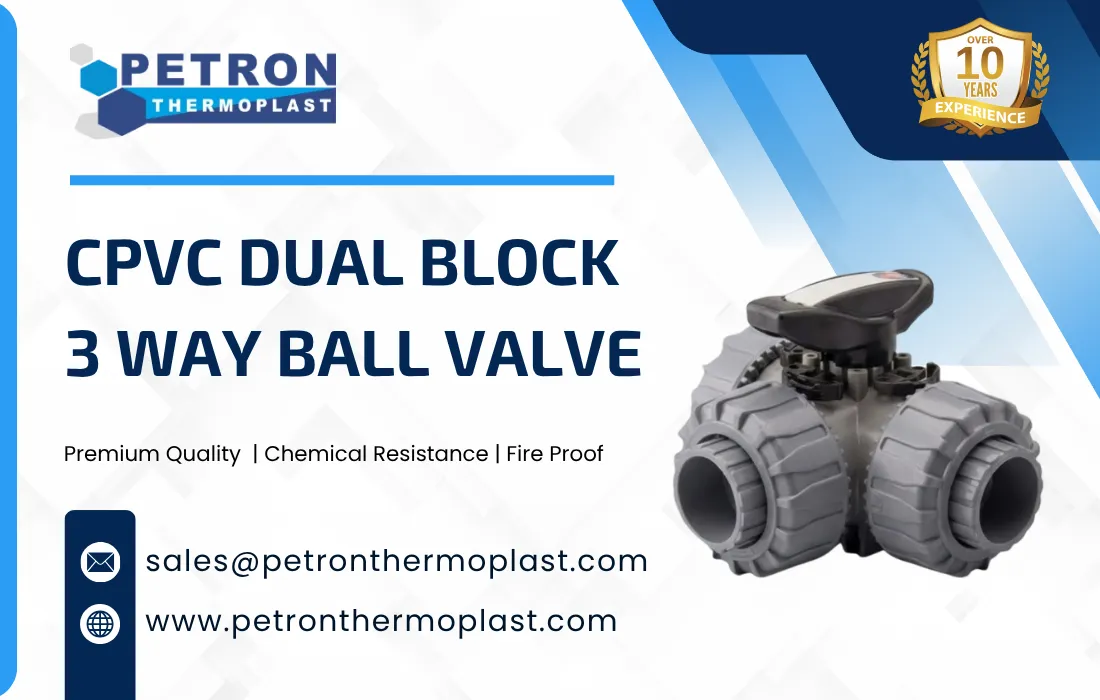
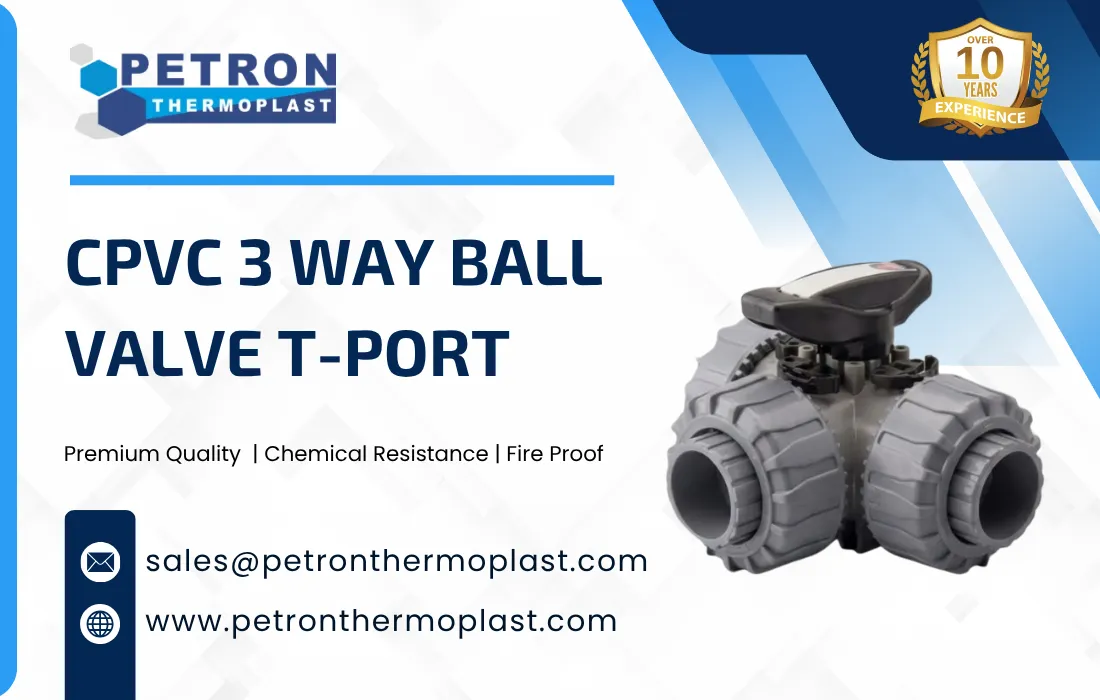
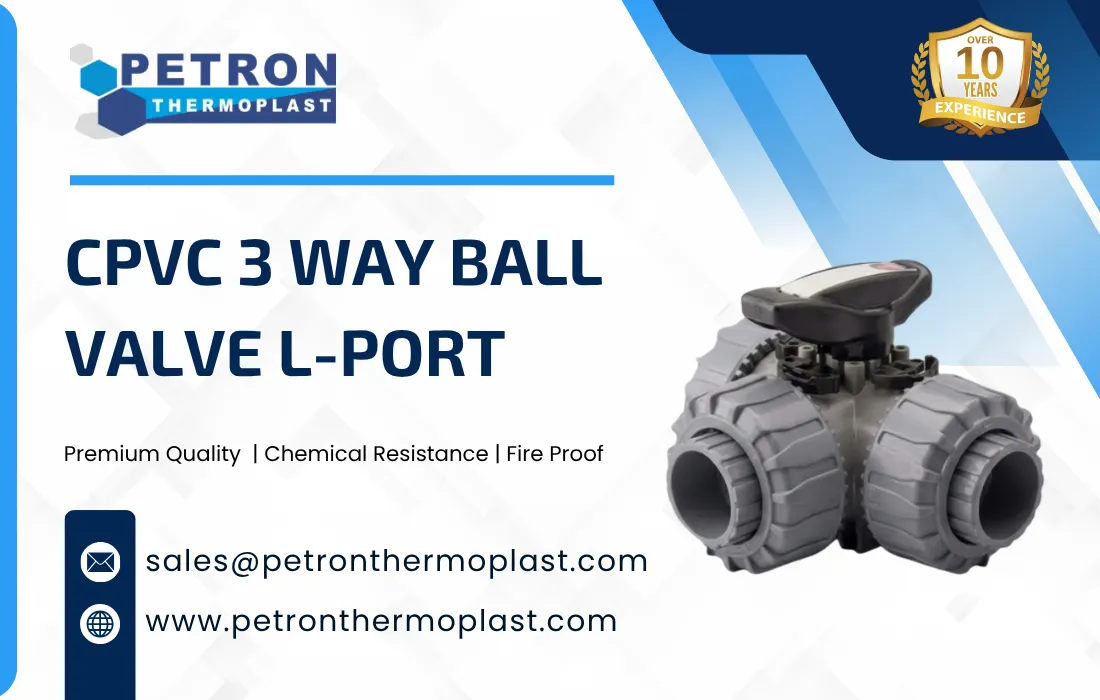
A CPVC Dual Block 3 Way Ball Valve is a thermoplastic industrial valve made from Chlorinated Polyvinyl Chloride (CPVC) that is designed to control, divert, or mix the flow of fluids through three ports. The term “Dual Block” refers to its true union design, where the valve body can be easily removed from the pipeline by loosening union nuts on both sides, allowing convenient maintenance without disturbing the entire piping system.
The CPVC Dual Block 3 Way Ball Valve has two modes of operation: input and output. A CPVC Dual Block 3 Way Ball Valve may be recommended in some systems when more than one medium is used. Instead of just two ports (entries), 3-way ball valves have three. This multiport arrangement can divert fluid from the primary valve input in two different directions via two independent valve outputs. The primary flow line is served by two separate and alternate inlets, which is another common application of CPVC Dual Block 3 Way Ball Valves.

- Chemical Resistance
- Low Maintenance Requirement
- Low Thermal Conductivity
- Long Service Life
- Easy Installation
- Corrosion Resistance
CPVC Dual Block 3-Way Ball Valve Details
C – Overall Top Width
C1 – Inner Top Width
B – Overall Height
L – End to Center Length
Z – Face to Center Dimension
H – Overall Length (Face to Face)
d – Inside Diameter
E – Center to Bottom Distance
| NPS | Outside Diam. (D) | No. of Holes | Diam. of Holes | Bolt Circle (BC) | Weight (lb) |
| 1/2″ | 3.50 | 4 | 0.62 | 2.38 | 2.55 |
| 3/4″ | 3.88 | 4 | 0.62 | 2.75 | 3.10 |
| 1″ | 4.25 | 4 | 0.62 | 3.12 | 4.11 |
| 1 1/4″ | 4.62 | 4 | 0.62 | 3.50 | 7.71 |
| 1 1/2″ | 5.00 | 4 | 0.62 | 3.88 | 9.07 |
| 2″ | 6.00 | 4 | 0.75 | 4.75 | 11.00 |
| Parameter | Specification |
| Material (Body) | CPVC (Chlorinated Polyvinyl Chloride) |
| Ball Material | CPVC (machined / polished) |
| Seat Material | PTFE (Teflon) |
| Seal / O-Ring Material | EPDM / FKM (Viton) |
| Stem Material | CPVC / Stainless Steel |
| Valve Type | 3-Way Ball Valve (L-Port / T-Port) |
| Design Type | Dual Block (Double Union / True Union Design) |
| Operation | Manual (Lever) / Actuated (Pneumatic / Electric optional) |
| Nominal Size Range | ½” to 4” (DN15 – DN100) |
| Connection Types | Socket, Threaded (BSP/NPT), Flanged |
| End Standards | ASTM, ANSI, DIN, BS |
| Pressure Rating | PN10 / PN16 |
| Max Working Pressure | Up to 10–16 bar @ 23°C |
| Temperature Range | 0°C to 95°C |
| Flow Configuration | L-Port (diverting) / T-Port (mixing/diverting) |
| Flow Direction | Multi-directional |
| Leakage Class | Bubble-tight shut-off |
| Standards | ASTM D1784, ISO 9393 |
| Maintenance | Inline maintenance (removable unions) |
| Density | ~1.45–1.58 g/cm³ |
| Color | Grey / Off-white |
| Corrosion Resistance | Excellent resistance to acids, alkalis, salts |
| Chemical Resistance | Suitable for aggressive chemical fluids |
| Surface Finish | Smooth internal bore → low friction loss |
| Thermal Resistance | Higher heat resistance than PVC |
| Mechanical Strength | Good tensile and impact strength |
| Weight | Lightweight compared to metal valves |
| Durability | Long service life, non-corrosive |
| Scaling Resistance | No rust or scale formation |
| UV Resistance | Moderate (can be improved with additives) |
- High-Quality CPVC Construction
Excellent resistance to acids, alkalis, and corrosive chemicals. - Three-Way Flow Control
Available in L-Port (diverting) and T-Port (mixing/diverting) configurations. - Dual Block (True Union) Design
The removable valve body allows easy maintenance without disturbing the pipeline. - Compact & Space-Saving Design
Replaces multiple valves and fittings in one unit. - Leak-Tight PTFE Seats
Ensures smooth operation and bubble-tight sealing. - High Temperature Resistance
Suitable for operating temperatures up to approximately 90°C–95°C. - Smooth 90° Operation
Quarter-turn lever ensures quick and easy flow control. - Low Torque Operation
Precision-machined ball provides easy manual handling. - Actuator Mounting Option
Compatible with pneumatic or electric actuators for automation. - Corrosion-Free Performance
Non-metallic body prevents rust and scaling. - Multiple End Connections
Available in threaded, socket, and flanged types. - Wide Size & Pressure Range
Typically available from ½” to 4” in PN 10 and PN 16 ratings.
| Nominal Size (DN) | Size (Inch) | Pressure Rating (PN) | Max Working Pressure | Hydrostatic Test Pressure | Temperature Limit |
| 15 mm | ½” | PN 16 | 16 Bar | 24 Bar | Up to 90°C |
| 20 mm | ¾” | PN 16 | 16 Bar | 24 Bar | Up to 90°C |
| 25 mm | 1” | PN 16 | 16 Bar | 24 Bar | Up to 90°C |
| 32 mm | 1¼” | PN 16 | 16 Bar | 24 Bar | Up to 90°C |
| 40 mm | 1½” | PN 16 | 16 Bar | 24 Bar | Up to 90°C |
| 50 mm | 2” | PN 16 | 16 Bar | 24 Bar | Up to 90°C |
| 65 mm | 2½” | PN 10 | 10 Bar | 15 Bar | Up to 90°C |
| 80 mm | 3” | PN 10 | 10 Bar | 15 Bar | Up to 90°C |
| 100 mm | 4” | PN 10 | 10 Bar | 15 Bar | Up to 90°C |

Custom Product Manufacturing Available
If you are searching for customized product designs that meet your requirements, don’t worry. Petron Thermoplast also offers custom product manufacturing services to meet the unique needs of various industries. Work with our expert engineers to create custom designs suited for your application.
Benefits of Using CPVC Dual Block 3-Way Ball Valve
1. Excellent Corrosion Resistance
Manufactured from CPVC, it resists acids, alkalis, salts, and aggressive chemicals, making it ideal for chemical industries.
2. Multi-Flow Control (3-Way Function)
Allows diverting or mixing of fluids through L-Port or T-Port design, reducing the need for multiple valves.
3. Dual Block (True Union) Design
The valve body can be removed easily without cutting the pipeline, simplifying maintenance and replacement.
4. Space & Cost Saving
One 3-way valve replaces two conventional valves and fittings, saving space and installation cost.
5. High Temperature Capability
Suitable for temperatures up to approximately 90°C–95°C.
6. Leak-Tight Performance
PTFE seats and seals provide reliable, bubble-tight shut-off.
7. Lightweight Construction
Easier handling and installation compared to metal ball valves.
8. Low Maintenance
Non-metallic body prevents rust, scaling, and corrosion buildup.
9. Automation Friendly
Can be fitted with pneumatic or electric actuators for automated systems.
10. Long Service Life
Resistant to chemical attack and environmental degradation.
Types of CPVC Dual Block 3-Way Ball Valve
Based on Ball Port Design
1️. L-Port (Diverter Type)
- The internal ball has an “L” shaped bore.
- Diverts flow from one inlet to one of two outlets.
- Does not allow mixing of both outlets simultaneously.
- Commonly used for directional flow control.
2️. T-Port (Mixing / Diverting Type) The internal ball has a “T” shaped bore.
- Allows mixing of two inlets into one outlet or splitting one inlet into two outlets.
- Can provide multiple flow patterns depending on ball design.
- Suitable for mixing and distribution systems.
Based on End Connection Type
- Threaded Type – For small pipelines and easy installation.
- Socket (Cement Joint) Type – For permanent leak-proof joints.
- Flanged Type – For larger pipelines and high-pressure systems.
Based on the Operation Method
- Manual Lever Operated – Standard hand-operated valve.
- Pneumatically Actuated – Air-operated for automated systems.
- Electrically Actuated – Motorized control for remote operation.
Based on Pressure Class
- PN 10 Type
- PN 16 Type
Applications of CPVC Dual Block 3-Way Ball Valve
Process Industry
High Purity Applications
Electronic Industry
Electrical Industry
Semi-conductors Industry
Pharmaceutical Industry
Solar power panels
Sugar Industry
Paper & Pulp Industry
Nuclear Power Industry
Automotive Industry
DI water plants
Why Choose Petron Thermoplast?
Petron Thermoplast CPVC Dual Block 3 Way Ball Valves are efficient, reliable, and essential tools in industrial automation, offering precise control of flow, pressure, and temperature. Proper selection, correct installation, and regular maintenance to ensure that these valves perform optimally in practical applications. As industrial automation technology continues to advance, the CPVC Dual Block 3 Way Ball Valve will see broader applications and improved performance, providing a reliable foundation for safe, efficient, and stable production.