UPVC Pressure Reducing Valve
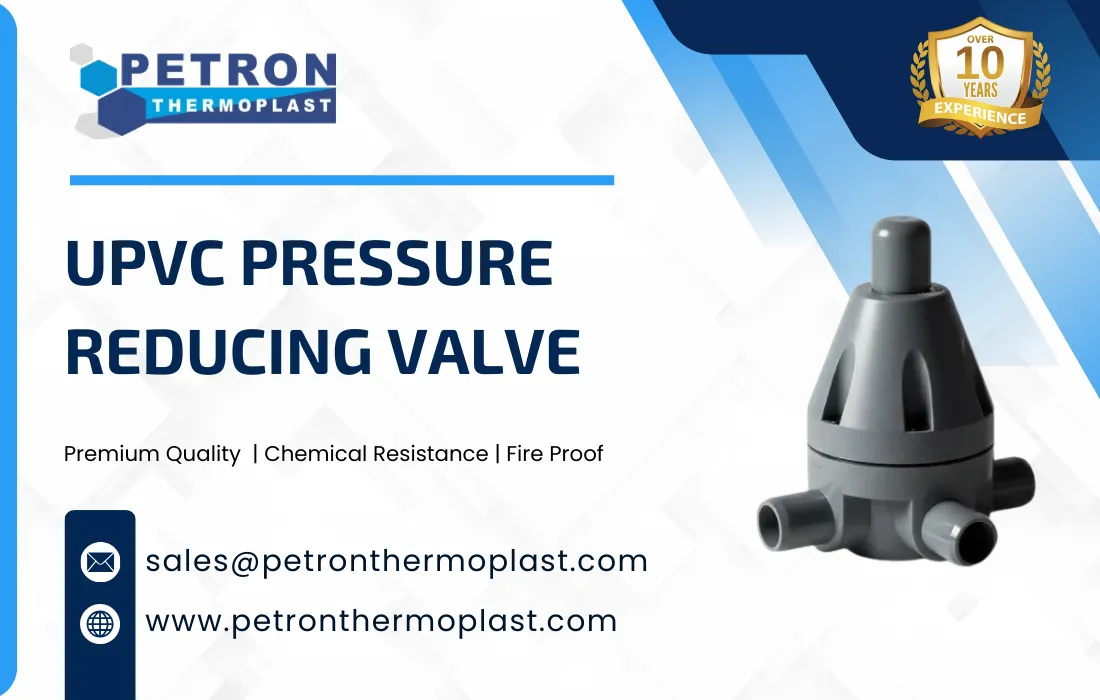
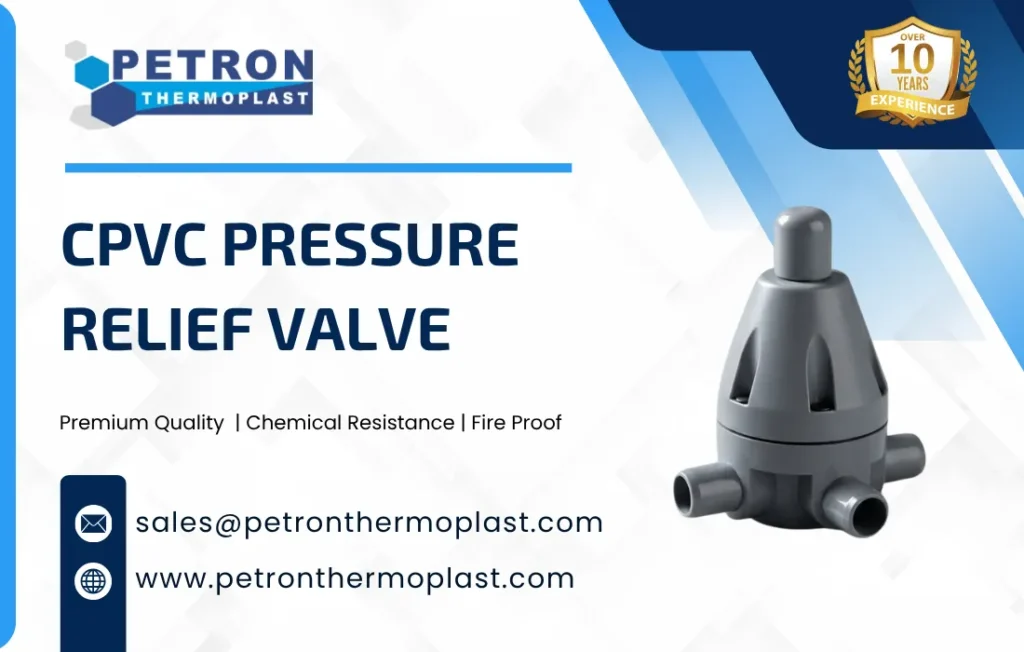
UPVC Pressure Reducing Valves are designed to reduce the incoming water and steam pressure for a safe, constant, predetermined downstream level. They depend on the type of valve, where the downstream pressure is established by a pressure adjustment setting on the valve or by an external sensor. UPVC Pressure Reducing Valves are utilized in commercial, institutional, and industrial applications. The UPVC Pressure Reducing Valve is a precision device designed to regulate and maintain the downstream pressure in the water fluid systems regardless of the fluctuating upstream pressure. These valves offer outstanding chemical resistance, and they are ideal for corrosive and aggressive media. It ensures the safe, consistent flow by automatically adjusting the pressure, making it suitable for water treatment, irrigation, and chemical processing systems.
The UPVC Pressure Reducing Valve is ideal for applications where a constant downstream pressure is required. They are used in various process lines, equipment, including the Water lines, Fuel control systems, and LPG distribution systems. PRV provides a reliable and economical solution for pressure regulation. A UPVC Pressure Reducing Valve is a device that is used in fluid piping systems to regulate and maintain a pressureer is automatically. They are stable, the downstream pressure is regardless am tupstream he pressure fluctuations. It is especially useful where high inlet pressure needs to be kept to protect piping to control, fixtures, and equipment. The body and components are made from Unplasticized Polyvinyl Chloride (UPVC), therefore giving excellent corrosion resistance and suitability for water or mild chemical media.

- Chemical Resistance
- Low Maintenance Requirement
- Low Thermal Conductivity
- Long Service Life
- Easy Installation
- Corrosion Resistance
UPVC Pressure Reducing Valve Details
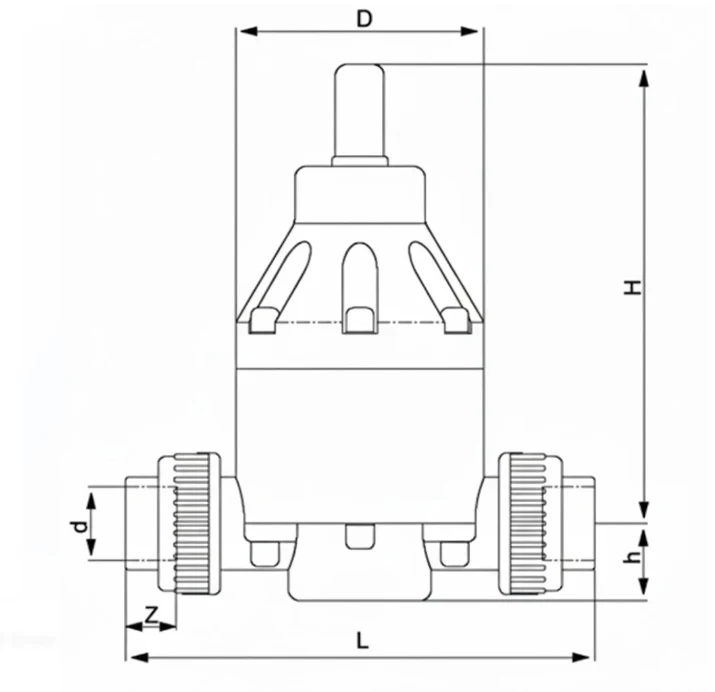
DN: Nominal Diameter (Internal size).
L: Total Face-to-Face Length.
H: Total Height from the bottom of the body to the top of the bonnet/handle.
D: Outer Diameter of the valve body or flange.
d / z / h: Typically refer to socket depth, port diameter, or specific bolt-hole center dimensions.
| DN | L | H | D | d | z | h |
| 15 | 170 | 172 | 82 | 20 | 21 | 27 |
| 20 | 170 | 172 | 82 | 25 | 21 | 27 |
| 25 | 212 | 202 | 107 | 32 | 26 | 35 |
| 32 | 226 | 202 | 107 | 40 | 28.5 | 35 |
| 40 | 292 | 259 | 148 | 50 | 37 | 58 |
| 50 | 305 | 259 | 148 | 63 | 37 | 58 |
| Parameter | Specification / Property |
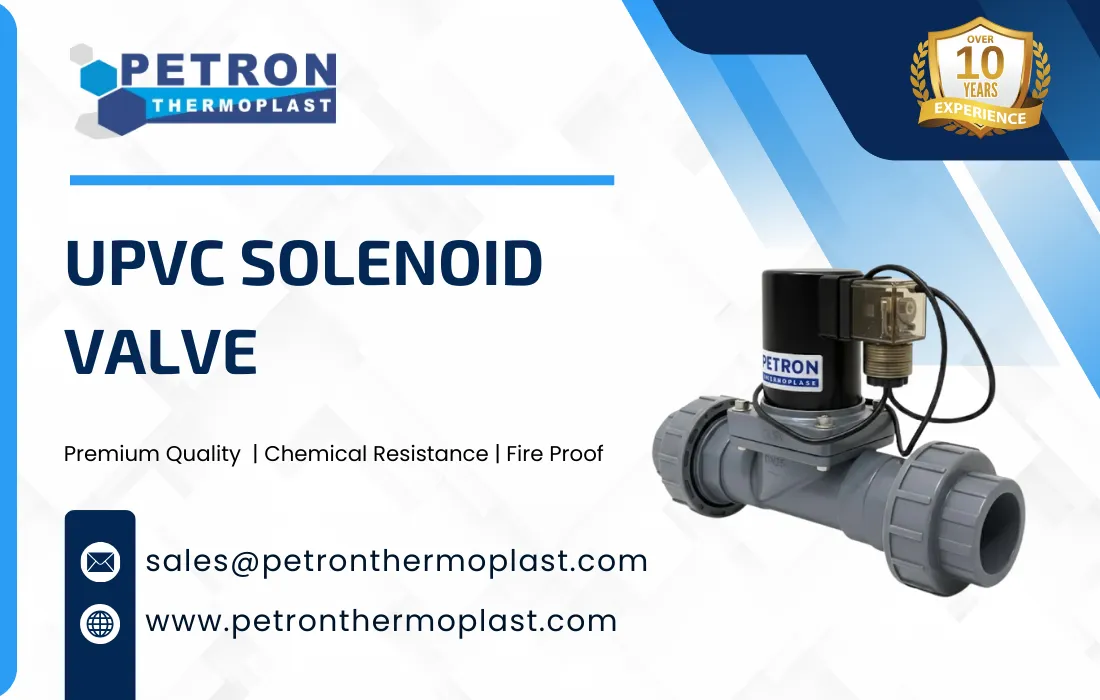
| Valve Type | Solenoid Valve (Electrically Actuated) |
| Body Material | UPVC (Unplasticized Polyvinyl Chloride) |
| Internal Parts | Stainless Steel (SS304/SS430) / Copper components |
| Seal Material | EPDM / FKM (Viton) |
| Operation Type | Normally Closed (NC) / Normally Open (NO) |
| Actuation | Electromagnetic Coil |
| Voltage Options | 12V DC, 24V DC, 24V AC, 110V AC, 230V AC |
| Protection Class | IP65 (Dustproof & Water-resistant) |
| Connection Type | Threaded (BSP/NPT) / Socket / Flanged |
| Size Range | DN15 – DN65 (½” – 2½”) |
| Pressure Rating | Up to 6–7 bar (Working range: 0.1 to 6 bar) |
| Temperature Range | -5°C to 60°C |
| Response Time | < 1 Second |
| Flow Direction | Uni-directional |
| Density | ~1.38 – 1.45 g/cm³ |
| Corrosion Resistance | Excellent (Acids, alkalis, and salts) |
| Mechanical Strength | High rigidity and tensile strength |
| Thermal Conductivity | Low (Self-insulating) |
| Surface Finish | Smooth internal bore (Minimal friction) |
| Weight | Lightweight compared to metal alternatives |
| Standards | CE compliant / ISO standards |
| Applications | Water treatment, chemical dosing, irrigation, automation |
Automatic Pressure Regulation: Maintains constant downstream pressure despite input fluctuations.
Corrosion-Resistant Body: UPVC construction ensures durability in aggressive chemical environments.
Adjustable Set Pressure: Customizable output pressure range using external adjustment screw.
Non-Metallic Internals: Prevents corrosion and minimizes maintenance.
Compact & Lightweight: Easy to install and suitable for space-restricted setups.
Reliable Sealing: High-performance diaphragm and seals prevent leakage and ensure accurate control.
Low Maintenance: Designed for long service life with minimal servicing requirements.
| Parameter | Typical Value / Rating | Notes |
| Nominal Pressure Rating (PN) | PN 10 (10 bar / ~150 psi) | Standard for UPVC valves at ~20 °C – common working pressure rating for many UPVC PRVs. |
| Adjustable Outlet Pressure Range | 0.5 – 6 bars (7 – 87 psi) | Typical adjustability range on many diaphragm-type UPVC reducing valves. |
| Maximum Working Temperature | 0 °C to ~60 °C | Above this temperature, plastic valves and their ratings may derate significantly. |
| Pressure Derating at Elevated Temp (Approx.) | 20 °C: 100 % = 10 bar 40 °C: ~65 % ≈ 6.5 bar 60 °C: ~30 % ≈ 3 bar | Pressure tolerance decreases with temperature for UPVC valves. |

Custom Product Manufacturing Available
If you are searching for customized product designs that meet your requirements, don’t worry. Petron Thermoplast also offers custom product manufacturing services to meet the unique needs of various industries. Work with our expert engineers to create custom designs suited for your application.
Benefits of UPVC Pressure Reducing Valve
1. Protects Piping & Equipment
- Reducing the high inlet pressure to a safe level and controlling the outlet pressure
- Prevents pipe bursts, leaks, and damage to fixtures, meters, and pumps
2. Corrosion & Chemical Resistance
- UPVC is highly resistant to rust, scale, and many of the chemicals
- They are ideal for water, wastewater, and mild chemical applications
3. Consistent & Stable Pressure
- Maintain the constant downstream pressure even when the inlet pressure fluctuates.
- Improves the performance and reliability of the system
4. Lightweight & Easy Installation
- Much lighter than metal PRVs
- Easy to handle, lower installation effort, and reduced labor cost
5. Low Maintenance
- Non-corrosive material means longer service life
- Fewer blockages and a reduction in the need for repairs
6. Cost-Effective Solution
- Lower initial cost compared to brass or metal
- A long life cycle reduces the replacement and maintenance expenses
7. Energy & Water Savings
- Prevent the excessive pressure and reduce the wastage of water
- Improves the efficiency of downstream equipment like irrigation systems
8. Adjustable Outlet Pressure
- Easily adjustable to suit different operating requirements
- Allows precise pressure control without changing hardwarE
9. Smooth Flow & Low Pressure Loss
- UPVC’s smooth internal surface to minimize the friction losses
- Better flow efficiency compared to rough metal surfaces
10. Suitable for Many Applications
- Domestic water supply
- Irrigation systems
- Water treatment plants
- Industrial fluid handling
- RO and filtration systems
Types of UPVC Pressure Reducing Valve
1. Diaphragm-Operated UPVC Pressure Reducing Valve
- Uses a flexible diaphragm to sense the downstream pressure
- Automatically opens and closes to maintain the set pressure
- Very accurate and stable control
2. Spring-Loaded (Direct Acting) UPVC PRV
- Pressure is balanced against an adjustable spring
- Compact design and quick response
- Suitable for smaller pipe sizes and moderate flow
3.Pilot-Operated UPVC Pressure Reducing Valve
- Uses a small pilot valve to control a main valve
- Handle high inlet pressure and large flow rates
- Provide a very stable outlet pressure
4. Inline UPVC Pressure Reducing Valve
- Installed it directly in the pipeline (straight-through design)
- Compact and space-saving
- Common in small and medium piping systems
- Angle-Type UPVC Pressure Reducing Valve
- Flow path changes direction (usually 90°)
- Reduces pressure and flow velocity simultaneously
- Helps minimize water hammer in some systems
6. Manual Adjustable UPVC Pressure Reducing Valve
- Outlet pressure adjusted manually using a screw or knob
- Simple construction and easy operation
- No external power required
7. Pressure Reducing Valve with Gauge (UPVC)
- Comes with a built-in or attached pressure gauge
- Allows easy monitoring and fine adjustment of outlet pressure
Why Choose Petron Thermoplast?
Petron Thermoplast provides the industrial UPVC Pressure Reducing Valve solutions designed to meet the demanding requirements of industrial and water treatment plants.
Wide range of industrial valves
Suitable for clean water, wastewater, and RO systems
High-quality materials and precision machining
Automation-ready valve designs
Reliable performance in continuous operation
Trusted by engineers and contractors
Petron Thermoplast UPVC Pressure Reducing Valves are used across the municipal, industrial, and commercial water treatment projects.