PVDF Air Release Valve
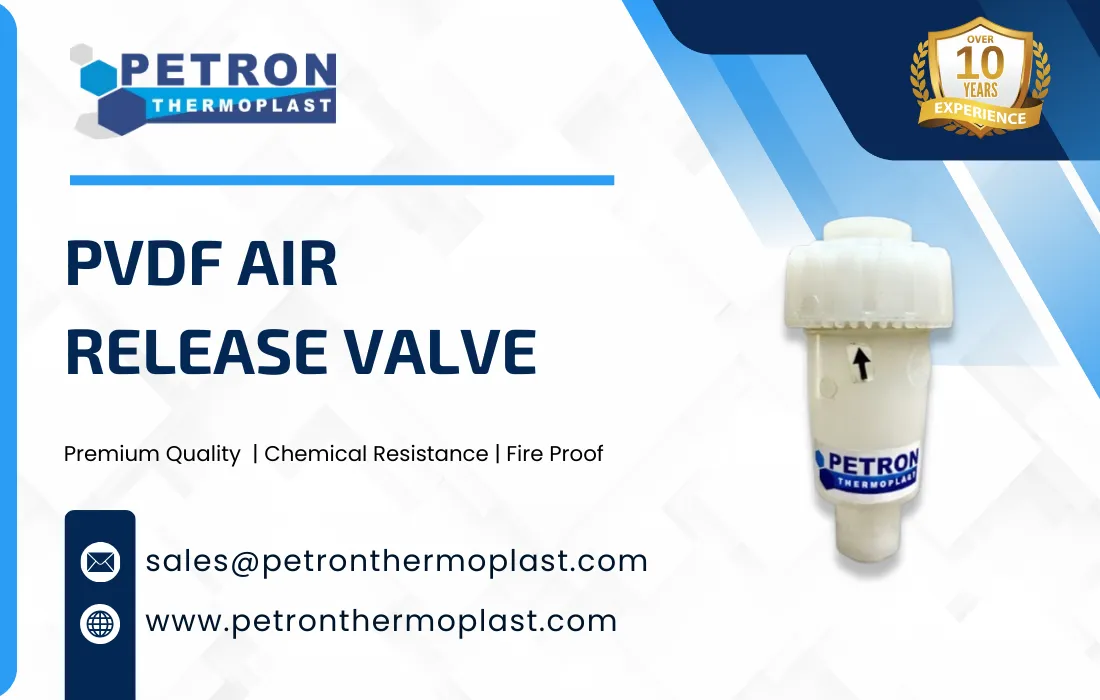
A PVDF Air Release Valve is a type of air valve made from Polyvinylidene Fluoride (PVDF), a high-performance thermoplastic material, designed to automatically release trapped air from liquid pipeline systems while preventing liquid from escaping. A PVDF Air Release Valve is a pipeline safety device made from Polyvinylidene Fluoride (PVDF) that is designed to automatically release trapped air or gases from liquid piping systems during filling, operation, or drainage.
The PVDF Air Release Valve is engineered to automatically release trapped air or gases from pipelines and pressurized systems to ensure optimal flow efficiency and prevent air blockages. This valve is ideal for highly corrosive and demanding environments such as chemical processing, oil and gas treatment, and ultra-pure fluid systems. The PVDF air release valve plays a critical role in maintaining system integrity, accuracy, and energy efficiency in industrial piping applications.

- Chemical Resistance
- Low Maintenance Requirement
- Low Thermal Conductivity
- Long Service Life
- Easy Installation
- Corrosion Resistance
PVDF Air Release Valve Details
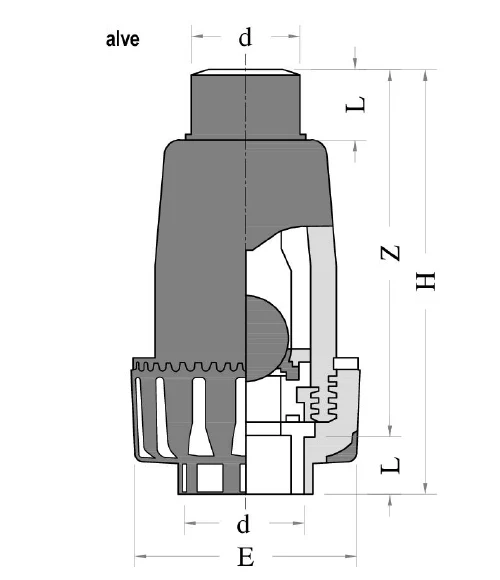
d – Outer Diameter of Pipe (mm)
DN – Nominal Diameter
PN – Pressure Nominal (Bar)
E – Flange Thickness / End Thickness (mm)
H – Overall Height (mm)
L – Length of Socket or Hub (mm)
Z – Center-to-End Distance (mm)
| d (DN) | d (inch) | PN | D (mm) | L (mm) | t (mm) | H (mm) |
| 20 | 1/2″ | 16 | 54 | 104 | 16 | 88 |
| 25 | 3/4″ | 16 | 65 | 125 | 19 | 106 |
| 32 | 1″ | 16 | 74 | 148 | 22 | 126 |
| 40 | 1 1/4″ | 16 | 86 | 171 | 26 | 145 |
| 50 | 1 1/2″ | 16 | 98 | 189 | 31 | 158 |
| 63 | 2″ | 16 | 119 | 222 | 38 | 184 |
| Parameter / Property | Specification / Description |
| Body Material | PVDF (Polyvinylidene Fluoride) |
| Float Material | PVDF or SS316 (depending on design) |
| Seat / Seal Material | PTFE / EPDM / FKM |
| Size Range | ½” to 4” (DN15 to DN100) |
| Pressure Rating | PN10 (≈10 bar / 150 PSI) |
| Temperature Range | -20°C to +120°C (depends on seal material) |
| Connection Type | Threaded (BSP/NPT), Socket, Flanged |
| Operation Type | Automatic air vent / automatic air release |
| Standards | ANSI, DIN, ISO |
| Flow Capacity | Designed for rapid air release to prevent vacuum or air locks |
| Media Compatibility | Water, chemicals, corrosive liquids, high-purity fluids |
| — | — |
| Design Type | Automatic air release (float-operated) |
| Internal Mechanism | Float lifts to allow air to escape, closes when liquid reaches float level |
| Body Construction | Compact, lightweight, corrosion-resistant PVDF |
| Sealing System | Leak-proof PTFE/EPDM seat |
| Maintenance | Easy disassembly for cleaning and float replacement |
| Flow Path | Vertical air vent path for efficient air discharge |
| Mounting Orientation | Vertical installation recommended |
| External Appearance | White / translucent PVDF body |
| Weight | Lightweight, easy to handle and install |
| Durability | Resistant to chemical attack, UV, and scaling |
Corrosion Resistance: PVDF construction provides outstanding chemical resistance to acids, bases, and solvents.
Automatic Air Venting: Efficiently releases air pockets without manual intervention, ensuring smooth fluid flow.
Compact Design: Space-saving design suitable for tight piping configurations.
Non-Leak Performance: Precision-engineered sealing components ensure a tight, leak-proof operation.
Low Maintenance: Simple construction with minimal moving parts reduces service needs.
High Temperature & Pressure Resistance: Withstands demanding process conditions without deformation or performance loss.
Installation Flexibility: Available in various connection types for easy integration into existing systems.
| Valve Type | Nominal Size (DN) | Typical Working Pressure Range | Maximum Pressure Rating (PN/Class) | Test Pressure (Approx.) |
| Single Orifice Air Release Valve | DN15 – DN50 | 0.2 – 10 bar | PN10 | 15 bar |
| Double Orifice (Air/Vacuum) Valve | DN25 – DN100 | 0.2 – 10 bar | PN10 | 15 bar |
| Combination Air Valve | DN25 – DN80 | 0.2 – 10 bar | PN10 | 15 bar |
| Heavy Duty Industrial Type | DN50 – DN150 | 0.5 – 16 bar | PN16 | 24 bar |

Custom Product Manufacturing Available
If you are searching for customized product designs that meet your requirements, don’t worry. Petron Thermoplast also offers custom product manufacturing services to meet the unique needs of various industries. Work with our expert engineers to create custom designs suited for your application.
Benefits of Using PVDF Air Release Valve
1. Excellent Corrosion Resistance
- Highly resistant to acids, alkalis, and aggressive chemicals
- Ideal for chemical processing and effluent treatment plants
- Long service life in harsh environments
2️. High Chemical Compatibility
- Suitable for handling corrosive liquids such as:
- Sulfuric acid
- Hydrochloric acid
- Sodium hypochlorite
- Reduces risk of material degradation
3️ . Lightweight & Easy Installation
- Much lighter than metal valves
- Easier handling and lower installation cost
- Reduced structural load on pipelines
4️. Automatic Air Removal
- Automatically releases trapped air from pipelines
- Prevents air pockets that reduce flow efficiency
- Improves system performance
5️. Prevents Water Hammer & Flow Issues
- Eliminates air accumulation that can cause:
- Pressure surges
- Pump inefficiency
- Pipeline vibration
6️. High Temperature & UV Resistance
- Performs well at elevated temperatures (typically up to 120°C depending on design)
- UV-resistant for outdoor installations
7️. Low Maintenance
- Non-corrosive material reduces scaling and rust
- Longer operational life
- Lower maintenance costs compared to metal valves
8️. Cost-Effective for Corrosive Applications
- More economical than exotic metal alloys (e.g., Hastelloy, titanium)
- Provides reliable performance in chemical industries
Types of PVDF Air Release Valve
1. Automatic Air Release Valves (AARVs)
- These valves automatically release small volumes of air from pipelines as the system fills with liquid. They are essential for preventing airlocks in the system that could reduce the efficiency of fluid transport.
- A float mechanism to open and close the valve as air or gas is released.
- Used in pipelines, water treatment plants, and chemical industries.
- Operates without manual intervention.
- A float mechanism to open and close the valve as air or gas is released.
2. Combination Air Release and Vacuum Relief Valves
- Function: These valves serve two purposes: releasing air during the filling of a system and allowing air into the system to prevent vacuum conditions.
- Key Features:
- Dual function helps to protect the system from both air pockets and vacuum conditions.
- Common in water, wastewater, and chemical transfer systems.
- PVDF construction enhances resistance to corrosion and harsh chemicals.
3. Manual Air Release Valves
- Function: These valves are manually operated, allowing users to release air or gas from a system at specified intervals or when required.
- Key Features:
- Typically used in small-scale or less automated systems.
- Manual control provides flexibility for air release.
- Suitable for low-pressure and low-flow systems.
- Typically used in small-scale or less automated systems.
4. Float-Type Air Release Valves
- Function: The valve uses a float to automatically open and close the valve as air is released. The float rises when air accumulates, opening the valve to vent gas.
- Key Features:
- Self-activating based on air buildup.
- Can handle larger volumes of air.
- Suitable for industrial applications where air pockets can be detrimental to system performance.
- Self-activating based on air buildup.
5. High-Pressure Air Release Valves
- Function: These valves are designed to handle high-pressure systems and release air or gas without compromising the structural integrity of the system.
- Key Features:
- Stronger construction for withstanding higher pressures.
- Often used in pipelines carrying water or chemicals under high pressure.
- PVDF material adds the benefit of chemical resistance while ensuring the valve can handle the elevated pressure.
- Stronger construction for withstanding higher pressures.
6. Venturi or Orifice Air Release Valves
- Function: These valves rely on a venturi or orifice mechanism to facilitate air release by creating a low-pressure zone as fluid flows through the valve.
- Key Features:
- Often used in large-scale pipeline systems.
- Can help minimize the amount of air released by optimizing the size of the valve opening.
- Suitable for systems with varying flow rates.
- Often used in large-scale pipeline systems.
7. Micro Air Release Valves
- Function: These valves are used to release very small amounts of air, which could otherwise affect the precision of sensitive operations.
- Key Features:
- Used in applications like chemical dosing systems, where air could disrupt the flow of liquids.
- Often integrated into smaller pipelines or systems with very specific pressure requirements.
- Used in applications like chemical dosing systems, where air could disrupt the flow of liquids.
8. Inline Air Release Valves
- Function: Installed directly into the pipeline, these valves are designed for continuous operation and are often used to release air during the filling process or in high-flow systems.
- Key Features:
- Low maintenance.
- Suitable for various industries, including pharmaceuticals, water treatment, and the chemical industries.
- Integration into the pipeline minimizes the need for additional space or hardware.
- Low maintenance.
9. Screw Cap Air Release Valves
- Function: These are manual air release valves that screw into the top of tanks or pipelines to allow air to escape.
- Key Features:
- Manual operation for controlled air release.
- Common in small systems and applications requiring manual oversight.
Applications of PVDF Air Release Valve
Process Industry
High Purity Applications
Electronic Industry
Electrical Industry
Semi-conductors Industry
Pharmaceutical Industry
Solar power panels
Sugar Industry
Paper & Pulp Industry
Nuclear Power Industry
Automotive Industry
DI water plants
Why Choose Petron Thermoplast?
At Petron Thermoplast, PVDF Air Release Valves are critical components in piping systems, ensuring smooth flow transitions and efficient use of space. Understanding the dimensions and applications of short radius bends is essential for designing reliable and efficient piping systems. By adhering to standards such as ASME B16.9, engineers can ensure compatibility and performance across various industries.