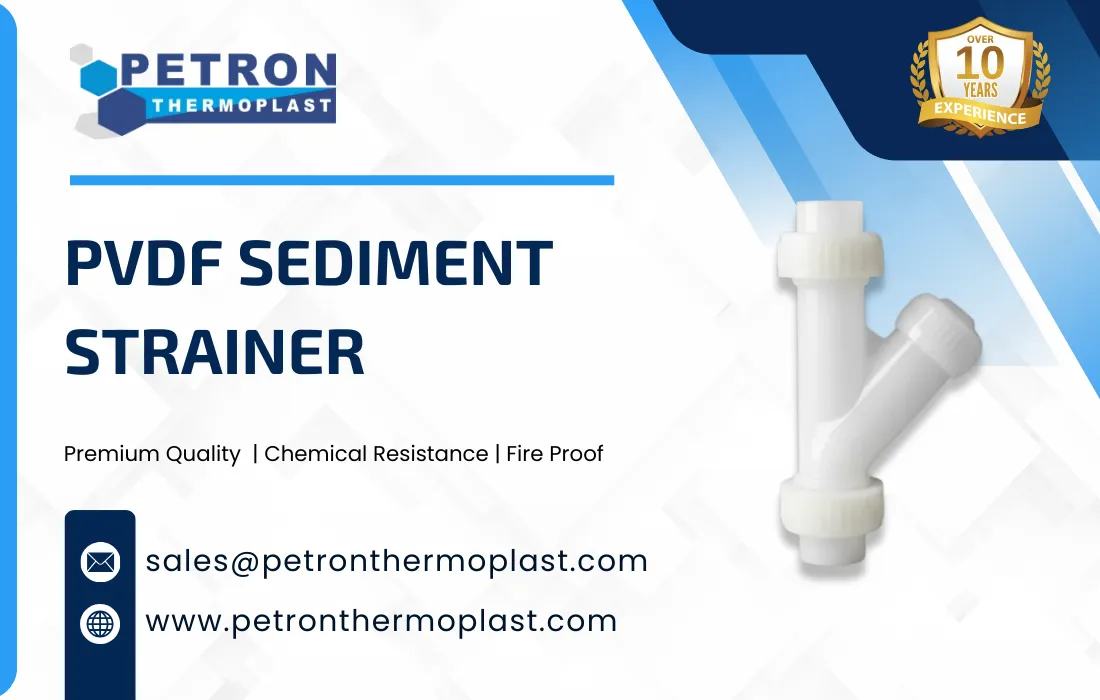
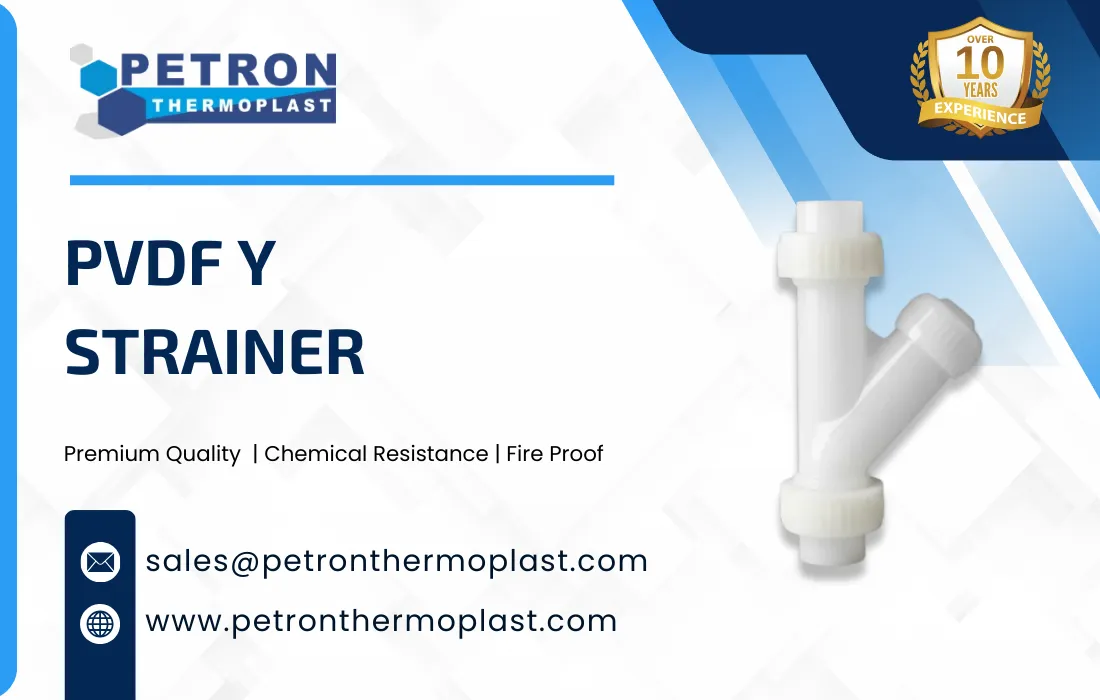
PVDF Sediment Strainer
A PVDF Sediment Strainer is a device made from Polyvinylidene Fluoride (PVDF) designed to filter out solid particles, debris, and sediment from liquid flow in piping systems, protecting downstream equipment like pumps, valves, and meters. These are meant to capture any solid contaminants that may sometimes be in the line. Solenoid valves and other devices with small holes, such as pumps or control valves, are protected by a PVDF Sediment Strainer. The filter screen is easily replaceable and available in a variety of mesh sizes.
The pump and meter are protected by a PVDF sediment strainer, which removes suspended particles and contaminants. The position of the screen can be easily determined due to its transparent thermoplastic structure. The optional in line cleaning valve flushes collected particles from the strainer port. It is easy to install or repair without enlarging the pipeline. A great filtering capacity and minimum pressure drop are two of its key features. As a result of the transparent PVDF sediment strainer, the condition of the filter screen can be easily assessed.

- Chemical Resistance
- Low Maintenance Requirement
- Low Thermal Conductivity
- Long Service Life
- Easy Installation
- Corrosion Resistance
PVDF Sediment Strainer Details

Size: Nominal Pipe Size (Inches).
d: Outside diameter of the pipe/fitting (mm).
DN: Diameter Nominal (Metric standard, mm).
L: Total Length (Face-to-face dimension).
H: Height (Centerline to top or total height).
I: Internal or insertion depth.
| DN | L | H | D | d | z | h |
| 15 | 170 | 172 | 82 | 20 | 21 | 27 |
| 20 | 170 | 172 | 82 | 25 | 21 | 27 |
| 25 | 212 | 202 | 107 | 32 | 26 | 35 |
| 32 | 226 | 202 | 107 | 40 | 28.5 | 35 |
| 40 | 292 | 259 | 148 | 50 | 37 | 58 |
| 50 | 305 | 259 | 148 | 63 | 37 | 58 |
| Parameter | Details |
| Product Type | Sediment Strainer (Y-Type / Inline Filter) |
| Material (Body) | Polyvinylidene Fluoride (PVDF) |
| Filter Element Material | PP / Stainless Steel / PVDF mesh |
| Seal Material | EPDM / FPM (Viton) |
| Construction | Thermoplastic molded body / True union design |
| Design Type | Y-type (angled) / Inline cylindrical |
| Function | Removes solid particles and impurities from fluid |
| Working Principle | Fluid passes through mesh screen that traps debris |
| Connection Type | Socket weld / Threaded (BSP/NPT) / Flanged |
| Available Sizes | DN15 to DN100 (½″ to 4″) |
| Pressure Rating | Up to PN10 (≈10 bar / 150 PSI typical) |
| Operating Temperature | -40°C to +120°C (PVDF range) |
| Flow Direction | Uni-directional (with flow arrow) |
| Filtration Size (Mesh) | Typically 20–60 mesh (custom options available) |
| Filtration Capacity | High dirt-holding capacity with large filtration area |
| Pressure Drop | Low due to optimized flow path |
| Cleaning Method | Removable/replaceable screen, flush valve option |
| Installation Position | Horizontal or vertical (screen downward preferred) |
| Transparency Option | Transparent body available for visual inspection |
| Density (PVDF) | ~1.75 – 1.78 g/cm³ |
| Tensile Strength | ~35 – 50 MPa |
| Chemical Resistance | Excellent (acids, alkalis, solvents, oxidizers) |
| Thermal Stability | High temperature resistance |
| UV Resistance | Excellent (suitable for outdoor use) |
| Maintenance | Easy (top-entry / removable filter element) |
| Design Feature | Replaceable mesh screen, compact structure |
| Application Position | Installed upstream of pumps, valves, meters |
| Applications | Chemical processing, water treatment, filtration systems |
- Material Advantages
- Made of PVDF, a highly durable thermoplastic
- Resistant to strong acids, alkalis, and most organic solvents.
- Excellent corrosion resistance compared to metals.
- Suitable for use in aggressive chemical environments
- High Thermal Stability
- Operates efficiently in a wide temperature range (typically up to 150°C depending on design).
- Maintains mechanical integrity under temperature fluctuations.
- Mechanical Strength
- Robust design to handle pressure without cracking or deformation.
- Can sustain moderate to high-pressure flow systems.
- Fine Filtration Capability
- Equipped with precision mesh or perforated elements to remove sediment, particles, and debris.
- Prevents clogging of downstream equipment like pumps, valves, or meters.
- Low Maintenance
- Easy to disassemble, clean, and reassemble.
- Non-stick surface reduces fouling and prolongs service life.
- Lightweight & Easy Installation
- Lighter than metal alternatives, reducing handling and installation efforts.
- Compatible with various piping systems (flanged or threaded connections).
- Lighter than metal alternatives, reducing handling and installation efforts.
- Chemical Compatibility
- Suitable for oil, gas treatment, chemical processing, pharmaceutical applications, and other corrosive fluid systems.
- Suitable for oil, gas treatment, chemical processing, pharmaceutical applications, and other corrosive fluid systems.
- Longevity
- UV-resistant for outdoor applications.
- Long service life even under continuous operation with abrasive or corrosive fluids.
1. By Strainer Design / Flow Pattern
| Type | Description | Typical Use |
| Y-Strainer | Inline strainer with angled body and removable screen | Common for pipelines with small debris; compact design |
| Basket Strainer | A cylindrical or rectangular basket that collects larger debris | High-capacity filtration; easier cleaning in process lines |
| Duplex / Twin Basket Strainer | Two baskets with a bypass valve for continuous operation | Allows cleaning one basket without shutting down the system |
| T-Strainer / Tee Strainer | Installed as a tee in the pipeline; contains a removable screen | Medium capacity; suitable for chemical or water systems |
2. By Connection Type
| Type | Description |
| Threaded (BSP/NPT) | Screwed connection for easy installation and removal |
| Socket / Solvent Weld | PVDF pipe solvent-welded into the strainer ends; strong and leak-proof |
| Flanged Ends | Bolted flanged connection; used for larger pipelines or frequent maintenance |
3. By Application / Special Features
| Variant | Feature / Use |
| High-Temperature Strainer | Rated for operation up to ~140°C; suitable for hot fluids |
| Corrosion-Resistant / High-Purity | Optimized for chemical, pharmaceutical, or semiconductor systems |
| Fine Mesh / Micron-Rated Strainer | Screens down to 20 microns for high-precision filtration |
| Vacuum / Low-Pressure Strainer | Designed for low-pressure or partial vacuum systems |
| Automatic / Self-Cleaning Strainer | Uses a flushing mechanism to remove debris without manual intervention |
| Size (inches / mm) | Nominal Pressure Rating (PN / psi) | Operating Temperature Range |
| ½″ – 1″ (15–25 mm) | 10 bar / 145 psi | 0–100°C (32–212°F) |
| 1½″ – 2″ (40–50 mm) | 8 bar / 116 psi | 0–100°C (32–212°F) |
| 2½″ – 4″ (65–100 mm) | 6 bar / 87 psi | 0–100°C (32–212°F) |
| 4″ – 6″ (100–150 mm) | 5 bar / 72 psi | 0–100°C (32–212°F) |
| 6″ – 8″ (150–200 mm) | 4 bar / 58 psi | 0–100°C (32–212°F) |

Custom Product Manufacturing Available
If you are searching for customized product designs that meet your requirements, don’t worry. Petron Thermoplast also offers custom product manufacturing services to meet the unique needs of various industries. Work with our expert engineers to create custom designs suited for your application.
Benefits of Using PVDF Sediment Strainer
1. Excellent Chemical Resistance
- Made from PVDF, highly resistant to acids, alkalis, solvents, and other corrosive fluids
- Ideal for chemical processing, pharmaceutical, and high-purity fluid systems
- Long service life in aggressive environments
2️. High Temperature Capability
- Can operate up to ~140°C (depending on pressure)
- Suitable for hot process fluids without deformation or failure
3️. Effective Particle Filtration
- Removes sediment, debris, and particulate matter from fluid systems
- Protects downstream equipment such as pumps, valves, meters, and pipelines
- Reduces wear and maintenance costs
4️. Easy Maintenance
- Removable basket or screen allows quick cleaning
- Reduces downtime compared to inline filters
- Minimal tools required for maintenance
5️. Lightweight & Easy Installation
- Lighter than metal strainers, easier to handle
- Can be installed horizontally or vertically, depending on the type
- Reduces support structure requirements
6️. Corrosion & UV Resistance
- Resistant to outdoor exposure and UV degradation
- Suitable for corrosive, harsh, or outdoor environments
7️. Long-Term Cost Efficiency
- Durable PVDF construction reduces replacement frequency
- Low maintenance requirements lower operating costs
- Extends the life of pumps, valves, and other downstream equipment
8️. Wide Applications
- Chemical and petrochemical plants
- Pharmaceutical and biotech industries
- Water treatment and wastewater systems
- Semiconductor and high-purity fluid system.
Applications of PVDF Sediment Strainer
Process Industry
High Purity Applications
Electronic Industry
Electrical Industry
Semi-conductors Industry
Pharmaceutical Industry
Solar power panels
Sugar Industry
Paper & Pulp Industry
Nuclear Power Industry
Automotive Industry
DI water plants
Why Choose Petron Thermoplast?
With so many options on the market, why should you trust Petron Thermoplast for your PVDF Sediment Strainer needs? The answer lies in our commitment to quality, service, and understanding your unique challenges.
We don’t just sell products—we engineer solutions. Our PVDF Sediment Strainers are manufactured using the highest quality raw materials and technology, ensuring consistent performance and compliance with global standards. Every batch undergoes rigorous testing for pressure resistance, temperature tolerance, and durability, so you can be confident that what you’re installing is built to last.