PVDF Materials
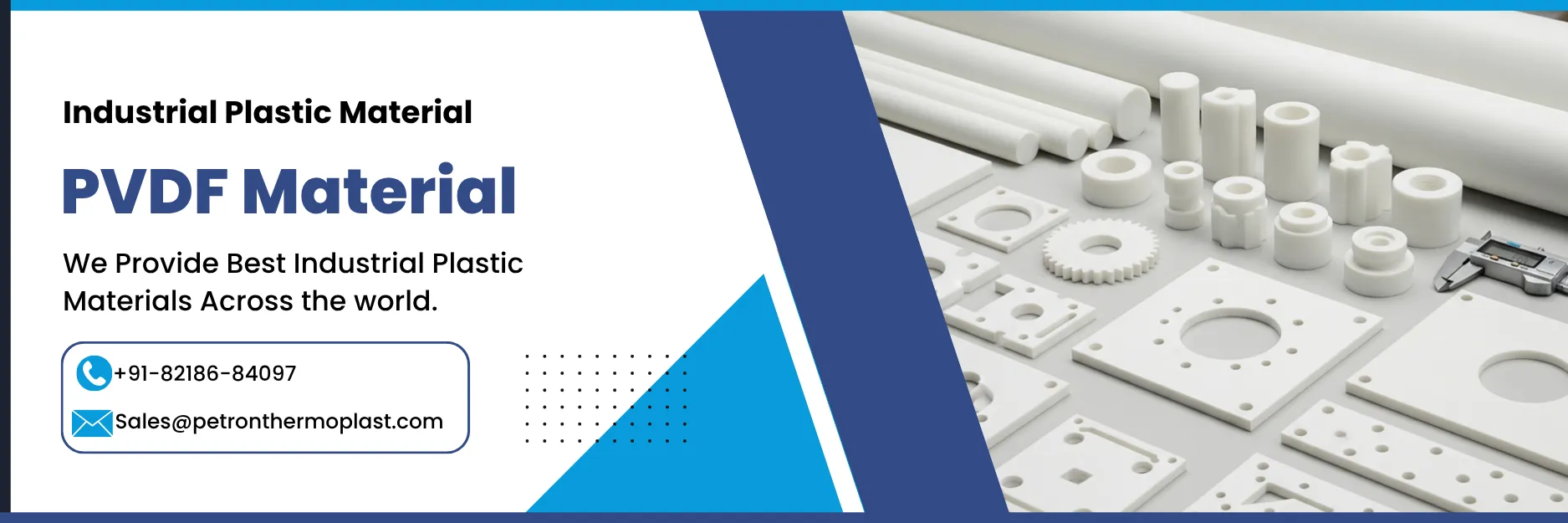
PVDF (Polyvinylidene Fluoride) Material is a high performance thermoplastic fluoropolymer known for its excellent chemical, thermal, and mechanical properties. It belongs to the family of fluoropolymers, similar to PTFE (Teflon), but is easier to process and mold into complex shapes. Its polymer chain consists of repeating units of –(CH₂–CF₂)–. The strong carbon fluorine bonds give it exceptional chemical and thermal stability.
PVDF Material is a semicrystalline thermoplastic fluoropolymer with high chemical, thermal, and UV resistance, widely used in industrial applications requiring durability and corrosion resistance. It is resistant to acids, bases, and many organic solvents. We can operate continuously up to ~140 °C and withstand short-term temperatures up to ~150 °C. Good tensile and impact strength compared to other fluoropolymers. Resistant to sunlight degradation and to gas and liquid permeation.
- Chemical Resistance
- Low Maintenance Requirement
- Low Thermal Conductivity
- Long Service Life
- Easy Installation
- Corrosion Resistance
PVDF Materials Details
| Property | Typical Value / Description |
| Chemical Name | Polyvinylidene Fluoride |
| Abbreviation | PVDF |
| Appearance | White to translucent, opaque thermoplastic |
| Density | 1.75 – 1.78 g/cm³ |
| Melting Point | 165 – 175 °C |
| Glass Transition Temperature (Tg) | ~ -35 °C |
| Max Continuous Service Temp | ~140 °C (up to 150 °C for some grades) |
| Min Service Temperature | ~ -40 °C |
| Tensile Strength | 40 – 55 MPa |
| Elongation at Break | 30 – 50% |
| Flexural Strength | 50 – 80 MPa |
| Hardness (Shore D) | 70 – 80 |
| Impact Strength (Notched Izod) | 5 – 8 kJ/m² |
| Thermal Conductivity | 0.17 – 0.19 W/m·K |
| Coefficient of Thermal Expansion | 100 – 150 ×10⁻⁶ /°C |
| Dielectric Constant | ~8 – 10 at 1 kHz |
| Dielectric Strength | 30 – 40 kV/mm |
| Water Absorption (24 h) | < 0.04% |
| Chemical Resistance | Excellent: acids, bases, alcohols, hydrocarbons, halogens, oxidizers |
| UV Resistance | Moderate; may degrade unless stabilized |
| Flammability | UL 94 V-0 rating (self-extinguishing) |
| Surface Finish | Smooth, glossy, or matte |
| Processing Methods | Injection molding, extrusion, casting, compression molding |
Temprature
| Property | Typical Value | Notes |
| Melting Temperature (Tm) | 170 – 175 °C | Crystalline PVDF; varies with grade and processing |
| Glass Transition Temp (Tg) | –35 °C | Amorphous regions; below this, material is brittle |
| Decomposition Temp | 350 – 400 °C | Onset of significant chemical degradation |
| Service Temp (Continuous) | ≤150 °C | Maximum temperature for long-term applications |
| Ignition Temperature | ~500 °C | Approximate auto-ignition point in air |
Density
| PVDF Form / Grade | Typical Density (g/cm³) | Notes |
| Homopolymer PVDF (general) | 1.78 – 1.80 | Standard solid PVDF resin |
| PVDF Films / Sheets | 1.75 – 1.78 | Depends on processing (extrusion, calendering) |
| PVDF Membranes | 1.70 – 1.78 | Porosity reduces effective density |
| PVDF Copolymers (HFP blends) | 1.72 – 1.78 | Slightly lower density due to comonomer incorporation |
| PVDF Composites (with fillers) | 1.80 – 2.0+ | Increases with fillers like glass fiber or carbon |
| PVDF Material / Product | Standard Size (DN / NPS) | Max Pressure @ 20°C (psi / bar) | Max Pressure @ 60°C (psi / bar) | Max Pressure @ 100°C (psi / bar) | Notes |
| PVDF Pipe (Sch 80) | DN 10–50 (½–2″) | 400 psi / 27.6 bar | 280 psi / 19.3 bar | 140 psi / 9.7 bar | Typical for chemical transport; derate with temperature |
| PVDF Pipe (Sch 80) | DN 65–150 (2½–6″) | 250 psi / 17.2 bar | 180 psi / 12.4 bar | 90 psi / 6.2 bar | Larger diameters have lower pressure rating |
| PVDF Tube (thin wall) | 6–25 mm | 250–300 psi / 17–20 bar | 175–210 psi / 12–14 bar | 90–105 psi / 6–7 bar | Used for instrumentation and small pipelines |
| PVDF Flange / Fittings | DN 10–50 | 300–400 psi / 20–27 bar | 200–280 psi / 14–19 bar | 100–140 psi / 7–9.7 bar | Depends on fitting type (elbow, tee, valve) |
| PVDF Valve Body | DN 10–50 | 300–350 psi / 20–24 bar | 200–250 psi / 14–17 bar | 100–140 psi / 7–9.7 bar | Derating required at higher temperature; max temp ~150°C |
| PVDF Form | Typical Thickness | Typical Width / Size | Notes |
| PVDF Films | 12 µm – 500 µm | Rolls: 100 mm – 2000 mm | Used for electrical insulation, coatings, or flexible applications |
| PVDF Sheets / Plates | 0.5 mm – 50 mm | 500×1000 mm to 2000×4000 mm | Used for chemical tanks, panels, structural components |
| PVDF Pipes / Tubes | Wall: 1 mm – 30 mm | Diameter: 10 mm – 500 mm | For chemical piping and fluid handling |
| PVDF Rods / Bars | 3 mm – 100 mm dia | Lengths: 1000 mm – 3000 mm | Machinable for industrial parts |
| PVDF Membranes | 50 µm – 200 µm | Rolls: 100 mm – 2000 mm | Porous for microfiltration/ultrafiltration |
1. Semi-Crystalline Structure
- Crystallinity typically ~50–70%
- Provides a balance of rigidity and toughness
- Good dimensional stability
2. High Chemical Stability
- Resistant to most acids, bases, and organic solvents
- Low chemical reactivity
- Excellent corrosion resistance
3. Wide Operating Temperature Range
- Service temperature: approx. –40°C to 150°C
- Good thermal stability
- Maintains properties under continuous heat exposure
4. High Mechanical Strength
- High tensile strength compared to many thermoplastics
- Good impact resistance
- Strong creep resistance
5. Low Water Absorption
- Very low moisture uptake
- Maintains mechanical and electrical properties in humid environments
6. UV & Weather Resistance
- Excellent resistance to sunlight and oxidation
- Long outdoor service life
- Color stability over time
7. Electrical Performance
- Good dielectric strength
- Stable insulating properties
- Also exhibits piezoelectric and pyroelectric behavior
8. Flame Retardant Nature
- Self-extinguishing
- Low smoke emission
- Meets fire safety requirements without additives
9. Processability
- Can be processed by:
- Injection molding
- Extrusion
- Welding
- Thermoforming
- Available in sheets, rods, films, pipes, and coatings
1️. Mechanical Testing
| Test | Purpose | Standard / Method |
| Tensile Test | Measures strength and elongation | ASTM D638 |
| Flexural Test | Determines stiffness (Modulus) | ASTM D790 |
| Impact Test | Evaluates toughness | ASTM D256 (Izod) |
| Hardness Test | Surface resistance | Shore D ASTM D2240 |
| Compression Test | Load-bearing capacity | ASTM D695 |
2️. Thermal Testing
| Test | Purpose | Standard / Method |
| Differential Scanning Calorimetry (DSC) | Measures melting temperature & crystallinity | ASTM D3418 |
| Thermogravimetric Analysis (TGA) | Measures decomposition temperature and thermal stability | ASTM E1131 |
| Heat Deflection Temperature (HDT) | Temperature at which part deforms under a specific load | ASTM D648 |
| Coeff. of Thermal Expansion (CTE) | Measures dimensional change per degree of temperature | ASTM E831 |
3️. Chemical & Corrosion Resistance Testing
- Immersion Test: PVDF samples submerged in chemicals; check for swelling, cracking, or weight change
- pH Resistance Test: Typically pH 0–14 exposure
- Solvent Compatibility Test: Evaluate exposure to solvents or acids/bases
- Standards: ASTM D543, ISO 175
4️. Electrical Testing
| Test | Purpose | Standard / Method |
| Dielectric Strength | Measures maximum voltage withstand before breakdown | ASTM D149 |
| Volume Resistivity | Measures bulk insulation properties through the material | ASTM D257 |
| Surface Resistivity | Measures insulation across the surface (prevents tracking) | ASTM D257 |
| Piezoelectric Testing | Measures charge coefficient beta-phase PVDF | IEC 62857 / Custom |
5️. Dimensional & Surface Quality
- Thickness & Diameter Measurement: Calipers, micrometers
- Flatness / Warp Measurement: Laser or mechanical gauges
- Visual Inspection: Check for cracks, voids, discoloration
- Surface Finish: Gloss, roughness, or adhesion suitability
6️. Nondestructive Testing (NDT)
- Ultrasonic Testing: Detect voids or delamination in thick sheets or linings
- X-ray / Radiography: Detect internal flaws in molded parts
- Spark / Holiday Testing: Check PVDF tank or pipe linings for pinholes
7️. Quality Assurance & Standards
| Aspect | Standard / Specification | Notes |
| Material Grade Verification | ASTM D3222 | Standard specification for PVDF molding and extrusion materials |
| Piping Systems | ASTM F1673 / ISO 10931 | Covers PVDF corrosion-resistant industrial piping systems |
| Sheet / Film | ASTM D5199 / ISO 1183 | Standards for measuring thickness and density of plastic sheets |
| Electrical Applications | IEC 60243 / UL 94 | Dielectric strength and flammability (V-0 rating) standards |
| FDA / Pharma | 21 CFR 177.2510 | Compliance for repeated use in contact with food/pharmaceuticals |
8️. Testing Frequency
- Incoming Raw PVDF Resin: Every batch
- After Extrusion / Molding: Random sampling (mechanical + visual + thermal)
- Piping & Tank Systems: Pre-installation hydrostatic testing + periodic inspection
- Critical Applications (Semiconductor, Battery): Continuous monitoring for purity, dielectric, and mechanical compliance
More About PVDF Materials
1. High Temperature Resistance
- Continuous operating temperature up to ~150°C (302°F)
- Maintains mechanical strength at elevated temperatures
- Suitable for hot liquid handling systems
2. Outstanding Mechanical Strength
- High tensile strength and toughness
- Good abrasion resistance
- Durable under mechanical stress
3. Superior UV & Weather Resistance
- Excellent resistance to UV radiation
- Does not degrade easily in outdoor environments
- Commonly used in architectural coatings and outdoor piping
4. Low Permeability
- Very low gas and liquid permeability
- Ideal for fluid transfer and storage applications
- Prevents contamination and leakage
5. Electrical Insulation Properties
- Good dielectric strength
- Used in wire insulation and electronic components
- Stable electrical performance over time
6. Flame Resistance
- Naturally flame retardant
- Low smoke generation
- Meets strict fire safety standards
8. High Purity Grades Available
- Available in ultra-pure forms for:
- Semiconductor industry
- Pharmaceutical production
- Medical applications
9. Piezoelectric & Pyroelectric Properties
- Unique among polymers
- Used in:
- Sensors
- Actuators
- Energy harvesting devices
1. Preparation Before Installation
Before beginning the installation, inspect all PVDF pipes and fittings for any visible damage or contamination. Make sure the environment is clean and free from particles that may affect jointing quality.
Cut the pipes to the desired lengths using appropriate tools to ensure straight and clean edges. Deburr both the inside and outside of the pipe ends to ensure a smooth connection and to prevent flow disturbances.
2. Joining Methods
There are several methods for joining PVDF pipes, including:
- Butt Fusion Welding: This is the most common method, using heat to join two pipe ends directly. Proper alignment, temperature, and pressure are crucial to ensure a strong, leak-free joint.
- Socket Fusion: Ideal for smaller diameters, socket fusion uses a heated tool to melt both the pipe and fitting before pushing them together.
- Electrofusion: A method using fittings with embedded heating elements that fuse the pipe and fitting together when electric current is applied.
3. Support and Alignment
PVDF pipes must be properly supported using clamps or hangers to avoid stress and sagging. The spacing between supports depends on the pipe size and temperature. Avoid sharp bends or misalignment that can cause mechanical stress or leaks over time.
Thermal expansion must also be considered, especially in high-temperature environments. Expansion loops or flexible connectors can be used to accommodate movement.
4. Testing and Inspection
After installation, conduct a pressure test with water or air to verify the integrity of the piping system. Check all joints and connections for leakage or deformation. A visual inspection is also recommended to confirm proper alignment and support.
5. Safety Considerations
When working with fusion equipment, always wear protective gloves and eyewear. Ensure the work area is well-ventilated and free from flammable materials. For systems used with aggressive chemicals, additional safety measures may be required.
1️.Routine Inspection
Visual Checks (Monthly / Quarterly)
- Surface cracks or discoloration
- Joint integrity (fusion welds or flanges)
- Leakage at connections
- Pipe sagging or support failure
- Chemical attack signs (softening or swelling)
Mechanical Checks
- Check pipe supports and clamps
- Verify bolt tightness (flanged joints)
- Ensure no excessive vibration
2️. Cleaning Procedures
A. General Cleaning
- Use mild detergent + warm water
- Soft cloth or non-abrasive sponge
- Rinse thoroughly
B. For Chemical Residue
- Flush with compatible neutralizing solution
- Follow chemical compatibility chart
- Avoid abrasive cleaners
3️. Maintenance of PVDF Piping Systems
| Maintenance Task | Frequency | Notes |
| Leak Inspection | Monthly | Check weld joints, flange gaskets, and valve unions. |
| Pressure Testing | Annually | Hydrostatic test as per system design limits. |
| Expansion Check | Annually | Inspect expansion loops and bellows for thermal stress or fatigue. |
| Support Alignment | 6–12 months | Check pipe hangers and brackets to prevent sagging or “bowing.” |
4️. Tank & Lining Maintenance
Inspection Focus:
- Weld seam integrity
- Delamination (for lined tanks)
- Surface blistering
- Chemical erosion areas
Testing Methods:
- Spark testing (holiday detection)
- Ultrasonic thickness testing
- Hydrostatic testing
5️. Repair Methods
Minor Damage:
- Hot air welding repair
- Extrusion weld patch
- Replace damaged fittings
Major Damage:
- Cut out affected pipe section
- Install new section with butt fusion
- Re-test system before operation
6️. Preventive Maintenance Best Practices
- Maintain operating temperature within design range
- Follow manufacturer welding parameters
- Keep maintenance records
7️. Typical Service Life
- When properly installed and maintained:
- Avoid sudden pressure surges (water hammer)
- Install vibration dampers if necessary
- Industrial piping: 20–30+ years
- Chemical tanks: 15–25+ years
- Outdoor systems: Long-term due to UV resistance
1️. Material (Formulation) Customization
A. Reinforced Grades
| Type | Purpose | Benefit |
| Glass Fiber Reinforced | Structural parts | Higher stiffness & strength |
| Carbon Fiber Reinforced | Lightweight structural use | Increased rigidity & conductivity |
| Mineral Filled | Dimensional stability | Reduced thermal expansion |
B. Additives
- UV Stabilizers → Outdoor durability
- Heat Stabilizers → High-temp performance
- Flame Retardants → Fire safety compliance
- Lubricants → Improved processing
- Antistatic Agents → Static discharge control
2️. Electrical Customization
PVDF is widely customized for electrical applications:
| Application | Custom Feature | Benefit |
| Piezoelectric Sensors | Beta-phase enhanced PVDF | Converts mechanical stress into electrical signals |
| Cable Insulation | High dielectric strength grade | Superior electrical insulation in harsh environments |
| Lithium-ion Battery Binder | High purity PVDF | Chemical stability and strong adhesion for electrodes |
| Capacitor Films | Controlled crystallinity | High energy density and low dielectric loss |
3️. Processing Customization
| Process | Application | Key Considerations |
| Extrusion | Pipes, sheets, films | Best for continuous profiles; requires precise temperature control. |
| Injection Molding | Valves, fittings, pump parts | High-volume production; accommodates complex geometries. |
| Blow Molding | Tanks, containers | Ideal for hollow, thin-walled vessels for chemical storage. |
| Compression Molding | Specialty parts | Suitable for thick-walled components and low-volume runs. |
| 3D Printing | Prototypes & small parts | Uses FFF/FDM; requires heated chambers to prevent warping. |
4️. Surface Customization
- Plasma treatment → Improve adhesion
- Surface texturing → Anti-slip applications
- Co-extrusion → Multi-layer chemical resistance
- Laminated structures → Barrier enhancement
5️. Dimensional & Design Customization
PVDF products can be customized in:
- Pipe diameter (SDR / PN rating)
- Sheet thickness (1–50 mm typical)
- Film thickness (micron level for electronics)
- Custom molded geometries
- Precision-machined components
6️. Industry-Specific Customization
| Industry | Custom Feature | Benefit |
| Chemical Processing | High chemical resistance grade | Handles aggressive acids (Nitric, Sulfuric) and Wet Chlorine |
| Semiconductor | Ultra-high purity (UHP) PVDF | Low extractables; ensures zero contamination in DI water lines |
| Pharmaceutical | FDA-compliant grades | Non-toxic, biostable, and capable of withstanding SIP/CIP cycles |
| Solar Industry | UV-resistant formulation | Long-term weatherability for backsheets and protective films |
| Oil & Gas | Reinforced, high-pressure grade | High mechanical strength for downhole components and liners |
7️. Advanced Functional Customization
- Conductive PVDF (carbon filled)
- Electrically insulating high-voltage grade
- Flame-retardant V-0 grade
- High-impact modified grade
- High-flexibility grade
1️. Common Processing Methods
| Method | Description | Typical Products | Key Considerations |
| Extrusion | PVDF pellets melted and pushed through a die | Pipes, sheets, films | Maintain melt temperature ~220–280°C; avoid degradation |
| Injection Molding | Melted PVDF injected into molds under pressure | Fittings, valves, pump parts | Mold temperature: 80–100°C; hold pressure 60–120 MPa |
| Blow Molding | Melted PVDF formed into hollow shapes using air | Tanks, containers | Control cooling to prevent warping |
| Compression Molding | PVDF powder/granules pressed under heat | Specialty parts, plaques | Use release agents to avoid sticking |
| Calendaring / Casting | PVDF melted and rolled to thin sheets | Electronic films, battery separators | Uniform thickness control is critical |
| 3D Printing (FDM) | Specialized PVDF filaments | Prototypes, small parts | Precise temp control and slow cooling required |
2️.Thermal Processing Parameters
| Parameter | Typical Range | Unit | Notes |
| Melt Temperature | 220–280 | °C | Depends on grade and reinforcement; avoid >350°C |
| Mold Temperature | 80–100 | °C | Prevents internal stress and improves surface finish |
| Cooling Rate | Moderate | — | Too fast → warpage; too slow → crystallinity issues |
| Processing Atmosphere | Air / Inert Gas | — | Ensure no moisture to prevent bubbles/voids |
3️. PVDF Welding and Joining
- Hot Air Welding – Used for sheets/linings
- Butt Fusion Welding – For piping systems
- Socket Fusion – Small-diameter pipes
- Extrusion Welding – Thick sheets or tank linings
4️. Machining and Post-Processing
- PVDF can be cut, drilled, and milled using standard plastic tools.
- Avoid overheating during machining; use coolant or low-speed cutting.
- Surface finishing may include polishing or flame treatment.
5️. Additive & Composite Processing
- PVDF can be compounded with glass fibers, carbon fibers, or mineral fillers for reinforced parts.
- Additives like UV stabilizers, heat stabilizers, flame retardants, or lubricants are mixed before extrusion or molding.
- Specialized formulations can produce beta-phase PVDF for piezoelectric applications.
6️. Safety Considerations During Processing
- Avoid exceeding decomposition temperature (~350°C) – releases toxic fumes.
- Use proper ventilation in extrusion/molding areas.
- Store PVDF dry; moisture can cause voids or bubbles.
Conclusion
PVDF’s rare blend of chemical resistance, thermal stability, mechanical strength and ease of processing makes it an extremely versatile material for challenging environments Indeed, whether transporting aggressive chemicals, shielding sensitive electronics, or filtering ultrapure water, PVDF is the only material that offers consistently reliable performance where others fall down. As industry moves towards longer life-spans, higher performance standards and greater sustainability, PVDF Material is still a viable future-proof good material solution.
As a mature and long-standing supplier, we can provide you with PVDF material from almost all kinds of famous brand manufacturers.
Applications of PVDF Materials
PVDF (Polyvinylidene Fluoride) is a high-performance thermoplastic with exceptional chemical resistance, thermal stability, and mechanical strength, making it suitable for a wide range of industrial applications. Below are the key uses:
Chemical Processing Industry
- Piping systems, valves, and fittings for handling corrosive acids, bases, and solvents.
- Storage tanks and linings resistant to aggressive chemicals.
- Heat exchangers and process equipment requiring high purity.
Water & Wastewater Treatment
- PVDF membranes for ultrafiltration and microfiltration.
- Components in desalination plants and filtration systems.
- Pipes and fittings for handling chlorinated water and aggressive cleaning agents.
Oil & Gas Industry
- Lining and tubing for offshore and onshore oil exploration.
- Pipe systems for transporting aggressive hydrocarbons and chemical mixtures.
- Coatings for corrosion protection in extreme environments.
Electrical & Electronics
- Insulation material for wires and cables due to high dielectric strength.
- Semiconductor manufacturing components requiring ultra-pure materials.
- Battery binders and components in lithium-ion batteries.
Pharmaceutical & Food Industry
- PVDF piping and tanks for hygienic fluid handling.
- Components in pharmaceutical production requiring contamination-free environments.
- Food-grade fittings and processing equipment.
Renewable Energy
- PVDF films and coatings in solar panels for weather resistance.
- Components in fuel cells and energy storage systems.
- Protective layers for outdoor energy equipment.
Construction & Architectural Applications
- Coatings for aluminum, steel, and concrete structures.
- Durable finishes for building facades and roofing materials.
- Weather-resistant architectural panels.
Aerospace & Automotive
- Lightweight components with excellent chemical and heat resistance.
- Fuel system components, seals, and gaskets.
- Protective coatings for exterior automotive and aerospace applications.
Why Choose Petron Thermoplast for PVDF Materials?
Comprehensive Range
fittings, valves, sheets, rods, and tanks
High-Quality Standards
durable, tested, and certified products
Customization Available
tailored solutions for your projects
Industry Expertise
trusted supplier across India and the Middle East
Competitive Pricing
premium quality at the best value
Frequently Asked Questions
PVDF is a high-performance thermoplastic fluoropolymer known for excellent chemical resistance, mechanical strength, UV stability, and electrical insulation. It is semi-crystalline and used in piping, sheets, films, and electrical components.
- Density: 1.75–1.78 g/cm³
- Melting Temperature: 170–177°C
- Tensile Strength: 35–55 MPa
- Elongation at Break: 20–50%
- Electrical Resistivity: 10¹³–10¹⁵ Ω·cm
- Chemical Resistance: Excellent to acids, bases, and solvents
- Chemical and petrochemical piping
- Tanks and lining for corrosive fluids
- Electrical insulation and piezoelectric devices
- Pharmaceutical, food, and water treatment industries
- Solar panels and lithium-ion batteries
- Extrusion: Pipes, sheets, films
- Injection Molding: Fittings, valves, components
- Blow Molding: Tanks, containers
- Compression Molding: Specialty parts
- 3D Printing: Prototypes and small-scale parts
- Welding methods include hot air, extrusion, butt fusion, and socket fusion
- Regular visual inspection for cracks, leaks, or discoloration
- Clean with mild detergent and water; avoid abrasive tools
- Inspect piping supports, joints, and thermal expansion points
- Pressure and hydrostatic testing periodically for critical systems
- Repair minor damages with welding; replace sections if major damage occurs
Yes. PVDF can be tailored for:
- Mechanical reinforcement: Glass fiber, carbon fiber, mineral fillers
- Electrical properties: High dielectric strength, piezoelectric β-phase
- Thermal & chemical performance: UV/heat stabilizers, flame retardants
- Dimensional & surface: Custom thickness, sheets, pipes, or films; co-extrusion and surface treatment
Yes, FDA-compliant grades are available (21 CFR 177.2510). They are chemically resistant, non-toxic, and suitable for contact with food, drugs, and purified water.
- Industrial piping: 20–30+ years
- Chemical tanks: 15–25+ years
- Outdoor exposure: Long-term due to UV resistance
- Continuous service temperature: –40°C to 140°C
- Short-term exposure: Up to 170°C
- Processing temperature: 220–280°C
- Exceeding these limits may cause deformation or degradation.
- Mechanical: Tensile, flexural, impact, hardness
- Thermal: DSC, TGA, HDT, CTE
- Chemical resistance: Immersion, pH, solvent tests
- Electrical: Dielectric strength, volume & surface resistivity
- Nondestructive: Ultrasonic, spark testing for pipes and tank linings